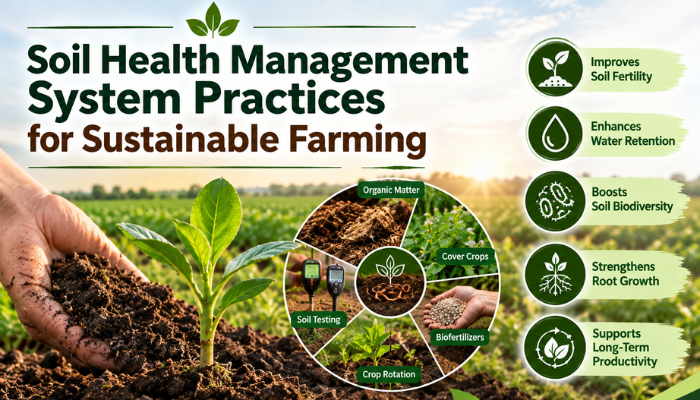
Soil Health Management System Practices for Sustainable Farming
Healthy soil is important for good crops and sustainable farming. Soil management includes simple farming practices that help plants grow, use nutrients properly, manage water, and support useful soil organisms.
A soil health management system focuses on maintaining soil fertility, structure, water, and biological activity for the long term. Practices like reducing soil disturbance, keeping soil covered, growing different crops, and maintaining living roots help improve soil health.
In this blog, we will discuss important soil health management system practices and how they support sustainable farming and long-term soil health.
Best Soil Health Management System Practices for Sustainable Farming
These practical soil health management practices help farmers maintain fertile soil while supporting productive farming:
1. Minimise Soil Disturbance
Frequent and heavy soil preparation can damage soil structure, increase erosion and disturb organisms living in the soil. Reducing unnecessary soil disturbance helps protect soil structure, organic matter and biological activity.
Farmers can consider:
- Minimum or reduced soil preparation
- Conservation tillage
- No-till systems
- Avoiding unnecessary field operations
- Reducing traffic over wet soils to limit compaction
The appropriate level of soil preparation depends on crop requirements, soil conditions and the local farming system.
2. Keep Soil Covered
Uncovered soil is more likely to be affected by wind and water erosion. Crop residues and cover crops create a protective layer over the soil surface.
Cover crops can help:
- Reduce soil erosion
- Protect soil from rainfall impact
- Recycle nutrients
- Control some weeds
- Add plant material to the soil
- Support soil organisms
Keeping crop residues on the field after harvest, where appropriate, can also help protect the soil between growing seasons.
3. Use Crop Rotation
Growing the same crop repeatedly can use up certain nutrients and may increase the risk of crop-specific pests and diseases. Crop rotation means growing different crops as part of the farming cycle.
For example, a rotation may include cereals, legumes and other suitable crops instead of relying on a single crop year after year.
Benefits can include:
- Greater crop diversity
- Better nutrient cycling
- Better use of soil resources
- Breaking some pest and disease cycles
- More varied plant residues and root systems
4. Maintain Living Roots
Soil organisms depend on organic matter and nutrients provided by plants and their roots. Keeping living roots in the soil for longer can therefore support soil life and nutrient cycling.
Farmers can keep living roots in the soil for longer by:
- Selecting suitable long season crops
- Using cover crops between main crops
- Including different crop types in rotations
- Avoiding long periods of uncovered soil
This approach also helps support soil life when the main crop is not actively growing.
5. Improve Soil Organic Matter
Soil organic matter helps improve soil structure, nutrient supply and water holding capacity. Crop residues, compost, organic fertilizers and other organic materials can help increase organic matter in the soil.
Good management includes:
- Returning suitable crop residues to the soil
- Using properly managed organic fertiliser where appropriate
- Growing cover crops
- Reducing practices that improves organic matter loss
- Monitoring soil conditions over time
The goal is not simply to add more material, but to maintain a healthy balance within the soil system.
6. Manage Nutrients Responsibly
Crops need the right amount of nutrients. Too little can slow growth, while too much can waste nutrients and harm the environment.
A responsible nutrient management approach should consider:
- Soil test results
- Nutrient needs of the crop
- Suitable nutrient sources
- Nutrients removed by crops
- Nutrient loss through flowing water or soil drainage
7. Manage Water Efficiently
Water management is closely linked to soil health. Healthy soil with good structure can absorb and store more water, while damaged soil may lead to more water loss.
Sustainable water management can include:
- Watering based on crop and soil needs
- Protecting soil structure
- Improving water infiltration
- Avoiding too much irrigation
- Using suitable irrigation systems and schedules
The right approach depends on soil type, crop, rainfall and local water availability.
8. Control Soil Erosion
Erosion removes valuable topsoil and can transport soil particles and nutrients away from agricultural land.
To reduce erosion, farmers can use practices such as:
- Cover crops
- Crop residues
- Reduced soil preparation
- Farming along the natural slope where suitable
- Plant barriers
- Keeping the soil covered during high-risk periods
Combining several erosion-control measures is often more effective than relying on a single practice.
9. Reduce Soil Compaction
Soil hardening can reduce the space between soil particles and limit the movement of air and water. It can also make it harder for plant roots to grow properly.
Farmers can reduce the risk of soil becoming hard by:
- Limiting unnecessary machinery use
- Avoiding field work when soil is very wet
- Using controlled traffic methods
- Maintaining suitable soil organic matter
- Managing grazing pressure properly
These practices help keep the soil loose, healthy and suitable for strong root growth.
Why Soil Health Matters for Sustainable Farming
Soil health affects more than crop growth. It influences how agricultural land stores and moves water, manages nutrients and supports soil life.
Healthy soils can help farmers:
- Improve water absorption and storage
- Support nutrient cycling
- Reduce soil erosion and water loss
- Maintain good soil structure
- Support different types of soil organisms
- Helps crops handle too much or too little water.
- Can reduce unnecessary input and field-work costs.
For a better understanding of environmentally responsible agricultural methods, farmers can also explore sustainable farming methods and compare different approaches according to their farm's needs.
Soil Testing and Monitoring
A soil health programme should not depend only on what we can see. Regular soil tests and field checks can help farmers understand changes in soil condition and make better management decisions.
Depending on the farming system, monitoring may include:
- Soil pH
- Organic matter
- Soil structure
- Soil hardening
- Water absorption
- Crop performance
- Signs of soil erosion
- Soil Life
Comparing results over several seasons can give a clearer idea of whether changes in farming practices are improving soil health.
Common Mistakes That Can Harm Soil Health
Even good farming decisions can harm soil when they are done at the wrong time or used too much.
Common issues include:
- Too much soil preparation
- Leaving soil uncovered for long periods
- Growing the same crop repeatedly
- Using too much fertiliser
- Poor water management
- Heavy machinery traffic on wet soil
- Removing too much crop residue
- Ignoring early signs of soil erosion or hardening
A soil health management system helps farmers consider these factors together instead of dealing with soil problems one at a time.
Conclusion
A Soil Health Management System supports sustainable farming by combining reduced soil disturbance, soil cover, crop variety, living roots, organic matter, balanced nutrients and efficient water management to keep soil healthy and productive. Farmers should select practices according to their soil, climate, crops and farming goals and check results over time.
Choose SV Agro Solutions for Quality Agricultural Inputs
SV Agro Solutions Pvt. Ltd. is a leading producer of agricultural inputs, offering quality biostimulants, fertilizers and micronutrients to support healthy crop growth and better soil management. The company has its own research and development facility in Indapur, Pune, Maharashtra, along with a manufacturing unit at Indapur MIDC.
With its focus on product quality, research and innovation, SV Agro Solutions serves more than 80,000 farmers across Maharashtra, Karnataka, Gujarat, Odisha and other regions of India. Its range of biostimulants, fertilizers and micronutrients is developed to support plant growth, improve nutrient availability and help farmers maintain productive and healthy crops.
FAQs
- What are some sustainable agricultural practices that can benefit soil health?
Crop rotation, cover cropping, reduced soil preparation, crop residue management, organic matter addition, balanced nutrient use and erosion control help improve soil health.
- What are the 7 practices of sustainable agriculture?
The seven common practices are crop rotation, cover crops, reduced soil preparation, organic matter management, integrated pest management, precise nutrient management and efficient water management.
- What is the best practice to maintain soil health in organic farming?
A combination of crop rotation, cover crops, organic matter management, soil cover and reduced soil disturbance is effective for maintaining soil health.
- What are the 5 principles of soil health?
Soil health principles generally include minimising disturbance, maximising soil cover, increasing crop diversity, maintaining living roots and supporting healthy soil biological activity.
- What are sustainable soil management practices?
Sustainable soil management includes reduced soil preparation, crop rotation, cover crops, organic matter management, balanced nutrients, efficient water use and erosion control.
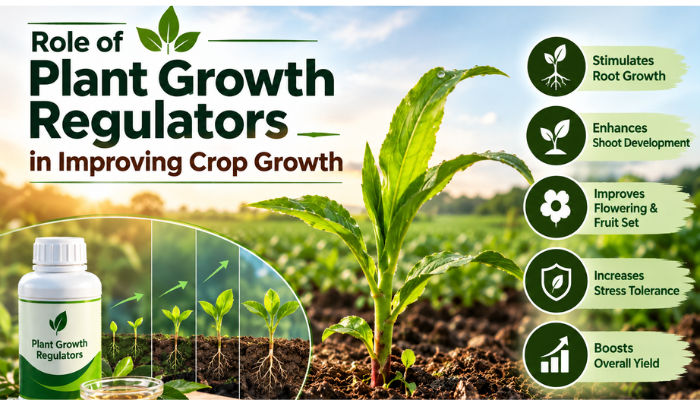
Role of Plant Growth Regulators in Improving Crop Growth
Plants naturally produce hormones that help control their growth and development. These hormones help with root growth, shoot growth, flowering, fruit formation, ripening, and maturity.
Plant Growth Regulators (PGRs) are natural or man-made substances that help control plant growth. They can be used to support root growth, improve flowering and fruit development, manage plant growth, and improve crop quality.
Understanding the Role of Plant Growth Regulators helps farmers select the right product and apply it at the appropriate crop stage.
What are Plant Growth Regulators?
Plant Growth Regulators are compounds that affect plant growth and development when used in small quantities. They are different from fertilizers because they do not mainly provide nutrients such as nitrogen, phosphorus, potassium, or micronutrients.
PGRs can influence several plant activities, including:
- Seed germination
- Root and shoot development
- Cell division and growth
- Flowering
- Fruit formation
- Fruit ripening
- Plant height
- Leaf ageing and dormancy
The major groups of plant hormones associated with growth regulation include auxins, gibberellins, cytokinins, ethylene, and abscisic acid.
Role of Plant Growth Regulators at Different Crop Stages
PGRs support different plant needs, from root growth and flowering to fruit development and maturity.
During Seed Germination and Early Growth
- At the early stage, PGRs may help manage seed dormancy and support germination.
- Some PGR applications can also encourage early root and shoot development, helping seedlings establish well.
During Vegetative Growth
- During vegetative growth, PGRs can be used to manage plant height, branching, root development, and canopy growth.
- Maintaining a suitable plant structure can help crops make better use of sunlight, water, and available nutrients.
During Flowering and Fruit Set
- At the flowering stage, some PGRs can help manage flowering and improve fruit set.
- They may also help reduce the dropping of flowers or young fruits in suitable crops.
- This is especially important for horticultural crops where fruit set has a direct effect on production.
During Fruit Development and Maturity
- During fruit development, selected PGRs may help manage fruit size, firmness, colour, maturity, and uniformity.
- In some crops, they may also support more uniform maturity and harvesting.
During Stress Conditions
- Some PGRs can influence plant responses to environmental conditions such as drought, salinity, heat, and transplanting stress.
- However, PGRs should not replace proper irrigation, nutrition, or other essential crop management practices.
Why are Plant Growth Regulators Important in Agriculture?
Plant Growth Regulators help farmers manage particular stages of crop development. When used correctly, they can support:
- Better seed germination
- Stronger crop establishment
- Improved root development
- Better branching and plant structure
- Controlled plant height
- Improved flowering and fruit set
- Reduced premature fruit drop
- Better fruit size and quality
- More uniform crop maturity
- Easier harvesting
PGRs are most effective when used along with proper soil management, balanced nutrition, irrigation, and pest management. They should not be considered a substitute for basic crop care.
Types of Plant Growth Regulators
Plant Growth Regulators are available in different types, each helping with specific plant growth processes such as roots, shoots, flowering, fruiting, and maturity.
1. Auxins
Auxins help crops grow roots and fruits.
- Help root growth
- Improve fruit setting
- Reduce early fruit drop
- Support fruit growth
- Examples: IAA, IBA, NAA
2. Gibberellins
Gibberellins help crops grow and develop fruits.
- Help seed germination
- Support plant growth
- Improve fruit size
- Help in fruit development
- Example: GA₃
3. Cytokinins
Cytokinins help plants grow new shoots and leaves.
- Help shoot growth
- Encourage new branches
- Support cell growth
- Keep leaves fresh for longer
- Support fruit and vegetable growth
4. Ethylene
Ethylene helps control fruit ripening and maturity.
- Helps fruits ripen
- Improves fruit colour
- Helps manage maturity
- Supports more uniform harvesting
- Example: Ethephon
5. Abscisic Acid and Growth Inhibitors
These help control plant growth and water loss.
- Help plants handle water stress
- Control excess plant growth
- Help manage plant height
- Reduce lodging
- Support stronger plant structure
How to Use Plant Growth Regulators Correctly?
Use the right PGR at the recommended dose and crop stage to support healthy and balanced plant growth.
1. Select the Right PGR
- Choose the product based on the crop, growth stage, crop problem, and expected result.
- A PGR suitable for root development may not be suitable for fruit development or ripening.
2. Apply at the Right Crop Stage
- The timing of the PGR application is very important.
- Applying a product too early or too late may reduce its effectiveness or cause unwanted effects.
- Always follow the product label and crop specific’s recommendation.
3. Use the Recommended Dose
- PGRs are effective in small quantities. Using a higher dose does not necessarily give better results.
- Excessive application can lead to abnormal growth, poor flowering, leaf damage, fruit drop, or reduced crop performance.
4. Follow the Correct Application Method
Depending on the product and crop, PGRs can be applied through:
- Seed treatment
- Soil drenching
- Foliar spray
- Fertigation
For foliar sprays, ensure proper and even coverage of the plant.
5. Check Weather Conditions
- Weather conditions can affect the application and performance of PGRs.
- Follow the product instructions and avoid spraying during unsuitable conditions such as strong winds, heavy rain, or extreme heat.
6. Try on a Small Area First
- Before applying a new PGR across the whole field, testing it on a small area can help farmers observe how the crop responds.
- If the response is satisfactory, the product can be used according to the recommended instructions.
Improve Fruit Size and Quality with Plant Growth Regulators
SV Agro Solutions’ SV Size Builder is a unique blend of auxins, vitamins, fulvic acid, proteins, enzymes, and other plant-supporting nutrients designed to support faster fruit growth and size development. It helps improve fruit size, weight, colour, and shine, making it suitable for orchards and crops with a high fruit load.
With SV Size Builder from SV Agro Solutions, farmers can support better fruit development and improve overall crop quality. It is designed to help plants during important fruit development stages and support better marketable produce.
Conclusion
The Role of Plant Growth Regulators is to influence specific plant growth and development processes. Depending on the crop and product, PGRs can support seed germination, root growth, flowering, fruit set, fruit development, crop quality, maturity, and harvesting.
For effective results, farmers should select the appropriate PGR, use the recommended dose, and apply it at the correct crop stage. Proper application can support crop development, while incorrect or excessive use may cause unwanted effects.
FAQs
1. What are the types of PGR?
PGRs are mainly classified into three types: growth promoters, growth retardants, and growth inhibitors.
2. What is the main Role of Plant Growth Regulators?
The main role of PGRs is to influence processes such as seed germination, root growth, flowering, fruit set, fruit development, ripening, and plant height.
3. Do Plant Growth Regulators replace fertilizers?
No. Plant Growth Regulators do not replace fertilizers. Fertilizers supply nutrients, while PGRs mainly influence plant growth and development.
4. When should farmers apply Plant Growth Regulators?
PGRs should be applied at the appropriate crop stage according to the product and crop recommendation.
5. Can excess PGR harm crops?
Yes. Excessive or incorrect use can result in abnormal growth, leaf damage, poor flowering, fruit drop, or reduced crop performance.
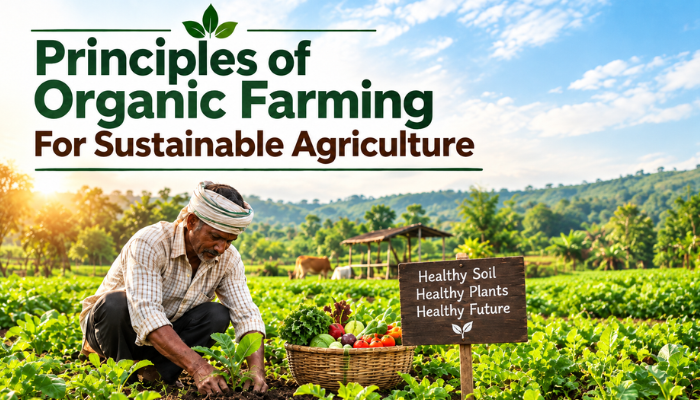
Principles of Organic Farming For Sustainable Agriculture
Organic farming is not only about avoiding chemical fertilizers and pesticides. It is a complete farming system that focuses on healthy soil, natural farming cycles, biodiversity, proper use of resources, and animal welfare.
The Principles of Organic Farming are based on four main foundations: Health, Ecology, Fairness, and Care. These principles help farmers grow safe food while protecting soil, water, animals, people, and the environment. They also help keep farms productive for future generations.
What is Organic Farming?
Organic farming works with natural processes and reduces dependence on synthetic inputs. Common organic farming practices include:
- Using compost and farmyard manure.
- Practising crop rotation and mixed cropping.
- Using green manure and cover crops.
- Managing pests through natural and biological methods.
- Recycling crop residues and animal waste.
- Protecting soil, water, and beneficial organisms.
The main goal of organic farming is to maintain soil fertility, biodiversity, and the health of crops, animals, and people. It focuses on the overall health of the farm rather than only increasing production for one season.
The Four Principles of Organic Farming
The four principles of organic farming are Health, Ecology, Fairness, and Care guide farmers in maintaining healthy soil, protecting nature, and practising sustainable farming.
1. Principle of Health
- The Principle of Health focuses on maintaining and improving the health of soil, plants, animals, people, and the environment.
- Healthy soil helps crops grow well, while healthy crops provide better food for people and animals.
Farmers can follow this principle by:
- Adding compost, manure, and organic matter to the soil.
- Using healthy seeds and planting materials.
- Avoiding harmful chemical residues.
- Providing proper feed, water, shelter, and care to animals.
- Following safe working practices.
- Producing safe and nutritious food.
For example, compost improves soil structure and supports beneficial microorganisms, helping crops develop stronger roots and absorb nutrients better.
2. Principle of Ecology
- The Principle of Ecology means farming in harmony with nature and supporting natural ecosystems.
- Soil organisms, insects, birds, trees, water, and crops all work together.
- Biodiversity helps control pests naturally.
- Crop rotation also helps improve nutrient cycling and reduces pest and disease problems.
- Farm resources should also be reused wherever possible.
For example, animal waste can be used to make compost, and crop residues can be returned to the soil instead of being burned.
Farmers can support this natural balance through:
- Crop rotation.
- Mixed cropping and intercropping.
- Green manuring.
- Recycling crop residues.
- Biological pest control.
- Protecting trees, hedges, ponds, and natural habitats.
3. Principle of Fairness
- The Principle of Fairness promotes fair and respectful treatment of farmers, workers, animals, consumers, and the environment.
Fairness includes:
- Fair prices and income for farmers.
- Safe working conditions for workers.
- Proper care and welfare of animals.
- Access to safe and nutritious food.
- Responsible use of land, water, and other resources,
Farmers should use natural resources responsibly so that soil and water remain available for neighbouring communities and future generations.
4. Principle of Care
- The Principle of Care means managing the farm carefully and responsibly to protect people, animals, soil, water, and the environment.
- Before using a new product or farming method, farmers should consider its possible effects.
Some useful practices include:
- Testing soil before applying amendments.
- Using safe and approved farm inputs.
- Protecting wells, ponds, and rivers from pollution.
- Monitoring pests and diseases regularly.
- Using water and organic resources carefully.
- Avoiding practices that can harm people, animals, or the environment.
For example, farmers should take steps to prevent soil erosion before valuable topsoil is lost.
Important Practices Based on Organic Farming Principles
Learn the key farming practices that support healthy soil, crops, and sustainable agriculture.
Soil Fertility Management
- Farmers can maintain soil fertility by using compost, farmyard manure, vermicompost, and green manure.
- These materials add organic matter and support beneficial microorganisms.
- Crop rotation, especially with legumes, also helps improve soil health and nutrient management.
Natural Pest and Disease Management
Organic farming uses natural methods to manage pests and diseases, such as:
- Growing resistant crop varieties.
- Using healthy seeds.
- Encouraging beneficial insects and natural predators.
- Using traps, barriers, botanical products, and biological control.
- Maintaining field hygiene and crop diversity.
Preventing pest problems is better than trying to control a major pest attack later.
Biodiversity Conservation
- Growing different crops instead of depending on one crop can improve biodiversity and reduce farming risks.
- Trees, hedges, flowering plants, and ponds can provide food and shelter for pollinators, birds, earthworms, and beneficial insects.
Recycling Farm Resources
- Crop residues can be returned to the soil or used for composting. Animal waste can be converted into manure.
- Reusing farm resources helps reduce waste and dependence on outside inputs.
Responsible Water and Land Management
Farmers can protect soil and water through:
- Mulching.
- Cover crops.
- Field bunds.
- Contour farming.
- Terracing on slopes.
- Efficient irrigation.
Drip irrigation and proper irrigation scheduling can help save water. Farmers should also prevent manure and other farm inputs from entering ponds, wells, and groundwater.
Benefits of Following Organic Farming Principles
Following the Principles of Organic Farming can help farmers:
- Improve soil fertility and soil structure.
- Support beneficial soil organisms and biodiversity.
- Reduce dependence on synthetic fertilizers and pesticides.
- Improve water retention and reduce soil erosion.
- Support animal welfare and safer working conditions.
- Build farms that can better handle changing weather conditions.
- Support long-term food production and sustainable income.
How Farmers Can Apply These Principles
Farmers can start with simple steps:
- Test the soil and understand available farm resources.
- Add compost, manure, and crop residues regularly.
- Include legumes in crop rotation.
- Practise mixed cropping and use cover crops.
- Protect beneficial insects and natural predators.
- Avoid burning crop residues.
- Prevent soil erosion and water pollution.
- Maintain records of farm inputs and activities.
- Use approved inputs when the farm is certified organic.
- Improve farming practices step by step.
Conclusion
The Principles of Organic Farming are based on four foundations: Health, Ecology, Fairness, and Care. These principles help farmers protect soil, support biodiversity, care for animals and people, and use natural resources responsibly.
Looking for the Right Fertilizer for Better Crop Growth? SV Agro Solutions offers quality fertilizer products designed to support healthy plant growth, balanced nutrition, and better crop productivity. As a trusted Fertilizer manufacturer in Pune, we provide reliable solutions developed according to crop and farming needs.
Choose SV Agro Solutions for quality fertilizers that support healthier crops, improved soil health, and sustainable farming.
FAQs
1. What are the four principles of organic farming?
The four principles are Health, Ecology, Fairness, and Care. They support the health of soil, plants, animals, people, and the environment.
2. What is the Principle of Health in organic farming?
It focuses on maintaining and improving the health of soil, plants, animals, people, and the planet as one connected system.
3. How does organic farming follow the Principle of Ecology?
It works with natural cycles through crop rotation, biodiversity, composting, recycling, green manuring, and biological pest control.
4. Why is fairness important in organic farming?
Fairness ensures respectful and responsible treatment of farmers, workers, consumers, animals, communities, and the environment.
5. What does the Principle of Care mean?
The Principle of Care means managing farms responsibly and taking precautions to protect people, animals, natural resources, and future generations.

Difference between Primitive and Intensive Subsistence Farming
Agriculture can be practised in many different ways depending on land availability, climate, technology and the needs of farmers. Subsistence farming is one of the major types of agriculture in which farmers mainly grow crops to meet their own and their family's needs.
The two main forms of subsistence agriculture are primitive and intensive farming. The difference between primitive and intensive subsistence farming is that primitive farming uses traditional methods, while intensive farming aims for maximum production from a small piece of land using intensive labour and inputs.
Understanding these differences is important for farmers. Let's look at the two farming systems in detail.
Difference Between Primitive and Intensive Subsistence Farming
The difference between primitive subsistence and intensive subsistence farming can be understood by comparing their farming methods, land use and geographical conditions.
|
Basis |
Primitive Subsistence Farming |
Intensive Subsistence Farming |
|
Meaning |
Traditional farming for basic needs. |
Farming that maximises output from small land. |
|
Method |
Often involves shifting cultivation. |
Land is cultivated continuously and intensively. |
|
Land Use |
Farmers may move to new plots. |
The same land is used repeatedly. |
|
Tools |
Simple, traditional tools are used. |
Labour and modern inputs may be used. |
|
Labour |
Mainly depends on family labour. |
Requires intensive family labour. |
|
Technology |
Limited use of modern technology. |
Greater use of improved farming methods. |
|
Population Pressure |
Usually lower pressure on land. |
Common in densely populated areas. |
|
Main Focus |
Meeting family needs. |
Maximum production from limited land. |
|
Common Regions |
Tropical and forested regions. |
Densely populated parts of Asia. |
Although both types of farming are practised mainly to meet the food needs of farmers and their families, they differ significantly in their methods, use of land and level of farming intensity.
1. Farming Method
Primitive Subsistence Farming:
- Follows traditional farming methods often including shifting cultivation.
- Farmers cultivate a piece of land for a limited period before moving to another plot when required.
Intensive Subsistence Farming:
- Focuses on carefully and repeatedly cultivating the available land for maximum use.
- Use intensive cultivation practices to produce the maximum possible output from limited land.
2. Use of Land
Primitive Subsistence Farming:
- Farmers may leave or shift from a plot when its productivity declines, especially in shifting cultivation.
- The same piece of land may not be cultivated continuously for a long period.
Intensive Subsistence Farming:
- The same small piece of land is used continuously for cultivation.
- Farmers try to make the best possible use of limited agricultural land to increase production.
3. Tools and Technology
Primitive Subsistence Farming:
- Mainly depends on simple and traditional farming tools.
- Modern machinery and advanced agricultural technology are generally used to a limited extent.
Intensive Subsistence Farming:
- May use improved farming methods, irrigation and other agricultural inputs depending on available resources.
- Farming techniques are often managed carefully to improve productivity from limited land.
4. Labour Requirement
Primitive Subsistence Farming:
- Mainly depends on the farmer and family members for agricultural work.
- Most farming activities are carried out through manual labour using simple methods and tools.
Intensive Subsistence Farming:
- Also relies heavily on family labour for cultivation and land management.
- Labour is used more intensively because small plots need careful and efficient cultivation.
5. Population Pressure
Primitive Subsistence Farming:
- Traditionally developed in regions where communities had access to larger natural areas for cultivation.
- Farmers could move between different plots of land, particularly where shifting cultivation was practised.
Intensive Subsistence Farming:
- More common in densely populated regions where many people depend on agriculture.
- Limited agricultural land forces farmers to cultivate small plots intensively to increase production.
6. Regions Where They Are Practised
Primitive Subsistence Farming:
- Has traditionally been practised in tropical and forested regions.
- It is found in parts of Asia, Africa and South America.
Intensive Subsistence Farming:
- Particularly common in densely populated agricultural regions of Asia.
- Widely practised in areas where landholdings are small and agricultural land is limited.
7. Main Objective
Primitive Subsistence Farming:
- To produce enough food to meet the basic needs of the farmer and their family.
- Production is mainly focused on personal and family consumption rather than large-scale commercial purposes.
Intensive Subsistence Farming:
- The basic purpose is also to meet the food requirements of the farmer and their family.
- Farmers place greater emphasis on increasing production from the limited land available to them.
What is Primitive Subsistence Farming?
Primitive subsistence farming is a type of subsistence farming that uses simple tools and methods and relies mainly on local natural resources.
Shifting cultivation is a common form where vegetation is cleared, crops are grown for a limited period, and farmers move to another plot when the soil becomes less productive.
Where is Primitive Subsistence Farming Practised?
Primitive subsistence agriculture has traditionally been associated with tropical regions, including parts of:
- Africa
- South and Central America
- Southeast Asia
- Northeast India
The exact farming practices can vary significantly depending on the local climate, soil, vegetation and culture.
What is Intensive Subsistence Farming?
Intensive subsistence farming is practised where there is high pressure on agricultural land and farmers have limited land available for cultivation. In this system, farmers try to obtain maximum production from a relatively small plot. Family labour plays an important role, and land may be cultivated intensively to support the needs of the household.
Types of Intensive Subsistence Agriculture
Intensive subsistence agriculture can be divided into two main types:
1. Wet Paddy-Dominated Intensive Farming
- Common in regions with suitable climate and water availability.
- Rice is the main crop.
- Uses small landholdings and high family labour.
- Focuses on intensive cultivation and high production per unit area.
- Common in densely populated parts of Asia.
2. Intensive Farming with Other Crops
- Found in areas where rice cultivation is not suitable due to differences in climate, soil, relief, or water availability.
- Common crops include wheat, barley, soybeans, sorghum, and millets.
- Irrigation is often used where rainfall is insufficient.
Conclusion
The main difference between Primitive and Intensive Subsistence Farming is the farming method and how farmers use their land and resources. The choice of farming method depends on factors such as land availability, climate, water, soil, and crop requirements. Understanding these factors can help farmers choose suitable farming practices and improve crop production.
Looking for Better Plant Growth and Stress Support? SV Agro Solutions offers quality biostimulant products designed to support nutrient uptake, plant growth, and crop resilience. As a trusted biostimulants manufacturer in Pune, we provide solutions for healthier crops and sustainable farming.
Our biostimulants are developed to support plants during different growth stages and help improve overall crop performance. Choose SV Agro Solutions for reliable biostimulant solutions that support better plant health and productive farming.
Frequently Asked Questions
1. What is the main difference between intensive farming and extensive farming?
Intensive farming uses more labour on smaller areas, while extensive farming uses larger areas with fewer inputs per unit of land.
2. What are different types of subsistence farming?
The two main types of subsistence farming are primitive subsistence farming and intensive subsistence farming.
3. What are two types of primitive subsistence farming?
The two types of primitive subsistence farming are shifting cultivation and nomadic herding.
4. What is another name for intensive subsistence farming?
Another name for intensive subsistence farming is intensive subsistence agriculture.
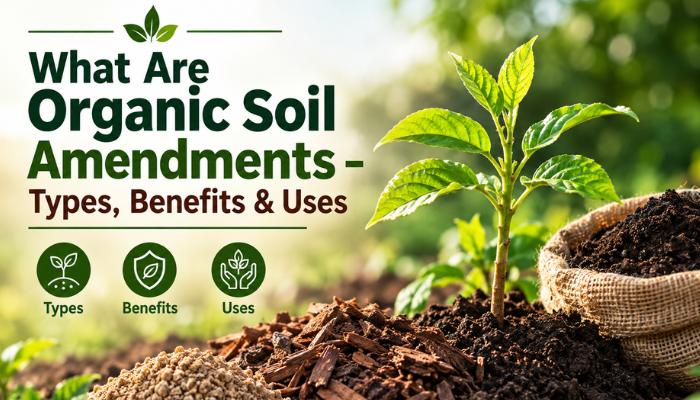
What Are Organic Soil Amendments - Types, Benefits & Uses
Healthy soil is the base of healthy crop growth. Even good-quality seeds and fertilizers may not give the expected results if the soil is poor. One of the most important parts of healthy soil is organic matter.
Organic soil amendments are natural materials added to the soil to improve its quality, structure, and biological activity. They help the soil hold water, improve nutrient availability, support useful microorganisms, and maintain long-term fertility. For farmers, using organic soil amendments can be a useful way to improve crop growth while maintaining the health of the land.
What Are Organic Soil Amendments?
Organic soil amendments are natural materials made from plant, animal, or microbial sources. They are added to the soil to improve its physical, chemical, and biological properties.
Organic soil amendments are different from fertilizers. Fertilizers mainly provide nutrients to crops, while amendments focus on improving the overall condition of the soil. Some common examples include compost, farmyard manure, green manure, crop residues, vermicompost, and biochar.
These materials may work slowly compared with some chemical inputs, but their benefits can continue for a longer period by improving soil health.
Types of Organic Soil Amendments
Learn about different organic materials used to improve soil quality, fertility, and moisture retention.
1. Compost
- Compost is made from decomposed plant and animal waste.
- It adds organic matter to the soil and helps improve soil structure and water retention.
- It also supports beneficial microorganisms and provides nutrients slowly as it breaks down.
2. Farmyard Manure (FYM)
- Farmyard manure (FYM) is made from animal dung, urine, and bedding materials.
- It contains organic matter and important nutrients such as nitrogen, phosphorus, and potassium.
- Regular use of FYM can increase soil fertility, structure, and moisture-holding capacity. It is one of the most commonly used organic amendments in farming.
3. Green Manure
- Green manure includes fast-growing crops such as sunhemp, dhaincha, and cowpea that are grown and then mixed into the soil.
- These crops add organic matter to the soil.
- Legume-based green manure crops can also help add nitrogen to the soil, supporting better soil fertility.
4. Crop Residues and Mulch
- Crop residues include straw, stalks, leaves, and other plant materials left after harvesting.
- These materials can be incorporated into the soil or used as mulch on the soil surface.
- They help protect the soil from erosion, reduce moisture loss, control weeds, and add organic matter as they decompose.
5. Vermicompost
- Vermicompost is produced when earthworms break down organic waste.
- It contains nutrients and beneficial microorganisms that support healthy soil and plant growth.
- It can improve soil structure, nutrient availability, and moisture retention.
- Vermicompost is especially popular in horticulture and vegetable farming.
6. Biochar
- Biochar is a charcoal-like material made from plant materials under low-oxygen conditions.
- It can improve soil porosity, water retention, and nutrient-holding capacity.
- Biochar also helps store carbon in the soil and can remain in the soil for a long time, making it a useful long-lasting soil amendment.
7. Leaf Mold and Peat Moss
- Leaf mold is made from decomposed leaves and can improve soil structure and moisture retention.
- Peat moss is also used to improve moisture-holding capacity and is commonly used in gardening and horticulture, especially in potting mixes.
8. Animal By-Products
- Animal-based materials such as bone meal, blood meal, feather meal, and fish emulsion can also be used as organic amendments.
- Different materials provide different nutrients.
- For example, bone meal is a source of phosphorus, while blood meal provides nitrogen.
Benefits of Organic Soil Amendments
Understand how organic amendments improve soil health, nutrient availability, water retention, and crop growth.
1. Improves Soil Structure
- Organic soil amendments help improve soil structure and make it easier for plant roots to grow.
- They can make heavy clay soils more loose and workable while helping sandy soils hold more water and nutrients.
2. Enhances Water Retention and Drainage
- Organic matter helps soil hold water for a longer time, which can reduce moisture stress during dry periods.
- At the same time, it can improve drainage in heavy soils and reduce the risk of waterlogging.
3. Supplies Slow-Release Nutrients
- Organic amendments release nutrients slowly as they decompose.
- This provides a steady supply of nutrients to plants and can reduce nutrient loss through leaching.
4. Boosts Soil Microbial Activity
- Organic materials provide food for useful soil microorganisms such as bacteria and fungi.
- They also support earthworm activity.
- These organisms help break down organic matter and improve nutrient cycling in the soil.
5. Increases Soil Organic Carbon
- Regular use of organic amendments can increase soil organic carbon and improve long-term soil health.
- Some amendments, such as biochar, can also help store carbon in the soil for longer periods.
6. Reduces Soil Erosion
- Healthy soil with good structure is less likely to be washed away by rain or blown away by wind.
- Crop residues and mulch also provide surface protection and help reduce soil erosion.
7. Improves Nutrient Holding Capacity
- Organic matter can improve the soil's cation exchange capacity (CEC).
- This helps the soil hold important nutrients and make them available to plants.
- Over time, better nutrient-holding capacity can help reduce the need for excessive fertilizer application.
8. Suppresses Soil-Borne Diseases
- Organic amendments can support beneficial microorganisms that compete with harmful soil pathogens.
- A healthier soil microbial community may help reduce the impact of some soil-borne diseases and lower dependence on chemical pesticides.
How to Use Organic Soil Amendments
Learn the right methods, timing, quantity, and practices for applying organic soil amendments effectively.
1. Start With Soil Testing
- Test the soil for organic matter and nutrient levels.
- Use the results to choose the right amendment and quantity.
2. Choose the Right Time
- Apply amendments before sowing or transplanting.
- They can also be used during fallow periods or as mulch during crop growth.
3. Use the Right Application Method
- Broadcasting: Spread evenly and mix with the topsoil.
- Banding: Apply in rows near seeds or plant roots.
- Mulching: Cover the soil surface to retain moisture and control weeds.
- Incorporation: Mix amendments into the soil during land preparation.
4. Follow the Right Quantity and Frequency
- Apply around 5-10 tonnes of compost or FYM per hectare for field crops, based on soil and crop needs.
- For gardens, apply a 2-5 cm layer of compost or mulch annually.
- Reapply every 1-3 years depending on soil condition and amendment type.
5. Combine With Other Soil Practices
- Use organic soil amendments with crop rotation and green manuring.
- Combine them with reduced tillage and balanced fertilizers for better soil fertility and crop growth.
Best Practices for Using Organic Soil Amendments
- Use well-decomposed compost and manure to reduce the risk of weed seeds and harmful pathogens.
- Avoid applying fresh manure directly to edible crops because it may cause contamination.
- Store organic amendments properly to reduce nutrient loss.
- Use different types of amendments when suitable to provide a wider range of benefits.
- Test the soil regularly to monitor changes in soil health.
- Follow recommended application rates instead of applying large quantities at once.
- Make sure the amendment is suitable for the crop and soil type.
Conclusion
Organic soil amendments are an important part of maintaining healthy and productive soil. Materials such as compost, FYM, green manure, vermicompost, crop residues, and biochar can improve soil structure, water retention, nutrient availability, and microbial activity.
Want to improve your crop nutrition and yield? Are your crops getting the nutrients they need for healthy and productive growth? SV Agro Solutions provides quality fertilizer solutions designed to support crop nutrition, improve plant growth, and help farmers achieve better results. As a trusted fertilizer manufacturer in Pune, we focus on quality, research, and solutions suitable for different crop and soil requirements
FAQs
1. What are organic soil amendments?
Organic soil amendments are natural materials like compost, manure, green manure, and crop residues that improve soil structure, fertility, and biological activity.
2. How do organic soil amendments benefit crops?
They improve soil structure, water retention, nutrient availability, and microbial activity, supporting healthier crop growth.
3. Which organic amendment is best for sandy soil?
Compost, FYM, and biochar are useful for sandy soil because they improve water and nutrient retention.
4. Can organic amendments replace chemical fertilizers?
Organic amendments improve soil health, but combining them with balanced fertilizers can provide better nutrient management for high-yield farming.
5. How often should I apply organic soil amendments?
Organic soil amendments can generally be applied every 1-3 years based on soil condition, crop needs, and amendment type.
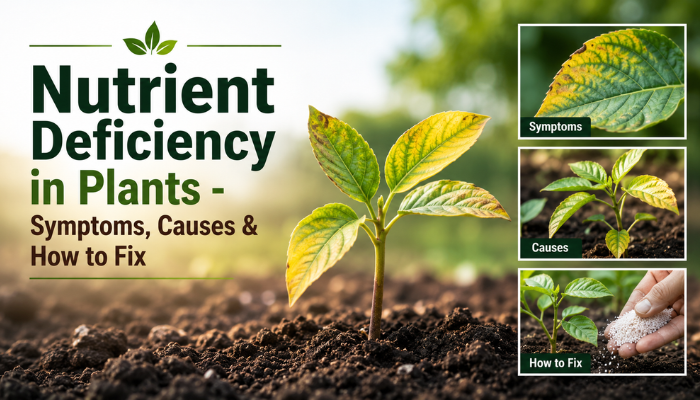
Nutrient Deficiency in Plants - Symptoms, Causes & How to Fix
Healthy crops need the right amount of nutrients at the right time. Just like we need a balanced diet to stay healthy, plants also need different nutrients for proper growth, flowering, fruiting, and good yield.
When a plant does not get enough of one or more essential nutrients, it starts showing visible signs such as yellow leaves, weak growth, leaf spots, poor flowering, or small fruits. These problems are commonly known as nutrient deficiency in plants.
For farmers, identifying these symptoms early is very important. A nutrient deficiency can reduce crop growth and yield if it is not corrected on time. The good news is that with proper soil testing, balanced fertilization, and timely nutrient application, most nutrient deficiencies can be managed effectively.
What is Nutrient Deficiency in Plants?
Nutrient deficiency in plants means that a plant is not getting enough of an essential nutrient required for healthy growth and development.
There are two main types of plant nutrients:
- Macronutrients, which plants need in larger quantities.
- Micronutrients, which plants need in smaller quantities but are still very important.
One important point farmers should remember is that a nutrient may be present in the soil but still not be available to the plant. This can happen because of unsuitable soil pH, poor moisture conditions, waterlogging, or an excess of another nutrient.
Common signs of nutrient deficiency include yellowing leaves, slow growth, weak stems, leaf spots, poor flowering, and poor fruit or grain development.
Essential Plant Nutrients and Their Roles
Every nutrient has a different job inside the plant. Knowing these roles makes it easier to understand deficiency symptoms.
Macronutrients: Nutrients Needed in Larger Amounts
Nitrogen (N)
Nitrogen helps plants develop healthy green leaves and strong vegetative growth. It is also important for chlorophyll formation and overall plant vigour.
Phosphorus (P)
Phosphorus supports root development, flowering, fruiting, and energy movement within the plant. It is especially important during early plant growth and reproductive stages.
Potassium (K)
Potassium helps plants manage water, improves their strength, and supports better resistance to environmental stress and diseases. It also helps improve crop and fruit quality.
Calcium (Ca)
Calcium helps build strong cell walls and supports healthy root and shoot development. It is particularly important for growing parts of the plant.
Magnesium (Mg)
Magnesium is an important part of chlorophyll. It helps plants carry out photosynthesis and supports several enzyme activities.
Sulphur (S)
Sulphur is required for protein formation and is important for oil-producing crops.
Micronutrients: Needed in Small Amounts
Although plants need micronutrients in smaller quantities, they are essential for proper crop growth.
- Iron (Fe): Helps in chlorophyll formation and enzyme activity.
- Manganese (Mn): Supports photosynthesis and nitrogen metabolism.
- Zinc (Zn): Helps with plant hormones, growth, and protein formation.
- Copper (Cu): Supports enzyme activity and reproductive growth.
- Boron (B): Important for cell wall development, flowering, and fruit setting.
- Molybdenum (Mo): Helps in nitrogen fixation and nitrate use.
- Chlorine (Cl): Supports water balance and other important plant functions.
Common Symptoms of Nutrient Deficiency in Plants
One of the easiest ways to identify nutrient deficiency in plants is to regularly observe the crop. Pay attention to the colour, shape, and position of affected leaves.
Nitrogen (N) Deficiency
Older leaves usually turn pale green or yellow first. Plants may look weak, thin, and shorter than normal.
Phosphorus (P) Deficiency
Leaves may become dark green and can develop a purple or reddish colour, especially on older leaves. Root growth may be poor and crop maturity can be delayed.
Potassium (K) Deficiency
The edges of older leaves may turn yellow and later become brown or look burnt. Plants may have weak stems, and grain or fruit quality can decrease.
Calcium (Ca) Deficiency
Young leaves may become distorted or hooked. Growing points of roots and shoots can die. Some fruits may develop blossom end rot.
Magnesium (Mg) Deficiency
Yellowing usually appears between the veins of older leaves while the veins remain green. In severe cases, leaves may become reddish and fall early.
Sulphur (S) Deficiency
Young leaves at the top of the plant become yellow. This can look similar to nitrogen deficiency, but sulphur deficiency usually appears first in younger leaves.
Iron (Fe) Deficiency
Young leaves may become yellow between the veins while the veins remain green. Severe deficiency can make leaves almost white.
Manganese (Mn) Deficiency
Yellowing may appear between the veins of young leaves along with small brown spots.
Zinc (Zn) Deficiency
Plants may develop small or narrow leaves and shorter spaces between the leaves. In crops such as maize, a condition called "white bud" may appear.
Copper (Cu) Deficiency
Young leaves may wilt, leaf tips may die back, and flowering or grain and fruit setting may be poor.
Boron (B) Deficiency
The growing points may die. Plants can develop hollow stems, cracked fruits, and poor fruit setting.
Molybdenum (Mo) Deficiency
Legume crops may show poor nodulation. Leaves can become yellow, and leaf margins may roll and turn brown.
Chlorine (Cl) Deficiency
Plants may show wilting, yellowing of leaves, and reduced root growth.
What Causes Nutrient Deficiency in Plants?
- Soil may naturally lack essential nutrients, or nutrients may decrease due to continuous farming.
- Very acidic or alkaline soil can make nutrients unavailable to plants.
- Excess of one nutrient, such as phosphorus, can reduce the uptake of another like zinc.
- Poor organic matter can reduce the soil’s ability to hold nutrients and support healthy soil microbes.
- Growing the same crop repeatedly can remove specific nutrients from the soil.
- Drought, waterlogging, heavy rain, and cold soil can reduce nutrient absorption by roots.
How to Diagnose Nutrient Deficiency in Plants
- Observe leaf colour, spots, leaf edges, shape, and overall plant growth.
- Check nutrient levels and soil pH to identify possible deficiencies.
- Leaf or tissue testing can confirm nutrient deficiencies when symptoms are unclear.
- Uniform symptoms may indicate nutrient problems, while patchy symptoms can be caused by pests or diseases.
- Note when symptoms appear, such as during early growth, flowering, fruiting, or grain filling.
How to Correct Nutrient Deficiency in Plants
- Apply fertilizers such as urea, DAP, MOP, or micronutrient mixtures based on soil test results and crop needs.
- Spray nutrients like iron, zinc, boron, and manganese directly on leaves for faster correction.
- Treat seeds with suitable nutrients such as zinc, boron, or biofertilizers to support early plant growth.
- Apply water-soluble fertilizers through drip irrigation to deliver nutrients directly to the root zone.
- Maintain suitable soil pH to improve nutrient availability and absorption by plants.
- Use compost, farmyard manure, or green manure to improve soil health and nutrient retention.
- Rotate different crops, including legumes, to maintain nutrient balance and improve soil health
Best Practices to Prevent Nutrient Deficiency
Prevention is better than trying to correct a severe deficiency after the crop has already been affected.
Farmers can follow these practices:
- Test the soil every 2-3 years to understand its nutrient status.
- Apply balanced fertilizers according to soil test results and crop requirements.
- Use split applications of nitrogen to reduce nutrient losses.
- Combine organic and inorganic nutrient sources where suitable.
- Inspect crops regularly for early signs of deficiency.
- Avoid excessive use of a single fertilizer or nutrient.
- Maintain proper soil moisture to support nutrient uptake.
- Keep records of fertilizers used and how the crop responds.
- Correct nutrient problems early instead of waiting until severe symptoms appear.
Conclusion
Nutrient deficiency in plants can affect crop growth, yield, and quality. The first step towards solving the problem is to identify the deficiency correctly.
Yellow leaves, leaf spots, weak growth, poor flowering, and poor fruit or grain development can be warning signs, but these symptoms should not always be treated with fertilizer without checking the actual cause.
Looking for better crop growth and improved plant performance? Nutrient deficiency can affect crop health, yield, and quality, but the right plant nutrition can make a difference. SV Agro Solutions offers a range of biostimulants designed to support healthy plant growth, better nutrient utilisation, and improved crop performance.
With products such as SV Fruiter, SV Cofez, SV Defence, SV Sugarban, and SV Size Builder, farmers can provide additional support to crops at different growth stages. Choose quality biostimulant solutions from SV Agro Solutions to support healthier crops and better farming results.
FAQs
1. What is nutrient deficiency in plants?
It occurs when plants do not get enough essential nutrients, causing yellow leaves, weak growth, poor flowering, and low yield.
2. How can I tell which nutrient my plants are lacking?
Check leaf colour, spots, leaf edges, and growth, and use soil or leaf testing to confirm the deficiency.
3. What causes nutrient deficiency in crops?
Low soil nutrients, unsuitable pH, nutrient imbalance, low organic matter, continuous cropping, drought, and waterlogging can cause deficiencies.
4. How can I correct nutrient deficiency quickly?
Foliar sprays can provide quick nutrient support, while soil application and fertigation can help with longer-term correction.
5. Can too much fertilizer cause deficiency?
Yes, excess of one nutrient can reduce the plant’s ability to absorb another, such as phosphorus reducing zinc availability.
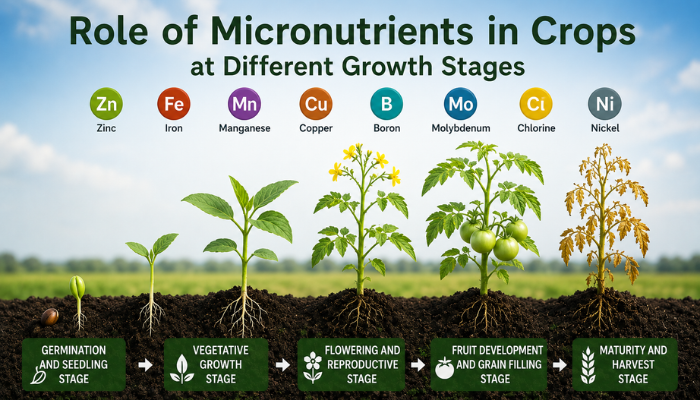
Role of Micronutrients in Crops at Different Growth Stages
Crops need more than just Nitrogen (N), Phosphorus (P), and Potassium (K) for healthy growth. They also need small amounts of other important nutrients called micronutrients.
Micronutrients are needed in very small quantities, but they play an important role in plant growth, flowering, fruit development, and crop quality. Even a small micronutrient deficiency can reduce crop yield and quality.
Understanding the role of micronutrients in crops at different growth stages helps farmers provide the right nutrients at the right time for healthier crops and better harvests.
What Are Micronutrients?
Micronutrients are essential nutrients that crops need in small amounts for healthy growth and development. The main micronutrients required by crops include Zinc (Zn), Iron (Fe), Manganese (Mn), Copper (Cu), Boron (B), Molybdenum (Mo), Chlorine (Cl), and Nickel (Ni) in small amounts.
These nutrients support important plant functions such as photosynthesis, enzyme activity, hormone production, flowering, seed formation, and stress management.
Why Are Micronutrients Important for Crops?
Micronutrients support many important plant functions, including:
- Helping crops produce chlorophyll and carry out photosynthesis.
- Supporting enzyme activity and plant metabolism.
- Helping maintain proper hormone balance.
- Supporting flowering, fruit set, and seed formation.
- Improving root, leaf, and stem development.
- Helping crops tolerate drought, heat, salinity, and other stresses.
- Supporting better crop quality and yield.
Even when farmers apply enough N, P, and K, a micronutrient deficiency can still affect crop growth and yield.
Role of Micronutrients in Crops at Different Growth Stages
Different micronutrients become important at different stages of crop growth. Providing the required nutrients at the right stage helps crops develop properly.
1. Germination and Seedling Stage
During germination and early seedling growth, crops need strong roots and healthy early growth.
Important micronutrients at this stage include:
- Zinc: Supports early root growth and helps maintain proper plant hormone activity.
- Manganese: Supports germination and early leaf development.
- Boron: Helps cell division and root tip growth.
- Iron: Supports chlorophyll formation and helps young crops develop a healthy green colour.
A lack of micronutrients during this stage can result in weak seedlings, poor root growth, and slow crop establishment.
2. Vegetative Growth Stage
During the vegetative stage, crops develop their leaves, stems, and roots. Good micronutrient supply helps crops build a strong structure.
- Iron: Helps in chlorophyll formation and photosynthesis, which keeps leaves healthy and green.
- Manganese: Supports photosynthesis and proper nitrogen use.
- Zinc: Helps with protein formation, leaf growth, and stem development.
- Copper: Supports enzyme activity and helps strengthen plant tissues.
- Chlorine: Helps maintain water balance and proper stomatal function.
Proper micronutrient nutrition during this stage helps crops develop a strong base for flowering and fruit or grain production.
3. Flowering and Reproductive Stage
The flowering stage is very important because it affects flower formation, fruit set, seed development, and final yield.
- Boron: Supports flowering, pollen development, fruit set, and seed formation.
- Zinc: Helps maintain hormone balance and supports fruit and grain development.
- Copper: Supports reproductive growth and seed quality.
- Molybdenum: Helps crops use nitrogen properly, especially in pulse and legume crops.
A deficiency of Boron or Zinc during flowering may result in flower drop, poor fruit set, and poor grain formation.
4. Grain Filling and Fruit Development Stage
During grain filling and fruit development, crops need proper nutrition to produce good-size, weight, and quality.
- Zinc: Supports carbohydrate use and helps in grain filling.
- Iron: Supports chlorophyll formation and continued photosynthesis.
- Manganese: Helps maintain photosynthesis and food production.
- Copper: Supports grain and fruit quality.
- Boron: Helps with seed development and uniform crop maturity.
Proper micronutrient supply at this stage can help improve grain weight, fruit size, colour, and overall market quality.
5. Maturity and Harvest Stage
Micronutrients also play a role during crop maturity and harvesting.
- Boron and Zinc: Support uniform maturity and seed development.
- Manganese: Helps with proper crop maturity and seed quality.
- Molybdenum: Supports proper nitrogen use and can help maintain seed protein development.
Good micronutrient nutrition at maturity can support better seed quality, uniform harvesting, and improved storage performance.
Micronutrient Functions in Crops
Here is a quick look at the main functions of important micronutrients:
- Zinc (Zn): Supports hormone balance, protein formation, root growth, stem growth, and grain development.
- Iron (Fe): Helps with chlorophyll formation, photosynthesis, and enzyme activity.
- Manganese (Mn): Supports photosynthesis, nitrogen use, germination, and crop maturity.
- Copper (Cu): Supports enzyme activity, reproductive growth, and plant tissue strength.
- Boron (B): Helps with cell wall formation, flowering, fruit set, and seed development.
- Molybdenum (Mo): Helps with nitrogen fixation and nitrogen use, especially in legume crops.
- Chlorine (Cl): Helps maintain water balance, stomatal activity, and plant health.
Common Micronutrient Deficiency Symptoms
Micronutrient deficiencies can affect plant growth in different ways.
- Zinc deficiency: Small leaves, short plant growth, short internodes, and stunted crops.
- Iron deficiency: Young leaves may turn yellow while the veins remain green.
- Manganese deficiency: Yellowing between leaf veins and small brown spots may appear.
- Copper deficiency: Young leaves may wilt, and flowering or fruit and grain formation may be poor.
- Boron deficiency: Growing points may die, stems may become hollow, and fruit set may be poor.
- Molybdenum deficiency: Yellowing, stunted growth, and poor nodulation may occur in legume crops.
- Chlorine deficiency: Wilting, chlorosis, and reduced root growth may occur.
Many nutrient deficiency symptoms look similar. Therefore, soil testing and leaf testing can help farmers identify the actual nutrient deficiency before applying a product.
How to Manage Micronutrients in Crops?
Farmers can manage micronutrients by following these simple practices:
1. Test the Soil and Leaves
Test the soil before applying micronutrients to identify which nutrients are low. Leaf testing can also help confirm nutrient problems during crop growth.
2. Use Micronutrient Mixtures
Micronutrient mixtures can provide nutrients such as Zinc, Iron, Manganese, Copper, Boron, and Molybdenum according to crop requirements.
3. Choose the Right Application Method
Micronutrients can be applied through:
- Soil application: Granular or soil-mixed products can be applied according to crop and soil requirements.
- Foliar spray: Water-soluble micronutrients can be sprayed directly on plant leaves.
- Seed treatment: Suitable micronutrients can be used during seed treatment to support early crop growth.
4. Apply at the Right Growth Stage
Apply micronutrients according to crop requirements and important growth stages such as:
- Seedling stage
- Vegetative growth
- Flowering
- Fruit development
- Grain filling
5. Avoid Excess Application
- Crops need micronutrients in very small amounts.
- Applying too much can cause toxicity and may damage the crop.
- Always follow the recommended dose and product instructions.
Benefits of Proper Micronutrient Management
Proper micronutrient management can help farmers achieve:
- Better germination and crop establishment.
- Stronger roots, leaves, and stems.
- Better flowering and fruit set.
- Improved grain filling and seed development.
- Higher crop yield.
- Better fruit and vegetable size, colour, and quality.
- Improved tolerance to drought, heat, salinity, and other stresses.
- Better overall crop health and productivity.
Conclusion
The role of micronutrients in crops is important at every stage of crop growth, from germination to maturity. Although crops need micronutrients in small amounts, these nutrients support important processes such as photosynthesis, root growth, flowering, fruit set, grain filling, and stress tolerance.
Want to improve crop growth, yield, and quality with the right micronutrient nutrition? SV Agro Solutions offers high-quality micronutrient fertilizers designed to support crops at different growth stages. Our solutions help provide essential nutrients like Zinc, Iron, Boron, Manganese, and other micronutrients needed for healthy roots, strong plant growth, better flowering, fruit development, and improved crop quality. Choose SV Agro Solutions for balanced crop nutrition and healthier, more productive crops.
FAQs
1. What is the role of micronutrients in crops?
Micronutrients support important plant functions such as photosynthesis, enzyme activity, hormone formation, flowering, fruit set, seed development, and stress tolerance.
2. Which micronutrients are important for flowering and fruit set?
Boron and Zinc are especially important during flowering because they support pollen development, fruit set, and seed formation.
3. When should farmers apply micronutrients?
Micronutrients should be applied at important crop stages such as seedling growth, vegetative growth, flowering, and grain or fruit development, based on crop and soil requirements.
4. Can too much micronutrient harm crops?
Yes. Excess micronutrients can cause toxicity, leaf damage, and poor plant growth. Farmers should always follow the recommended dose.
5. How can farmers identify micronutrient deficiency?
Farmers can look for symptoms such as yellow leaves, stunted growth, poor flowering, and poor fruit or grain development. Soil and leaf tests can help confirm the exact deficiency.
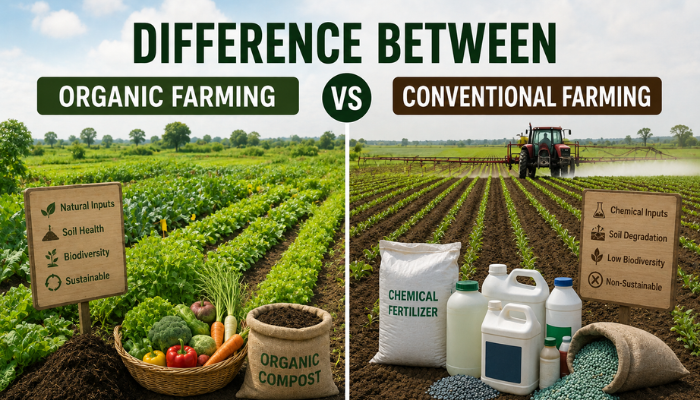
Difference Between Organic Farming and Conventional Farming
Farmers mainly use two methods to grow crops: organic farming and conventional farming. Both methods aim to produce healthy crops, but they differ in the way they manage soil, provide nutrients, control pests, and improve crop production.
Understanding the difference between organic farming and conventional farming helps farmers choose the right farming method based on their land, budget, crop type, and market demand.
What is Organic Farming?
Organic farming is a natural farming method that avoids synthetic fertilizers and chemical pesticides. Instead, it uses natural materials and eco-friendly practices to improve soil fertility and crop growth.
Organic farming mainly focuses on keeping the soil healthy and maintaining a natural balance in the farming ecosystem.
Common practices used in organic farming include:
- Compost and farmyard manure (FYM)
- Green manure
- Crop rotation
- Biological pest control
- Mulching
- Organic fertilizers and bio-based inputs
Organic farming does not allow the use of synthetic fertilizers, most chemical pesticides, or genetically modified (GMO) seeds.
What is Conventional Farming?
Conventional farming is a modern farming method that uses synthetic fertilizers, chemical pesticides, herbicides, and advanced farming technologies to increase crop production.
The main goal of conventional farming is to produce higher yields and protect crops from pests, diseases, and weeds quickly.
Common practices used in conventional farming include:
- Chemical fertilizers
- Chemical pesticides
- Herbicides
- Modern irrigation systems
- High-yielding seed varieties (including GMO seeds in some countries)
Conventional farming mainly depends on purchased farm inputs and modern technology.
Difference Between Organic Farming & Conventional Farming
The difference between organic farming and conventional farming can be understood by comparing how both methods manage crops and soil.
|
Feature |
Organic Farming |
Conventional Farming |
|
Inputs Used |
Uses compost, manure, biofertilizers, and natural inputs. |
Uses synthetic fertilizers, pesticides, and herbicides. |
|
Soil Fertility |
Improves soil using compost, crop rotation, and organic matter. |
Mainly depends on chemical fertilizers for plant nutrients. |
|
Pest & Weed Control |
Uses natural methods, beneficial insects, traps, and crop rotation. |
Uses chemical pesticides and herbicides for quick control. |
|
Crop Yield |
May produce lower yields initially but improves over time. |
Usually provides higher yields in the short term. |
|
Environmental Impact |
Supports soil health, biodiversity, and reduces pollution. |
Can affect soil and water if chemicals are overused. |
|
Cost & Dependency |
Uses fewer synthetic inputs but may require more labour. |
Depends more on purchased fertilizers and pesticides. |
|
Certification |
Requires organic certification and follows strict standards. |
Usually does not require special certification. |
Which Farming System is More Sustainable?
Both farming methods can be successful when managed properly.
Organic farming is generally considered more sustainable because it:
- Improves soil health.
- Reduces the use of synthetic chemicals.
- Supports biodiversity.
- Protects the environment.
Conventional farming can also become more sustainable when farmers:
- Test their soil regularly.
- Apply balanced fertilizers.
- Follow Integrated Pest Management (IPM).
- Avoid excessive use of chemicals.
The best farming method depends on:
- Soil condition
- Crop type
- Market demand
- Available budget
- Farm resources
Benefits of Organic Farming
Organic farming offers several long-term benefits:
- Uses compost, organic manure, and crop rotation to keep the soil healthy and fertile.
- Reduces the use of harmful chemicals, helping protect soil and water.
- Encourages beneficial insects, birds, earthworms, and other useful organisms.
- Crops contain fewer synthetic chemical residues.
- Organic produce often sells at a higher price, increasing farmers' income.
Benefits of Conventional Farming
Conventional farming also offers many advantages:
- Helps farmers produce more crops in a shorter time.
- Chemical pesticides help control pests, diseases, and weeds faster.
- Modern machinery and farming methods make it easier to manage large farming areas.
- Chemical fertilizers provide nutrients quickly, helping crops grow faster.
- Produces large quantities of crops efficiently, reducing the cost of production.
How Farmers Can Choose the Right Farming System
Farmers should choose the farming method based on their goals.
Choose Organic Farming if you want to:
- Improve soil health for the long term.
- Reduce the use of chemical fertilizers and pesticides.
- Grow chemical-free and eco-friendly crops.
- Protect the environment and support sustainable farming.
- Sell produce in organic markets for better prices.
Choose Conventional Farming if you want to:
- Get higher crop yields in a shorter time.
- Control pests, diseases, and weeds quickly.
- Produce crops on a large scale.
- Use modern fertilizers and farming techniques for faster crop growth.
- Meet high market demand with consistent production.
Many farmers also follow integrated farming, where they combine organic manure, balanced fertilizers, and safer pest management practices to improve productivity and soil health.
Conclusion
Understanding the difference between organic farming and conventional farming helps farmers choose the best farming method for their crops and land. Organic farming focuses on improving soil health, protecting the environment, and supporting sustainable agriculture. Conventional farming helps farmers achieve higher production and quicker crop response with modern inputs.
Want to grow healthy crops without relying on harmful chemicals? SV Agro Solutions offers a range of high-quality fertilizers for organic farming that improve soil fertility, support healthy plant growth, and promote chemical-free farming. Our organic solutions help increase nutrient availability, strengthen crops, improve long-term soil health, and support sustainable agriculture.
FAQs
1. What is the main difference between organic farming and conventional farming?
Organic farming uses natural inputs like compost and biofertilizers, while conventional farming uses synthetic fertilizers, pesticides, and herbicides to increase crop production.
2. Which farming method is better for soil health?
Organic farming is generally better for soil health because it improves organic matter, soil structure, and beneficial microbial activity.
3. Does conventional farming always produce higher yields?
Conventional farming often gives higher yields in the short term, while organic farming may improve productivity gradually as soil health improves.
4. Is organic farming completely chemical-free?
Organic farming avoids synthetic chemicals but may use approved natural and biological products for nutrient management and pest control.
5. Can farmers use both organic and conventional farming practices together?
Yes. Many farmers follow integrated farming by using organic manure, balanced fertilizers, and safer pest management practices to improve crop yield and soil health.
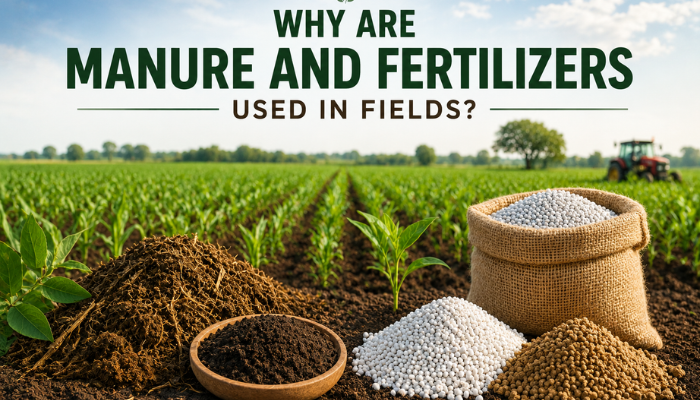
Why Are Manure and Fertilizers Used in Fields
Farmers grow crops on the same land every season. As crops grow, they absorb nutrients from the soil. After harvesting, many of these nutrients are removed from the field along with the grains, fruits, vegetables, and crop residues. Over time, the soil becomes less fertile, which can reduce crop growth and yield.
This is why farmers use manure and fertilizers in their fields. They help replace the lost nutrients, improve soil fertility, and support healthy crop growth. Understanding why are manure and fertilizers used in fields helps farmers choose the right nutrient source for better crop production and long-term soil health.
What is Manure?
Manure is a natural fertilizer made from decomposed plant and animal waste such as:
- Cow dung
- Compost
- Farmyard manure (FYM)
- Green manure
It contains organic matter and natural nutrients that help improve soil health. Manure also improves soil structure, increases water-holding capacity, and supports beneficial soil microorganisms.
What are Fertilizers?
Fertilizers are materials added to the soil to supply essential nutrients that plants need for healthy growth. They may be organic or synthetic and mainly provide nutrients such as:
- Nitrogen (N)
- Phosphorus (P)
- Potassium (K)
- Secondary nutrients and micronutrients
Fertilizers help plants grow faster, correct nutrient deficiencies, and improve crop yield.
Why Are Manure and Fertilizers Used in Fields?
Learn why manure and fertilizers are used in fields, how they improve soil fertility, support healthy crop growth, and help farmers achieve higher yields.
1. Replaces Lost Soil Nutrients
- Every crop absorbs nutrients from the soil while growing.
- After harvesting, these nutrients are removed from the field along with the crops.
- Manure and fertilizers help replace these lost nutrients.
- Restore nutrients that are removed after every harvest.
- Maintain the right balance of nutrients in the soil.
- Prevent soil from becoming less fertile over time.
- Ensure crops receive enough nutrients for healthy growth.
- Keep the land productive for future farming seasons.
2. Improves Soil Fertility
- Healthy soil is the foundation of good crop production.
- Manure and fertilizers improve the fertility of the soil by supplying essential nutrients required for plant growth.
- Supply nutrients needed for healthy crop development.
- Improve the soil's ability to support plant growth.
- Maintain soil productivity season after season.
- Support better crop performance and higher yields.
3. Supports Healthy Plant Growth
- Plants need nutrients like Nitrogen, Phosphorus, and Potassium to grow properly.
- Manure and fertilizers provide these nutrients at different stages of crop growth.
- Promote healthy green leaves and strong stems.
- Develop deeper and healthier root systems.
- Improve flowering and fruit formation.
- Support proper grain and seed development.
- Produce stronger, healthier, and more productive plants.
4. Increases Crop Yield
When crops receive balanced nutrition, they grow faster and produce better harvests.
- Increase the quantity of crops produced.
- Improve grain filling and fruit development.
- Produce bigger, healthier, and better-quality crops.
- Improve the market value of the produce.
- Increase farm income through higher yields.
5. Improves Soil Structure and Water Retention
Good soil structure allows roots to grow easily and helps the soil store water for a longer time.
- Improve soil texture and make the soil loose.
- Increase the soil's ability to hold water.
- Improve air movement within the soil.
- Encourage better root growth.
- Reduce soil erosion and nutrient loss.
When fertilizers are used along with manure, they provide balanced nutrition while maintaining good soil quality.
6. Supports Beneficial Soil Microorganisms
Healthy soil contains beneficial microorganisms that naturally improve soil fertility and plant growth.
- Increase the population of beneficial bacteria and fungi.
- Improve the breakdown of organic matter into nutrients.
- Support better nutrient cycling in the soil.
- Maintain long-term soil health and fertility.
- Create a healthier environment for continuous crop growth.
Balanced use of fertilizers along with manure supports healthy plant growth without affecting beneficial soil microorganisms.
Why Use Both Manure and Fertilizers Together?
Using both manure and fertilizers together gives better results than using only one.
- Manure improves soil health by adding organic matter and increasing soil fertility.
- Fertilizers provide essential nutrients quickly for faster crop growth.
- Manure improves soil structure, making it easier for roots to grow.
- Fertilizers help correct nutrient deficiencies during important crop growth stages.
- Manure increases the soil's ability to hold water and nutrients.
- Together, they improve nutrient absorption and fertilizer efficiency.
- This combination supports healthier crops, higher yields, and sustainable farming.
Best Practices for Using Manure and Fertilizers
Follow these simple practices for better crop performance.
- Test your soil before application to know which nutrients your crops need.
- Use well-decomposed or composted manure to improve soil safely and avoid harmful bacteria.
- Apply manure before sowing so it mixes well with the soil.
- Apply fertilizers at the correct crop growth stage for better nutrient absorption.
- Spread manure and fertilizers evenly across the field for uniform crop growth.
- Avoid using more than the recommended amount to prevent crop damage and nutrient loss.
- Water the field after fertilizer application if needed to help nutrients reach the roots.
- Combine manure and fertilizers in the right proportion for healthier soil and better crop yields.
Conclusion
Understanding why are manure and fertilizers used in fields helps farmers improve crop production and maintain healthy soil. Manure improves soil structure, organic matter, and microbial activity, while fertilizers supply essential nutrients quickly for better crop growth. Using both together provides balanced nutrition, improves soil fertility, increases crop yield, and supports sustainable farming.
Want to improve soil fertility and achieve better crop yields naturally? SV Agro Solutions offers a wide range of high-quality organic fertilizers that help improve soil health, increase nutrient availability, promote strong root growth, and support healthy crop development. Our organic fertilizer solutions are designed to enhance long-term soil fertility, improve crop productivity, and encourage sustainable farming practices.
FAQs
1. Why are manure and fertilizers used in fields?
Manure and fertilizers are used to replace lost nutrients, improve soil fertility, and support healthy crop growth for higher yields.
2. What is the main difference between manure and fertilizers?
Manure is a natural source of nutrients that improves soil health, while fertilizers provide concentrated nutrients for faster crop growth.
3. Can farmers use only manure without fertilizers?
Yes, but manure alone may not supply enough nutrients for high-yield crops. Using both together often gives better results.
4. How do manure and fertilizers improve soil?
Manure improves soil structure and organic matter, while fertilizers provide essential nutrients needed for healthy crop growth.
5. Is it better to use manure or fertilizers?
Both are beneficial. Manure supports long-term soil health, while fertilizers provide quick nutrients. Using both together is the best approach for healthy crops and sustainable farming.
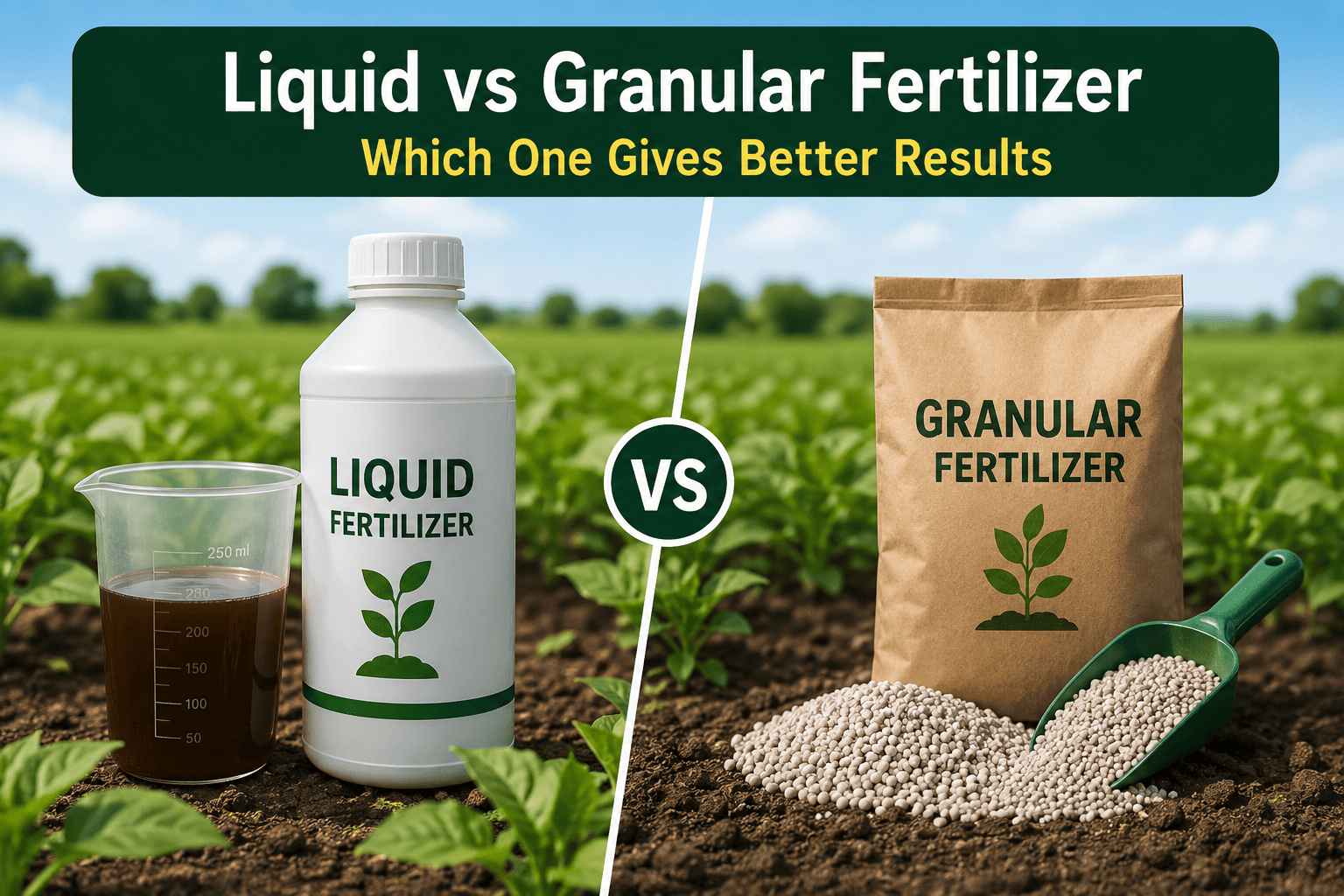
Liquid vs Granular Fertilizer - Which One Gives Better Results?
Choosing the right fertilizer is important for healthy crop growth and better yields. Farmers and gardeners often compare liquid vs granular fertilizer because both provide essential nutrients, but they work in different ways.
Liquid fertilizer provides nutrients quickly, while granular fertiliser releases them slowly over time. Knowing the difference between liquid vs granular fertilizer helps farmers choose the right option based on their crop, soil conditions, budget, and farming method.
Liquid vs Granular Fertilizer: A Complete Comparison
Learn the key differences between liquid and granular fertilizer to choose the right option for better crop growth, nutrient efficiency, and higher yields.
|
Feature |
Liquid Fertilizer |
Granular Fertilizer |
|
Nutrient Release |
Nutrients are already dissolved in water, so crops absorb them quickly and show faster results. |
Nutrients are released slowly as the granules dissolve in the soil, providing a steady nutrient supply. |
|
Duration |
Provides a quick nutrient boost, but the effect lasts for a shorter period and may require repeated applications. |
Releases nutrients gradually and feeds crops for a longer time, reducing the need for frequent applications. |
|
Application Method |
Applied through foliar spray, fertigation, or irrigation systems for quick nutrient uptake. |
Applied directly to the soil by broadcasting, band placement, or side dressing before or during crop growth. |
|
Nutrient Distribution |
Spreads evenly with water, ensuring uniform nutrient application when applied correctly. |
Nutrient distribution depends on how evenly the granules are spread across the field. |
|
Cost |
Usually costs more but provides faster nutrient availability and quick crop response. |
Generally more affordable, easy to store and transport, and suitable for large-scale farming. |
Although both fertilizers provide nutrients, they differ in how they work and how they are applied.
What is Liquid Fertilizer?
Liquid fertilizer contains nutrients that are dissolved in water. It can be applied through foliar spray, drip irrigation (fertigation), or directly to the soil.
Crops absorb liquid fertilizer quickly through their roots and, in some cases, through their leaves. Because of its fast action, it is commonly used to correct nutrient deficiencies and support crops during important growth stages.
What is Granular Fertilizer?
Granular fertilizer is a dry fertilizer available in small granules or pellets. It is applied directly to the soil, where it slowly dissolves with water and releases nutrients over time.
Granular fertilizer is mainly used before sowing or planting and provides long-lasting nutrition for crops. It is widely used for field crops and large farming areas.
Benefits of Liquid Fertilizer
Liquid fertilizer is ideal when crops need nutrients quickly.
1. Quick Nutrient Absorption
- Nutrients are absorbed rapidly by crops.
- Helps correct nutrient deficiencies quickly.
2. Suitable for Foliar Spray
- Can be sprayed directly on leaves.
- Provides fast nutrition during important growth stages.
3. Ideal During Crop Stress
- Helps crops recover faster from drought, heat, transplant shock, and other stress conditions.
4. Accurate Application
- Easy to apply in the required quantity.
- Reduces uneven fertilizer distribution.
5. Best for High-Value Crops
- Commonly used for vegetables, fruits, flowers, and greenhouse crops where quick results are needed.
Benefits of Granular Fertilizer
Granular fertilizer provides steady nutrition for a longer period.
1. Long-Lasting Nutrition
- Releases nutrients slowly.
- Supports crop growth for a longer time.
2. Improves Soil Fertility
- Helps maintain nutrient levels in the soil.
- Supports healthy crop growth throughout the season.
3. Cost-Effective
- Usually costs less per unit of nutrient.
- Suitable for large farming areas.
4. Easy to Store and Transport
- Simple to handle and store.
- Has a longer shelf life than liquid fertilizer.
5. Suitable for Base Fertilization
- Ideal before sowing or transplanting.
- Provides nutrients during early crop growth.
Which One Should Farmers Choose?
The right fertilizer depends on your farming needs.
Choose liquid fertilizer when:
- Nutrients are already mixed with water, so crops absorb them faster through roots or leaves.
- Helps crops recover quickly if they show yellow leaves or poor growth due to nutrient deficiency.
- Nutrients are spread evenly across the crop, helping all crops grow uniformly.
- Can be used through foliar spray, drip irrigation (fertigation), or irrigation water.
- Gives quick results, making it suitable for high-value crops like vegetables, fruits, flowers, and greenhouse crops.
- Since it works quickly, its effect lasts for a shorter time and may need to be applied again during the season.
Choose granular fertilizer when:
- Granules dissolve slowly in the soil, providing nutrients over a longer period.
- One application can supply nutrients for several weeks, reducing the need for frequent use.
- Usually cheaper than liquid fertilizer, especially for large farms.
- Granular fertilizers are simple to handle, store, and carry in large quantities.
- Commonly used for crops like wheat, rice, maize, cotton, and other large-scale field crops.
- Because nutrients are released slowly, farmers do not need to apply them often.
- Rainfall or irrigation is needed to dissolve the granules so crops can absorb the nutrients.
Can Liquid and Granular Fertilizer Be Used Together?
Yes. Many farmers use both liquid and granular fertilizer together to get better crop performance.
- Liquid fertilizer provides nutrients quickly and helps crops recover from nutrient deficiencies faster.
- Granular fertilizer releases nutrients slowly, providing continuous nutrition over a longer period.
- Liquid fertilizer is ideal for quick crop response, while granular fertilizer supports steady plant growth.
- Using both together improves nutrient uptake and fertilizer efficiency.
- This combination promotes healthier crops, better growth, and higher yields.
- Always follow the recommended dosage and application schedule for the best results.
When used correctly, this combination can improve crop growth, yield, and fertilizer efficiency.
Best Practices for Using Fertilizer Wisely
Follow these simple practices for better results:
- Test the soil before choosing the fertilizer.
- Select the right fertilizer according to crop needs.
- Apply fertilizer at the correct crop stage.
- Calibrate sprayers and spreaders for even application.
- Avoid using more fertilizer than recommended.
- Always follow the instructions on the product label.
Conclusion
Understanding liquid vs granular fertilizer helps farmers choose the right fertilizer based on crop requirements, soil conditions, and farming practices. Liquid fertilizer provides fast nutrient absorption and is useful during stress or nutrient deficiency, while granular fertilizer supplies nutrients gradually and supports long-term crop growth.
Looking for the right fertilizer for your crops? SV Agro Solutions offers a wide range of high-quality organic fertilizers and granular fertilizers designed to improve nutrient availability, support healthy plant growth, and increase crop productivity.
Whether you need quick nutrient absorption with liquid fertilizers or long-lasting nutrition with granular fertilizers, our solutions help farmers achieve better yields and sustainable farming. Choose SV Agro Solutions for reliable fertilizer products that support healthier crops and improved farm performance.
FAQs
1. What is the main difference between liquid and granular fertilizer?
Liquid fertilizer works quickly because nutrients are dissolved in water, while granular fertilizer releases nutrients slowly over time.
2. Which works faster: liquid vs granular fertilizer?
Liquid fertilizer works faster because crops absorb the nutrients quickly through roots or leaves.
3. Is granular fertilizer better for long-term feeding?
Yes. Granular fertilizer provides a slow and steady supply of nutrients, making it suitable for long-term crop nutrition.
4. Can I use both liquid and granular fertilizer together?
Yes. Many farmers use granular fertilizer for base nutrition and liquid fertilizer for quick nutrient supply during important crop stages.
5. Which is more cost-effective liquid or granular fertilizer?
Granular fertilizer is generally more economical for large-scale farming, while liquid fertilizer provides faster results and precise nutrient application.
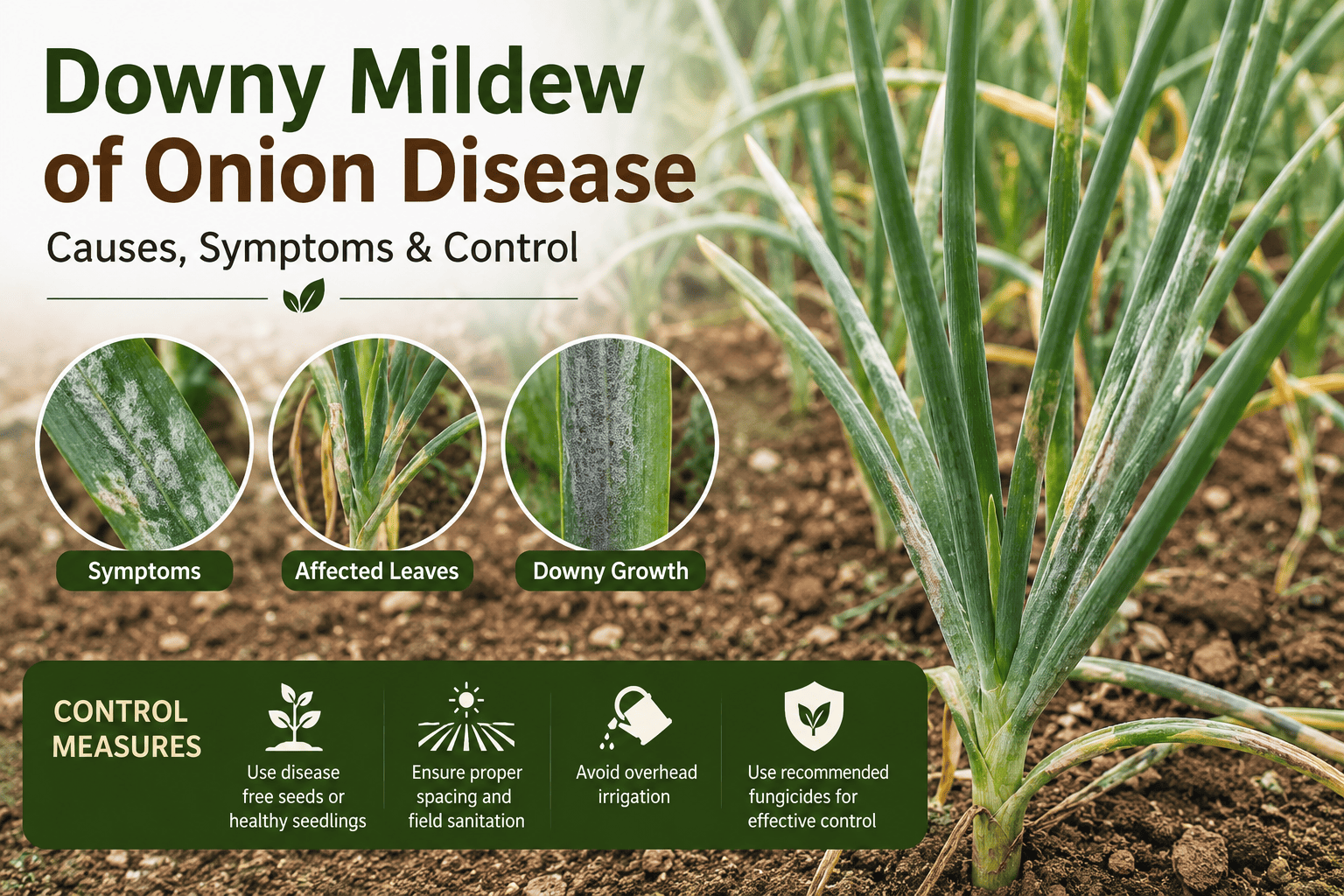
Downy Mildew of Onion Disease - Causes, Symptoms & Control
Downy Mildew of Onion is a serious disease that affects onion crops, especially during cool and humid weather. It attacks the leaves, reduces plant growth, and results in smaller bulbs of poor quality. If farmers do not control the disease at the right time, it can cause heavy yield losses.
The disease spreads quickly when onion leaves remain wet due to rain, heavy dew, or overhead irrigation. By identifying the symptoms early and following proper field management along with timely fungicide sprays, farmers can protect their onion crop and improve production.
What is Downy Mildew Onion Disease?
Downy Mildew of Onion is a disease caused by Peronospora destructor, which is a fungus-like organism called an oomycete (water mould). It mainly attacks onion leaves, flower stalks, and sometimes bulbs.
The disease weakens the plant, reduces bulb size, affects bulb quality, and shortens storage life. It can also infect other Allium crops such as garlic, shallots, and chives.
Causes of Downy Mildew of Onion
Downy Mildew develops quickly when weather conditions are favourable.
Cool and Humid Weather
- Cool temperatures between 10°C and 20°C are ideal for disease development.
- High humidity above 80–90% helps the disease spread rapidly.
- Rain, heavy dew, and long periods of wet leaves increase infection.
Infected Crop Residue
- The disease survives in infected onion leaves, crop debris, volunteer onions, and old bulbs left in the field.
- If infected plant material is not removed, it becomes the source of infection for the next crop.
Spread Through Wind and Water
The disease spreads through:
- Wind
- Rain splash
- Overhead irrigation
- Heavy dew
- Infected planting material
Poor Field Management
- Dense planting reduces air circulation.
- Poor drainage and waterlogging increase humidity.
- Overhead irrigation keeps leaves wet for a longer time.
- Excess nitrogen fertilizer produces soft leaves that are more prone to infection.
Downy Mildew Symptoms Found in Onion
Farmers should inspect onion fields regularly, especially during cool and humid weather.
- Light green or yellow patches first appear on older leaves.
- These patches usually develop near the leaf tip or middle portion.
- During humid mornings, a grey or violet fuzzy growth appears on infected leaves.
- As the disease spreads, infected areas turn brown and dry.
- Several spots join together and cover large portions of the leaf.
- Leaves start drying from the tip and finally collapse.
- Flower stalks may also become infected, reducing seed production.
- Bulbs remain small, soft, and have poor storage quality.
- Severe infection causes early drying of leaves and significant yield loss.
Disease Cycle of Downy Mildew of Onion
The disease spreads very quickly under favourable weather conditions.
- The pathogen survives in infected crop residue, volunteer onion plants, old bulbs, and infected planting material.
- During cool, humid weather, it produces large numbers of spores on infected leaves.
- These spores spread through wind, rainwater, irrigation water, and heavy dew.
- When spores land on wet onion leaves, they germinate and infect the plant.
- New yellow patches appear within a few days.
- These infected spots produce more spores, which continue spreading the disease throughout the field.
Impact on Crop and Yield
Downy Mildew can cause serious damage to onion crops.
- It reduces the green leaf area needed for photosynthesis.
- Leaves dry early, and crops become weak.
- Bulbs remain small and lightweight.
- Reduces bulb quality and storage life.
- Infected bulbs may rot during storage.
- Seed crops produce poor-quality seed.
- Severe infection can cause heavy yield losses.
Prevention of Downy Mildew of Onion
Good farming practices help reduce disease incidence.
Cultural Practices
- Use healthy and disease-free seeds or seedlings.
- Select disease-tolerant onion varieties whenever available.
- Maintain proper spacing for better air circulation.
- Avoid excessive nitrogen fertilizer.
- Follow crop rotation with non-onion crops for 2-3 years.
- Remove and destroy infected plants and crop residue after harvest.
- Eliminate volunteer onion plants growing near the field.
Field and Irrigation Management
- Maintain proper drainage.
- Avoid waterlogging.
- Use drip irrigation instead of overhead sprinklers.
- Do not work in the field when leaves are wet.
- Keep the field free from weeds that increase humidity.
Control of Downy Mildew of Onion
Early detection, proper field management, and timely fungicide application are essential to effectively control Downy Mildew of Onion and protect crop yield and bulb quality.
Early Detection
- Inspect the crop regularly during cool and humid weather.
- Check older leaves for yellow patches and grey fungal growth.
- Start disease control immediately after the first symptoms appear.
Biological and Biostimulants Management
- Use neem-based products or biological products wherever recommended.
- Apply SV Rounder P from SV Agro Solutions as part of an integrated crop management programme.
- It improves crop health, acts as a bactericide, and is effective against viral infections, helping plants remain stronger under disease pressure.
- Maintain balanced crop nutrition to improve the plant's natural resistance against diseases.
- Avoid excessive irrigation and keep leaves as dry as possible to reduce disease spread.
- Combine cultural practices, biological products, and recommended fungicides for better and long-lasting control of Downy Mildew.
Conclusion
Downy Mildew of Onion is a serious disease that spreads rapidly during cool and humid weather. If not managed on time, it can reduce bulb size, quality, storage life, and overall yield.
Farmers can effectively control the disease by using healthy planting material, maintaining proper field hygiene, improving drainage, following crop rotation, regularly monitoring the crop, and applying recommended fungicides at the right time.
Looking for high-quality biostimulants to improve crop growth and yield? SV Agro Solutions is a trusted biostimulants manufacturer and supplier in Pune, offering high-quality biostimulants that improve plant health, nutrient uptake, stress tolerance, and overall crop productivity. Our products support sustainable farming and are trusted by farmers across India as well as international markets.
Frequently Asked Questions (FAQs)
1. What causes Downy Mildew of Onion?
Downy Mildew of Onion is caused by Peronospora destructor, a fungus-like water mould that survives in infected crop residue and spreads through wind, rain, and irrigation water.
2. What are the early symptoms of Downy Mildew of Onion?
The first symptoms are light green or yellow patches on older leaves. During humid weather, grey or violet fuzzy fungal growth appears on these patches.
3. How does Downy Mildew spread in onion fields?
The disease spreads through spores carried by wind, rain splash, irrigation water, heavy dew, infected bulbs, and infected crop residue.
4. How can farmers prevent Downy Mildew of Onion?
Farmers should use healthy seeds, maintain proper spacing, follow crop rotation, remove infected plant debris, improve field drainage, use drip irrigation, and avoid excessive nitrogen fertilizer.
5. Which fungicides are commonly used to control Downy Mildew of Onion?
Common fungicides include Mancozeb, Chlorothalonil, Metalaxyl, Fosetyl Aluminium, Azoxystrobin, and Difenoconazole. These should be used according to the product label and local agricultural recommendations.
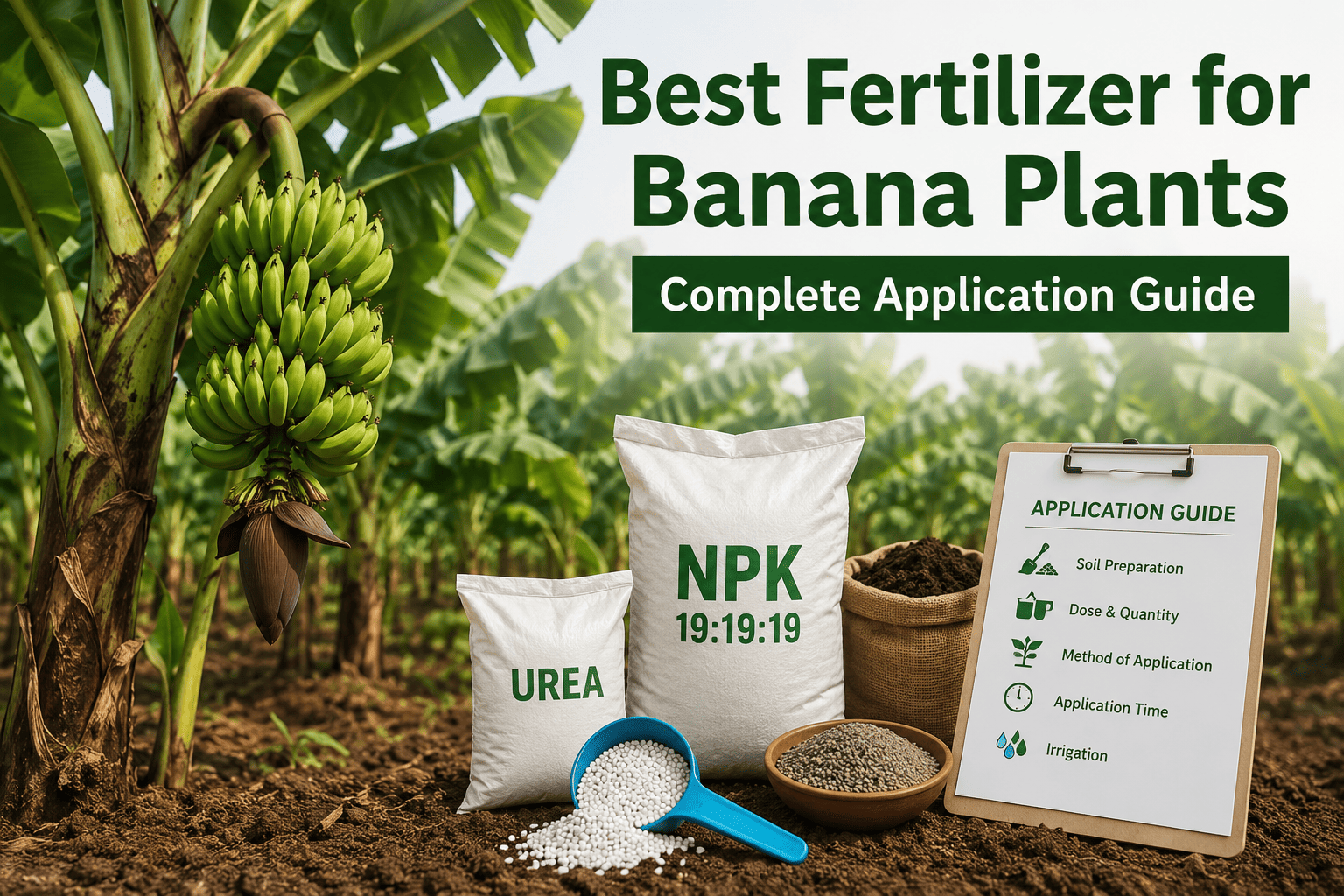
Best Fertilizer for Banana Plants - Complete Application Guide
Bananas are one of the most nutrient-demanding fruit crops. To produce healthy plants, large bunches, and high-quality fruits, bananas require a continuous supply of nutrients throughout their growing season. If the plant does not receive the right nutrients at the right time, farmers may notice poor growth, weak plants, small bunches, and lower yields.
However, there is no single best fertilizer for banana plants. The right fertilizer depends on factors such as soil fertility, crop growth stage, banana variety, irrigation method, and whether you follow organic or conventional farming.
This guide explains the nutrient requirements of banana plants, the best fertilizers to use, recommended NPK ratios, stage-wise fertilizer application, and best practices to help farmers achieve higher yields and better fruit quality.
Why Do Banana Plants Need Fertilizer?
Banana plants grow quickly and produce large leaves, thick pseudostems, and heavy fruit bunches. During this process, they remove large amounts of nutrients from the soil.
Without regular fertilizer application:
- Plant growth becomes slow.
- Leaves turn yellow.
- Flowering is delayed.
- Fruits remain small.
- Bunch weight decreases.
- Yield and fruit quality are reduced.
Proper fertilizer management keeps the plants healthy throughout the crop cycle.
Nutrient Needs of Banana Plants
Banana plants require both macronutrients and micronutrients for healthy growth.
1. Nitrogen (N)
Nitrogen helps produce healthy green leaves and supports rapid vegetative growth.
Benefits:
- Promotes leaf production
- Increases plant height
- Improves photosynthesis
- Supports vigorous growth
Deficiency Symptoms
- Yellow older leaves
- Slow plant growth
- Thin pseudostem
2. Phosphorus (P)
Phosphorus is important during the early growth stage.
Benefits:
- Strong root development
- Better plant establishment
- Early flowering
- Improved energy transfer
Deficiency Symptoms
- Poor root growth
- Slow development
- Delayed flowering
3. Potassium (K)
Potassium is the most important nutrient for bananas.
It improves:
- Bunch size
- Finger size
- Fruit sweetness
- Fruit quality
- Shelf life
- Disease tolerance
Deficiency Symptoms
- Brown leaf edges
- Weak pseudostem
- Small bunches
- Poor fruit filling
4. Secondary Nutrients
Banana also needs:
- Calcium (Ca)
- Magnesium (Mg)
- Sulphur (S)
These nutrients strengthen plants and improve fruit quality.
5. Micronutrients
Banana requires small amounts of:
- Zinc (Zn)
- Boron (B)
- Iron (Fe)
- Manganese (Mn)
These nutrients support flowering, fruit development, and overall plant health.
Best Fertilizer for Banana Plants
Different fertilizers serve different purposes during the banana crop cycle.
1. NPK Fertilizers
NPK fertilizers provide Nitrogen, Phosphorus, and Potassium together.
Common fertilizers include:
|
Fertilizer |
Best Use |
|
19:19:19 |
Early balanced growth |
|
12:12:17 |
Vegetative stage |
|
13:00:45 |
Flowering and bunch development |
|
0:01:00 |
Potassium supply during fruit filling |
2. Complex Fertilizers
Complex fertilizers contain two or more nutrients in one product.
Common examples include:
- 17:17:17
- 15:15:15
- 10:26:26
These fertilizers are commonly used during early crop growth and fertigation.
3. Single Nutrient Fertilizers
Sometimes only one nutrient needs correction.
|
Nitrogen |
Urea, CAN |
|
Phosphorus |
DAP, SSP, MAP |
|
Potassium |
SOP, MOP, Potassium Nitrate |
|
Calcium & Sulphur |
Gypsum |
|
Calcium & Magnesium |
Dolomite |
4. Organic Fertilizers
- Organic fertilizers improve soil fertility and support long-term crop health.
- Common options include Farmyard Manure (FYM), Compost, Vermicompost, and Neem Cake
Benefits:
- Improve soil structure
- Increase organic matter
- Improve water retention
- Encourage beneficial microbes
5. Biofertilizers
Biofertilizers contain beneficial microorganisms.
Examples:
- Azospirillum
- Phosphate Solubilizing Bacteria (PSB)
- Potash Mobilizing Bacteria
Benefits:
- Improve nutrient availability
- Enhance root growth
- Reduce fertilizer requirement
6. Micronutrient Fertilizers
Micronutrient fertilizers help prevent hidden deficiencies.
Common products include:
- Zinc Sulphate
- Borax
- Ferrous Sulphate
- Chelated Micronutrients
They improve:
- Flowering
- Fruit setting
- Fruit quality
- Crop health
Recommended NPK Ratios for Banana
The fertilizer ratio changes during crop growth.
|
Crop Stage |
Recommended NPK Ratio |
|
Early Growth |
2:1:1 or 1:1:1 |
|
Flowering |
1:0.5:1.5 |
|
Bunch Development |
1:1:2 or higher Potassium |
The exact fertilizer dose should always be based on:
- Soil test
- Banana variety
- Expected yield
- Local agricultural recommendations
Stage-wise Fertilizer Management
Applying the right fertilizer at each growth stage helps banana plants grow healthier, produce bigger bunches, and achieve higher yields.
1. Planting and Early Growth (1-2 Months)
- Apply the full dose of phosphorus at planting for strong root growth.
- Start with small doses of nitrogen and potassium for healthy plant development.
2. Vegetative Growth (3-4 Months)
- Apply more nitrogen to encourage healthy leaves and stem growth.
- Continue split doses of potassium with regular irrigation.
3. Pre-Flowering Stage (5-6 Months)
- Increase potassium to support flowering and bunch formation.
- Apply micronutrients like zinc and boron if needed.
4. Flowering and Bunch Formation (7 Months)
- Reduce nitrogen slightly.
- Continue high potassium for better fruit set and bunch growth.
5. Bunch Development (8-9 Months)
- Continue potassium application to improve fruit size, weight, and quality.
- Use SOP if recommended for better fruit quality.
6. Fruit Maturity (10-11 Months)
- Gradually reduce fertilizer application.
- Stop fertilizer application 15-20 days before harvest.
Best Fertilizer for Banana Plants in Different Farming Systems
The best fertilizer for banana plants depends on the farming method, whether it is drip irrigation, open-field cultivation, or organic farming.
Drip Irrigation
Use water-soluble fertilizers such as:
- 19:19:19
- 13:0:45
- Potassium Nitrate
- Urea
Apply small doses regularly for better nutrient use efficiency.
Open Field Farming
Use:
- Granular NPK fertilizers
- Single nutrient fertilizers
- Organic manure
- Mulching
Split fertilizer doses throughout the season.
Organic Banana Farming
Recommended inputs include:
- FYM
- Vermicompost
- Green manure
- Neem cake
- Biofertilizers
- Seaweed extracts
- Panchagavya
These improve soil health and support sustainable farming.
How Much Fertilizer Should Farmers Apply?
There is no fixed fertilizer dose for every farm.
- Always conduct a soil test before applying fertilizers.
- It shows which nutrients are lacking and helps you apply the correct amount.
- Different banana varieties have different nutrient requirements depending on their growth and yield potential.
- Drip-irrigated crops usually require smaller and more frequent fertilizer applications, while open-field farming often needs split applications.
- Rainfall, temperature, and soil moisture affect nutrient availability and fertilizer losses.
- Adjust the fertilizer schedule according to local weather conditions.
- Higher yield targets require better nutrient management and balanced fertilizer application throughout the crop cycle.
- Give the full recommended dose of phosphorus during planting to support strong root development and early plant growth.
- Instead of applying all at once, divide nitrogen and potassium into 6–10 split doses from planting until harvest.
- This improves nutrient uptake and reduces wastage.
Signs You Are Using the Right Fertilizer
These symptoms indicate nutrient deficiency or improper fertilizer management.
- Leaves are dark green and healthy, showing that the plant is getting enough nitrogen.
- New leaves grow normally without turning yellow or becoming weak.
- Plants have strong stems and balanced growth instead of becoming too tall and weak.
- Roots grow well, helping the plant absorb more water and nutrients.
- Flowering and fruit setting are better, leading to bigger bunches, fruits, or grains.
- Fruits are larger, healthier, and of better quality because the crop is getting enough potassium.
- Plants are more resistant to pests, diseases, drought, and heat stress.
- Leaves do not show burnt edges or drying, which means fertilizer is applied in the right amount.
- Micronutrients like zinc, iron, and boron are available, so the crop grows without deficiency symptoms such as yellow leaves or poor fruit development.
- The crop grows uniformly and yields more, indicating that the fertiliser programme is balanced and effective.
Conclusion
There is no single specific fertilizer that is best for banana plants; instead, a balanced nutrient management programme. Banana requires adequate nitrogen for healthy growth, phosphorus for strong roots, and high potassium for better bunch development and fruit quality. Organic manures, biofertilizers, and micronutrients also play an important role in improving soil fertility and crop productivity.
Are you looking for the right fertilizer to improve banana growth and increase yield?
SV Agro Solutions is a trusted fertilizer manufacturer and supplier in Pune, offering high-quality fertilizers that help improve crop growth, soil fertility, and farm productivity. We provide reliable crop nutrition solutions for farmers across India and also export our products to international markets, supporting sustainable and high-yield farming.
Frequently Asked Questions (FAQs)
1. What is the best fertilizer for banana plants?
A balanced fertilizer programme containing adequate nitrogen, phosphorus, high potassium, and essential micronutrients is the best choice for healthy banana growth and higher yield.
2. Which NPK ratio is best for banana?
During early growth, ratios like 2:1:1 or 1:1:1 are suitable. During flowering and bunch development, fertilizers with higher potassium (1:1:2 or higher) are recommended.
3. How often should banana plants be fertilized?
Nitrogen and potassium are generally applied in 6-10 split doses from planting to harvest. In drip irrigation systems, fertilizers are applied weekly or fortnightly through fertigation.
4. Can I grow bananas using only organic fertilizers?
Yes. Banana can be grown using FYM, vermicompost, neem cake, biofertilizers, and other organic inputs, but nutrient planning should be done carefully to meet the crop's high nutrient demand.
5. How can I identify nutrient deficiency in banana plants?
Yellow leaves, poor plant growth, weak pseudostems, delayed flowering, and small bunches are common signs of nutrient deficiency. A soil test is the most reliable way to determine the exact nutrient requirement.
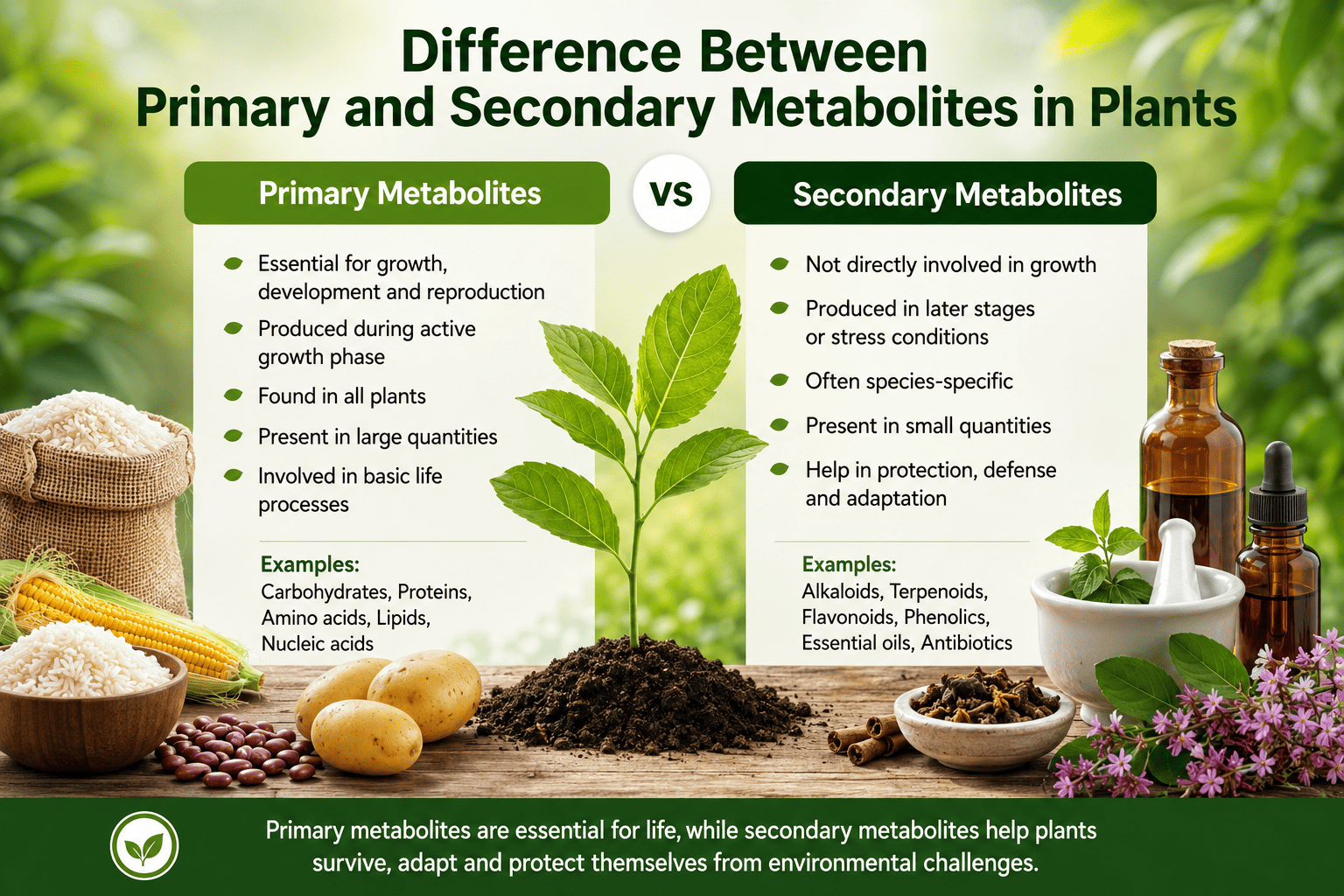
Difference Between Primary and Secondary Metabolites in Plants
Plants, animals, and microorganisms produce many different substances during their growth and development. These substances are known as metabolites. They play an important role in helping living organisms grow, reproduce, survive, and protect themselves from environmental challenges.
Metabolites are mainly divided into two categories: primary metabolites and secondary metabolites. While both are important, they serve different purposes. Primary metabolites are essential for growth and life processes, whereas secondary metabolites help organisms adapt to their surroundings and defend themselves against pests, diseases, and stress.
In this article, we will understand the difference between primary and secondary metabolites, their definitions, examples, functions, and importance in agriculture and industry.
What are Metabolites?
Metabolites are chemical compounds produced inside living organisms during metabolism. Metabolism includes all the chemical reactions that help organisms obtain energy, grow, repair tissues, and maintain life.
These compounds can be classified based on their role in the organism:
- Primary metabolites are directly involved in growth and development.
- Secondary metabolites are not directly required for growth but help organisms survive and adapt to their environment.
Understanding these metabolites is important in agriculture, biotechnology, medicine, and plant science.
What Are Primary Metabolites?
- Primary metabolites are organic compounds that are essential for the normal growth, development, and reproduction of living organisms.
- They are produced during the active growth phase and are found in almost all living cells.
- Without primary metabolites, plants and microorganisms cannot survive because they are directly involved in basic life processes.
Examples of Primary Metabolites
- Carbohydrates (glucose, starch)
- Proteins
- Lipids (fats and oils)
- Amino acids
- Nucleic acids (DNA and RNA)
- Organic acids
These compounds provide energy, build cell structures, and support important biological activities.
Characteristics of Primary Metabolites
- Essential for survival
- Produced during the growth phase
- Found in large quantities
- Present in most organisms
- Directly involved in metabolism
What Are Secondary Metabolites?
- Secondary metabolites are organic compounds that are not directly involved in the basic growth and development of an organism.
- However, they play a major role in protection, adaptation, and survival.
- Plants and microorganisms often produce secondary metabolites during later stages of growth or when they face environmental stress such as pest attacks, diseases, drought, or competition.
Examples of Secondary Metabolites
- Alkaloids (Nicotine, Caffeine)
- Terpenoids
- Phenolic compounds
- Flavonoids
- Plant pigments
- Antibiotics
- Essential oils
These compounds help plants defend themselves and interact with their environment.
Characteristics of Secondary Metabolites
- Not directly required for growth
- Produced in smaller amounts
- Often species-specific
- Help in defense and adaptation
- Commonly formed during stress conditions
Difference Between Primary and Secondary Metabolites
The main difference between primary and secondary metabolites is that primary metabolites are necessary for growth and survival, while secondary metabolites mainly support defense and adaptation.
|
Feature |
Primary Metabolites |
Secondary Metabolites |
|
Definition |
Compounds essential for growth and development |
Compounds involved in defense and adaptation |
|
Role |
Support basic life processes |
Help survive under environmental stress |
|
Production Stage |
Active growth phase |
Later growth stages or stress conditions |
|
Quantity Produced |
Large amounts |
Small amounts |
|
Distribution |
Found in almost all organisms |
Often species-specific |
|
Importance |
Essential for survival |
Important for protection and ecological interactions |
|
Examples |
Carbohydrates, proteins, amino acids |
Alkaloids, terpenoids, flavonoids, antibiotics |
|
Commercial Uses |
Food, fermentation, biotechnology |
Medicines, pesticides, flavours, fragrances |
This table clearly explains the difference between primary and secondary metabolites and helps students and farmers understand their unique roles.
Functions of Primary Metabolites
Primary metabolites are the building blocks of life. They perform several important functions.
1. Energy Production
Carbohydrates such as glucose provide the energy required for plant growth and cellular activities.
2. Formation of Cell Structures
Proteins, lipids, and nucleic acids help build and maintain plant cells and tissues.
3. Growth and Development
Amino acids and proteins support plant growth, flowering, and seed formation.
4. Enzyme Production
Many primary metabolites are involved in enzyme synthesis, which controls metabolic reactions.
5. Reproduction
Primary metabolites provide the materials required for reproduction and seed development.
Functions of Secondary Metabolites
Secondary metabolites may not be directly involved in growth, but they play a vital role in plant survival.
1. Protection Against Pests
Many secondary metabolites act as natural insect repellents and reduce pest attacks.
2. Disease Resistance
Plants produce antimicrobial compounds that protect them from bacteria, fungi, and viruses.
3. Environmental Stress Tolerance
Secondary metabolites help plants survive drought, heat, UV radiation, and other stress conditions.
4. Attraction of Pollinators
Pigments and fragrances attract bees, butterflies, and other pollinating insects.
5. Competition With Other Plants
Some plants release secondary metabolites into the soil to suppress the growth of competing plants.
Conclusion
Understanding the Difference Between Primary and Secondary Metabolites is important for farmers, students, and researchers. While both types of metabolites are essential for living organisms, they perform different roles. Primary metabolites are essential for growth, development, and reproduction, while secondary metabolites help in protection, survival, and adaptation to environmental challenges.
Looking for high-quality fertilizers to improve crop growth and increase yields? SV Agro Solutions is a trusted fertilizer manufacturer and supplier in Pune, offering innovative agricultural solutions for farmers and agribusinesses. Our products are designed to support healthy plant growth, improve productivity, and help farmers achieve better farming results. Trusted by farmers across India, we also supply our fertilizers to international markets.
FAQs
1. What is the difference between primary and secondary metabolites?
Primary metabolites are essential compounds required for growth and development, while secondary metabolites mainly help in defense, adaptation, and survival.
2. What are examples of primary metabolites?
Examples include carbohydrates, proteins, amino acids, lipids, nucleic acids, and organic acids.
3. What are examples of secondary metabolites?
Examples include alkaloids, flavonoids, terpenoids, phenolic compounds, pigments, and antibiotics.
4. Are secondary metabolites essential for growth?
No. Secondary metabolites are not directly required for growth but help organisms survive environmental challenges and protect themselves from pests and diseases.
5. Why are secondary metabolites important in plants?
Secondary metabolites help plants defend against insects, pathogens, drought, UV radiation, and other environmental stresses while also attracting pollinators.
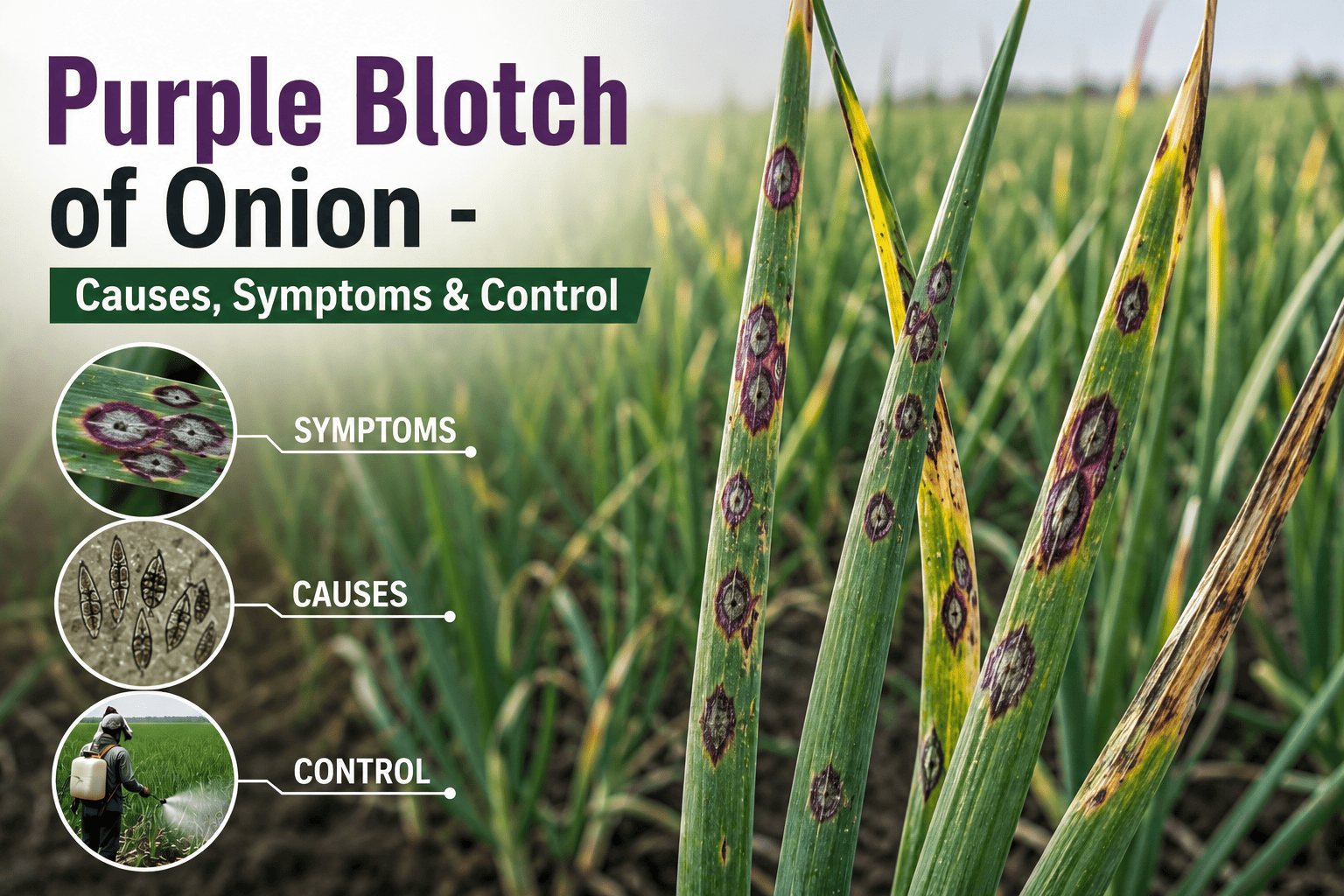
Purple Blotch of Onion - Causes, Symptoms & Control
Purple blotch is one of the most common fungal diseases in onion farming. It mainly attacks onion leaves and reduces the plant's ability to produce healthy bulbs. If the purple blotch of onion is not identified and managed at the right time, it can cause heavy yield losses, poor bulb quality, and lower storage life.
The disease spreads quickly in warm, humid weather, especially when onion leaves remain wet for extended periods. Farmers can reduce damage by identifying symptoms early and by following proper field management and applying timely fungicide sprays.
What is the Purple Blotch Disease in Onions?
Purple blotch is a serious fungal disease of onion caused by Alternaria porri. It spreads quickly during the monsoon and kharif seasons when the weather is warm and humid. High humidity (above 85%), frequent rainfall, and temperatures between 20°C and 25°C create ideal conditions for the fungus. The disease spreads from one plant to another through wind and rainwater.
Causes of Purple Blotch of Onion
Purple blotch spreads easily when weather conditions are favourable, and the fungus finds a way to enter the plant.
Favourable Weather Conditions
- Warm and humid weather helps the fungus grow quickly.
- Continuous rainfall, heavy dew, and high humidity keep onion leaves wet for a long time.
- Wet leaves allow fungal spores to germinate and infect the plant easily.
Damage to Leaves
- The fungus enters the plant through small wounds on the leaves.
- Damage caused by thrips, hailstorms, or other diseases creates openings for the fungus.
- Onion plants with damaged leaves are more likely to get infected.
Infected Soil and Crop Residue
- The fungus can survive in infected onion leaves, plant debris, and the upper layer of the soil after harvest.
- If infected crop residue is left in the field, it becomes a source of infection for the next onion crop.
Susceptible Onion Varieties
- Some onion varieties are more sensitive to purple blotch than others.
- Commonly grown short-day onion varieties, such as Bhima Super, N-2-4-1, and many local varieties, are more prone to this disease, especially during the rainy season.
Poor Field Management
- Dense planting reduces air circulation and keeps leaves wet for longer.
- Overhead irrigation and poor drainage also increase the chances of disease development.
- Fields that are not cleaned after harvest may carry the fungus into the next season.
Symptoms of Purple Blotch Disease
Farmers should regularly inspect onion fields to detect the disease early.
- Small, round, white or light-coloured spots with purple or brown edges appear on the lower leaves.
- These spots slowly become larger and develop purple or brown rings, giving them a target or bull's-eye appearance.
- As the disease grows, the spots join together and cover a large part of the leaf.
- Infected leaves gradually turn yellow, then brown, and finally dry up completely.
- During humid or rainy weather, dark grey or brown fungal growth may appear on the infected spots.
- The infection usually starts on the lower leaves and slowly moves to the upper leaves.
- As more leaves dry, the entire plant becomes weak, and the crop looks yellow and sparse.
- Since the leaves cannot prepare enough food, onion bulbs remain small, light in weight, and have poor storage quality.
- If not controlled in time, purple blotch can reduce onion yield by 30-50% and increase bulb rotting during storage.
Disease Cycle of Purple Blotch of Onion
Purple blotch spreads quickly when weather conditions are favourable. The disease follows this cycle:
- The fungus remains alive in infected crop residue, onion plant debris, and leftover bulbs after harvest.
- During warm and humid weather, especially in the monsoon season, the fungus produces large numbers of spores.
- These spores spread from one plant to another through wind, rain splashes, irrigation water, and infected plant material.
- When onion leaves stay wet for several hours, the spores germinate and enter the plant through small wounds or natural openings in the leaves.
- Within a few days, small white spots appear on the leaves. These spots gradually become purple blotches with concentric rings.
- The new purple blotches produce more spores, which continue spreading the disease to healthy plants throughout the growing season.
Impact on Crop and Yield
Purple blotch reduces the green leaf area needed for photosynthesis.
As leaves dry early, plants cannot prepare enough food for bulb development.
This results in:
- Smaller bulb size
- Lower bulb weight
- Poor bulb quality
- Reduced storage life
- Yield losses that may exceed 40% under severe infection.
Prevention of Purple Blotch of Onion
Good farming practices can greatly reduce the chances of disease.
Cultural Practices
- Use healthy and disease-free seeds or seedlings.
- Choose disease-tolerant onion varieties whenever available.
- Maintain proper spacing between plants for better air circulation.
- Avoid applying excess nitrogen fertilizer.
- Follow crop rotation with non-onion crops for 2-3 years.
- Remove and destroy infected leaves and crop residues after harvest.
- Plough crop residue deep into the soil to reduce fungal survival.
Field and Irrigation Management
- Maintain proper drainage to avoid waterlogging.
- Prefer drip irrigation instead of overhead sprinklers.
- Avoid working in the field when leaves are wet.
- Keep the field free from weeds that increase humidity.
Control of Purple Blotch Disease
Timely identification, proper field management, and recommended fungicide sprays help control purple blotch of onion and protect crop yield and bulb quality.
Early Detection
- Inspect the crop regularly, especially after rainfall or during humid weather.
- Check older leaves carefully for early spots.
- Start control measures immediately after the first symptoms appear.
Chemical Control
- Spray the recommended fungicides as soon as symptoms appear.
- Common protective fungicides include:
Mancozeb
Chlorothalonil
Boscalid - Systemic fungicides commonly used include:
Tebuconazole
Propiconazole
Azoxystrobin - Rotate fungicides with different modes of action to avoid resistance.
- Repeat spraying every 7-14 days, depending on weather and disease pressure.
- Ensure complete coverage of both sides of the leaves.
Biological and Integrated Control
- Use neem-based products or biological products where recommended.
- Maintain balanced crop nutrition.
- Provide proper irrigation without overwatering.
- Combine cultural, biological, and chemical methods for better disease management.
Conclusion
Purple blotch of onion is a serious fungal disease that spreads quickly during warm and humid weather. If ignored, it can reduce bulb size, quality, and overall yield.
Farmers can successfully manage this disease by using healthy planting material, maintaining proper field hygiene, following crop rotation, monitoring the crop regularly, and applying recommended fungicides at the right time.
Looking for a simple solution to improve crop growth and correct micronutrient deficiencies? SV Mr. Micro-G from SV Agro Solutions is an advanced multi-micronutrient fertilizer that supplies essential micronutrients required for healthy plant growth, better flowering, fruit development, and higher yields.
Developed with Slow Release Fertilizer (SRF) Technology, it provides a steady supply of nutrients for up to 90-120 days, helping reduce nutrient loss and improve fertilizer efficiency. Its nano polymer coating prevents nutrient fixation and leaching, ensuring better nutrient availability to crops.
Frequently Asked Questions (FAQs)
1. What causes purple blotch of onion?
Purple blotch is caused by the fungus Alternaria porri, which survives in infected crop residue and spreads through wind, rain, irrigation water, and infected planting material.
2. What are the early symptoms of purple blotch in onion?
The first signs are small white or light-coloured spots on older leaves, which later become purple or brown patches with circular rings.
3. How does purple blotch spread in onion fields?
The disease spreads through fungal spores carried by wind, rain splash, irrigation water, and infected crop residue.
4. How can farmers prevent purple blotch of onion?
Farmers should use healthy seeds, maintain proper spacing, follow crop rotation, avoid excess nitrogen, remove infected plant debris, and use drip irrigation whenever possible.
5. Which fungicides are commonly used to control purple blotch?
Common fungicides include Mancozeb, Chlorothalonil, Boscalid, Tebuconazole, Propiconazole, and Azoxystrobin, used according to label instructions and local agricultural recommendations.
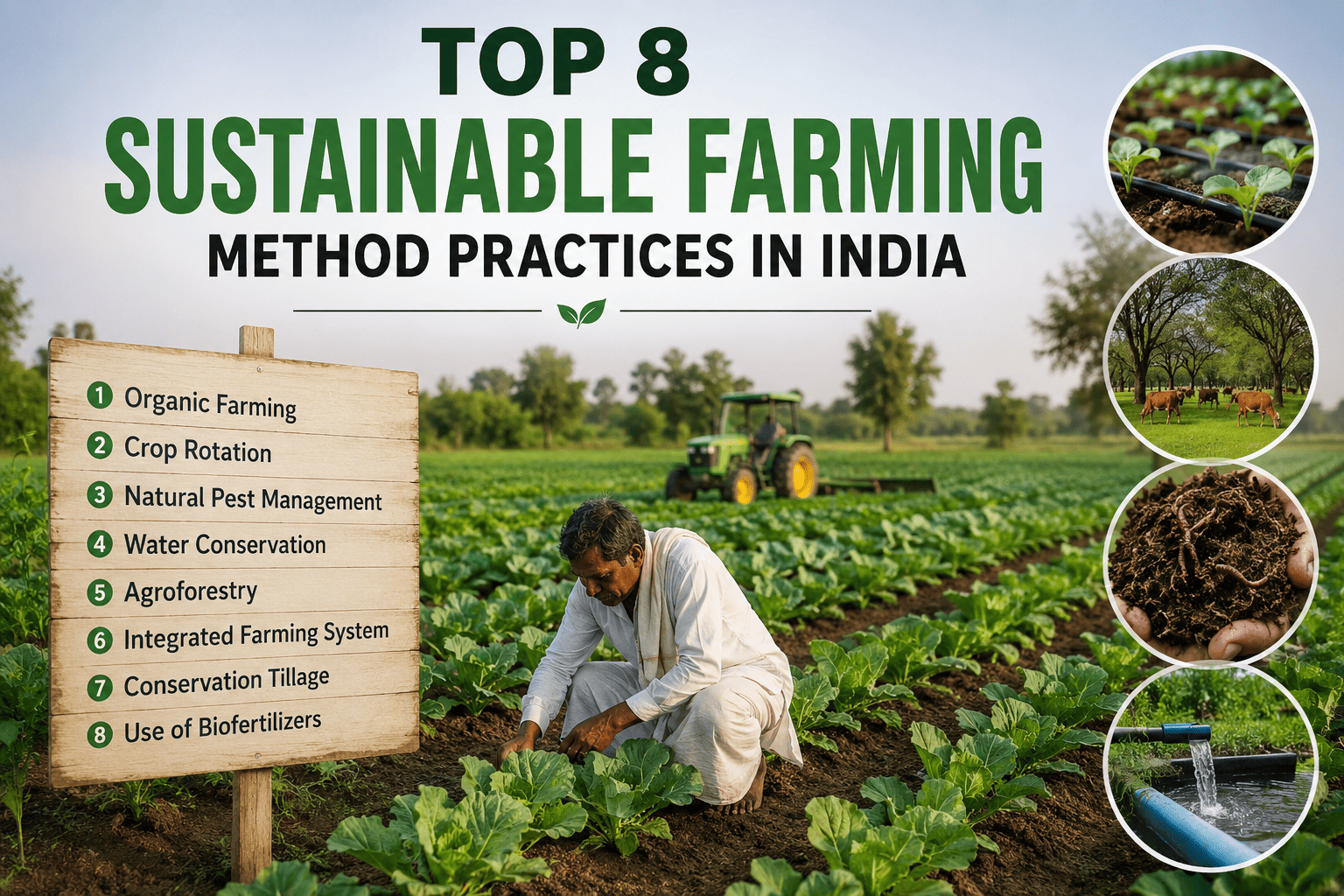
Top 8 Sustainable Farming Method Practices in India
Nowadays, Farming is not just about growing more crops. It is also about protecting soil, water, and the environment for future generations. This is where a sustainable farming method becomes very important.
A sustainable farming method means growing crops in a way that keeps the soil healthy, saves water, protects nature, and also supports the farmer’s income. It focuses on balancing high productivity today without harming the future farming system.
In recent years, more farmers are moving toward sustainable agriculture practices because of rising input costs, soil damage, water shortage, and climate change problems.
Popular Sustainable Farming Methods
A sustainable farming method is a way of farming that uses natural and smart practices to grow crops while protecting the environment. In simple words, it means farming in a way that does not harm soil, water, or air.
Zero Budget Natural Farming (ZBNF)
- This method avoids chemical fertilizers and pesticides completely.
- Farmers use natural inputs like cow dung, cow urine, jaggery, and pulse flour mixtures.
- One popular solution is Jeevamrutha, which increases helpful microorganisms in soil.
- It improves soil health and reduces farming costs over time.
Vermicomposting
- This means making compost using earthworms.
- Farm waste like leaves, vegetable scraps, and dung is converted into organic manure.
- It produces rich compost that improves soil fertility.
- It also helps soil hold more water and become more fertile naturally.
Micro-Irrigation (Drip and Sprinkler Systems)
- Water is given directly to plant roots in small amounts.
- Drip irrigation saves a lot of water compared to flood irrigation.
- It is very useful in dry and water-scarce areas.
- It also improves crop growth and reduces water wastage.
Rainwater Harvesting
- Rainwater is collected and stored for future use.
- It helps recharge underground water levels.
- Farmers can use this water during dry seasons.
- It reduces dependence on borewells and groundwater
Crop Rotation and Intercropping
- Crop rotation means growing different crops one after another in the same field.
- For example, cereals followed by pulses or oilseeds.
- This improves soil nutrients naturally, especially nitrogen.
- It also reduces pests and diseases in the soil.
- Intercropping means growing two crops together in the same field for better land use.
Mulching
- Mulching means covering soil with straw, leaves, or crop waste.
- It helps stop weed growth.
- It keeps soil moist for a longer time by reducing water evaporation.
- It also protects soil from heat and erosion.
Integrated Pest Management (IPM)
- This method controls pests using a combination of safe techniques.
- It includes natural predators, traps, organic sprays, and careful monitoring.
- Chemical pesticides are used only when absolutely necessary.
- It protects crops without harming soil, humans, and beneficial insects.
Agroforestry
- This means growing trees along with crops on the same farm.
- Trees protect crops from wind and heat.
- They prevent soil erosion and improve soil moisture.
- Farmers can earn extra income from fruits, wood, or fodder.
- It also increases biodiversity and improves farm sustainability.
Benefits of Sustainable Farming Methods
- Farmers can save money by using natural manure, crop rotation, and natural pest control methods.
- It reduces the need for expensive chemical fertilizers and pesticides.
- Overall farming costs become much lower.
- Sustainable farming increases organic matter in the soil.
- It helps soil hold more water and nutrients.
- Soil becomes more fertile and does not get damaged easily.
- Methods like agroforestry and drip irrigation protect crops from drought and irregular rainfall.
- Farms become more stable during extreme weather conditions.
- Crop loss risk is reduced.
- Less use of harmful chemicals means safer food.
- Fruits and vegetables are more natural and healthy to eat.
- It improves overall food quality for consumers.
- The Indian government supports sustainable farming practices.
- Schemes like Paramparagat Krishi Vikas Yojana (PKVY) help farmers financially.
- Farmers get training and incentives to shift towards organic and natural farming.
Challenges in Adoption
- Switching to sustainable farming needs some investment at the start.
- Farmers may need money for tools, training, or new farming systems.
- In the beginning, crop production may be reduced for a short time.
- Farmers may take time to adjust to new methods like organic farming or no-till farming.
- Many farmers do not get enough local training or guidance.
- It becomes difficult to understand new farming techniques easily.
- Unpredictable rainfall, droughts, and temperature changes affect farming.
- This makes it harder to fully depend on new methods.
- Small farmers may find it hard to adopt all changes at once.
- Limited resources make the transition slower.
Trusted Biostimulants & Organic Fertilizers for Sustainable Farming
SV Agro Solutions is a leading biostimulants manufacturer in Pune, committed to supporting farmers with high-quality solutions that improve plant health and boost agricultural productivity. As a trusted biostimulants company in Pune, we focus on developing innovative products that promote sustainable and eco-friendly farming practices.
We are also a reliable biostimulants supplier in Pune, serving local farmers as well as exporting our products to international markets. Our products are designed to meet global agricultural standards and suit different farming conditions.
For better results in sustainable farming, we also recommend using our organic fertilizers, which help improve soil health naturally, increase soil fertility, and support long-term farm productivity without harming the environment.
Conclusion
A sustainable farming method is not just a farming technique; it is a long-term solution for better agriculture. It helps farmers grow healthy crops while protecting soil, water, and the environment.
For more help with sustainable farming practices and to get the right organic solutions for your farm, contact SV Agro Solutions. Our team is here to guide you with the best biostimulants and organic fertilizers to support healthy soil, better crop yield, and long-term sustainable farming success.
FAQs
How does sustainable farming improve soil health?
It adds organic matter, reduces chemical use, and improves soil structure and microbes.
Is sustainable farming profitable for small farmers?
Yes, it reduces input costs and improves long-term productivity.
Can sustainable farming replace conventional farming completely?
It may not fully replace it immediately, but it can significantly improve farming systems when combined wisely.
1.jpg)
Major Soil Types in India for Better Farming & Crop Growth
Soil is one of the most important parts of agriculture in India. Healthy soil helps crops grow properly, improves productivity, and supports long-term farming success. India has different types of soil because of changes in climate, rainfall, temperature, landforms, rocks, and vegetation across different regions.
Understanding the major soil types in India is very important for farmers. It helps them choose the right crops, use proper fertilizers, manage irrigation effectively, and improve soil health for better crop yield.
In this blog, we will explain the classification, characteristics, and agricultural importance of the major soil types found in India in simple words.
What are Soil Types?
Soil types are different kinds of soil based on their texture, mineral content, and ability to hold water. The main types of soil are sandy, clay, silt, loam, peat, and chalky soil. Each soil type has different properties that affect water retention, crop growth, farming, and construction work.
Classification of Major Soil Types in India
India’s soils are mainly classified into the following major groups:
|
Soil Type |
Found In |
Main Characteristics |
Suitable Crops |
|
Alluvial Soil |
Punjab, Haryana, Uttar Pradesh, Bihar, West Bengal, Assam, and the river delta regions |
Most fertile soil in India, formed by river deposits, rich in potash and lime, good water retention, and easy to cultivate. |
Rice, wheat, sugarcane, cotton, maize, oilseeds |
|
Black Soil (Regur Soil) |
Maharashtra, Gujarat, Madhya Pradesh, Telangana |
Black in color, rich in lime, iron, magnesium, excellent water retention, develops cracks in summer, also called cotton soil |
Cotton, soybean, sugarcane, wheat, sunflower, tobacco |
|
Red and Yellow Soil |
Tamil Nadu, Karnataka, Andhra Pradesh, Odisha, Chhattisgarh |
Red due to iron oxide, low in nitrogen and phosphorus, and low water retention |
Millets, pulses, groundnut, tobacco, cotton |
|
Laterite Soil |
Kerala, Tamil Nadu, Odisha, Assam, Western and Eastern Ghats |
Formed in heavy rainfall areas, acidic, low-fertility soils, nutrients are washed away by leaching |
Tea, coffee, rubber, cashew, coconut, tapioca |
|
Arid and Desert Soil |
Rajasthan, Gujarat, Western Punjab |
Sandy texture, low moisture, low organic matter, high salt content, less fertile |
Bajra, barley, pulses, fodder crops |
|
Forest and Mountain Soil |
Himalayan regions, Western Ghats, Eastern Ghats |
Rich in organic matter, fertility depends on altitude and climate, suitable for plantation crops |
Tea, coffee, spices, apples, oranges |
|
Saline and Alkaline Soil |
Rajasthan, Haryana, Punjab, Gujarat, Maharashtra |
High salt and sodium content, poor fertility, affects root growth, needs gypsum treatment, and drainage improvement |
Salt-tolerant crops |
|
Peaty and Marshy Soil |
West Bengal, Odisha, Kerala, Tamil Nadu |
High moisture and organic matter, dark black color, acidic, and heavy texture |
Rice, jute, water-loving crops |
1. Alluvial Soil
- Alluvial soil is the most common and fertile soil in India. It covers the largest part of the agricultural land in the country.
- It is mainly formed by the deposition of sand, silt, and clay carried by rivers over many years.
- Found in the Indo-Gangetic-Brahmaputra plains, including states like Punjab, Haryana, Uttar Pradesh, Bihar, West Bengal, and Assam.
- It is also found in river delta areas such as Godavari, Krishna, and Kaveri.
- This soil is rich in potash, lime, and phosphoric acid, which makes it highly productive for farming.
- It has a good moisture-holding capacity and is easy to cultivate.
- There are two types:
- Khadar - New alluvial soil, very fertile
- Bhangar - Old alluvial soil, slightly less fertile
- Suitable crops: Rice, wheat, sugarcane, cotton, maize, and oilseeds.
2. Black Soil (Regur Soil)
- Black soil is also called Regur soil or Black Cotton Soil because it is highly suitable for cotton cultivation.
- It is mainly found in Maharashtra, Gujarat, Madhya Pradesh, and Telangana.
- This soil is black in color due to the presence of iron and organic compounds.
- It contains high amounts of lime, magnesium, iron, and alumina.
- Its biggest feature is its excellent water retention capacity, which helps crops survive during dry periods.
- During summer, it develops deep cracks that improve soil aeration.
- Suitable crops: Cotton, soybean, sugarcane, wheat, sunflower, and tobacco.
3. Red and Yellow Soil
- Red and yellow soil is commonly found in Tamil Nadu, Karnataka, Andhra Pradesh, Odisha, Chhattisgarh, and parts of Maharashtra.
- It develops from crystalline igneous rocks.
- The red color comes from iron oxide, while the yellow color appears due to the hydration of iron.
- This soil is usually poor in nitrogen, phosphorus, and humus, so it needs proper fertilization.
- It has a low water-holding capacity compared to black soil.
- Suitable crops: Millets, pulses, groundnut, tobacco, and cotton.
4. Laterite Soil
- Laterite soil is formed in areas with high temperatures and heavy rainfall.
- It is mainly found in the Western Ghats, Eastern Ghats, Kerala, Tamil Nadu, Odisha, and Assam.
- Heavy rainfall washes away nutrients from the soil through a process called leaching.
- This makes the soil acidic and low in fertility.
- It requires organic manure and balanced fertilizers for better productivity.
- Suitable crops: Tea, coffee, rubber, cashew, coconut, and tapioca.
5. Arid and Desert Soil
- This soil is found in dry regions such as Rajasthan, Gujarat, and western Punjab.
- It has a sandy and loose texture.
- It contains very little moisture and organic matter.
- High salt content makes it less fertile for farming.
- With proper irrigation and soil management, farmers can grow crops successfully.
- Suitable crops: Bajra, barley, pulses, and fodder crops.
6. Forest and Mountain Soil
- This soil is found in hilly and mountainous regions, including the Himalayas and Western Ghats.
- Its properties change depending on height, temperature, and rainfall.
- It is rich in organic matter and humus in the upper regions.
- Lower valley areas are more fertile and suitable for farming.
- Suitable crops: Tea, coffee, spices, apples, oranges, and other fruits.
7. Saline and Alkaline Soil
- Saline and alkaline soils contain high amounts of salts and sodium.
- It is found in Rajasthan, Haryana, Punjab, Gujarat, and coastal Maharashtra.
- These soils are locally called Reh, Usar, or Kallar.
- High salt concentration reduces plant growth and affects water absorption by roots.
- These soils can be improved by:
- Applying gypsum
- Improving drainage
- Using salt-tolerant crops
- Without treatment, crop productivity remains low.
8. Peaty and Marshy Soil
- This soil is found in waterlogged and marshy areas such as West Bengal, Odisha, Tamil Nadu, and Kerala.
- It contains a large amount of organic matter and moisture.
- The soil is dark black and heavy in texture.
- It is usually acidic in nature.
- Suitable for crops that require high moisture.
- Suitable crops: Rice, jute, and other water-loving crops.
How Farmers Can Improve Soil Health?
Farmers can improve soil health by:
- Farmers can improve soil health by following simple and effective farming practices.
- Reducing excessive ploughing helps protect the natural structure of the soil and prevents soil loss.
- Growing cover crops like legumes protects the soil from erosion, adds organic matter, and improves fertility.
- Crop rotation helps maintain nutrient balance and reduces pest and disease problems.
- Adding organic matter such as compost, manure, or crop residue improves soil structure, increases water-holding capacity, and provides essential nutrients.
- Healthy soil can hold more moisture, reduce erosion, and support better root growth, which ultimately leads to higher crop yield and long-term farm productivity.
Conclusion
India has many different soil types, and each has its own strengths and limitations. Understanding the major soil types in India helps farmers select suitable crops and adopt better farming practices.
Want to boost soil health naturally? SV Agro Solutions offers SV Fruiter, a soil booster that improves soil fertility, root growth, and nutrient uptake. It makes soil loose for better aeration, improves drainage, increases useful microbes, reduces chemical fertilizer use, and helps grow healthier crops with better fruit size, sweetness, and longer shelf life.
FAQs
1. Which is the 2nd largest soil group in India?
Red soil is the second-largest soil group in India, covering around 18.5% of the country’s total land area.
2. Which is the most fertile soil in India?
Alluvial soil is considered the most fertile soil in India.
3. Which crops grow in black soil and alluvial soil?
Black soil supports cotton and soybean, while alluvial soil supports rice and wheat.
4. Why is red soil less fertile?
Red soil has low nitrogen and phosphorus content.
5. How can farmers improve poor soil types?
Farmers can improve poor soil using organic matter, balanced fertilizers, and soil conditioners.
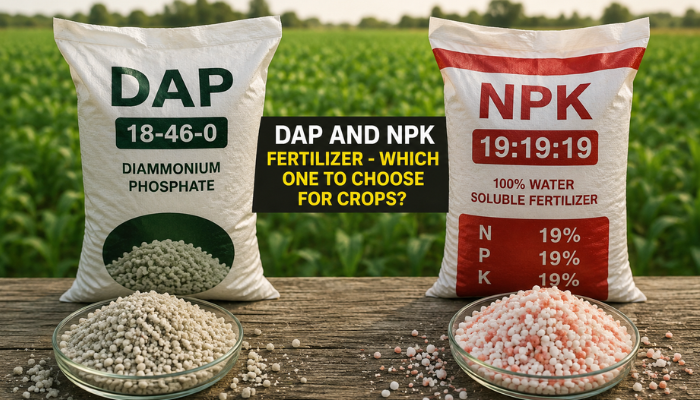
DAP and NPK Fertilizer - Which One to Choose for Crops?
Fertilizers play an important role in modern farming because they provide essential nutrients needed for healthy crop growth and higher yield. Among the most commonly used fertilizers in India are DAP (Diammonium Phosphate) and NPK fertilizer. Farmers often compare these two fertilizers before sowing or during crop growth to decide which one is better for their crops.
Choosing the right fertilizer depends on several factors, such as crop stage, soil nutrient condition, crop type, and yield goals. Using the correct fertilizer at the right time helps improve crop growth, nutrient efficiency, and overall farm productivity.
In this guide, we will explain the difference between DAP and NPK fertilizer, their uses, benefits, and how farmers can choose the right one for better crop production.
What is DAP Fertilizer?
DAP (Diammonium Phosphate) is one of the most commonly used phosphorus fertilizers in farming. It contains 18% nitrogen and 46% phosphorus, which are important nutrients for healthy crop growth.
Farmers mainly use DAP during the early stage of crop growth because it helps in strong root development, better seed germination, and faster plant establishment. It gives young plants a strong start, helps roots absorb nutrients more effectively, and supports healthy overall crop growth.
What is NPK Fertilizer?
NPK fertilizer is a fertilizer that contains three important nutrients needed for healthy plant growth: Nitrogen (N), Phosphorus (P), and Potassium (K). These nutrients help plants grow strong roots, healthy green leaves, better flowers, and higher-quality fruits.
NPK fertilizer is widely used in farming because it provides balanced nutrition to crops, improves overall plant development, increases crop yield, and helps replace important nutrients in the soil that are used up during farming.
Difference Between DAP and NPK Fertilizer
DAP mainly focuses on phosphorus supply, while NPK provides balanced nutrition throughout the crop cycle.
|
Feature |
DAP Fertilizer |
NPK Fertilizer |
|
Nutrients |
Contains high phosphorus and moderate nitrogen |
Contains balanced nitrogen, phosphorus, and potassium |
|
Best Used For |
Mainly used during the sowing stage for early crop growth |
Used from vegetative growth to flowering and fruiting stages |
|
Suitable Soil Type |
Works best in neutral and alkaline soils |
Suitable for almost all soil types |
|
Nutrient Release |
Releases nutrients quickly for immediate root development |
Provides moderate or controlled nutrient release for continuous growth |
|
Main Benefit |
Improves root growth, seed germination, and early plant establishment |
Improves overall plant growth, flowering, fruit development, and final yield |
|
Cost |
Usually slightly higher due to high phosphorus content |
Generally moderate depending on grade and nutrient ratio |
|
Versatility |
Limited because it does not contain potassium |
Highly versatile because different grades are available for different crop needs |
DAP and NPK Fertilizer Uses
DAP and NPK fertilizers are widely used to provide essential nutrients that support strong root development, healthy plant growth, better flowering, and higher crop yield.
DAP Uses
- Seed Starter: DAP provides important nutrients during the early growth stage and helps develop strong and healthy roots.
- Basal Application: Farmers usually mix DAP into the soil before sowing or planting to provide phosphorus for better crop establishment.
- Foliar Spray and Fertigation: Water-soluble DAP can be applied through leaf spray or irrigation systems for quick nutrient absorption.
- Suitable for Many Crops: DAP is widely used for crops like wheat, rice, maize, pulses, sugarcane, vegetables, and fruit crops to support healthy early growth.
NPK Uses
- Nitrogen (N): Helps plants grow healthy green leaves and strong stems. It also supports chlorophyll production, which helps plants prepare food through photosynthesis.
- Phosphorus (P): Helps in strong root development and supports better flowering, fruit formation, and seed development.
- Potassium (K): Improves overall plant strength, increases disease and drought resistance, and helps plants absorb and move water and nutrients properly.
Which is Better, DAP or NPK?
- Both fertilizers are useful, but the right choice depends on the crop growth stage and soil nutrient needs.
- Use DAP during sowing or planting time because it helps in strong root development and better early plant growth.
- Use NPK during the vegetative, flowering, and fruiting stages for balanced nutrition and better crop development.
- DAP is best for: Seed sowing, planting, and early crop establishment.
- NPK is best for: Leaf growth, flowering, fruit development, and improving final yield.
- For best results, farmers can use both:
Apply DAP at sowing to build strong roots, then apply NPK during later growth stages to provide complete and balanced nutrition for healthy crop growth and higher production
Conclusion
DAP and NPK fertilizers are both essential for successful farming, but they serve different purposes. DAP is best for early root development and crop establishment, while NPK is ideal for balanced nutrition throughout the crop cycle.
Looking for a trusted fertilizer company in Pune for better crop growth and higher productivity?
SV Agro Solutions is a leading fertilizer company in Pune offering high-quality fertilizers for farmers and agricultural businesses. As a trusted fertilizer manufacturer and supplier in Pune, we provide innovative agricultural solutions that help improve soil health, crop quality, and overall farm productivity. We are committed to supporting local farmers with reliable products while also supplying our fertilizers to international markets.
Frequently Asked Questions
1. What is the golden ratio for fertilizer?
The golden ratio for fertilizer is often NPK 20:10:10, which provides balanced nutrients for healthy crop growth and better yield.
2. What is the best time to apply DAP fertilizer?
DAP is best applied before or during sowing to support strong root growth and early plant development.
3. What plants benefit most from DAP?
DAP is useful for cereals, pulses, vegetables, fruit crops, and flowering plants for better early growth.
4. Can we spray NPK on leaves?
Yes, NPK can be sprayed on leaves as a foliar spray for quick nutrient absorption and faster plant response.
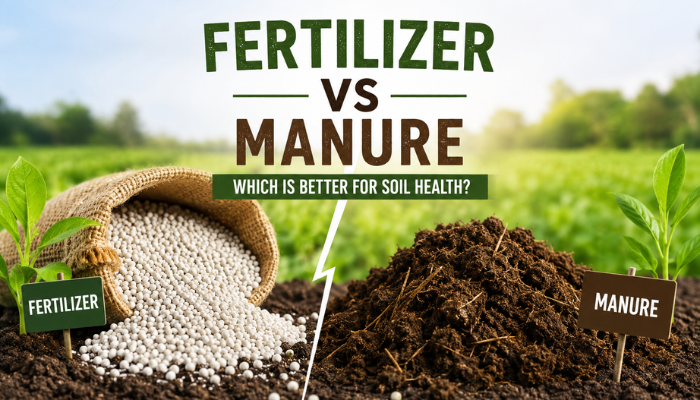
Fertilizer vs Manure - Which is Better for Soil Health?
Farmers often compare fertilizer vs manure before applying nutrients to their crops. Both are important for healthy crop growth and better yield, but they work in different ways.
Some farmers prefer fertilizers because they provide nutrients quickly and help crops grow faster. Others choose manure because it improves soil fertility naturally and supports long-term soil health.
The simple difference is that fertilizer gives quick nutrition to crops, while manure improves soil quality over time.
What is Manure?
Manure is a natural organic material used to improve soil fertility. It is made from animal waste, plant waste, and other decomposed organic matter. Farmers add manure to the soil to provide nutrients, improve soil structure, increase water-holding capacity, and support healthy crop growth.
Common examples of manure include:
- Cow dung manure
- Poultry manure
- Compost
- Green manure
- Vermicompost
What is Fertilizer?
A fertilizer is a natural or chemical material added to soil or plants to provide essential nutrients for healthy growth. It helps replace nutrients used by crops, improves plant health, increases crop yield, and supports better food production.
Fertilizers are usually manufactured products designed to supply specific nutrients like:
- Nitrogen (N)
- Phosphorus (P)
- Potassium (K)
These nutrients help crops grow faster and produce better yields.
Fertilizer vs Manure in Farming
Both manure and fertilizer help crops grow, but there are important differences.
|
Feature |
Manure |
Fertilizer |
|
Source |
Natural material made from animal dung, plant waste, and organic matter |
Chemical or factory-made nutrient products |
|
Nutrient Content |
Contains low but balanced nutrients that improve overall soil fertility |
Contains high amounts of specific nutrients like Nitrogen, Phosphorus, and Potassium |
|
Effect on Soil Health |
Improves soil structure, adds humus, and supports useful soil microbes |
Mainly provides nutrients to crops but does not improve soil structure |
|
Water Holding Capacity |
Helps soil hold more water for a longer time |
Does not improve water-holding capacity |
|
Nutrient Release Speed |
Releases nutrients slowly over time |
Provides nutrients quickly for fast crop growth |
|
Plant Absorption |
Nutrients are absorbed slowly by plants |
Nutrients are easily and quickly absorbed by plants |
|
Environmental Impact |
Eco-friendly and helps recycle natural waste |
Overuse can harm soil and pollute water sources |
|
Long-Term Effect |
Improves soil fertility for the long term |
Excessive use may reduce soil quality over time |
|
Cost |
Usually cheaper but needed in large quantity |
Usually costlier but needed in smaller quantity |
|
Best Use |
Best for improving soil health and long-term farming |
Best for quick crop growth and immediate nutrient supply |
Which is Better - Fertilizer or Manure?
There is no single answer to fertilizer vs manure because both are useful.
- Manure is better for long-term soil health because it improves soil fertility, increases organic matter, and makes the soil stronger over time.
- Fertilizer is better for quick plant growth because it gives nutrients to crops immediately and helps plants grow faster.
- Choose manure if you want to improve soil structure, water-holding capacity, and support healthy farming for many years.
- Choose fertilizer if your crops need a quick nutrient boost to correct nutrient deficiency and improve growth fast.
- The best option is to use both together for balanced crop nutrition, better soil health, and higher yield.
How Can Farmers Use Both Smartly?
- Check your soil to know which nutrients are missing and understand soil pH.
- Test manure to know how much Nitrogen, Phosphorus, and Potassium it contains.
- This helps farmers apply the right amount of fertilizer.
- Use manure before sowing so it gets mixed well into the soil and improves soil quality.
- Use fertilizer during crop growth when plants need quick nutrients for fast development.
- Manure already provides some nutrients slowly.
- Farmers can reduce chemical fertilizer use when manure is applied.
- This saves money and protects soil health.
- Mix manure properly into the soil after applying to avoid nutrient loss.
- Apply fertilizers close to plant roots so crops can absorb nutrients easily.
- Farmers can check recommendations from the Indian Council of Agricultural Research (ICAR) or local Krishi Vigyan Kendra (KVK) for correct fertilizer and manure use based on soil and crop type.
Common Mistakes to Avoid
Farmers should avoid these common mistakes:
- Using too much can increase salt levels in the soil, damage plant roots, and reduce crop growth. It can also pollute nearby water sources.
- Fresh manure may contain harmful bacteria, too much heat, and high ammonia, which can burn plant roots. Always use well-decomposed manure.
- Using both in large amounts at the same time can create excess salts in the soil and damage young plants.
- Applying nutrients without checking soil conditions can create a nutrient imbalance and reduce plant nutrient absorption.
- Manure already contains nutrients, so reduce fertilizer quantity accordingly to avoid overloading the soil.
- Raw organic matter can temporarily reduce nitrogen availability, which may cause yellow leaves and slow crop growth.
- On dry soil, nutrients may not dissolve properly.
- During heavy rain, nutrients can wash away, causing product loss.
Conclusion
The comparison of fertilizer vs manure shows that both have different roles in farming. Manure improves soil structure, increases organic matter, and supports long-term fertility. Fertilizer supplies nutrients quickly and helps improve crop growth and yield. For best results, farmers should combine both for balanced nutrition and healthier soil.
Looking for trusted crop nutrition solutions? SV Agro Solutions offers high-quality fertilizers, organic inputs, soil conditioners, and sustainable farming products that help improve soil health, boost crop growth, and increase farm productivity.
FAQs
1. Can I mix NPK and DAP?
Yes, NPK and DAP can be used together to support strong roots and balanced crop growth.
2. Is fertilizer the same as manure?
No, manure is natural organic matter, while fertilizer gives specific nutrients to plants.
3. Which fertilizer makes plants grow faster?
Nitrogen-rich fertilizers help plants grow faster by promoting green leaf growth.
4. What is the most effective organic fertilizer?
Compost and well-rotted manure are the best organic fertilizers for improving soil health and crop growth.
Which Organic Farming Fertilizers Are Best for Soil Health?
Modern farming is changing as more farmers focus on improving soil health naturally. Continuous use of chemical fertilizers can reduce soil fertility, damage beneficial microbes, and lower long-term productivity. Because of this, many farmers are now using organic farming fertilizers to keep the soil healthy and productive.
Organic fertilizers are natural nutrient sources made from plant, animal, or mineral materials. They help improve soil fertility, soil structure, water-holding capacity, and soil biology over time. Unlike chemical fertilizers, they not only feed crops but also improve the overall health of the soil.
In this guide, we’ll compare the best organic farming fertilizers and explain how to choose the right one for healthier soil and better crop yields.
What are Organic Farming Fertilizers?
Organic farming fertilizers are natural substances used to improve soil fertility and support plant growth. These fertilizers are made from plant waste, animal waste, beneficial microbes, or natural minerals.
They help provide nutrients slowly while improving soil health naturally. Organic fertilizers feed both plants and soil, making them important for sustainable farming.
Why Soil Health Improves with Organic Inputs?
Organic fertilizers improve soil structure and increase humus content in the soil. They help soil become loose and fertile, allowing roots to grow deeper and absorb nutrients better.
They also increase microbial activity, improve moisture retention, and support long-term soil productivity.
Best Organic Fertilizers for Soil Health
Improve your soil naturally with the best organic fertilizers that increase fertility, improve plant growth, and support long-term soil health.
Compost
Compost is one of the best organic fertilizers for improving soil health. It is made from decomposed plant waste, kitchen waste, leaves, and crop residues.
Benefits of compost:
- Improves soil texture
- Increases moisture retention
- Supports beneficial microbes
- Improves root growth
- Reduces soil erosion
Vermicompost
Vermicompost is prepared using earthworms that convert organic waste into nutrient-rich compost.
Benefits of vermicompost:
- Rich in nutrients and beneficial microbes
- Improves soil fertility naturally
- Increases plant growth
- Improves soil aeration
- Helps increase crop yield and quality
Farmyard Manure (FYM)
Farmyard manure is made from cow dung, urine, bedding material, and farm waste.
Benefits of FYM:
- Adds organic matter to the soil
- Improves long-term soil fertility
- Enhances water-holding capacity
- Improves microbial activity
- Supports healthy plant growth
Neem Cake
Neem cake is made from neem seed residue after oil extraction.
Benefits of neem cake:
- Improves soil fertility
- Supports root zone health
- Helps reduce harmful soil pests
- Improves nitrogen efficiency
- Supports eco-friendly farming
Bone Meal
Bone meal is an organic fertilizer rich in phosphorus and calcium.
Benefits of bone meal:
- Supports strong root development
- Improves flowering and fruiting
- Helps seed and fruit formation
- Useful for vegetable and fruit crops
Seaweed Extract
Seaweed extract is a natural plant-based supplement used in organic farming.
Benefits of seaweed extract:
- Improves crop stress tolerance
- Enhances nutrient absorption
- Supports root and shoot growth
- Improves plant vitality
Biofertilizers
Biofertilizers contain beneficial microorganisms like Azospirillum, Rhizobium, Azotobacter, and phosphate-solubilizing bacteria that naturally improve nutrient availability and soil fertility.
Benefits:
- Improve soil microbial activity
- Increase nutrient uptake
- Improve soil fertility naturally
- Reduce dependence on chemical fertilizers
Types of Organic Fertilizers
Organic fertilizers come in various types, including compost, manure, bone meal, seaweed, and biofertilizers, each helping improve soil fertility and plant growth naturally.
Plant-Based Fertilizers
Plant-based fertilizers are made from natural plant materials like compost, leaf mold, crop residues, seaweed products, and plant meals that help improve soil fertility and organic matter naturally.
Animal-Based Fertilizers
Animal-based fertilizers are prepared from animal waste and by-products like farmyard manure, poultry manure, bone meal, and blood meal that provide essential nutrients for healthy crop growth.
Mineral Amendments
Mineral amendments are natural mineral sources like rock phosphate, rock dust, lime minerals, and gypsum that help restore trace nutrients and improve soil quality.
How Organic Fertilizers Improve Soil Health?
Organic fertilizers improve soil health by enriching the soil with natural nutrients, enhancing microbial activity, and improving soil structure for long-term crop productivity.
Boosts Microbial Activity
Organic fertilizers increase useful microbes like bacteria, fungi, and earthworms in the soil. These microbes help break down nutrients and improve soil health naturally.
Enhances Soil Structure
They improve soil structure by making the soil loose and well-aerated. This helps plant roots grow deeper and absorb water and nutrients more easily.
Improves Water Retention
Organic matter helps soil hold moisture for a longer time, reducing water stress and lowering the need for frequent irrigation during dry conditions.
Provides Slow, Steady Nutrient Release
Organic fertilizers release nutrients slowly and steadily, providing long-term nourishment to crops without damaging plants or causing nutrient loss.
Balances Soil pH and Prevents Erosion
They help maintain balanced soil pH levels and reduce soil erosion by improving soil strength and preventing topsoil from washing or blowing away.
Best Organic Fertilizer for Soil Health
Improve your crop growth with Mr. Micro - G from SV Agro, an advanced micronutrient solution developed using India’s first SRF (Slow Release Fertilizer) Technology for long-lasting and effective plant nutrition.
Why Choose Mr. Micro - G?
- Developed with advanced Slow Release Fertilizer Technology for gradual and efficient nutrient availability.
- Suitable for all types of crops and farming conditions.
- Prevents nutrient loss through leaching, ensuring better nutrient retention in the soil.
- Its unique nano polymer coating prevents nutrient fixation with other soil elements.
- Provides crops with a controlled nutrient supply for 90 to 120 days during critical growth stages.
- Performs effectively in different soil types and varying soil pH conditions.
- Supports healthy crop development without causing any harmful effects on soil health or soil properties.
Choose Mr. Micro - G by SV Agro for smarter farming, healthier soil, and better yields.
Conclusion
Organic farming fertilizers play an important role in improving soil biology, soil structure, and nutrient balance naturally. They help farmers maintain long-term soil fertility while supporting healthy crop growth and sustainable farming.
The best organic fertilizer depends on soil condition, crop requirement, and farming goals. Farmers should combine soil testing, proper fertilizer selection, composting practices, and balanced nutrient management to build healthier soil and achieve better long-term yields.
Frequently Asked Questions
1. What are Organic Farming Fertilizers?
Organic farming fertilizers are natural fertilizers made from plant, animal, or mineral sources that improve soil fertility and crop growth.
2. Which organic fertilizer is best for soil health?
Compost and vermicompost are considered among the best fertilizers for improving overall soil health.
3. Is vermicompost better than compost?
Vermicompost is usually richer in nutrients and beneficial microbes, but both are useful for soil improvement.
4. Can organic fertilizers replace chemical fertilizers completely?
Yes, with proper nutrient management and soil care, organic fertilizers can reduce or replace chemical fertilizer use over time.
5. How often should organic fertilizers be applied?
Application depends on crop type and soil condition, but regular seasonal use gives better results.
6. Do biofertilizers improve soil health?
Yes, biofertilizers increase beneficial microbial activity and improve nutrient availability naturally.
Plant Growth Promoters for Crops - Types, Benefits & Uses
Modern farming is not only about using fertilizers and pesticides. Today, farmers also focus on improving plant growth, crop quality, and stress resistance naturally. This is where plant growth promoters play an important role in agriculture.
Plant growth promoters are natural or chemical substances that help improve plant growth, root development, flowering, fruit setting, nutrient absorption, and stress tolerance. They do not directly work like fertilizers, which provide nutrients, but they help plants use nutrients more efficiently and grow healthier.
The use of plant growth promoters is increasing in modern farming because they help improve crop productivity, reduce stress damage, and support better-quality harvests. They are widely used in cereals, vegetables, fruits, pulses, plantation crops, and commercial farming systems.
What is a Plant Growth Promoter?
A plant growth promoter (PGP) is a biological or chemical substance that stimulates plant growth and improves plant functions naturally. These products help plants absorb nutrients better, develop stronger roots, tolerate stress conditions, and increase crop yield.
Plant growth promoters may contain:
- Plant hormones
- Beneficial microbes
- Amino acids
- Seaweed extracts
- Humic substances
- Organic stimulants
Types of Plant Growth Promoters
Plant growth promoters include auxins, gibberellins, cytokinins, bio-based stimulants, and beneficial microbes that help improve plant growth, root development, flowering, and crop productivity naturally.
Auxins (IAA, NAA)
- Auxins are plant hormones that help plants develop strong and healthy roots.
- They improve cell elongation, support early plant growth, and help flowers develop into fruits properly.
- These promoters are commonly used during seedling growth, rooting, and fruit setting stages.
Gibberellins (GA₃, GA₄/₇)
- Gibberellins help increase plant height and improve stem growth.
- They are widely used in crops like sugarcane, grapes, and vegetables to improve size, growth, and yield.
- These hormones also help improve seed germination, flowering, and fruit development.
Cytokinins (Kinetin)
- Cytokinins promote cell division and encourage better branching and shoot growth.
- They help plants stay green for a longer time by slowing leaf and fruit aging.
- These growth promoters are useful for improving crop quality and overall plant health.
Bio-based Promoters
- These are natural plant growth promoters made from seaweed extracts, amino acids, humic acids, and other organic materials.
- They improve nutrient absorption, stimulate plant metabolism, increase stress tolerance, and support healthy crop growth naturally.
Plant Growth-Promoting Rhizobacteria (PGPR)
- PGPR are beneficial soil bacteria that improve nutrient uptake and root development.
- They help plants absorb nutrients more efficiently and increase resistance against drought, salinity, heat, and other stress conditions.
- They also improve soil microbial activity and overall soil health.
How Plant Growth Promoters Work
- Plant growth promoters (PGPs) help plants grow faster, healthier, and stronger by improving natural plant processes.
- They support important activities like cell division, root development, nutrient absorption, and photosynthesis, which help plants produce more energy for growth.
- These products improve root strength, flowering, fruit setting, and overall crop quality.
- They also help plants tolerate stress conditions such as drought, heat, salinity, and water shortage.
- Some plant growth promoters work like natural plant hormones, such as auxins, gibberellins, and cytokinins, which control plant growth and development.
- Others act as biostimulants that increase plant metabolism and improve nutrient efficiency.
- Regular and proper use of plant growth promoters can help farmers achieve better crop yield, healthier plants, and improved produce quality.
Benefits of Plant Growth Promoters for Farmers
- Plant growth promoters help plants grow healthier, resulting in bigger fruits, better crop quality, and higher production.
- They encourage deeper and stronger roots, helping plants absorb water and nutrients more effectively. This also improves fertilizer efficiency.
- Plant growth promoters help crops survive drought, high temperature, salinity, and other difficult environmental conditions.
- They increase plant growth speed and help crops mature earlier, allowing farmers to harvest sooner.
- These products reduce flower and fruit dropping, helping plants produce more fruits and a better yield.
- Plant growth promoters improve photosynthesis and plant metabolism, making crops stronger and healthier.
- Many plant growth promoters are made from natural ingredients like seaweed and plant extracts, making them eco-friendly and safer for the environment.
How to Choose the Right Plant Growth Promoter?
- Select plant growth promoters based on crop stage and farming goals for better growth and higher productivity.
- Auxin-based products help develop strong and healthy roots, improving water and nutrient absorption.
- Gibberellin-based products improve plant height, stem growth, and overall crop development.
- Cytokinin-based products help increase flowering, reduce flower and fruit drop, and improve fruit quality. Products like SV Cofez by SV Agro Solutions provide important nutrients during flowering, and help improve crop greenery and shine quickly.
- Stress-control promoters help crops tolerate drought, heat, salinity, insects, and diseases more effectively.
- Seedling stage for root growth
- Pre-flowering stage for better flowering
- Fruit-setting stage for improved fruit size and retention
- Always check compatibility with fertilizers and pesticides.
- EcoCert-certified organic products like SV Cofez can be used for both foliar spray and soil application while helping reduce nutrient deficiency symptoms naturally.
Conclusion
Plant growth promoters are becoming important tools in modern agriculture because they help improve plant health, crop yield, nutrient efficiency, and stress tolerance. They support better farming productivity without depending only on chemical inputs.
However, farmers should use plant growth promoters along with proper nutrient management, irrigation, and pest control practices for the best results.
Looking for trusted agricultural solutions for better crop growth and soil health? Choose high-quality biostimulants, fertilizers, and micronutrients from a trusted agriculture company like SV Agro Solutions to support sustainable and profitable farming.
FAQs
1. Which PGR promotes root growth?
Auxins and Ethylene are commonly used plant growth regulators that help improve root growth and development.
2. Which PGR increases fruit size?
Gibberellins help improve fruit size, stem growth, and overall fruit development.
3. How to use PGR and regular fertilizer together?
PGRs can be mixed with compatible low-salt fertilizers and applied together as recommended.
4. Can we spray PGR in the rain?
No, PGR spray should be done on a clear and rain-free day for better effectiveness
Types & Benefits of Biofertilizers & Biopesticides in Farming
Modern farming is changing rapidly as farmers look for safer and more eco-friendly ways to improve crop production. Excessive use of chemical fertilizers and pesticides can reduce soil fertility, increase production costs, and harm the environment over time. Because of this, many farmers are now shifting towards sustainable agricultural practices.
Two important tools used in sustainable farming are biofertilizers and biopesticides. These natural agricultural inputs help improve soil health, increase plant growth, and manage pests and diseases without causing heavy environmental damage.
Biofertilizers support plant nutrition naturally, while biopesticides help protect crops from harmful insects, fungi, and diseases. Together, they help farmers grow healthy crops while maintaining long-term soil fertility and environmental balance.
What are Biofertilizers?
Biofertilizers are natural products that contain beneficial living microorganisms. These microorganisms improve nutrient availability in the soil and help plants absorb nutrients more efficiently.
They increase soil fertility naturally by fixing nitrogen, solubilizing phosphorus, and improving nutrient uptake.
What are Biopesticides?
Biopesticides are natural pest-control products made from microorganisms, plant extracts, or naturally occurring substances. They help control insects, fungi, weeds, and crop diseases in an eco-friendly way.
Unlike chemical pesticides, biopesticides are safer for humans, animals, beneficial insects, and the environment.
Types of Biofertilizers
Types of biofertilizers include Rhizobium, Azotobacter, Azospirillum, Mycorrhiza, and Blue-Green Algae, which help improve soil fertility and plant growth naturally.
Rhizobium
- Rhizobium is one of the most commonly used biofertilizers in farming.
- It works together with legume crops like soybean, gram, pea, and groundnut.
- These bacteria form nodules on plant roots and help convert atmospheric nitrogen into a form plants can use.
Azospirillum
- Azospirillum is a beneficial bacterium mainly used for cereal and millet crops.
- It has a close relationship with plant roots and supports plant growth naturally.
- Commonly used in crops like maize, sorghum, pearl millet, finger millet, and fodder grasses.
Azotobacter
- Azotobacter is a free-living soil bacterium commonly found in agricultural soil.
- It helps increase nitrogen availability in the soil naturally.
- It works best in soils rich in organic matter and compost.
Blue Green Algae (BGA)
- Blue-green algae are useful biofertilizers mainly used in paddy fields.
- They naturally fix atmospheric nitrogen and improve soil fertility in rice cultivation.
- These algae grow well in waterlogged conditions found in rice fields.
Types of Biopesticides
Types of biopesticides include microbial, botanical, viral, fungal, and biochemical biopesticides that help control pests and diseases naturally and safely.
Microbial Biopesticides
- These biopesticides use beneficial microorganisms like bacteria, fungi, viruses, and protozoa to control harmful pests and diseases naturally.
- They are eco-friendly and safer than chemical pesticides.
Bacterial Biopesticides (Bt)
- Bacillus thuringiensis (Bt) is one of the most commonly used bacterial biopesticides.
- It controls harmful insect larvae that damage crops.
- Widely used in vegetable, cotton, and fruit crops.
Fungal Biopesticides
- Fungi like Beauveria bassiana and Trichoderma help control insects and soil-borne diseases.
- They improve plant protection and reduce fungal infections naturally.
- Viral Biopesticides
- Viruses like NPV (Nucleopolyhedrovirus) are used to control caterpillars and leaf-eating pests.
- Commonly used in crops like cotton and vegetables.
Benefits of Biofertilizers
- Biofertilizers increase useful microbial activity in the soil.
- They improve soil structure, water-holding capacity, and soil health naturally.
- Beneficial microbes help convert nutrients like nitrogen and phosphorus into forms plants can easily absorb.
- This improves plant growth and reduces nutrient deficiency.
- Biofertilizers support healthy root and plant development, which helps increase crop production and quality.
- They reduce the need for chemical fertilizers, helping farmers save money on farming inputs.
- Regular use improves soil fertility naturally and keeps the land productive for many years.
Benefits of Biopesticides
- Biopesticides target harmful insects and diseases without harming useful insects like bees and pollinators.
- They break down naturally and do not leave toxic chemicals on crops, soil, or water.
- Pests are less likely to become resistant to biopesticides compared to chemical pesticides.
- Some biopesticides help plants strengthen their natural defense system against diseases.
- They are safer to handle and reduce environmental pollution.
How Farmers Can Choose the Right Product?
Farmers should select products based on crop type, soil condition, and farming requirements.
Important points to check include:
- Product quality and certification
- Expiry date and storage condition
- Reliable brand and manufacturer
- Suitable crop recommendation
- Proper nutrient or pest-control purpose
Farmers should use biofertilizers and biopesticides as part of integrated nutrient and pest management practices for better results.
Conclusion
Biofertilizers and biopesticides are becoming important tools in modern sustainable agriculture. They help improve soil fertility, support healthy plant growth, and protect crops naturally from pests and diseases.
Looking for trusted agricultural solutions for sustainable farming? SV Agro Solutions Pvt. Ltd. offers high-quality biofertilizers, organic inputs, micronutrients, and crop nutrition products that help farmers improve soil health, increase crop productivity, and promote eco-friendly agriculture.
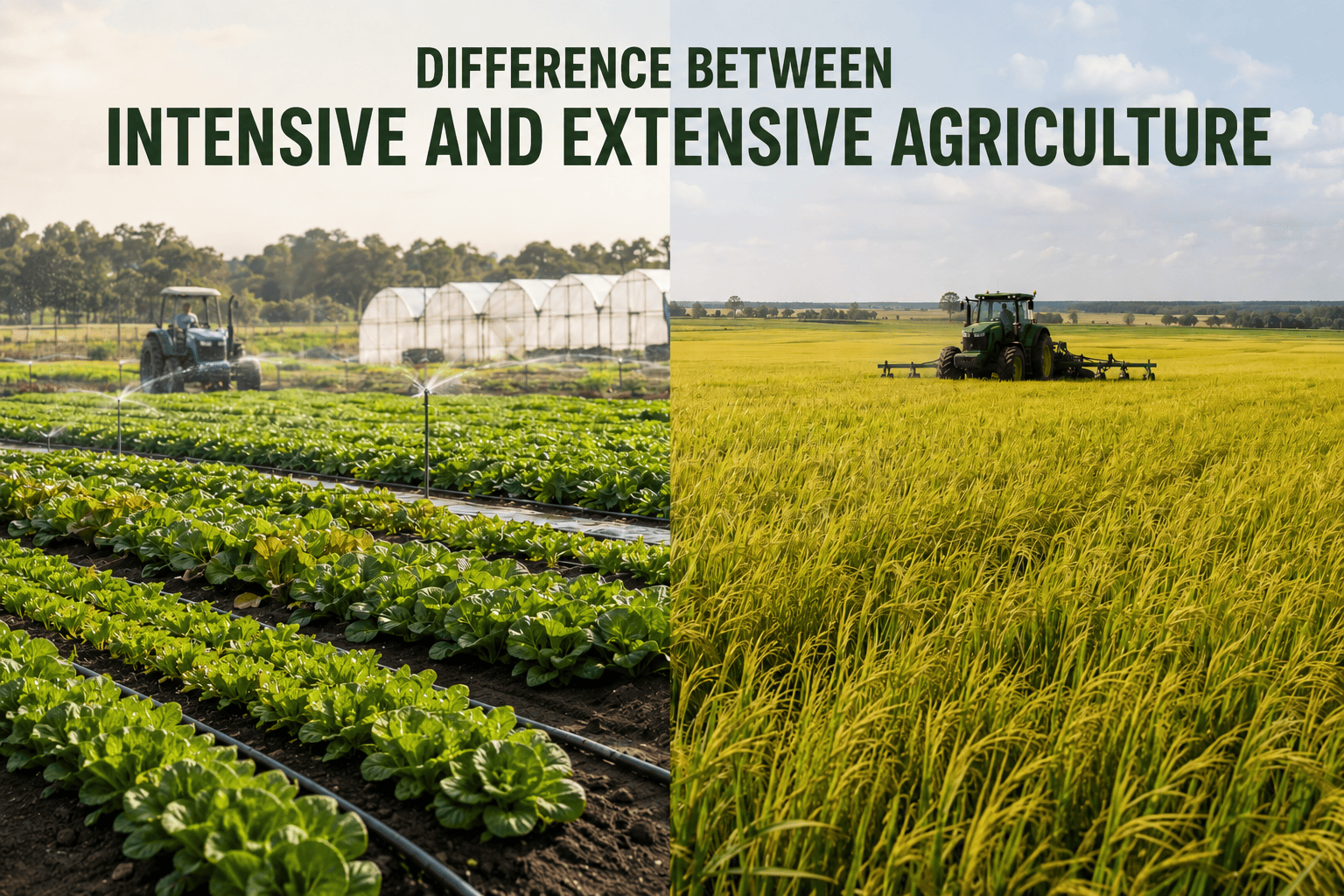
Difference Between Intensive and Extensive Agriculture
Agriculture is the practice of growing crops and raising animals to produce food, fibre, and other useful products. Farmers use different farming methods depending on land availability, climate, labour, and resources.
Two major farming systems commonly used around the world are intensive agriculture and extensive agriculture.
Intensive agriculture focuses on getting maximum production from a small area of land by using more labour, irrigation, fertilizers, machinery, and modern farming techniques. On the other hand, extensive agriculture uses large areas of land with fewer inputs and lower labour use.
What is Intensive Agriculture?
Intensive agriculture is a farming system that uses high amounts of labour, fertilizers, pesticides, irrigation, machinery, and investment to produce maximum crop or livestock yield from small land areas.
It is commonly practised in densely populated regions where food demand is high. This method helps increase production quickly, but excessive use of chemicals and resources can harm soil and the environment over time.
Intensive farming is widely used for:
- Vegetable farming
- Dairy farming
- Poultry farming
- Fruit cultivation
- High-value commercial crops
What is Extensive Agriculture?
Extensive agriculture is a farming system that uses large land areas with fewer inputs like labour, fertilizers, machinery, and investment. It gives lower crop yield per hectare compared to intensive farming, but it is more cost-effective and environmentally friendly.
This method is mostly used in areas where land is easily available and the population is low, such as large grain farms and livestock ranching.
This system is commonly used for:
- Wheat farming
- Grazing and livestock farming
- Large-scale grain production
- Pasture farming
Difference Between Intensive and Extensive Agriculture
The main difference between intensive and extensive agriculture is the amount of land and inputs used for farming. Intensive agriculture aims for higher production from smaller land areas, while extensive agriculture uses larger land with fewer inputs.
|
Basis of Difference |
Intensive Farming |
Extensive Farming |
|
Inputs Used |
Uses high inputs like fertilizers, irrigation, labour, machinery, and capital for maximum production. |
Uses fewer and low-cost inputs, mainly depending on natural rainfall and soil fertility. |
|
Land Use |
Practised on small land areas with high crop production. |
Requires large land areas with lower crop density. |
|
Crop Yield |
Gives higher yield per hectare due to modern farming methods. |
Gives lower yield per hectare but covers large farming areas. |
|
Environmental Impact |
Heavy chemical and water use can affect soil and the environment. |
More eco-friendly because it uses fewer chemicals and inputs. |
|
Location |
Common near urban and highly populated areas. |
Common in rural areas where land is easily available. |
|
Labour Requirement |
Requires more labour because crops need regular irrigation, fertilizer use, pest control, and continuous care for higher production. |
Requires less labour as farming is done on large land areas with fewer inputs and less crop management. |
|
Capital Investment |
Needs high investment in machinery, irrigation, fertilizers, improved seeds, and modern farming technology. |
Requires moderate to low investment because fewer inputs and technologies are used. |
|
Yield per Unit Area |
Produces very high yields per hectare due to better management, irrigation, and fertilizer use. |
Produces lower yield per hectare because farming depends more on natural conditions and fewer inputs. |
|
Technology Use |
Uses advanced machinery, irrigation systems, and modern farming techniques for higher productivity. |
Uses less machinery and lower technology input compared to intensive farming. |
|
Harvest Frequency |
Farmers can grow multiple crops and take more than one harvest in a year. |
Usually limited to one major harvest per year. |
|
Population Pressure |
Common in densely populated areas where land is limited, and food demand is high. |
Common in low population areas where large land is available for farming. |
|
Examples |
Vegetable farming, dairy farming, greenhouse farming, floriculture, rice farming |
Wheat farming, livestock farming, grain farming, cattle ranching |
Advantages of Intensive Agriculture
- Produces high crop and livestock yields from small land areas
- Helps lower food prices because production is done on a large scale
- Makes efficient use of limited farmland
- Supports year-round crop production with irrigation and greenhouse farming
- Helps meet the food demand of growing populations
Disadvantages of Intensive Agriculture
- Excessive use of chemicals can damage soil and pollute water
- Monocropping may reduce biodiversity and harm the environment
- Requires high investment in machinery, fertilizers, and technology
- Intensive livestock farming can affect animal welfare
- Chemical residues and pesticide exposure may create health risks for farmers and consumers
Advantages of Extensive Agriculture
- Uses fewer chemicals, which helps reduce soil and water pollution
- Requires lower investment because fewer irrigation systems and inputs are needed
- Needs less labour per hectare due to large-scale mechanized farming
- Supports biodiversity and causes less disturbance to natural ecosystems
Disadvantages of Extensive Agriculture
- Produces lower yield per hectare compared to intensive farming
- Requires very large land areas for successful farming
- Depends heavily on rainfall and weather conditions
- Profit per acre is usually lower than that of intensive farming
- Managing large farms may require costly machinery and skilled operators
Which Type of Agriculture is Better?
- Neither intensive nor extensive agriculture is best for every farmer.
- The right method depends on land size, water, labour, climate, and farming goals. Intensive agriculture increases crop yield on small land using fertilizers, irrigation, machinery, and technology, but excessive chemical use can harm soil and water over time.
- Extensive agriculture uses larger land with fewer inputs, making it more sustainable and environment-friendly, though crop yield per acre is lower.
- Today, many farmers combine both methods to improve soil productivity while protecting long-term environmental health.
Conclusion
Understanding the difference between intensive and extensive agriculture is important for modern farming. Intensive agriculture helps increase production from limited land using advanced methods, while extensive agriculture depends on large land areas with lower inputs.
Looking for a trusted agricultural company to improve crop yield and soil health? SV Agro Solutions Pvt. Ltd. is a leading manufacturer of organic agricultural inputs that helps more than 80,000 farmers across India with high-quality products designed to improve productivity, support sustainable farming, and promote healthy crop growth.
FAQs
1. What crops are grown in intensive farming?
Rice, wheat, maize, vegetables, fruits, cotton, and sugarcane are commonly grown in intensive farming.
2. What country is an example of intensive farming?
Countries like India, China, and Japan are common examples of intensive farming.
3. What are the methods of intensive farming?
Intensive farming uses machinery, irrigation, fertilizers, pesticides, and high-yield seeds for maximum production.
4. Which crops are grown in extensive farming?
Wheat, maize, barley, and pasture crops are mainly grown in extensive farming.
5. What is another name for extensive farming?
Extensive farming is also called low-input farming or large-scale farming.
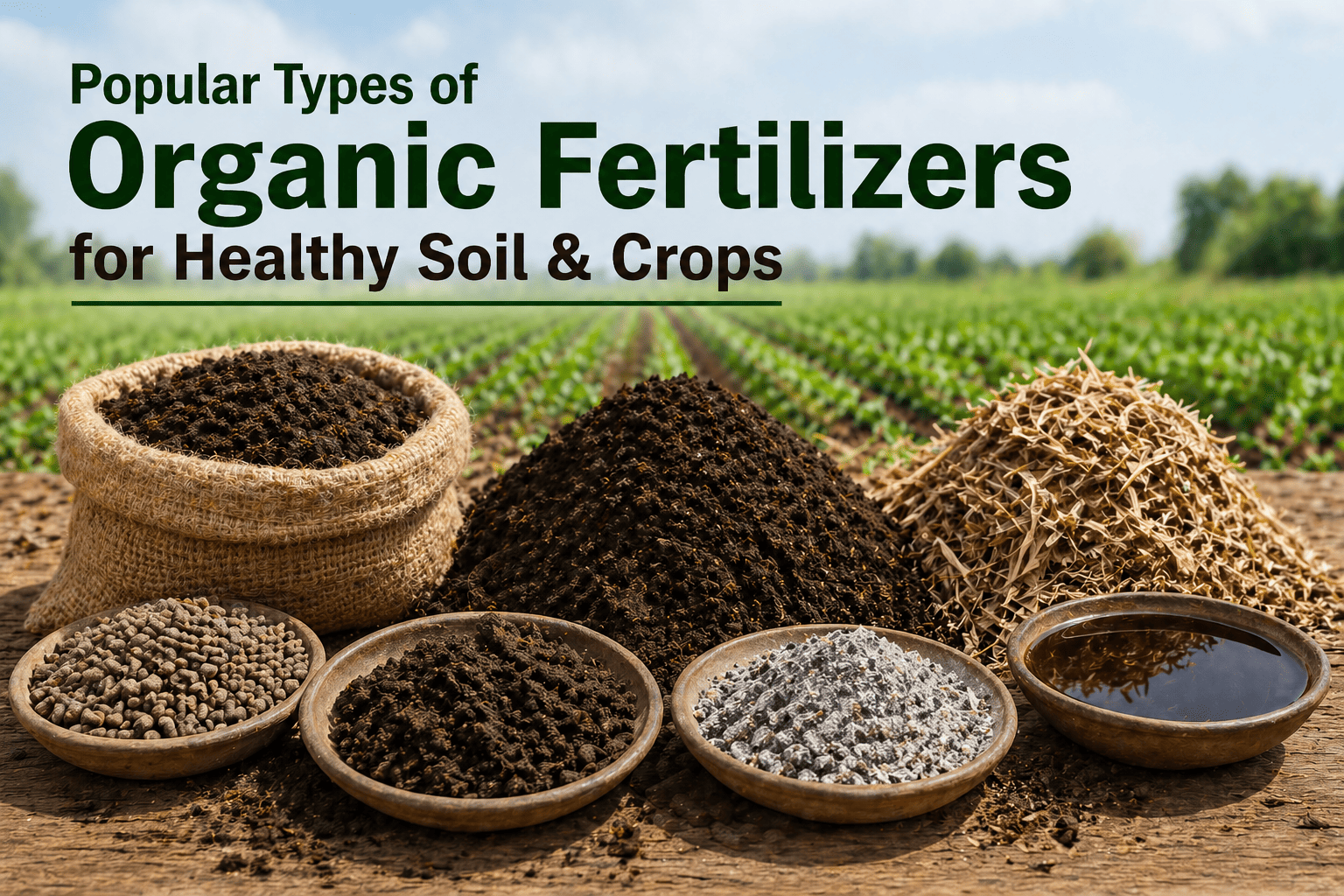
Popular Types of Organic Fertilizers for Healthy Soil & Crops
Healthy crops need proper nutrition, and one of the best natural ways to feed plants is by using organic fertilizers. Understanding the types of organic fertilizers is important for farmers because they help improve crop growth and protect soil health.
Organic fertilizers are natural sources of nutrients that support sustainable farming. They not only supply essential nutrients to plants but also improve soil fertility, increase microbial activity, and make the soil healthier over time.
There are three main types of organic fertilizers: plant-based fertilizers, animal-based fertilizers, and mineral amendments.
What are Organic Fertilizers?
Organic fertilizers are natural fertilizers made from plant or animal materials. They break down naturally in the soil and release nutrients slowly for plant use.
These fertilizers:
- Supply essential nutrients to crops
- Improve soil structure
- Support beneficial soil microbes
- Increase organic matter in soil
One major benefit of organic fertilizers is slow nutrient release. This gives plants a steady supply of nutrients over time.
Main Types of Organic Fertilizers
There are three main types of organic fertilizers: plant-based, animal-based, and mineral-based fertilizers that provide natural nutrients while improving soil fertility and plant growth.
1. Plant-Based Organic Fertilizers
Some organic fertilizers are made from plant materials and are used to provide natural nutrients to crops. They improve plant growth as well as soil health. These fertilizers break down slowly in the soil and release nutrients over time.
Compost / Leaf Mold
- Compost and leaf mold are made when leaves, food waste, and plant materials break down naturally over time.
- They improve soil by making it soft, loose, and rich. This helps plant roots grow deeper and stronger.
- They also help the soil hold more water and nutrients, which supports healthy crop growth for a long time.
Wood Ash
- Wood ash is the leftover powder after burning wood.
- It is rich in potassium, which helps plants grow stronger and produce better fruits and flowers.
- It also reduces soil acidity, making the soil more balanced for plant growth.
- But it should be used carefully in small amounts to avoid harming the soil.
Liquid Fertilizers
- Liquid fertilizers are nutrients mixed in water and applied to plants.
- Plants absorb them very quickly through roots or leaves.
- They are useful when crops need fast nutrition, especially during growth, flowering, or stress periods.
- They are often sprayed on leaves for quick and effective results.
2. Animal-Based Organic Fertilizers
Animal-based fertilizers come from animal waste or by-products and are rich in nutrients. They are widely used to improve soil fertility and increase crop productivity.
- Animal-based organic fertilizers are made from animal waste and by-products like manure, bone meal, and blood meal.
- They are rich in important nutrients such as nitrogen, phosphorus, and potassium, which help plants grow well.
- These fertilizers improve soil health by adding organic matter and making the soil more fertile.
- They release nutrients slowly, so plants get a steady supply over time.
- They increase beneficial microbial activity in the soil, which supports plant growth.
- They are an eco-friendly option and reduce the need for chemical fertilizers.
3. Mineral and Natural Amendments
Mineral and natural amendments are fertilizers made from natural minerals and rocks found in the soil.
- They are not made from plants or animals but come from mined materials like rock dust.
- These materials are ground into a fine powder so plants can absorb nutrients easily.
- They help improve soil health and increase soil fertility naturally.
- They release nutrients slowly, giving plants a steady supply over a long time.
- They provide important nutrients and trace minerals needed for plant growth.
- They improve soil structure, making it easier for roots to grow.
- They help the soil hold water better and reduce water loss.
- They support beneficial soil microbes, which improve overall soil quality.
Innovative Agricultural Inputs for Healthy Crop Growth
SV Agro Solutions, a trusted Fertilizer Company in Pune, offers high-quality biostimulants, fertilizers, and micronutrients to improve soil fertility, boost plant growth, and support sustainable farming.
Biostimulants
Biostimulants help plants grow stronger by improving their natural processes rather than simply adding nutrients.
They help:
- Improve nutrient absorption and root growth
- Increase resistance to drought, heat, and pests
- Support better flowering, fruiting, and crop quality
- Promote balanced growth and higher productivity
Fertilizers
Fertilizers supply essential nutrients needed for healthy crop growth and better yields.
They provide:
- Nitrogen (N) for leafy growth
- Phosphorus (P) for roots and flowering
- Potassium (K) for plant strength and quality
Micronutrients
Micronutrients are needed in small amounts but are important for plant health and crop quality.
They help:
- Improve photosynthesis and plant metabolism
- Support balanced nutrition
- Increase crop resilience to stress
- Prevent nutrient deficiency problems
Common micronutrients include zinc, iron, boron, manganese, and copper.
With innovative crop nutrition solutions, SV Agro Solutions helps farmers improve productivity, soil health, and long-term farming success.
Conclusion
Understanding the types of organic fertilizers helps farmers choose the right nutrient source for healthy crops and fertile soil. Whether it is compost, manure, plant meals, or natural mineral amendments, each has an important role in sustainable farming.
Want to improve crop health, soil fertility, and farm productivity with the right nutrition solutions? Contact SV Agro Solutions today for expert guidance and product support. For more information, get in touch with us. Call +91 9637781012 or email us at info@svagrosolutions.com.
FAQS
1. What are the top 3 fertilizers?
The top three plant nutrients in fertilizers are nitrogen (N), phosphorus (P), and potassium (K), which support growth, roots, and plant strength.
2. What are the big three types of fertilizers?
The three main types of fertilizers are organic fertilizers, chemical (synthetic) fertilizers, and hybrid fertilizers.
3. What is the most common type of fertilizer used in organic farming?
Compost and animal manure are the most common fertilizers used in organic farming.
4. What is the golden ratio of fertilizer?
The golden fertilizer ratio is 3-1-2, meaning three parts nitrogen, one part phosphorus, and two parts potassium.
Why is the Importance of Soil Health Essential for Farming
Soil is the foundation of farming. Many farmers think of soil as just dirt, but in reality, it is a living system full of life and energy. The importance of soil health cannot be ignored because it directly affects plant growth, crop yield, and long-term farming success.
Healthy soil supports farming productivity and environmental balance. It helps plants grow stronger, improves water quality, and protects the ecosystem. Good soil means better crops and higher income for farmers.
Importance of Soil Health in Agriculture
Plants depend completely on soil for their growth. Healthy soil provides everything a plant needs: support, water, oxygen, and nutrients.
1. Better Crop Yield and Quality
Healthy soil provides all the essential nutrients that plants need, such as nitrogen, phosphorus, and potassium, in the right balance. When soil is rich and well-structured, plant roots can grow deeper and spread easily. This helps plants absorb more nutrients and water.
Because of this:
- Crops grow faster and stronger
- Fruits, vegetables, and grains become bigger and better in quality
- Yield per acre increases
Soil directly leads to better production and higher profits for farmers.
2. Better Water Holding Capacity
Soil that contains enough organic matter (like compost or manure) can hold water like a sponge. This is very useful during dry periods because plants can use stored water.
At the same time, healthy soil also allows excess water to drain out properly. This prevents:
- Waterlogging
- Root damage
- Crop loss during heavy rains
So, healthy soil helps manage both drought and heavy rainfall conditions.
3. Natural Nutrient Supply (Nutrient Cycling)
Healthy soil contains many beneficial microorganisms like bacteria and fungi. These tiny organisms break down organic materials such as crop residues and manure.
During this process:
- Nutrients are released slowly into the soil
- Important elements like nitrogen, phosphorus, and potassium become available to plants
This natural process reduces the need for chemical fertilizers and keeps the soil fertile for a longer time.
4. Resistance to Pests and Diseases
In healthy soil, there is a wide variety of useful organisms. These organisms protect plants by:
- Controlling harmful bacteria and fungi
- Improving plant immunity
- Supporting strong plant growth
Strong plants are less likely to be affected by pests and diseases. This reduces:
- Crop damage
- Cost of pesticides
- Dependence on chemicals
5. Prevents Soil Erosion
Soil erosion is a big problem where topsoil gets washed away by rain or blown away by wind. This top layer is very important because it contains most of the nutrients.
Healthy soil:
- Has good structure
- Is rich in organic matter
- Holds together firmly
Because of this, it stays in place and reduces soil loss. This protects farm productivity for the long term.
6. Helps in Climate Control
Soil plays an important role in controlling the climate. It stores carbon from the atmosphere in the form of organic matter.
- Healthy soil captures and stores carbon (acts as a carbon sink)
- Poor or degraded soil releases carbon into the air
By maintaining soil health, farmers can:
- Reduce climate change impact
- Improve environmental sustainability
- Support long-term farming
Signs of Poor Soil Health
Farmers need to identify unhealthy soil early.
- Soil becomes hard and tight, making it difficult to dig or for roots to grow properly
- Water problem in soil, either water stays on the surface (puddles) or dries too quickly
- No signs of life in the soil, like earthworms, insects, or fungi, which shows low soil activity
- Plants do not grow well, they stay small, leaves turn yellow, stems are weak, and crops give poor yield even after using fertilisers
- Soil colour looks very light or grey instead of dark, and it may have a bad or sour smell
- A hard layer forms on the top of the soil, stopping water from going inside and making it difficult for seeds to grow
If soil lacks nutrients and biological activity, it cannot support proper crop growth.
How to Improve Soil Health?
Improving soil health is possible with simple and effective farming practices.
- Add organic materials like compost, manure, dry leaves, or straw to improve soil quality and help it hold more water
- Keep the soil covered using mulch or cover crops to protect it from erosion and reduce weed growth
- Avoid too much digging or ploughing so the soil structure stays natural and does not become hard or compact
- Grow cover crops during empty seasons, so plant roots keep feeding and supporting soil microorganisms
- Grow different types of crops in rotation to improve soil health, reduce pests, and increase the variety of useful soil microbes
Conclusion
The importance of soil health is very clear, as it is the base of good farming, healthy crops, and a balanced environment. By maintaining soil health, farmers can improve crop yield, reduce costs, and ensure long-term sustainability.
Looking for ways to improve soil health for better crop yield and sustainable farming? SV Agro Solutions supports healthy soil through high-quality biostimulant products. As a trusted manufacturer and supplier in Pune, we help boost plant growth, improve soil fertility, and support sustainable farming while reducing chemical use and meeting global standards.
FAQS
1. What are the 5 principles of soil health?
The 5 principles of soil health are keeping soil covered (soil armor), reducing soil disturbance, growing diverse crops, keeping living roots in the soil, and integrating livestock.
2. What are the 5 factors affecting soil?
The 5 factors affecting soil are climate, organisms, landform (relief), parent material, and time.
3. What are the five 5 components of soil?
The 5 components of soil are minerals, organic matter, living organisms, air, and water.
4. What are the three methods of adding nutrition to soil?
The three natural methods of adding nutrients to soil are leaving fields fallow, crop rotation, and mixed cropping

Which is the Best Fertilizer for Plants to Improve Crop Yield?
Choosing the best fertilizer for plants is not the same for every farm. It depends on three main factors: the type of crop, the stage of plant growth, and the soil condition. Many farmers think there is one perfect fertilizer, but in reality, the “best” fertilizer changes based on the situation.
Fertilizers are important because they supply essential nutrients that plants need for proper growth and good yield. However, using the wrong type or amount can reduce productivity rather than increase it. Today, farmers have many options like organic fertilizers, chemical fertilizers, liquid fertilizers, and balanced NPK fertilizers.
In this blog, we will clearly understand how each type works and how to choose the right fertilizer for better crop performance.
What Fertilizer Does for Plants?
Plants need nutrients just like humans need food. The three most important nutrients are:
- Nitrogen (N): Helps in leafy growth and gives plants a green colour
- Phosphorus (P): Supports root development and early plant growth
- Potassium (K): Improves plant strength, disease resistance, and stress tolerance
When soil lacks nutrients, plants show weak growth, yellow leaves, and reduced yields. Fertilizers help to correct these deficiencies and improve plant health.
Proper fertilization also helps in:
- Better flowering and fruiting
- Strong root system
- Higher crop yield
- Improved quality of produce
However, it is necessary to understand what your soil and crop actually need before applying any fertilizer.
3 Best Fertilizer for Plants Growth
Fertilizers are important for healthy crop growth. There are mainly three types of fertilizers used in farming: organic, inorganic, and mixed (NPK). Each type works differently and is useful in different situations.
Organic Fertilizers (Natural & Safe)
Organic fertilizers are natural and eco-friendly. They are made from plant and animal waste, so they are safe for soil, crops, and the environment.
Common types include:
- Compost (decomposed plant waste)
- Farmyard manure (FYM - cow dung and farm waste)
- Vermicompost (made using earthworms)
- Bio-fertilizers (beneficial bacteria and microbes)
How do they work?
- They release nutrients slowly over time
- Improve soil structure and fertility
- Increase soil microbial activity (good bacteria)
These fertilizers are best for long-term farming and improving soil health.
Inorganic (Chemical) Fertilizers
Inorganic fertilizers are man-made fertilizers that provide nutrients quickly. They are useful when crops need immediate support for growth.
Common examples:
- Urea:
Urea is rich in Nitrogen (N). It helps plants grow green leaves faster and is mainly used during the early growth stage. - DAP (Di-Ammonium Phosphate):
DAP provides Phosphorus (P), which helps in strong root development and better plant establishment. - MOP (Muriate of Potash):
MOP contains Potassium (K), which improves plant strength, disease resistance, and crop yield.
How they work:
- Nutrients are quickly available to plants
- Show fast results in crop growth
- Easy to apply and widely available
Overuse can damage soil health, reduce fertility, and harm crops.
Mixed / NPK Fertilizers (Balanced Nutrition)
Mixed or NPK fertilizers are balanced fertilizers that contain three main nutrients needed for plant growth:
- Nitrogen (N): Helps in green leafy growth
- Phosphorus (P): Supports strong roots and early plant development
- Potassium (K): Improves plant strength, disease resistance, and yield
These fertilizers are called balanced because they provide all three nutrients in the right proportions, so plants get complete nutrition in a single application.
Common ratios
- 10-10-10: Equal nutrients, suitable for general crop growth
- 19-19-19: Higher concentration, ideal for faster growth and better results
- 20-20-20: Strong balanced fertilizer for high productivity crops
These fertilizers are best for general use and balanced crop growth.
How to Pick the Right Fertilizer?
Choosing the right fertilizer is very important for good crop production.
- Always test the soil before applying fertilizer. It helps you understand which nutrients are already in the soil and which are missing, so you can use the right fertilizer.
- Organic fertilizers (such as compost and manure) improve soil quality slowly and are suitable for long-term use.
- Chemical fertilizers provide quick results and supply nutrients, but they do not improve soil health.
- Different plants need different nutrients:
- Leafy plants (spinach, lettuce) need more Nitrogen for leaf growth
- Fruiting plants (tomato, chilli) need more Phosphorus and Potassium
- Root crops (carrot, potato) need more Phosphorus and Potassium for strong roots
- Fertilizers come in two main forms:
- Slow-release fertilisers work slowly for 4-6 months and reduce frequent use
- Liquid fertilizers act quickly and are useful for quick plant growth
- Soil type is important.
- Sandy soil nutrients wash away quickly, so use slow-release fertilizers
- Clay soil holds nutrients longer, so use balanced fertilizers carefully
Common Fertilizer Mistakes
Farmers should avoid these common mistakes:
- Too much fertilizer can burn roots and damage crops.
- Using an incorrect nutrient balance can reduce plant growth.
- Nutrients like iron, zinc, and boron are also important for plant health.
- Fertilizers should be applied at the right growth stage for best results.
Practical Tips for Better Results
Here are some simple tips for farmers:
- Use the right quantity of fertilizer as per the recommendation
- Apply fertilizers at the right time
- Always water the field after fertilizer application (if required)
- Use organic fertilizers for better results
- Follow crop rotation to maintain soil fertility
- Monitor plant growth regularly to identify nutrient deficiencies early
Conclusion
Choosing the best fertilizer for plants is not about selecting one product, but about understanding your soil, crop, and farming goals. Organic fertilizers are best for long-term soil health, while chemical fertilizers give quick results. Balanced NPK fertilizers and liquid fertilizers also play an important role in modern farming.
Are you looking for reliable fertilizers to improve crop growth and yield?
SV Agro Solutions is a leading fertilizer company in Pune, offering high-quality and effective solutions for farmers. As a trusted fertilizer manufacturer and supplier in Pune, we focus on improving soil health and boosting agricultural productivity. We also serve international markets with our quality-assured products, helping farmers grow better crops with confidence.
FAQS
1. What is the most powerful natural fertilizer?
Compost is the most powerful natural fertilizer, made from decomposed organic waste that enriches soil with nutrients.
2. Which fertilizer releases nutrients fast?
Liquid fertilizers release nutrients quickly, giving plants an instant boost in growth.
3. Which fertilizer makes plants grow faster and healthier?
A balanced supply of Nitrogen, Phosphorus, and Potassium helps plants grow faster, stronger, and healthier.
How to Improve Soil Health and Soil Quality Naturally?
Healthy soil is the foundation of successful farming and sustainable crop production. When soil is rich, balanced, and full of life, it supports strong plant growth, improves yield, and reduces the need for chemical inputs.
However, continuous farming, excessive chemical use, and poor practices can degrade soil quality over time. You can restore and improve soil health naturally using simple, cost-effective methods.
By adding organic matter, reducing soil disturbance, and using natural farming techniques, you can build fertile soil that lasts for years. In this guide, you will learn practical and easy ways to improve soil health and soil quality without relying on harmful chemicals.
Best Tips to Improve Soil Health and Soil Quality
Healthy soil is the foundation of successful farming and gardening. By following the right natural practices, you can improve soil quality, maintain its fertility, and ensure long-term sustainability without harming the environment.
Add Compost (Natural/Organic Fertilizer)
Compost is one of the most effective and natural ways to improve soil quality. It acts as a powerful organic fertilizer and is made from everyday waste, such as kitchen scraps, dry leaves, crop residue, and animal waste.
Compost adds organic matter to the soil, which improves its overall condition. It makes hard soil softer and loose soil more stable. It also helps soil retain water for longer.
Benefits of Compost:
- Improves soil structure, making it easier for roots to grow
- Holds water like a sponge, reducing the need for frequent watering
- Provides nutrients slowly over time
- Increases helpful soil organisms like earthworms
Organic matter in compost can hold 10–20 times its weight in water, which is very helpful during dry seasons.
How to Use Compost:
- Apply compost before planting crops
- Mix it well into the top layer of soil
- Use it regularly in every growing season for the best results
Use Organic Manure
Organic manure is another natural way to improve soil fertility. It includes cow dung, farmyard manure, poultry manure, and vermicompost.
Unlike chemical fertilizers, organic manure releases nutrients slowly. This helps plants grow steadily without damaging the soil.
Benefits of Organic Manure:
- Improves soil fertility naturally
- Strengthens plant roots
- Helps soil retain moisture
- Supports long-term soil health
Organic manure also improves plants' ability to absorb water and nutrients efficiently.
Grow Cover Crops
Cover crops are plants grown mainly to protect and improve the soil, not for harvesting. They are usually grown during the off-season.
Common Examples of Cover Crops:
- Clover
- Mustard
- Grasses
When soil is left empty, it can lose nutrients and get damaged by wind or rain. Cover crops protect the soil surface and improve its quality.
Benefits of Cover Crops:
- Prevent soil erosion caused by wind and water
- Add organic matter when mixed into the soil
- Improve soil fertility
- Support beneficial soil organisms
Cover crops can reduce soil erosion by 80-95%, making them highly effective at protecting soil.
Practice Crop Rotation
Crop rotation means growing different crops in the same field in different seasons, rather than repeating the same crop year after year.
Example of Crop Rotation:
|
Season |
Crop |
|
Season 1 |
Wheat |
|
Season 2 |
Pulses |
|
Season 3 |
Vegetables |
Different crops use different nutrients from the soil. Rotating crops helps maintain nutrient balance and prevents soil from becoming depleted.
Benefits of Crop Rotation :
- Reduces pests and diseases
- Improves soil nutrients naturally
- Maintains soil balance
- Reduces the need for chemical fertilizers
Reduce Tillage (Less Digging)
Tillage means plowing or turning the soil before planting. While it helps prepare the land, doing it too often or too deeply can harm the soil rather than improve it.
Why Less Tillage is Better
When soil is disturbed again and again:
- The natural structure of soil breaks down
- Air spaces in soil get damaged
- Water drains too quickly or does not stay properly
- Helpful organisms like earthworms and good bacteria are disturbed or killed
Soil is like a living system. If you keep disturbing it, it becomes weak and less productive over time.
Benefits of Reducing Tillage
- Protects soil structure: Soil stays loose and well-formed, helping roots grow easily
- Keeps beneficial organisms alive: Earthworms and microbes continue to improve soil naturally
- Reduces soil erosion: Soil stays in place and is not easily washed away by rain or wind
- Maintains soil moisture: Water stays longer in the soil, reducing the need for frequent irrigation
Keep Soil Covered (Mulching)
Mulching is the practice of covering the soil surface with natural materials. It is one of the easiest and most effective ways to protect and improve soil health.
Why Mulching is Important
When soil is left bare:
- It loses water quickly due to sunlight
- It becomes hard and dry
- It is more exposed to heat and erosion
Mulching acts like a blanket for the soil. It protects the surface and creates a better environment for plant growth.
Benefits of Mulching
- Reduces water loss: Keeps soil moist for a longer time
- Protects from heat: Shields soil from direct sunlight and high temperatures
- Controls weeds: Prevents unwanted plants from growing
- Improves soil fertility: Adds nutrients slowly as mulch breaks down
As mulch decomposes, it mixes with the soil, increasing organic matter and making the soil richer and more productive.
Add Green Manure
Green manure is a natural method where certain plants are grown and then mixed into the soil while they are still green and fresh.
Why Green Manure is Effective
These plants are rich in nutrients. When they are turned into the soil, they decompose and release those nutrients back into the soil.
Legume plants are especially useful because they add nitrogen to the soil, which is very important for plant growth.
Benefits of Green Manure
- Improves soil fertility naturally: Adds essential nutrients without chemicals
- Enhances soil structure: Makes soil soft and easy for roots to grow
- Increases organic matter: Improves soil quality over time
- Acts like natural fertilizer: Provides nutrients in a balanced way
Green manure is a simple and low-cost way to enrich your soil. It improves soil health naturally and supports long-term farming success without harming the environment.
Use Natural Pest Control
Using chemical pesticides may yield quick results, but over time, they damage soil health and kill beneficial organisms. Natural pest control is a safer and long-term solution that protects both crops and soil.
Benefits of Natural Pest Control
- Protects soil life: Keeps helpful organisms like earthworms and microbes safe
- Keeps soil chemical-free: Maintains natural soil quality
- Maintains balance: Supports a healthy ecosystem where pests are controlled naturally
Natural pest control not only protects crops but also improves soil health in the long run. It is a sustainable and farmer-friendly approach.
Improve Soil Microorganisms
Soil is full of tiny living organisms such as bacteria, fungi, and earthworms. These organisms play a very important role in maintaining soil health.
Why Soil Microorganisms are Important
- They break down organic matter into nutrients
- Help plants absorb nutrients easily
- Improve soil structure
- Increase soil fertility naturally
Healthy soil always has a high number of these beneficial organisms.
The more living organisms your soil has, the healthier it becomes. Supporting soil life is key to long-term productivity.
Conclusion
Improving soil health and soil quality naturally is simple with the right practices. Using compost, organic inputs, and reducing chemicals helps build fertile, productive soil. Healthy soil supports better crops and ensures sustainable farming for the future.
Looking for a reliable fertilizer company in Pune to boost your crop productivity?
SV Agro Solutions is a trusted Fertilizer Company in Pune, committed to improving soil health with high-quality and effective fertilizers. As a leading Fertilizer Manufacturer in Pune, we focus on innovative solutions designed to meet modern agricultural needs.
We support local farmers while also exporting our products globally. Choose SV Agro Solutions for better yield, consistent quality, and sustainable farming success.
Frequently Asked Questions
1. How to bring soil back to life naturally?
Ans: To naturally bring soil back to life, add compost and organic manure regularly. Grow cover crops, use mulching, and avoid chemical fertilizers.
2. What is the fastest way to add nutrients to soil?
Ans: The fastest natural way to add nutrients is by using compost, vermicompost, or well-rotted organic manure.
3. What should I add to the soil to make it richer?
Ans: To enrich soil, add compost, organic manure, green manure, and natural mulch such as dry leaves or straw.
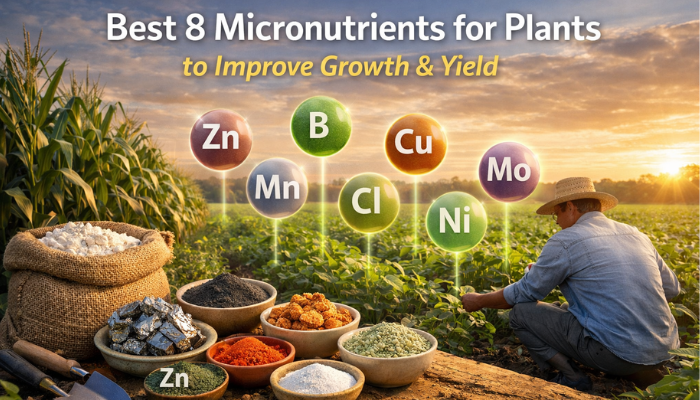
Best 8 Micronutrients for Plants to Improve Growth & Yield
Plants need the right balance of nutrients to grow strong, healthy, and productive. While most growers focus on major nutrients like nitrogen, phosphorus, and potassium, plants also require micronutrients to complete many important biological processes.
The best micronutrients for plants produce chlorophyll, activate enzymes, support photosynthesis, and improve nutrient absorption. They also contribute to better flowering, fruit development, and overall crop quality.
When plants do not receive enough micronutrients, they may show symptoms such as yellow leaves, stunted growth, and reduced yields. By understanding the best micronutrients and their functions, farmers and gardeners can maintain soil health and ensure better plant growth and productivity.
List of Best Micronutrients for Plants
Below are the most important micronutrients and their roles in plant growth.
|
Micronutrient |
Main Role in Plants |
|
Iron |
Helps in chlorophyll formation and supports photosynthesis |
|
Zinc |
Supports enzyme activity and growth hormone production |
|
Manganese |
Activates enzymes and supports photosynthesis |
|
Copper |
Helps in respiration, enzyme activation, and plant metabolism |
|
Boron |
Essential for cell wall formation, flowering, and fruit development |
|
Molybdenum |
Helps plants use nitrogen efficiently and supports nitrogen fixation |
|
Chlorine |
Maintains osmotic balance and supports photosynthesis |
|
Nickel |
Helps break down urea and supports nitrogen metabolism |
1. Iron (Fe)
Iron is one of the most important micronutrients for plants because it plays a major role in chlorophyll production and photosynthesis. Healthy green leaves depend heavily on sufficient iron levels.
Role in Plants
- Helps in chlorophyll formation
- Supports photosynthesis and energy transfer
- Assists in respiration and enzyme functions
Iron deficiency often appears as yellowing of young leaves, a condition called interveinal chlorosis.
2. Zinc (Zn)
Zinc is essential for plant growth and development because it regulates many enzymes and plant hormones.
Role in Plants
- Helps produce growth hormones like auxin
- Activates important enzymes
- Supports protein synthesis and plant metabolism
A lack of zinc can cause stunted plant growth, smaller leaves, and reduced crop yield.
3. Manganese (Mn)
Manganese is required for several plant metabolic processes, especially those related to photosynthesis.
Role in Plants
- Activates enzymes involved in photosynthesis
- Supports nitrogen metabolism
- Helps in oxygen production during photosynthesis
Manganese also helps plants convert nutrients into usable forms for growth.
4. Copper (Cu)
Copper plays an important role in plant metabolism and enzyme activity. It is also important for plant strength and disease resistance.
Role in Plants
- Supports photosynthesis and respiration
- Helps in enzyme activation
- Improves plant immunity and stress tolerance
Copper also contributes to strong stems and improved root development.
5. Boron (B)
Boron is essential for plant reproduction and cell structure. It helps plants produce flowers, fruits, and seeds effectively.
Role in Plants
- Supports cell wall formation
- Improves sugar transport within plants
- Helps pollen germination and fruit development
Boron deficiency can lead to poor flowering, fruit drop, and weak plant growth.
6. Molybdenum (Mo)
Molybdenum is required in very small amounts but plays a vital role in nitrogen metabolism.
Role in Plants
- Helps plants use nitrogen efficiently
- Supports nitrogen fixation in legumes
- Assists in protein formation
Without molybdenum, plants cannot convert nitrogen into usable forms for growth.
7. Chlorine (Cl)
Chlorine is an essential micronutrient that plays an important role in several physiological processes in plants. Although plants require chlorine in very small amounts, it is necessary for maintaining proper plant growth and development.
Role in Plants
- Supports photosynthesis
- Maintains osmotic balance
- Helps regulate water movement in plants
Chlorine also helps in the water-splitting reaction during photosynthesis, which releases oxygen.
8. Nickel (Ni)
Nickel is one of the micronutrients required by plants in extremely small quantities, but it is still essential for normal plant growth. Even though its requirement is minimal compared to other nutrients, nickel plays a critical role in certain enzyme functions and nitrogen metabolism in plants.
Role in Plants
- Supports nitrogen metabolism
- Helps break down urea into usable nitrogen
- Assists enzyme activity
Although needed in tiny quantities, nickel is important for proper plant nutrition.
Why Micronutrients are Important for Plants?
Micronutrients support several important plant functions. Even though they are needed in small quantities, their absence can significantly affect plant health.
1. Improve Photosynthesis: Elements like iron and manganese help plants produce chlorophyll, which is necessary for photosynthesis.
2. Activate Enzymes: Many micronutrients act as enzyme cofactors, helping plants carry out metabolic reactions.
3. Support Plant Growth: Micronutrients help regulate hormones and growth processes, leading to healthy development.
4. Increase Crop Yield: Balanced micronutrient supply improves flowering, fruit development, and seed production.
5. Improve Plant Resistance: Some micronutrients increase disease resistance and stress tolerance in plants.
Tips for Proper Micronutrient Management
To maintain healthy plants and improve productivity, follow these tips:
- Test the soil regularly to identify nutrient deficiencies
- Apply micronutrients only when needed
- Avoid excessive use, as high levels can harm plants
- Use balanced fertilizers with both macro and micronutrients
- Maintain proper soil pH for better nutrient absorption
Proper nutrient management ensures plants grow healthy and produce better yields.
Conclusion
The best micronutrients for plants are small but essential components of plant nutrition. Elements like iron, zinc, manganese, copper, boron, molybdenum, chlorine, and nickel play vital roles in plant growth, metabolism, and crop productivity. Even though plants require these nutrients in tiny amounts, their absence can lead to poor growth, low yield, and unhealthy plants.
Are your crops not growing well even after using regular fertilizers? Your soil may be lacking important micronutrients. SV Agro’s Micronutrient Fertilizer helps provide the essential trace nutrients that plants need for healthy growth, better flowering, and higher yields. It supports plant metabolism, improves nutrient absorption, and helps crops grow stronger and more productive.
Frequently Asked Questions
1. What is the best source of micronutrients?
Ans: The best sources of micronutrients for plants include organic matter, compost, manure, and balanced micronutrient fertilizers.
2. Where do plants get micronutrients from?
Ans: Plants mainly get micronutrients from the soil. These nutrients are naturally present in soil minerals, organic matter, and decomposed plant materials.
3. How to make micronutrients for plants naturally?
Ans: You can provide micronutrients to plants naturally by adding compost, well-rotted manure, or organic fertilizers to the soil.
4. Can I apply too much micronutrient fertilizer?
Ans: Yes, applying too much micronutrient fertilizer can harm plants. Excess nutrients can damage roots, cause leaf burn, and disturb the balance of other nutrients in the soil.
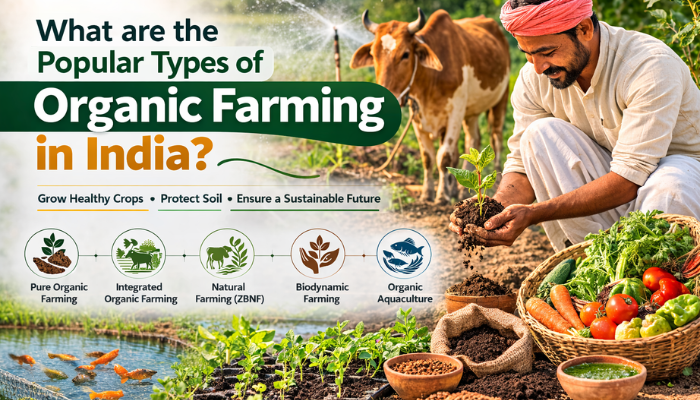
What are the Popular Types of Organic Farming in India?
Organic farming is becoming popular in India as farmers look for safe and sustainable ways to grow crops. In this method, chemical fertilizers and pesticides are avoided, and natural inputs are used to maintain soil health.
The main types of organic farming include pure organic farming, integrated organic farming, natural farming (ZBNF), biodynamic farming, and organic aquaculture systems. With support from schemes like Paramparagat Krishi Vikas Yojana, states such as Sikkim and Madhya Pradesh are leading the growth of organic farming in India. This guide explains these types and the techniques for farmers.
Types of Organic Farming in India
Here are the main types of organic farming in India, the inputs used in each method, the farm scale, and the states where these practices are commonly followed.
|
Type of Organic Farming |
Main Inputs Used |
Farm Size / Cost |
|
Pure Organic Farming |
Uses natural inputs like compost and bio-pesticides. No chemical fertilizers or pesticides are used. |
Mostly practised on small farms. The cost is moderate because farmers prepare natural inputs. |
|
Integrated Organic Farming |
Uses farm resources such as crop waste, animal manure, and livestock together to support farming. |
Suitable for medium to large farms. Requires low external inputs because most resources come from the farm itself. |
|
Natural Farming (ZBNF) |
Uses natural solutions made from desi cow products such as Jeevamrut and Beejamrut. |
Best for small farms and very low-cost farming because most inputs are locally available. |
|
Biodynamic Farming |
Uses special herbal and natural preparations to improve soil health and plant growth. |
Usually practiced on small farms and requires good knowledge and careful management. |
|
Organic-Aquaculture Farming |
Combines crop farming with fish farming in the same field or water system. |
Suitable for wetland farming areas and helps farmers earn income from both crops and fish. |
1. Pure Organic Farming
Pure organic farming is the most traditional form of organic farming. In this system, farmers use only natural inputs such as compost, farmyard manure, green manure, and bio-pesticides.
Chemical fertilisers, synthetic pesticides, and genetically modified seeds are completely avoided.
State- Sikkim (India’s first fully organic state, where all farmland follows organic practices)
Year- The organic farming movement began in 2003 when chemical fertilisers were banned.
Features
- Uses natural fertilizers like compost and vermicompost
- Uses bio-pesticides and herbal sprays
- Focuses on traditional farming practices
- Maintains soil fertility naturally
2. Integrated Organic Farming
Integrated organic farming is a holistic farming system where crops, livestock, poultry, and sometimes fish farming are combined. The waste from one activity becomes input for another.
For example, cow dung from livestock is used to make manure, which improves soil fertility for crops.
States- Sikkim, Uttarakhand, Tripura
Year- Started in the early 2000s as a modern and sustainable farming approach.
Features
- Combines crops, livestock, poultry, and fisheries
- Uses farm waste as natural fertilizer
- Reduces the need for external inputs
- Improves farm productivity and income
3. Natural Farming (ZBNF / SPNF)
Natural farming is a low-cost organic farming system developed by Subhash Palekar. It is also called Zero Budget Natural Farming (ZBNF) because farmers can grow crops with very low input costs.
This system mainly uses products made from desi cow dung and urine, such as Jeevamrut and Beejamrut.
States- Karnataka, Andhra Pradesh and Himachal Pradesh
Year- In the mid 1990s, by Subhash Palekar in Karnataka, and later expanded widely in Andhra Pradesh.
Features
- Very low farming cost
- No chemical fertilizers or pesticides
- Uses cow-based natural inputs
- Focuses on soil microbes and natural processes
4. Biodynamic Farming
Biodynamic farming is a special type of organic farming that treats the farm as a living ecosystem. It uses herbal preparations, compost mixtures, and follows natural cycles such as lunar phases. Although this method is not very common in India, it is slowly growing in hill states.
States- Kerala, Gujarat, Madhya Pradesh, and Uttarakhand
Year- Introduced in the early 1990s and started by T.G.K. Menon, who conducted training workshops for Indian farmers.
Features
- Uses herbal compost preparations
- Follows lunar and natural cycles
- Improves soil fertility naturally
- Focuses on ecological balance
5. Integrated Organic-Aquaculture Farming
In this system, crop farming is combined with fish farming. One common example is the paddy-fish system, where fish are raised in rice fields.
Fish help control pests and weeds, while their waste acts as natural fertilizer for crops.
State- Sikkim (first organic fish cluster started in Soreng district)
Year- Recently launched in 2025 under the Pradhan Mantri Matsya Sampada Yojana (PMMSY) to promote organic fish farming.
Features
- Combines rice farming with fish culture
- Efficient use of water resources
- Provides both grain and protein production
- Increases farmer income
This system is common in wetland regions such as Assam and Manipur.
Techniques Used in Organic Farming
Different types of organic farming use similar natural techniques to maintain soil health and improve crop production.
- Crop Rotation: Growing different crops in different seasons to maintain soil nutrients, improve soil health, and reduce pests and weeds.
- Composting and Mulching: Using decomposed organic waste and plant materials to improve soil fertility and retain moisture.
- Green Manure: Growing special crops like clover or sunhemp and mixing them into the soil to add natural nutrients.
- Integrated Pest Management (IPM): Controlling pests using natural methods such as beneficial insects, traps, and bio-pesticides like neem oil instead of chemicals.
- Mixed Farming: Combining crop farming with livestock so that animal manure can be used as natural fertilizer, creating a sustainable farming system
Conclusion
Organic farming is a sustainable way to grow crops while protecting soil health and the environment. Different types of organic farming, such as pure organic farming, integrated farming, natural farming, biodynamic farming, and organic-aquaculture systems, allow farmers to choose methods that suit their land and resources.
Start your organic farming journey with the support of SV Agro Solutions' organic fertilizers. Our research-based organic inputs help improve soil health, increase nutrient availability, and support healthy crop growth. The company also provides expert guidance to farmers from sowing to harvest, helping them achieve higher yields with sustainable farming practices.
FAQs
1. How does ZBNF differ from pure organic farming?
ZBNF focuses on very low-cost farming using cow-based inputs, while pure organic farming may use purchased organic inputs like compost and bio-fertilizers.
2. Which type of organic farming is best for small farmers?
Natural farming (ZBNF) and pure organic farming are often suitable for small farmers because they require lower investment.
3. Which government scheme supports organic farming in India?
The Paramparagat Krishi Vikas Yojana (PKVY) scheme supports organic farming through training and financial assistance.
4. Why is crop rotation important in organic farming?
Crop rotation improves soil fertility, reduces pest problems, and helps maintain healthy crop production.
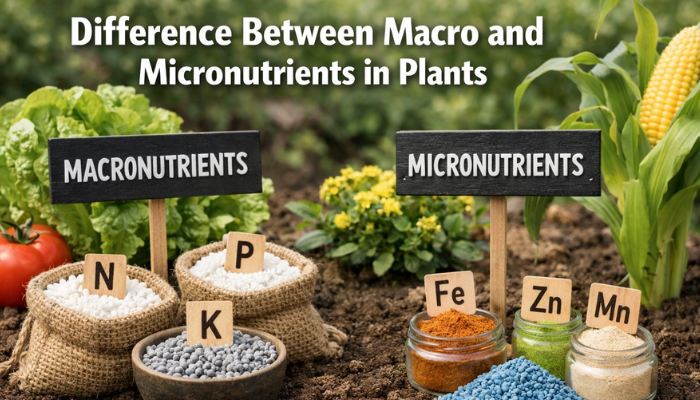
Difference Between Macro and Micronutrients in Plants
Plants need the right nutrients to grow healthy and give a good yield. In fact, plants require 17 essential nutrients for proper growth. These nutrients are divided into macronutrients and micronutrients based on the amounts the plant needs.
Macronutrients are nutrients that plants need in large amounts for growth and energy, while micronutrients are needed in very small amounts to support important plant processes like enzyme activity and metabolism.
If even one nutrient is missing, crops may not grow properly, and yields can decrease. That’s why farmers need to understand the difference between macro and micronutrients and apply them in the right balance for better crop production.
What are Macronutrients and Micronutrients?
Plants need 17 essential nutrients to grow properly and complete their life cycle. These nutrients are divided into two groups based on the amount the plant requires.
Macronutrients
Macronutrients are essential elements required in large amounts for plant growth, comprising Nitrogen (N), Phosphorus (P), Potassium (K), Calcium (Ca), Magnesium (Mg), and Sulfur (S), along with Carbon, Hydrogen, and Oxygen. These nutrients help in building plant tissues and supporting important processes like photosynthesis and energy production.
Micronutrients
Micronutrients are essential mineral elements required by plants in trace amounts for crucial metabolic processes, enzyme functions, and growth. Micronutrients include Iron (Fe), Boron (B), Chlorine (Cl), Manganese (Mn), Zinc (Zn), Copper (Cu), Molybdenum (Mo), and Nickel (Ni). Micronutrients usually make up less than 1% of the plant’s dry weight, but they play a very important role in enzyme activity, metabolism, and overall plant functioning.
Difference between Macro and Micronutrients
Plants need different nutrients to grow properly. These nutrients are divided into macronutrients and micronutrients based on how much the plant requires.
|
Points |
Macronutrients |
Micronutrients |
|
Meaning |
Needed in large amounts for plant growth. |
Needed in very small (trace) amounts. |
|
Quantity Required |
Similar to daily foods like Rice or Wheat for humans. |
Similar to small nutrients like salt or Vitamins in our diet. |
|
Main Role |
Help build plant parts like leaves, stems, and roots. |
Help control internal plant processes. |
|
Importance |
Affect plant size and crop yield. |
Help in chlorophyll formation and nutrient use. |
|
Deficiency Effect |
Deficiency causes slow growth and yellow leaves. |
Deficiency causes leaf discoloration or small leaves. |
Functions of Macronutrients and Micronutrients
Macronutrients and micronutrients play different but equally important roles in helping plants grow, develop properly, and produce healthy yields.
Macronutrients
- Helps in chlorophyll formation, photosynthesis, and healthy leaf growth.
- Supports energy transfer, root development, and flowering.
- Controls water balance and improves overall plant health.
- Strengthens cell walls and supports cell growth.
- Important for chlorophyll and photosynthesis.
- Helps form proteins and vitamins.
- Build the basic structure of plant tissues.
Micronutrients
- Supports plant growth, stem development, and enzyme activity.
- Important for cell formation, flowering, and fruit development.
- Helps in photosynthesis and plant metabolism.
- Activates enzymes and supports plant respiration.
- Helps plants use nitrogen properly.
- Maintains water balance and supports photosynthesis.
- Helps plants process nitrogen and prevents toxicity.
Tips for Managing Plant Nutrients
- Use good-quality or slow-release fertilizers, so plants get nutrients gradually.
- Nitrogen supports leaf growth, phosphorus strengthens roots and flowering, and potassium improves overall plant health.
- Micronutrients like iron and zinc are needed in small amounts but are very important.
- Apply micronutrients through foliar spray or water-soluble fertilizers for better absorption.
- Avoid over-fertilizing as it can burn leaves and reduce crop quality.
- Too much of one nutrient can block another (e.g., excess phosphorus reduces zinc uptake).
- Add compost or organic matter to improve soil fertility and structure.
- Check soil pH regularly because it affects nutrient availability.
- Watch for deficiency symptoms like yellow leaves or slow growth.
- Crop rotation helps maintain soil fertility and balanced nutrients
Conclusion
The main difference between macro and micronutrients is the quantity required, but both are equally essential for crop growth. Macronutrients help in plant structure and growth, while micronutrients support metabolic and enzyme functions. Farmers should always focus on balanced fertilization instead of only applying NPK.
Give your crops the essential nutrients they need with SV Agro’s Micronutrients Fertilizer, a high-quality micronutrient solution developed by SV Agro Solutions - one of India’s trusted agricultural experts in crop nutrition and micronutrient technology
SV Agro Solutions uses advanced research and quality manufacturing to deliver fertilizers that help farmers produce healthier crops at a lower cost.
FAQs
1. What is the role of micronutrients in plants?
Micronutrients help plants grow properly by supporting important internal processes, even though they are needed only in very small amounts.
2. Which crops suffer most from micronutrient deficiencies in India?
Rice, wheat, maize, sugarcane, and vegetables commonly suffer from zinc and iron deficiencies.
3. Why are secondary macronutrients important?
Calcium, magnesium, and sulfur support cell wall formation, chlorophyll production, and protein synthesis. Without them, crop quality decreases.
4. What are the 4 types of micronutrients?
The four types of micronutrients are water-soluble vitamins, fat-soluble vitamins, microminerals, and trace minerals.
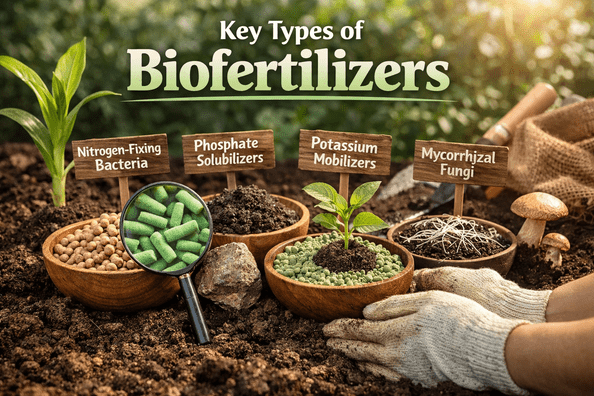
Key Types of Biofertilizers Every Farmer Should Know
Many farmers today are struggling with rising fertilizer costs and declining soil health. Overuse of chemical fertilizers has not only drained soil fertility but also increased farming expenses. This is where biofertilizers offer a natural solution.
Biofertilizers are made up of living microorganisms that supply essential nutrients to crops naturally. By using them, farmers can cut down chemical fertilizer usage by 25–50% while gradually improving soil health. In this article, we will explore key types of biofertilizers such as Nitrogen-Fixing, Phosphate-Solubilising, and Potassium-Mobilising biofertilizers along with practical tips for effective use, especially tailored for Indian farmers.
What are Biofertilizers?
Biofertilizers are natural fertilizers that contain useful bacteria, fungi, or algae. These microorganisms improve nutrient availability in the soil and support plant growth.
The most common ones used in India are nitrogen-fixing bacteria, phosphate-solubilizing bacteria (PSB), and potassium-mobilizing bacteria (KMB). They are very useful for crops like rice, pulses, wheat, vegetables, fruits, and oilseeds.
Classification of Biofertilizers
Biofertilizers can be grouped in different ways. Let us understand this step by step in an easy way.
1. Based on the Type of Microorganism
Biofertilizers contain living microbes. They can be:
i. Bacterial Biofertilizers
These contain useful bacteria.
- Rhizobium – Best for pulses like tur, gram, and soybean.
- Azotobacter – Good for wheat, vegetables, and cotton.
- Bacillus – Helps in nutrient availability and plant growth.
These bacteria live in soil or roots and help plants take nutrients easily.
ii. Fungal Biofertilizers
- These contain helpful fungi.
- Mycorrhiza (AMF) is the most common.
- It increases root size and helps plants absorb more water and phosphorus.
- Very useful for fruit crops, vegetables, sugarcane, and plantation crops.
iii. Algal Biofertilizers
- These contain algae that is Blue Green Algae (BGA).
- Mainly used in paddy (rice) fields.
- It fixes nitrogen naturally in standing water.
2. Based on the Nutrients They Supply
Some biofertilizers are grouped based on which nutrient they help to supply.
i. Nitrogen-Fixing Biofertilizers
- They take nitrogen from the air and give it to plants.
- Example: Rhizobium, Azotobacter.
- Very important for green growth and leaves.
ii. Phosphate-Solubilizing Biofertilizers (PSB)
- They unlock phosphorus already present in the soil.
- Make it available to the roots.
- Improve root growth and flowering.
iii. Potassium-Mobilising Biofertilizers (KMB)
- They help plants absorb potassium.
- Improve fruit size, grain filling, and disease resistance.
iv. Micronutrient Solubilizers
- Help in making small nutrients like Zinc available.
- Improve crop quality and reduce deficiency problems.
3. Based on Form
Biofertilizers come in two main forms:
i. Liquid Biofertilizers
- Available in liquid form.
- High number of live microbes.
- Easy to use in drip irrigation and soil drenching.
- Longer shelf life compared to powder.
ii. Carrier-Based (Powder) Biofertilizers
- Available in powder form.
- Mixed with materials like peat or lignite.
- Mostly used for seed treatment before sowing.
- Cost-effective and easy for small farmers.
Main Types of Biofertilizers
Explore the main types of biofertilizers that naturally improve soil fertility and help crops grow healthier and stronger.
|
Type of Biofertilizer |
What it do? |
Common Microbes |
Suitable Crops |
Main Benefits |
Best Time / Method of Application |
|
Nitrogen-Fixing Biofertilizers |
Take nitrogen from the air and convert it into a form plants can use for growth. |
Rhizobium, Azotobacter, Azospirillum, Cyanobacteria (BGA) |
Pulses, Rice, Wheat, Maize |
Improves green growth |
Seed treatment or soil application before sowing |
|
Phosphate-Solubilizing Biofertilizers (PSB) |
Make the fixed phosphorus in soil available to plants. |
Bacillus megaterium, Pseudomonas striata |
Cereals, Legumes, Fruits, Vegetables |
Better root growth |
Mix with FYM (Farm Yard Manure) and apply in soil before sowing |
|
Potassium-Mobilizing Biofertilizers (KMB) |
Release locked potassium from soil minerals so plants can absorb it. |
Frateuria aurantia |
Oilseeds, Fruits, Vegetables |
Better grain filling improves disease resistance and |
Best applied during the flowering stage |
|
Mycorrhizal Biofertilizers (AMF) |
Helpful fungi that attach to roots and increase nutrient and water absorption. |
Glomus species |
Horticulture crops, Tea, Plantation crops |
Improves phosphorus uptake, increases drought tolerance, and |
Best applied during transplanting |
|
Plant Growth-Promoting Rhizobacteria (PGPR) |
Helpful bacteria that promote plant growth by producing natural growth hormones and protecting plants from harmful microbes. |
Bacillus subtilis, Pseudomonas fluorescens |
Vegetables, Cereals, Floriculture crops |
Faster plant growth, better immunity, improved crop health |
Seed treatment or foliar spray |
|
Composite Bio NPK |
Contains multiple beneficial microbes that help provide Nitrogen, Phosphorus, and Potassium together. |
A combination of N, P, and K solubilizing microbes |
All crops |
Complete nutrient support, balanced growth and convenient for farmers |
Basal soil application or soil drenching |
Application Tips for Farmers
- Apply biofertilizers in the early morning or late evening when the weather is cool.
- Avoid applying during strong sunlight because heat can damage or kill the beneficial microbes.
- For seed treatment, coat the seeds evenly with biofertilizer before sowing.
- This helps in better germination and strong early root growth.
- For seedling root dipping, prepare a biofertilizer solution and dip the roots for 15–30 minutes before transplanting.
- This helps seedlings establish quickly in the field.
- For soil application, mix biofertilizer with 40-60 kg of well-decomposed FYM or compost and apply at the time of planting or as top dressing. This ensures proper spread in the soil.
- For drip irrigation (fertigation), use liquid biofertilizers through the drip system for uniform distribution and better efficiency.
Conclusion
Biofertilizers are an important part of sustainable farming in India. They reduce dependence on costly chemical fertilizers and improve soil health naturally. By understanding the different types of biofertilizers, farmers can choose the right one based on crop and soil needs.
Looking to improve crop yield and soil health? SV Agro offers advanced solutions like biostimulants for stronger roots and stress resistance, CR Fertilizers for steady nutrient supply, micronutrients to correct deficiencies, and biofertilizers to boost soil fertility naturally. With SV Agro, farmers can achieve better growth, higher quality produce, and sustainable farming results.
FAQs
1. Which is the main source of biofertilizer?
Biofertilizers mainly come from beneficial bacteria, fungi, and cyanobacteria that improve soil nutrients.
2. Which crops benefit the most from biofertilizers?
Most crops benefit, especially pulses, rice, wheat, maize, vegetables, fruits, sugarcane, and plantation crops.
3. Which fungi are used as a biofertilizer?
Arbuscular mycorrhizal fungi (AMF) are commonly used and help plant roots absorb nutrients better.
4. Which biofertilizer is used in rice crops?
Azolla and blue-green algae are commonly used in rice fields to supply natural nitrogen.

Natural Farming vs Organic Farming – Which Farming is Better?
Many Indian farmers are confused about chemical-based farming. Rising fertilizer prices, decreasing soil fertility, and changing climate conditions have made them question whether chemical farming is the right long-term solution. Because of these challenges, farmers are now looking for better, safer, and more sustainable farming methods that protect both soil and income.
Two popular options are natural farming and organic farming. Both methods avoid chemical fertilisers and pesticides, but they follow different approaches and principles.
In this blog, we will clearly explain natural farming vs organic farming, their basic ideas, benefits, challenges, and help you understand which method may be better for Indian farmers.
What is Natural Farming?
Natural farming is a simple and chemical-free way of doing agriculture. It works with nature instead of trying to control it. Farmers do not use chemical fertilizers or pesticides. Instead, they use natural materials available on the farm, like cow dung, cow urine, crop waste, and natural mixtures.
Natural farming is sometimes called “do-nothing farming” because farmers do very little disturbance to the soil and allow nature to manage most of the work on its own.
What is Organic Farming?
Organic farming is a method of farming where farmers do not use chemical fertilizers or pesticides. Instead, they use organic fertilizers made up of crop waste, animal manure, green plants, and bio-pesticides.
This helps farmers grow crops in a safe and sustainable way while maintaining soil fertility for the long term.
Organic farming allows approved natural inputs and follows certification standards like NPOP (National Programme for Organic Production) to sell produce in premium markets.
Natural Farming vs Organic Farming- Differences Every Farmer Must Know
Natural and organic farming grow crops without harmful chemicals, but their methods and inputs are different.
|
Aspect |
Natural Farming |
Organic Farming |
|
Inputs & Cost |
Farmers use only what is available on their farm, so the cost is very low. |
Farmers buy organic fertilizers and sprays, so the cost is higher. |
|
Soil Work |
Farmers do not plough much and let leaves and crop waste naturally improve the soil. |
Farmers plough the land and mix compost into the soil. |
|
Basic Idea |
Let nature handle most of the farming work. |
Replace chemical products with organic products. |
|
Certification |
Usually no official certificate; mostly based on trust in local markets. |
Needs official approval and a certificate to sell as organic. |
Principles of Natural Farming
- No chemical fertilizers, pesticides, or insecticides are used. Farming is done in a completely natural way.
- Deep ploughing is avoided to protect soil structure, earthworms, and useful microbes.
- Local materials like cow dung, cow urine, jaggery, and flour are used to make natural solutions such as Jivamrit (for soil health) and Beejamrit (for seed treatment).
- Indigenous cow dung and urine help increase good bacteria and improve soil fertility.
- Different crops are grown together through intercropping and multi-cropping to improve nutrients and reduce pest problems.
- Farmers interfere less and allow nature to manage pests, weeds, and soil health naturally.
Principles of Organic Farming
- Organic farming improves soil by using compost, organic fertilizer, and green manure instead of chemical fertilizers.
- Pests and weeds are controlled using natural methods like helpful insects, crop rotation, and hand weeding instead of chemical sprays.
- It does not use synthetic fertilisers, chemical pesticides, hormones, or GMOs.
- It supports biodiversity, helping more plants, insects, and animals grow naturally on the farm.
- Animals are raised with proper care, given natural feed, and antibiotics are used only when truly needed
Advantages of Natural Farming
- It reduces farming costs because farmers do not need to buy chemical fertilizers and pesticides.
- It improves soil health by making the soil loose, rich, and full of useful microorganisms.
- It helps the soil hold more moisture, so crops need less water.
- It produces safe and healthy food while reducing pollution in soil and groundwater.
- It also helps lower carbon emissions and protects the environment.
- In states like Andhra Pradesh, natural farming under ZBNF has helped many farmers reduce debts.
Advantages of Organic Farming
- It helps protect the environment by reducing pollution and stopping harmful chemicals from entering rivers and groundwater.
- It supports long-term farming by creating strong systems that can handle drought, floods, and climate change better.
- It produces healthy food that is free from harmful chemical residues and may contain more natural nutrients.
- Healthy organic soil can store more carbon, which helps in reducing the effects of climate change.
Challenges of Natural Farming
- Yields may drop in the first few years, causing income loss.
- Weed control and natural input preparation need more labour.
- Farmers need proper knowledge and training to avoid mistakes.
- Getting good market prices and certification can be difficult
- Pest attacks can cause losses without chemical sprays.
- Desi cow inputs may not be easily available.
Challenges of Organic Farming
- Crop yields are usually lower in the first 2-3 years.
- More labour is needed for weeding and composting, which increases costs.
- Controlling pests and weeds is harder without chemical sprays.
- Getting organic certification takes time, money, and paperwork.
- Small farmers may struggle to find proper markets and storage facilities.
- Organic seeds and inputs are sometimes not easily available
Which is Better- Natural Farming vs Organic Farming?
There is no single answer. It depends on your farm size, budget, and goals.
-
Natural farming is better if you are a small farmer who wants to reduce costs, improve soil health, and avoid buying outside inputs.
-
Organic farming is better if you want to sell in big markets that need certified and high-quality produce.
Both methods avoid chemical fertilizers and pesticides, but they follow different approaches in using inputs.
Conclusion
When we talk about natural farming vs organic farming, it’s not about deciding which one is better or worse. Both methods aim to grow safe food, keep the soil healthy, and support sustainable farming. Natural farming is about depending on nature and using farm-based resources, while organic farming follows certified standards and helps farmers sell their crops in premium markets.
Looking for a smarter and more sustainable way to farm? SV Agro Solutions offers advanced products like biostimulants, CRF fertilizers and micronutrients to improve soil health and crop productivity. Our solutions help plants absorb nutrients better, grow stronger roots, and handle stress like drought or poor soil conditions.
FAQS
1. Is natural and organic farming the same?
No, natural and organic farming are different; “natural” usually means no artificial colors or preservatives, while organic farming follows certified standards without chemicals.
2. Which state in India is 100% organic?
Sikkim is India’s first and only 100% organic state since 2016.
3. What is another name for natural farming?
Natural farming is also linked to terms like sustainable farming, agroecology, permaculture, and eco-friendly agriculture.
4. What is the subsidy for natural farming?
Farmers can get ₹4,000 per acre per year for up to 2 years (maximum 1 acre) under government support schemes.
What are the Major Types of Commercial Farming in India
Commercial farming is very important for supplying food to cities and helping farmers earn a steady income. In this type of farming, crops are not grown just for family use. Instead, they are produced on a large scale to sell in the market. To increase production and profit, farmers use modern tools, improved seeds, fertilizers, irrigation systems, and machines.
In India, commercial farming is growing fast because of good road networks, cold storage, food processing industries, and export demand. Let us understand the different types of commercial farming in simple words.
What is Commercial Farming?
Commercial farming is farming done on a large scale to sell crops and animals in markets and earn a profit. Farmers use modern machines, good quality seeds, fertilizers, and new technology. It needs high investment but gives higher production.
Main Features of Commercial Farming-
- Profit purpose: Farming is done mainly to earn money, not just to feed the family.
- Large land area: Crops or animals are raised on large farms.
- Use of machines: Tractors, harvesters, and other machines are widely used.
- Modern materials: Farmers use HYV seeds, fertilizers, pesticides, and insecticides.
- Special focus: Usually, one main crop or animal type is grown in large quantities.
Main Types of Commercial Farming
An overview of the different types of commercial farming that farmers use to produce crops and livestock for market sales.
1. Plantation Farming
Plantation farming is a large-scale farming system where farmers grow one main cash crop like tea, coffee, rubber, sugarcane, or oil palm. It needs high investment, many workers, and modern methods, and the crops are mainly grown to sell in national and international markets for profit.
Examples:
Assam (tea), Kerala (rubber), Karnataka (coffee)
2. Mixed Farming
Mixed farming is a farming method where a farmer grows crops and raises animals on the same land. Crop leftovers are used as animal feed, and animal manure is used to fertilize the fields. This system saves costs, reduces risk, and gives farmers more than one source of income.
Example: Punjab farmers grow wheat and keep dairy cows.
3. Dairy Farming
Dairy farming is a type of farming where farmers raise animals mainly for milk. These animals can be cows, buffalo, goats, sheep, or camels. Farmers take care of breeding, feeding, and managing the animals to get more and better-quality milk.
The milk is then sold directly or used to make products like butter, cheese, and other dairy items.
Example: Gujarat’s Amul dairy model.
4. Livestock Ranching
Livestock ranching is a type of farming where farmers raise large groups of animals like cows and sheep on large open lands. These animals are reared for products such as meat, milk, and wool.
Farmers manage grazing areas and take care of the animals in open fields instead of keeping them in small sheds or closed spaces.
Example: Sheep rearing in Rajasthan.
5. Market Gardening (Truck Farming)
Market gardening is a type of farming where farmers grow vegetables, fruits, and flowers on small pieces of land. These crops are high-value and are sold directly in local markets, to shops, or to restaurants.
Farmers mostly use manual work and grow many different crops instead of just one.
Example: Vegetable farms near Bengaluru, Pune, and Delhi.
6. Grain Farming
Grain farming is a specialised, large-scale agricultural practice focused on cultivating cereal crops such as wheat, corn, rice, barley, and oats primarily for commercial sale and profit.
It is highly mechanised, utilizing advanced technology, tractors, and harvesters across vast tracts of land to maximize yield.
Example: Punjab and Haryana wheat farms.
Comparison of Types of Commercial Farming
A simple comparison of different types of commercial farming based on scale, crops, inputs, and where they are commonly practiced.
|
Type of Farming |
Farm Size & What is Grown |
What Farmers Mainly Need (Inputs) |
Example from India |
|
Plantation Farming |
Very big farms growing one cash crop like tea, coffee, or rubber. |
High investment, many workers, and processing machines. |
Tea gardens in Assam, rubber farms in Kerala |
|
Mixed Farming |
Farms growing crops and raising animals together. |
Animal feed, crop waste for animals, and manure for fields. |
Punjab farms grow wheat and keep dairy animals |
|
Dairy Farming |
Farms focused on milk production. |
Good breed animals, proper feed, clean sheds, and vet care |
Gujarat (Amul model) |
|
Livestock Ranching |
Raising many animals, like sheep or cattle, on open land |
Large grazing land and basic animal care |
Rajasthan sheep farms |
|
Market Gardening |
Small farms growing vegetables, fruits, and flowers for city markets |
Greenhouses, drip irrigation, and regular watering |
Vegetable farms near Bengaluru |
|
Grain Farming |
Large farms growing wheat, rice, or maize |
Use of tractors, harvesters, fertilizers, and irrigation systems |
Punjab wheat farms |
Need for Organic Fertilizer in Commercial Farming
- Organic fertilizers like compost and manure make soil loose, airy, and rich in organic matter. They also increase good soil microbes.
- Soil with organic matter stores water better, so crops need less irrigation and can handle dry weather.
- Nutrients are released little by little, so plants get steady food, and there is less risk of burning crops.
- Regular use can increase production over time and grow more nutritious, healthy crops.
- Healthy soil reduces the need for expensive chemical fertilizers, improving farm profit over time.
- Organic fertilizers reduce chemical pollution, improve natural nutrient cycling, and help store carbon in the soil.
Conclusion
Healthy soil is the key to successful farming. When farmers understand crop nutrition and notice problems early, they can take the right steps to protect crops, improve plant growth, and increase yield and profit. Strong soil and balanced nutrients, along with choosing the different types of commercial farming suitable for their region, help farmers achieve long-term success.
Improve Your Crop Health with SV Agro Biostimulants!
SV Agro biostimulants naturally support stronger plant growth. They improve nutrient absorption, promote better root development, and help crops handle stress like drought and poor soil conditions. With SV Agro solutions, farmers can grow healthier crops, get higher yields, and practice more sustainable farming.
FAQs
1. What is another name for commercial farming?
Commercial farming is also called commercial agriculture or agribusiness, where crops and animals are grown mainly for sale in the market.
2. What type of commercial farming is most profitable?
Farming that produces high-demand products like organic vegetables, free-range eggs, grass-fed meat, mushrooms, or microgreens is usually more profitable.
3. What are the major crops of commercial farming?
Main commercial crops in India include cotton, jute, and sugarcane, which are grown mainly for sale and industrial use.
4. What is the largest commercial crop in India?
Rice is the largest crop in India and is the main food for most people in the country.

Difference Between Commercial Farming and Subsistence Farming
Farming is the backbone of rural life and food security. Across India, farmers follow different types of farming based on land size, resources, and purpose. The two most common systems are commercial farming and subsistence farming.
Understanding the difference between commercial farming and subsistence farming helps farmers make better decisions about crop selection, investment, income, and long-term sustainability. Both systems play an important role in Indian agriculture, but they differ greatly in methods, scale, and outcomes.
What is Commercial Farming?
Commercial farming is a type of agriculture where crops or livestock are grown mainly to sell in markets and earn a profit. It is usually practiced on large areas of land and uses modern farming techniques.
In commercial farming, farmers grow cash crops such as wheat, cotton, sugarcane, rice, vegetables, fruits, or flowers. This system depends on tractors, irrigation systems, high-yield seeds, fertilizers, pesticides, and hired labor to increase production and income.
What is Subsistence Farming?
Subsistence farming is a traditional form of farming where crops are grown mainly to feed the farmer’s family. Only a small surplus, if any, is sold in the local market.
It is practiced on small landholdings using family labor and simple tools. Subsistence farmers depend heavily on rainfall, local seeds, and organic manure. This type of farming is common among small and marginal farmers in many parts of India.
Differences Between Commercial Farming and Subsistence Farming
Here are the differences between commercial and subsistence farming, including purpose, scale, income, and farming methods.
|
Feature |
Commercial Farming |
Subsistence Farming |
|
Main Objective |
To earn profit by growing crops mainly for sale in markets, factories, or exports. |
To grow enough food for the farmer’s family and for basic survival. |
|
Scale of Farming |
Practiced on large farms and estates covering many acres of land. |
Practiced on small landholdings, usually 1–5 acres or less. |
|
Dependence on Rainfall |
Uses assured irrigation like canals, borewells, drip, and sprinklers. |
Depends mainly on monsoon rainfall for crop growth. |
|
Use of Technology |
Uses modern machines such as tractors, harvesters, irrigation systems, and farm equipment. |
Uses traditional tools like ploughs, sickles, and bullocks. |
|
Cropping Pattern |
Mostly follows monoculture, where one main crop is grown over a large area. |
Mixed cropping is common to reduce risk and meet family needs. |
|
Type of Seeds Used |
Uses improved and hybrid seeds for higher yield and uniform crops. |
Farmers often save seeds from the previous harvest. |
|
Fertilizers & Inputs |
Depends on chemical fertilizers, pesticides, and modern farm inputs. |
Uses compost, animal manure, and natural inputs. |
|
Labour Requirement |
Uses hired labour and machines; capital-intensive but time-efficient. |
Uses family labour and manual work; labour-intensive. |
|
Types of Crops Grown |
Cash crops include wheat, sugarcane, cotton, soybeans, and commercial vegetables. |
Food crops like rice, wheat, millets, pulses, and vegetables for home use. |
|
Market Connection |
Strongly connected to markets, storage units, mills, factories, and export chains. |
Very limited market access; surplus is rarely sold. |
|
Investment Level |
Requires high investment, bank loans, insurance, and advanced planning. |
Requires low investment with minimum external support. |
|
Productivity & Output |
High yield per hectare with a large surplus for sale. |
Low yield with little or no surplus after family consumption. |
|
Regional Presence in India |
Found in Punjab wheat belts, Maharashtra sugarcane areas, and cotton farms in Tamil Nadu. |
Common in the Deccan Plateau, Bihar, Odisha, tribal, and rain-fed regions. |
|
Examples in India |
Large wheat farms in Punjab, sugarcane farms in Maharashtra, cotton farms in Tamil Nadu, and supplying factories. |
Small farmers in Bihar or Odisha growing rice and pulses on 1–2 acres for family food. |
|
Government Support |
Supported by schemes like PMKSY, MSP, FPOs, crop insurance, and subsidies. |
Gradually supported through schemes to improve productivity and shift towards commercial farming. |
Advantages of Commercial Farming
- Produces large amounts of food, which helps meet the needs of a growing population
- Uses machines and modern methods, saving time and reducing the cost per unit of production
- Helps farmers earn more income and supports the growth of related businesses and industries
- Ensures regular and reliable food supply even during changing weather conditions
Disadvantages of Commercial Farming
- Heavy use of fertilizers and pesticides can pollute soil and water
- Continuous farming can reduce soil fertility over time
- Needs high investment for machines, fuel, seeds, and chemicals
- Small farmers may struggle to compete and lose their livelihoods
Advantages of Subsistence Farming
- Provides food for the family and reduces reliance on markets.
- Costs less because it uses simple tools and natural fertilizers.
- Keeps soil healthy and protects the environment.
- Preserves traditions, old crops, and local biodiversity.
Disadvantages of Subsistence Farming
- Produces low crop yields.
- Earns little money because most produce is for personal use.
- Vulnerable to bad weather and natural disasters.
- Limited access to technology, loans, and markets
Conclusion
The difference between commercial farming and subsistence farming lies in scale, purpose, technology, and income. Subsistence farming ensures food security, while commercial farming drives profit and growth.
For Indian farmers, a smart combination of both systems supported by technology and sustainable practices can improve income while protecting soil and resources. Choosing the right method based on land size, budget, and goals is the key to successful farming.
Looking to boost your farm’s productivity and crop health? SV Agro helps farmers in all types of farming across India with products like Biostimulants, CRF Fertilizers, and Micronutrients, which improve soil health, enhance plant growth, and ensure better yields, making farming easier and more profitable.
FAQs
1. What is the main aim of commercial farming?
The main aim is to earn profit by producing large quantities of crops or livestock efficiently.
2. What is another name for commercial farming?
Commercial farming is also called agribusiness, where produce is grown primarily for sale in markets.
3. What are the main types of subsistence farming?
Subsistence farming mainly includes shifting cultivation and intensive subsistence agriculture, focused on meeting family needs rather than profit.
4. Which crops suit commercial farming in India?
Wheat, cotton, sugarcane, rice, fruits, and vegetables.
5. Can subsistence farmers switch to commercial methods?
Yes, with government support, training, and investment.

What is Plantation Agriculture - Complete Guide for Farmers
Plantation agriculture is an important system of farming that focuses on growing cash crops on a large scale. Unlike traditional subsistence farming, which is mostly for family use, plantation agriculture produces crops for the market.
This type of farming is mostly done in warm regions and helps increase exports and rural income. In India, plantations give jobs, support businesses, and grow crops like tea, coffee, and rubber. Let us understand what is plantation agriculture, its main features, the crops grown, and its importance for India.
What is Plantation Agriculture?
Plantation agriculture is large-scale farming where one main cash crop is grown for profit. It is done in warm regions and uses a lot of money, workers, and modern methods to grow crops like tea, coffee, sugar, and rubber.
In India, it is common in places like Assam, Kerala, and the Nilgiris, where the climate is suitable. These farms are linked to local and global markets and help create jobs and income.
Main Characteristics of Plantation Agriculture
Plantation agriculture has several unique features that make it different from small-scale or subsistence farming:
1. Large Scale & One Crop Farming
Plantation farming is done on very large areas of land where only one main crop, like tea, coffee, rubber, sugarcane, or banana, is grown.
2. Commercial & Export-Oriented
Crops are grown mainly to earn a profit. Most of the produce is sold in big markets or exported to other countries, not for local use.
3. High Investment Needed
Plantation farming needs a lot of money for machines, fertilizers, irrigation systems, and processing units.
4. Needs Many Workers
A large number of workers are required for planting, caring for, and harvesting crops. In some places, workers may get low wages and basic facilities.
5. Uses Modern Farming Methods
Scientific techniques like improved seeds, fertilizers, and pesticides are used to get better and higher yields.
6. Connected to Industries
Plantations are linked with nearby factories and mills for processing crops. Good roads, transport, and communication are important.
7. Grown in Tropical Regions
This type of farming is suitable in tropical and subtropical areas where the climate supports cash crops.
8. Owned by Big Companies
Most plantations are owned by large companies or rich individuals who manage them as businesses.
Suitable Crops for Plantation Agriculture
Plantation agriculture mostly involves perennial crops, which live and produce for several years. Some common crops include:
- Beverages (Tea, Coffee, Cocoa)
These crops are mainly grown for making drinks. They are high-value crops and are mostly grown in hilly and rainy areas.
- Oils & Nuts (Coconut, Oil Palm, Cashew, Arecanut)
These crops are used to produce cooking oil, dry fruits, and edible nuts. They are long-term crops and give income for many years.
- Fibres & Materials (Rubber, Cotton, Sisal, Jute)
These crops are used in industries to make clothes, ropes, tyres, bags, and other products.
- Sugars & Spices (Sugarcane, Pepper, Cloves)
Sugarcane is grown for making sugar and jaggery, while spices are used in food and medicines.
- Fruits & Others (Bananas, Pineapples, Betel Vine)
These crops are grown for direct sale in markets and daily use.
Geographical Requirements
Plantations grow best in specific regions:
- Tropical or subtropical with annual rainfall between 150-300 cm.
- Fertile, well-drained soils, often on hill slopes, for root crops.
- Close to ports or transport facilities for easy export.
Plantation Agriculture in India
Plantation farming is prominent in India, especially in:
- Tea: Assam, West Bengal, Kerala, Tamil Nadu, Karnataka
- Coffee: Karnataka, Kerala, Tamil Nadu
- Rubber: Kerala, Tamil Nadu, North-East
- Spices & Cardamom: Kerala, South India
- Coconut, Cashew, Arecanut, Oil Palm: South India, North-East
Advantages of Plantation Agriculture
Plantation agriculture has many benefits:
- Gives high crop yield due to large-scale farming and the use of scientific methods
- Creates many jobs for skilled and unskilled workers in rural areas
- Helps earn foreign exchange by exporting crops like tea, coffee, and rubber
- Supports agro-based industries such as processing, packaging, and transport
- Encourages new technology and innovation in farming
- Produces important cash crops efficiently, benefiting both farmers and consumers
Disadvantages of Plantation Agriculture
Despite its benefits, plantation farming has some drawbacks:
- Causes environmental damage like deforestation, soil erosion, and loss of wildlife
- Reduces soil fertility because the same crop is grown again and again
- Heavy use of fertilizers and pesticides can harm soil, water, and human health
- Workers may face low wages, poor living conditions, and exploitation
- High farming and maintenance costs make it risky for farmers
- Dependence on one single crop increases the risk of crop failure
Conclusion
Plantation agriculture is a key part of India’s farming economy. When we understand what is plantation agriculture, it means growing cash crops like tea, coffee, and rubber on a large scale, mainly in tropical regions, creating jobs and supporting trade. With sustainable practices, it can be profitable and eco-friendly for farmers.
Want to start farming or feeling stuck with complicated chemical-based agriculture? It’s the right time to move towards organic and sustainable farming.
With products like Biostimulants, CRF Fertilizers, and natural Micronutrients, SV Agro Solutions helps improve soil health, nutrient efficiency, and crop strength, while increasing yield without harming the environment.
FAQs.
1. How does plantation agriculture contribute to India’s export economy?
It earns India over $2 billion every year by exporting tea, coffee, and rubber to global markets.
2. How much capital is required to start plantation agriculture?
Plantation farming needs a heavy investment of ₹50–100 lakhs per hectare and takes several years to start giving profits.
3. Why are perennial crops preferred in plantation agriculture?
Perennial crops give a harvest for many years, reduce replanting costs, and suit large farms focused on long-term production.
4. Can crop rotation be applied in plantation agriculture?
Crop rotation is limited, but small crops can be grown between main plants to improve soil health.
5. How is climate change affecting plantation agriculture in India?
Climate change is reducing yields due to irregular weather, forcing farmers to adopt climate-resilient farming methods.
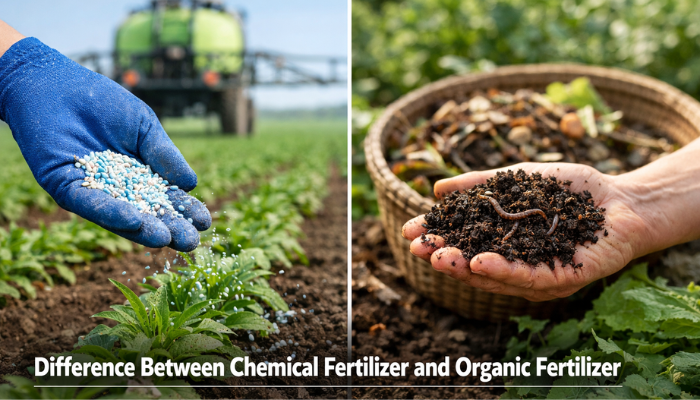
Difference Between Chemical Fertilizer and Organic Fertilizer
Fertilizers play a very important role in farming. They help crops grow faster, healthier, and give better yields. Today, farmers mainly use two types of fertilizers – chemical fertilizers and organic fertilizers. Understanding the difference between chemical fertilizer and organic fertilizer is very important for farmers who want good crop production along with healthy soil.
Chemical fertilizers give quick nutrients to crops, while organic fertilizers work slowly and improve soil health over time. Choosing the right fertilizer helps farmers balance yield, soil fertility, cost, and long-term sustainability, especially for Indian farms where soil health is a major concern.
What are Organic Fertilizers?
Organic fertilizers are made from natural materials like compost, cow dung, poultry manure, vermicompost, bone meal, and plant waste. These fertilizers break down slowly in the soil with the help of microorganisms. They improve soil structure, increase organic matter, and support beneficial soil life.
What are Chemical Fertilizers?
Chemical fertilizers are synthetic or man-made products produced in factories. They contain nutrients in a concentrated form, mainly NPK. These nutrients are immediately available to plants but do not improve soil health and can harm soil if used continuously.
This basic difference between natural and synthetic sources creates all other differences in their effects.
Differences Between Organic and Chemical Fertilizers
Organic fertilizers improve soil health naturally over time, while chemical fertilizers provide quick nutrients but may harm soil if overused.
|
Factors |
Organic Fertilizer |
Chemical Fertilizer |
|
Source |
Made from natural materials like cow dung, compost, plant waste, and bone meal |
Made in factories using chemicals and minerals |
|
Nutrient Release |
Nutrients are released slowly over time through soil microbes, feeding crops for longer |
Nutrients are released quickly and give instant growth |
|
Effect on Soil Health |
Makes soil soft, fertile, and rich in useful microbes |
Can make soil hard and reduce good microbes if used regularly |
|
Nutrient Content |
Provides balanced nutrients, including small (micro) nutrients |
Mostly gives only the main nutrients like N, P, K |
|
Environmental Impact |
Safe for soil and water, does not cause pollution |
Can pollute soil and water due to leaching and runoff |
|
Cost & Availability |
It may cost more at first and requires more quantity |
Cheaper initially and easily available in the market |
|
Safety for Crops |
Safe for plants with a very low risk of crop burning |
High risk of crop damage if applied in excess |
|
Long-term Use |
Improves soil fertility and crop health over time |
Continuous use reduces soil quality and fertility |
Pros of Organic Fertilizers
Organic fertilizers offer many long-term benefits to farmers:
- Improve soil structure and make the soil soft and fertile
- Increase beneficial bacteria, fungi, and earthworms
- Reduce soil erosion and improve water retention
- Improve crop resistance to pests and diseases
- Safe to handle and suitable for organic farming
- Reduce chemical pollution in soil and water
- Support biodiversity in crops like rice, vegetables, and pulses
Organic fertilizers are ideal for farmers who want sustainable yields without harming the soil.
Cons of Organic Fertilizers
Despite many benefits, organic fertilizers also have some limitations:
- Nutrient release is slow, so results take time
- Nutrient content varies, so soil testing is important
- The initial cost may be higher than chemical fertilizers
- Bulky materials require more storage and transport
- Not suitable for instant nutrient correction
Farmers need patience and regular use to see full benefits.
Pros of Chemical Fertilizers
Chemical fertilizers are popular due to their fast action:
- Provide quick nutrients to crops
- Easy to apply and store
- Cheaper for short-term use
- Useful during critical crop growth stages
- Suitable for high-yield commercial farming
They are helpful when crops show immediate nutrient deficiency.
Cons of Chemical Fertilizers
Long-term use of chemical fertilizers can create serious problems:
- Damage soil structure and reduce organic matter
- Kill beneficial soil microbes
- Increase soil acidity and salinity
- Causes water pollution through leaching and runoff
- Make crops dependent on chemicals
- Increase pest and disease attacks
- Risk of crop burn if overused
Over time, farmers may face higher costs and declining soil productivity.
Practical Applications for Farmers
- Use organic fertilizers for soil regeneration in kitchen gardens, subsistence farming, and natural farming systems.
- Use chemical fertilizers carefully in commercial farming, especially during peak nutrient demand stages.
- Combine both methods for best results – this is called integrated nutrient management.
- Apply organic fertilizers before sowing and chemical fertilizers in small, controlled doses.
- Rotate crops and add compost regularly to maintain soil health.
Conclusion
The difference between chemical fertilizer and organic fertilizer is not just about speed but about long-term soil health and sustainability. Chemical fertilizers give quick results, but organic fertilizers build strong soil and healthy crops over time.
For Indian farmers, the best approach is to use fertilizers wisely, protect soil fertility, and think long-term. Healthy soil today means better yields and safer farming tomorrow.
FAQs
1. What is the main difference between chemical fertilizer and organic fertilizer?
Chemical fertilizers give quick nutrients, while organic fertilizers improve soil health and provide nutrients slowly.
2. Which is better for soil health: organic or chemical?
Organic fertilizers are better for long-term soil health.
3. Can I use both chemical and organic fertilizers together?
Yes, using both in the right balance gives better crop and soil results.
4. How do organic fertilizers prevent nutrient leaching?
They release nutrients slowly and bind them to organic matter in the soil.
5. Are chemical fertilizers safe for vegetable farming?
They can be used carefully, but overuse may leave residues and damage soil.
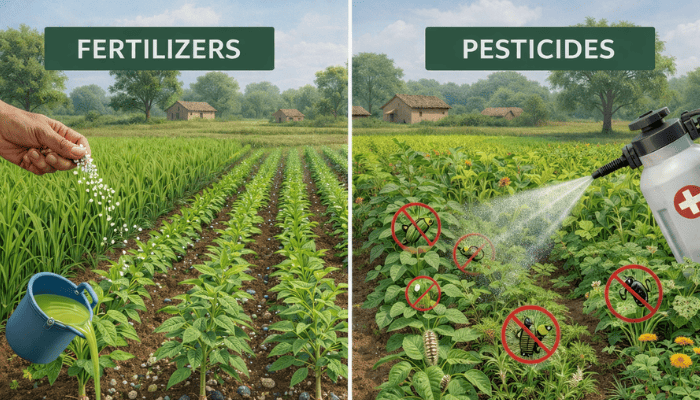
Difference Between Pesticides and Fertilizers
For every farmer, good crop growth and protection are equally important. Plants need nutrients to grow well, and they also need protection from insects, diseases, and weeds. This is where fertilizers and pesticides come in. However, many farmers still get confused between the two.
Understanding the difference between pesticides and fertilizers helps you use them correctly, improve soil health, reduce input costs, and increase productivity. In this blog, we will explain both in very simple words so that every farmer can follow the right farming practices.
What Are Fertilizers?
Fertilizers are natural or chemical materials added to soil or sprayed on crops to give plants the nutrients they need to grow well. The main nutrients are nitrogen (N), phosphorus (P), and potassium (K), which help plants grow strong, flower properly, and give good yields. Fertilizers replace the nutrients that crops take from the soil every season.
They work like vitamins for plants. Fertilizers can be organic, such as manure and compost, or chemical, such as urea and DAP. They also help improve soil fertility and hold moisture in the soil, which makes them very important for farming and food production today.
Main Nutrients in Fertilizers
Fertilizers mostly supply three important nutrients:
- Nitrogen (N) – helps in leafy growth
- Phosphorus (P) – helps in root growth and flowering
- Potassium (K) – helps in overall strength and disease tolerance
Some fertilizers also include micronutrients like zinc, iron, magnesium, and boron.
What Are Pesticides?
Fertilizers are natural or chemical materials added to soil or sprayed on crops to give plants the nutrients they need to grow well. The main nutrients are nitrogen (N), phosphorus (P), and potassium (K), which help plants grow strong, flower properly, and give good yields.
Fertilizers replace the nutrients that crops take from the soil every season. They work like vitamins for plants. Fertilizers can be organic, such as manure and compost, or chemical, such as urea and DAP. They also help improve soil fertility and hold moisture in the soil, which makes them very important for farming and food production today.
Types of Pesticides
- Insecticides: Kill insects such as borers, aphids, and whiteflies.
- Fungicides: Control fungal infections like rust, wilt, and blight.
- Herbicides: Kill unwanted weeds that compete with crops.
- Rodenticides: Control rats and rodents in fields and storage.
Difference between Pesticides and Fertilizers
Learn the key differences between pesticides and fertilizers and how to use them effectively for healthy crops.
|
Feature |
Fertilizers |
Pesticides |
|
Main purpose |
Give food and nutrients to plants |
Protect crops from insects, weeds, and diseases |
|
What they contain |
Nutrients like nitrogen (N), phosphorus (P), potassium (K), and micronutrients |
Chemicals or natural substances that kill or control pests |
|
Who they act on |
Plants and soil |
Insects, weeds, fungi, rodents, and other pests |
|
How they work |
Plants absorb nutrients through roots or leaves to grow better |
Pests die or stop harming crops after contact or eating |
|
When they are used |
Used regularly during crop growth |
Used only when pests or diseases appear |
|
Effect on crop |
Improves plant growth, yield, and quality |
Prevents crop damage and yield loss |
|
Method of application |
Applied to soil, mixed with water, or sprayed on leaves |
Sprayed on crops, soil, or used as seed treatment |
|
Frequency of use |
Applied in planned doses |
Applied only when needed |
|
Risk of overuse |
Can damage soil and pollute water |
Can harm humans, animals, and useful insects |
|
Safety requirement |
Basic care is enough |
Protective clothing and safety rules are needed |
|
Example |
Urea, DAP, compost, manure |
Insecticides, herbicides, fungicides |
|
Simple example |
Like food for plants |
Like medicine or protection for plants |
Application & Safety Tips for Farmers
Practical tips for farmers on using pesticides and fertilizers safely for healthy crops.
Fertilizer Usage Tips
- Always wear protective items like gloves and goggles while applying fertilizers.
- Read the instructions on the fertilizer bag or bottle and follow them carefully.
- Apply fertilizers to slightly moist soil, not on dry land or hard surfaces.
- Keep fertilisers away from rivers, ponds, and drains to prevent water pollution.
- Avoid using more fertilizer than needed to prevent crop damage.
- Do soil testing before application to know the right quantity for your field.
- Using the correct amount helps protect the soil, water, and environment.
- For safer and healthier farming, use Multi Micronutrient Fertilizer to strengthen crops naturally and reduce pest problems.
Pesticide Usage Tips
- First, use non-chemical methods like traps or cleaning.
- Use the right pesticide for the right pest and place.
- Buy only what you need.
- Keep children, pets, and people away during and after spraying.
- Read the label for safety and re-entry time.
- Keep first-aid and emergency numbers ready.
Conclusion
Fertilizers and pesticides play different but equally important roles in farming. Fertilizers help plants grow by providing nutrients, while pesticides protect crops from harmful pests and diseases. By understanding the difference between pesticides and fertilizers, farmers can choose the right input at the right time and avoid common mistakes.
For healthier crops and better soil productivity, choose SV Agro organic fertilizers. Our products help improve soil fertility, strengthen plants naturally, and support long-term sustainable farming. By using SV Agro organic and multi-micronutrient fertilizers, farmers can reduce chemical use and get better yields safely.
For more information and expert guidance, contact SV Agro Solutions at +91 96377 81012 and email us at info@svagrosolutions.com
FAQS
1 What is NPK full form?
NPK stands for Nitrogen (N), Phosphorus (P), and Potassium (K), the main nutrients plants need to grow healthy.
2. What are the two main types of fertilizers?
The two main types are Organic (natural, like compost or manure) and Inorganic (chemical, like urea or NPK).
3. What is farming without pesticides called?
Farming without pesticides is called Natural Farming, which grows crops without chemicals.
4. What is the most common pesticide used in agriculture?
The most common pesticides are herbicides, insecticides, and fungicides used to protect crops.

What is Sustainable Farming - A Complete Guide for Farmers
Farming is not only about growing crops; it also involves taking care of the soil, water, and the people who depend on it. But what is sustainable farming? Sustainable farming is a way of growing food that protects the environment, conserves natural resources, and ensures future generations can continue farming. It helps farmers get good yields without harming the soil, water, or ecosystem.
By using sustainable practices, farmers can use fewer harmful chemicals, improve soil health, and save money over time. This type of farming becomes more productive, environmentally friendly, and helpful for both people and nature.
What is Sustainable Farming?
Sustainable farming means growing crops in a way that protects the soil, water, and environment. It reduces the use of chemicals and encourages natural fertilisers, crop rotation, and methods that keep the soil healthy.
It also cares about the safety of farmers and local communities. For Indian farmers, using sustainable methods can improve crop yield, reduce spending on chemical inputs, and support eco-friendly farming.
Sustainable Farming Practices in India
There are several sustainable farming practices that farmers can adopt:
- Rotate crops to keep the soil healthy and fertile.
- Use organic fertilizers and micronutrients to improve soil nutrition.
- Control pests carefully using less chemicals (integrated pest management).
- Save water with efficient irrigation methods like drip irrigation.
- Plant trees and cover crops to protect soil and help nature.
- Use biostimulants to help plants grow naturally and strongly.
SV Agro Solutions provides products like biostimulants, CRF fertilizers, and micronutrients that support these practices for Indian farmers.
Types of Sustainable Farming
Understanding types of sustainable farming helps farmers choose suitable methods for their land:
- Organic Farming – Uses natural fertilizers like compost and avoids chemicals.
- Agroforestry – Plants crops with trees to keep soil healthy.
- Conservation Agriculture – Ploughs less and changes crops to keep the soil good.
- Permaculture – Farms in a way that works like nature.
- Crop-Livestock Farming – Grows crops and keeps animals together to reuse nutrients naturally.
These methods help farmers improve productivity while caring for the environment.
Benefits of Sustainable Development in Agriculture
The benefits of sustainable development in farming are numerous:
- Maintains healthy soil and water resources.
- Reduces dependency on chemical fertilizers and pesticides.
- Increases long-term crop productivity.
- Supports biodiversity and wildlife.
- Helps farmers save costs and earn better returns.
- Contributes to climate change mitigation.
By adopting sustainable practices, Indian farmers can grow healthier crops and secure their livelihood.
Challenges in Sustainable Farming
While sustainable farming has many advantages, there are some challenges:
- Money is needed to buy organic fertilizers and biostimulants.
- Learning new methods like drip irrigation and pest control.
- Time required to see better soil and crop results.
- Finding buyers or markets for organic or eco-friendly products.
Practices for Successful Sustainable Farming in India
Starting sustainable farming in India involves:
-
Check soil health and water availability before planting.
- Choose the right crops and farming methods for your land.
- Use natural fertilizers, biostimulants, and micronutrients to improve growth.
- Practice crop rotation and smartly control pests.
- Take advice from agricultural experts when needed.
SV Agro Solutions helps farmers with consultation, fertilizers, and support to grow crops in a sustainable way.
Conclusion
Understanding what is sustainable farming and implementing the right practices can improve farm productivity, protect the environment, and secure a better future for farmers. Adopting these methods in India not only benefits the land but also increases income and crop quality.
Start your sustainable farming journey today with SV Agro Solutions and explore our range of biostimulants, fertilisers, and micronutrients to grow healthier crops naturally.
Frequently Asked Questions
1. What is the most sustainable type of farming?
The most sustainable type of farming is permaculture, where farms are designed like natural ecosystems. This method uses fewer resources, protects the environment, and gives better, long-lasting yields
2. What are the three sustainable farming methods?
The three main methods are organic farming, agroforestry, and conservation agriculture.
3. Why is sustainable farming good?
It protects the environment, improves soil health, reduces chemical use, and ensures long-term farm productivity.
4. How do you create a sustainable farm?
Use organic fertilisers, crop rotation, water-efficient irrigation, and integrated pest management to maintain soil and ecosystem health.
5. What are the two elements of sustainable agriculture?
The two main elements are environmental care and long-term economic viability.
6. What are the principles of sustainable farming?
Principles include protecting soil, conserving water, reducing chemicals, maintaining biodiversity, and supporting local communities.
7. What is the future of sustainable agriculture?
It will focus on eco-friendly farming, higher efficiency, climate resilience, and producing healthy food for a growing population.
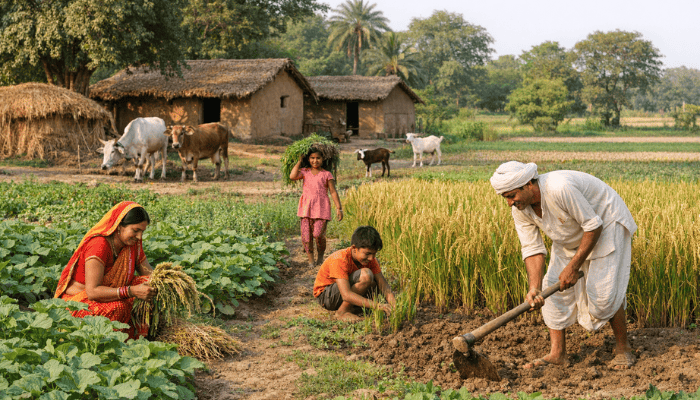
What is Subsistence Farming - Meaning, Types & Features
Agriculture is practised in many different ways across the world. Some farmers grow crops mainly to sell in the market, while some grow food only for their own family. This second type of farming is called subsistence farming.
Understanding “What is Subsistence Farming” is very important for small and marginal farmers in India because a large part of rural families still follow this system. It helps them meet their basic food needs even when income is low or market conditions are uncertain.
What is Subsistence Farming?
Subsistence farming means growing crops or keeping animals mainly to feed your own family. Farmers usually do not have extra produce to sell. The farms are small, work is done by hand using simple tools, and the yield is low. It is common in developing countries where families aim to be self-sufficient.
Characteristics of Subsistence Farming
Here are the main features:
1. The main purpose is self-use
Farmers grow crops and keep animals mainly to feed their own family. Very little is sold in the market.
2. Small farms
The land is small and sometimes spread out, so it is hard to grow crops on a large scale.
3. More manual work
Most of the work is done by family members using simple tools like sickles or hoes, not big machines.
4. Low production
Because there is less technology, no proper irrigation, and fewer inputs, the crop yield remains low.
5. Old farming methods
Farmers follow traditional methods that they learned from older generations.
6. Less use of modern inputs
Many farmers cannot afford fertilisers, pesticides, or improved seeds.
7. Depends on rainfall
Farming mostly depends on rain, so droughts or irregular rains can reduce production.
8. Different crops grown
Farmers grow many types of crops to make sure the family has food throughout the year.
Types of Subsistence Farming
|
Type of Farming |
Method (How it is done) |
Crops/Livestock |
Where it is Common |
|
Intensive Subsistence Farming |
Small land, high manual labour, simple tools; aim is to get maximum food for family |
Rice, wheat, millets, pulses, oilseeds |
Fertile and crowded plains of India |
|
Shifting Cultivation (Jhum) |
Cut and burn forest patches, farm for few years, move when soil becomes weak |
Millets, vegetables, tubers |
Tribal and hilly areas, Northeast India |
|
Nomadic Herding (Pastoralism) |
People move with animals in search of grass and water |
Sheep, goats, camels, yaks |
Dry and semi-dry regions like Rajasthan, J&K |
|
Sedentary Subsistence Farming |
Farmers stay in one place and grow food mainly for self-use |
Cereals, vegetables, pulses |
Plains and settled village areas |
|
Diversified Subsistence Farming |
Many crops + some livestock grown on small farms for family needs |
Fruits, vegetables, grains, cows, goats |
Throughout rural India |
Common crops grown in Subsistence Farming
- In India, subsistence farming mainly focuses on rice, especially in areas with good rainfall and water.
- Along with rice, farmers also grow wheat, maize, millets (like jowar, bajra, ragi), pulses, and oilseeds.
- These crops are grown on small pieces of land mainly for the family’s food needs.
- Most of the work is done using manual labour and traditional tools, not big machines.
- Farmers use old farming practices to get the best possible yield from their small land.
- This type of farming is common in the densely populated regions of South, Southeast, and East India, where people depend heavily on agriculture for daily food.
Advantages of Subsistence Farming
- Farmers mostly use organic manure to keep the soil healthy. This is an important part of sustainable farming.
- This type of farming is low-cost because it does not require expensive machines or inputs. So, it is suitable for small farmers with limited money.
- Subsistence farming gives food security to farmers and their families, as they get fresh food throughout the year.
- It also helps farmers become self-sufficient, meaning they can grow their own food and depend less on the market.
- This farming system is based on traditional knowledge and old methods.
- These practices, passed down through generations, help preserve local culture and farming traditions.
Challenges of Subsistence Farming
- Soil can lose its fertility over time, and the land may get damaged.
- Farmers often do not have enough resources, money, or access to good markets.
- Productivity stays low because farmers mostly use old and traditional methods.
- Since there is no extra produce to sell, farmers earn very little income.
- There are fewer chances to grow different types of crops due to limited land and resources.
Conclusion
Understanding What is Subsistence Farming? helps us know how small farmers grow food mainly for their own families using simple tools and traditional methods. Even today, subsistence farming is important in rural India, and with better seeds, water management, and government support, farmers can improve their productivity while still meeting their family’s basic needs.
Boost your farm with SV Agro CRF Fertilizers! They release nutrients slowly, helping crops grow healthier and give higher yields. Perfect for small farms and unpredictable rainfall, CRF saves labour, improves soil, and makes farming easier and more profitable.
FAQs
1. What are the three main types of farming in India?
India mainly has three types of farming: subsistence farming, organic farming, and industrial/commercial farming.
2. How many subsistence farmers are there in India?
Nearly two-thirds of Indians depend on small subsistence farms, where farmers grow crops mainly to feed their families and earn a small income
3. Which crops are grown under subsistence farming in India?
Rice, wheat, millets, pulses, vegetables, and maize.
4. How is subsistence farming different from commercial farming?
Subsistence focuses on self-consumption; commercial focuses on profit.
5. Is subsistence farming sustainable in the long run?
Yes, if improved with better seeds, water management, and eco-friendly practices.
Best Fertilizer for Sugarcane in India
Sugarcane is one of the most important crops grown in India. It provides farmers with good income, especially in Maharashtra, Uttar Pradesh, and Karnataka. From jaggery to sugar and ethanol, sugarcane plays a big role in our daily life and in the country’s economy.
To get a healthy crop and higher sugar recovery, using the right fertilizer at the right time is very important. Many farmers often ask, “What is the best fertilizer for sugarcane?” The answer depends on your soil condition, the variety of sugarcane you grow, and the type of fertilizer you use.
In this guide, you will learn about the nutrients required for sugarcane, the optimal fertiliser schedule, and how using SV Sugarban can help you increase yield and improve soil health naturally.
Fertilizer for Sugarcane
Sugarcane is a crop that grows for a long time and needs a large amount of nutrients from the soil. To get a good harvest with higher sugar content, farmers must use the right type of fertilizer in the right quantity and at the right time.
Fertilizers provide the essential nutrients that sugarcane plants need for healthy growth. The three major nutrients are Nitrogen (N), Phosphorus (P), and Potassium (K), often called NPK. Each of these nutrients plays an important role in the crop’s development:
- Nitrogen (N): Helps in leaf and stem growth. It makes the plant green and increases the number of tillers.
- Phosphorus (P): Promotes strong root development and early crop establishment.
- Potassium (K): Improves sugar content, juice quality, and resistance to pests and diseases.
In addition to these, sugarcane also needs secondary nutrients (Calcium, Magnesium, Sulphur) and micronutrients (Zinc, Iron, Manganese, Boron). Lack of these nutrients can lead to weak growth and low sugar recovery.
To maintain soil fertility and achieve high yield, it is best to follow an integrated approach using organic manure, chemical fertilizers, and bio or plant booster fertilizers together. This ensures balanced nutrition, better soil health, and sustainable farming.
Why Fertilizer Important in Sugarcane Farming?
Sugarcane needs a lot of nutrients to grow tall, strong, and produce more juice. It is called a heavy feeder crop because it takes large amounts of nitrogen, phosphorus, and potassium from the soil. If these nutrients are not replaced through fertilisers, the soil becomes weak, and the crop yield goes down year after year.
Using the right type and quantity of fertiliser helps the crop in many ways:
- Better Growth: Fertilizer provides nitrogen for healthy leaves and stalks.
- Stronger Roots: Phosphorus helps the roots grow deep and absorb more water and nutrients.
- More Sugar: Potassium increases sugar content in the cane and improves juice quality.
- Improved Soil Health: Balanced use of organic and biofertilizers keeps the soil fertile for future crops.
Without proper fertilizer management, even good-quality sugarcane varieties may not give expected yields. That’s why every farmer should follow a balanced fertilizer plan suited to their soil type and region.
Fertilizer Dose for Sugarcane
Applying the right amount of fertilizer at the right time is the key to getting a high yield and good sugar recovery. The dose of fertilizer depends on the soil fertility, variety of sugarcane, and irrigation method. However, the general recommendation for Indian conditions, especially for Maharashtra, is as follows:
|
Crop Stage |
Time After Planting |
Recommended Fertilizer Dose (per acre) |
|
Land Preparation |
Before planting |
2 tons of farmyard manure (FYM) or compost + 50 kg Single Super Phosphate (SSP) |
|
Early Growth Stage |
30–45 days after planting |
50 kg Urea + 25 kg Muriate of Potash (MOP) |
|
Tillering Stage |
60–90 days after planting |
100 kg Urea + 25 kg MOP |
|
Grand Growth Stage |
120–180 days after planting |
50 kg Urea + 20 kg SSP + 25 kg MOP |
|
Maturity Stage |
After 6 months |
Foliar spray of micronutrient mixture or plant booster such as SV Sugarban |
SV Agro Solutions is a trusted name in plant nutrition and crop care, offering advanced agricultural products designed for Indian farmers. Their SV Sugarban Plant Booster enhances sugarcane yield, improves soil health, and helps farmers achieve better returns with fewer inputs.
Sugarcane productivity depends on balanced fertilizer use, soil health, and good agronomic practices.
By combining organic, chemical, and bio-booster fertilizers, farmers can achieve higher yields and better sugar recovery.
For those seeking a reliable fertilizer for sugarcane, explore SV Sugarban by SV Agro Solutions. It supports sustainable farming and long-term soil health.
FAQ
1. What's the best fertilizer for sugarcane?
The best fertilizer for sugarcane is a balanced NPK fertilizer like NPK 18-46-0, 19-19-19, or 20-10-10, along with urea (nitrogen) and potash for strong cane growth and sugar content.
2. What is the fertilizer for sugarcane?
Sugarcane mainly needs Nitrogen (N) for growth, Phosphorus (P) for root development, and Potassium (K) for sugar formation. Common fertilizers include Urea, DAP, MOP, and NPK blends.
3. When to apply fertilizer on sugarcane?
Apply fertilizer in three stages:
- Basal dose: at planting
- 1st top dressing: 30–45 days after planting
- 2nd top dressing: 60–90 days after planting
These timings support strong early growth and cane tillering.
4. How to increase sugarcane growth?
To increase sugarcane growth:
- Use high-yield varieties
- Apply balanced fertilizers
- Ensure proper irrigation
- Use organic manure
- Maintain weed control and timely earthing-up

Importance of Agriculture in India for Farmers & Economy
Agriculture is often called the backbone of India because a large part of the country’s population depends on farming for food, income, and employment. Even today, agriculture plays a major role in India’s economy by supporting rural livelihoods, supplying raw materials to industries, and ensuring food security for millions of people.
India is one of the world’s largest producers of rice, wheat, pulses, fruits, vegetables, milk, and spices. Agriculture not only supports farmers but also helps many industries such as food processing, textiles, dairy, sugar, and transportation.
In this blog, we will explain the importance of agriculture in India, its benefits, role in rural development, and the 10 key contributions of agriculture to India’s growth.
Top 10 Importance of Agriculture in India for Farmers
These are the 10 major importance of agriculture in Indian economy that support food security, employment, rural development, industries, exports, and the overall growth of the Indian economy.
1. Food Security
Agriculture provides food grains, fruits, vegetables, pulses, milk, and other essential products for India’s large population. Without agriculture, maintaining food security would not be possible.
2. Employment Generation
Agriculture is the largest source of employment in rural India. Millions of farmers, laborers, transport workers, and traders depend directly or indirectly on farming activities for their livelihood.
3. Contribution to GDP
Agriculture contributes significantly to India’s Gross Domestic Product (GDP). In recent years, agriculture and allied sectors have contributed around 17-20% to the Indian economy.
4. Supply of Raw Materials
Many industries depend on agriculture for raw materials.
Examples include:
- Cotton for textile industries
- Sugarcane for sugar mills
- Jute for packaging industries
- Oilseeds for edible oil production
- Spices and tea for the food industries
5. Support for Exports
India exports many agricultural products, such as:
- Rice
- Tea
- Coffee
- Cotton
- Spices
- Fruits and vegetables
These exports help India earn valuable foreign exchange and strengthen the economy.
6. Rural Development
Agriculture improves the income and living standards of rural families. Higher farm income increases spending on education, healthcare, housing, and local businesses.
Development in agriculture also improves:
- Roads
- Irrigation systems
- Storage facilities
- Rural markets
7. Growth of the Food Processing Industry
Agriculture supports food processing industries that convert raw farm produce into finished products.
Examples include:
- Rice mills
- Dairy processing units
- Fruit processing industries
- Flour mills
- Sugar factories
These industries create additional employment and business opportunities.
8. Market and Trade Activity
Agriculture strengthens trade and business activities across the country.
Farming supports:
- Transportation
- Warehousing
- Wholesale markets
- Retail shops
- Cold storage systems
This improves the movement of goods from farms to consumers.
9. Poverty Reduction
Better crop production and higher farm income help reduce poverty and unemployment in rural areas. Productive agriculture creates economic stability for farming families.
Government support schemes, irrigation, and improved farming practices also help increase rural income.
10. Cultural and Social Importance
Agriculture is deeply connected to Indian culture and traditions. Many Indian festivals and rural customs are linked with farming seasons and crop harvesting.
Examples include:
- Pongal
- Makar Sankranti
- Baisakhi
- Onam
Agriculture continues to shape rural life and social traditions in India.
Role Of Agriculture in Rural India
Agriculture is the main source of livelihood for most rural households in India. Many villages depend directly on farming and allied activities like dairy, poultry, and fisheries.
When agriculture performs well:
- Rural income increases
- Employment improves
- Migration to cities reduces
- Local businesses grow
Improved agricultural productivity also increases purchasing power in villages, which supports rural economic growth.
Future Of Agriculture In India
- The future of Indian agriculture is moving towards modern, technology-based, and sustainable farming methods.
- Farmers are increasingly using technologies like Artificial Intelligence (AI), Internet of Things (IoT), drones, and precision farming to improve crop production.
- These technologies help farmers make better decisions using real-time data and digital tools.
- Modern farming methods help save water, fertilizers, and other important resources.
- Advanced technology also helps farmers manage problems like climate change, unpredictable weather, and soil degradation.
- Digital agriculture can improve crop monitoring, pest control, irrigation management, and overall farm productivity.
- New farming innovations are helping India overcome challenges such as small landholdings and low resource availability.
- Sustainable and climate-resilient agriculture will play an important role in improving farmer income and ensuring long-term food security in India.
Conclusion
Agriculture is one of the strongest pillars of the Indian economy. It supports food production, employment, industries, exports, and rural development. The importance of agriculture in India goes far beyond GDP because it directly affects the lives of millions of farmers and consumers.
Improving agriculture through modern technology, irrigation, balanced nutrition, and sustainable farming practices is essential for India’s future growth and food security.
Looking for a trusted fertilizer company in Pune for better crop growth and higher farm productivity? SV Agro Solutions offers high-quality fertilizers, biostimulants, micronutrients, and sustainable crop nutrition solutions designed to improve soil fertility, plant health, and agricultural yield. As a leading fertilizer manufacturer and supplier in Pune, we provide innovative farming products that support both Indian farmers and international agricultural markets.
FAQs
1. Which type of agriculture is the best?
The best type of agriculture depends on land size, climate, water availability, and farming resources.
2. What are the four types of agriculture?
The four main types of agriculture are subsistence farming, intensive farming, shifting cultivation, and commercial farming.
3. Which type of agriculture is most profitable?
High-value crop farming, dairy farming, poultry farming, and organic farming are considered the most profitable types of agriculture.
4. What type of land is best for agriculture?
Level land with fertile loamy soil is considered the best for healthy crop growth and higher productivity.
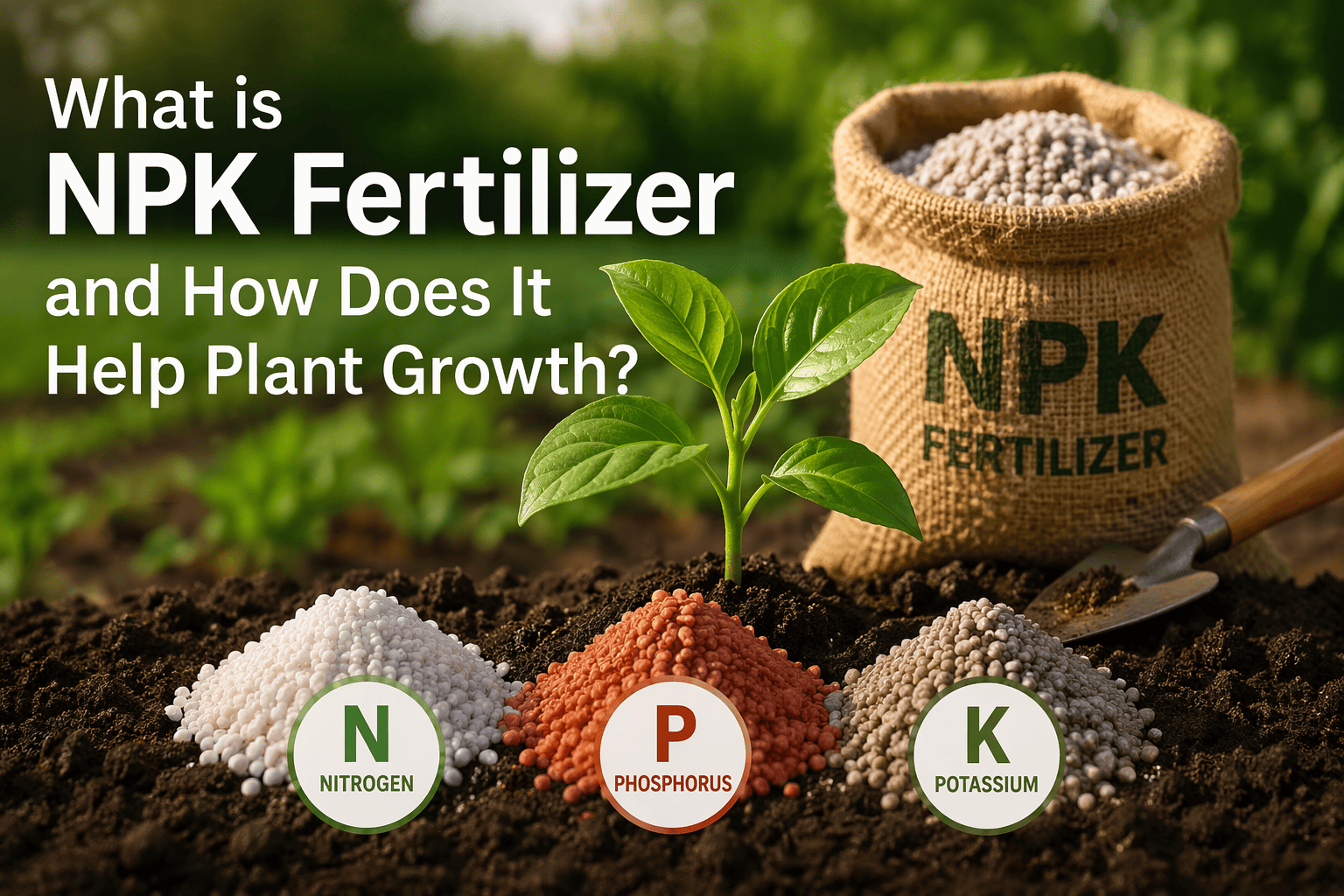
What is NPK Fertilizer and How Does It Help Plant Growth?
NPK fertilizer is one of the most essential inputs in modern farming, helping crops grow faster, healthier, and more productively. It contains three key nutrients: nitrogen (N), phosphorus (P), and potassium (K) that plants need at different stages of growth.
Because every crop and soil type is different, choosing the right NPK ratio is crucial for achieving the best results. Using the correct combination can improve plant strength, boost yields, and enhance overall crop quality.
If you are wondering what NPK fertilizer is and how it works, this guide explains everything, including its types, ideal usage for different crops, and how liquid NPK fertilizers support efficient farming.
What is NPK Fertilizer?
NPK fertilizer is a combination of three important plant nutrients: Nitrogen (N), Phosphorus (P), and Potassium (K). These nutrients are essential for healthy plant growth and higher crop yield.
Nitrogen (N)
- Nitrogen (N) helps plants grow green and strong.
- It mainly supports leaf and stem growth, making plants look healthy and fresh.
- Crops like spinach, wheat, and other leafy vegetables need more nitrogen.
Phosphorus (P)
- Phosphorus (P) is important for strong root growth and early plant development.
- It also helps in flowering and seed formation, especially during the early stages of crop growth.
Potassium (K)
- Potassium (K) improves overall plant strength.
- It helps plants resist diseases, manage water better, and improves the size and quality of fruits and vegetables.
Why is NPK important for Plants?
- NPK fertilizers are important because they help maintain a balanced nutrient supply in the soil.
- Many soils naturally lack one or more of these nutrients.
- NPK (Nitrogen, Phosphorus, Potassium) is essential for healthy plant growth and good crop yield.
- It provides the three main nutrients that help plants grow strong and productive.
- These nutrients support leaf growth, root development, flowering, and fruit quality.
- Without proper NPK, plants become weak, grow slowly, and give low yields.
- Nitrogen helps plants grow fast and stay green. It supports leaf and stem growth and improves overall plant development.
- Phosphorus helps in strong root formation, seed germination, and early plant growth. It is also important for flowering and fruit development.
- Potassium strengthens the plant, improves disease resistance, and helps plants handle stress like drought and heat. It also improves fruit size, taste, and quality.
Types of NPK Fertilizers
There are different types of NPK fertilizers based on nutrient ratio and formulation:
- Granular fertilizers
These are small, solid pellets spread on the soil. They release nutrients slowly and are good for gardens and lawns.
- NPK Liquid fertilizers
These come in liquid form and are mixed with water. Plants absorb them quickly, giving fast results.
- Water-soluble fertilizers
These are powders or crystals that dissolve completely in water. They are used for quick feeding through irrigation or leaf spray.
- Slow-release fertilizers
These are coated pellets that release nutrients slowly over time. They reduce the need for frequent application and prevent over-fertilizing.
- Organic NPK fertilizers
These are made from natural sources like compost, bone meal, and manure. They not only feed plants but also improve soil health.
Best NPK Fertilizer for Different Needs
The best NPK fertilizer depends on the crop type and its growth stage. Different stages need different nutrients for better growth and yield.
High Nitrogen fertilizers
-
Best for leafy growth and green plants
-
Helps crops grow faster with strong leaves and stems
- Useful in the early vegetative stage
High Phosphorus fertilizers
-
Best for strong root development
-
Supports flowering and seed formation
- Ideal during the early growth and blooming stage
High Potassium fertilizers
-
Improves fruit size, taste, and quality
-
Increases plant strength and disease resistance
- Best for fruiting and the maturity stage
Balanced fertilizers
-
Provide equal nutrients for overall plant growth
-
Suitable for general farming and mixed crops
- Good for maintaining healthy soil and steady development
How to Choose the Right NPK Ratio?
Choosing the correct NPK ratio is very important for good farming results. Follow these simple steps:
- The right NPK fertilizer depends on plant type, growth stage, and soil condition.
- Leafy crops like lettuce and spinach need more nitrogen (e.g., 20-5-5) for green leaf growth.
- Root crops like carrots and potatoes need more phosphorus and potassium (e.g., 5-10-10) for strong roots.
- Flowering and fruit crops like tomato and rose need higher phosphorus and potassium (e.g., 10-20-20) for better flowers and fruits.
- Lawns and trees usually need balanced or nitrogen-rich fertilizers for steady growth.
- In the early stage, plants need more phosphorus (e.g., 12-24-12) for root development.
- During the vegetative stage, plants need more nitrogen for leaf growth.
- During flowering and fruiting, plants need more phosphorus and potassium for better yield.
- Always do a soil test before applying fertilizer.
- If the soil already has enough nutrients, avoid adding more to prevent waste and damage.
- Choose the correct NPK ratio (like 10-0-5 if phosphorus is already high) to save cost and maintain soil health.
Common Mistakes to Avoid
Many farmers make simple mistakes while using NPK fertilizers.
- Using too much NPK can damage roots, cause salt buildup, and lead to yellow or burnt leaves.
- Without testing, you may add unnecessary nutrients, which can create an imbalance and reduce plant growth.
- Applying high nitrogen during flowering or fruiting increases leaf growth but reduces flowers and fruits.
- Fertilizing during hot, dry weather or when plants are not growing can burn plants or waste nutrients.
- Putting fertilizer too close to the stem or leaves can damage roots and plant parts.
- Using only NPK may cause a deficiency of important nutrients like zinc and boron.
These mistakes can reduce yield and increase cost without improving results.
Conclusion
Understanding what is NPK fertilizer is very important for every farmer because it helps in proper plant growth and better crop yield. The right NPK ratio should always be chosen based on soil test and crop type. The best NPK fertilizer is the one that matches your soil and crop needs.
Looking for good fertilizers to improve your farm yield? SV Agro Solutions is a trusted company that provides quality fertilizers to improve soil health and crop growth. We are a leading fertilizer manufacturer and supplier in Pune, helping farmers in India and also exporting our products to other countries.
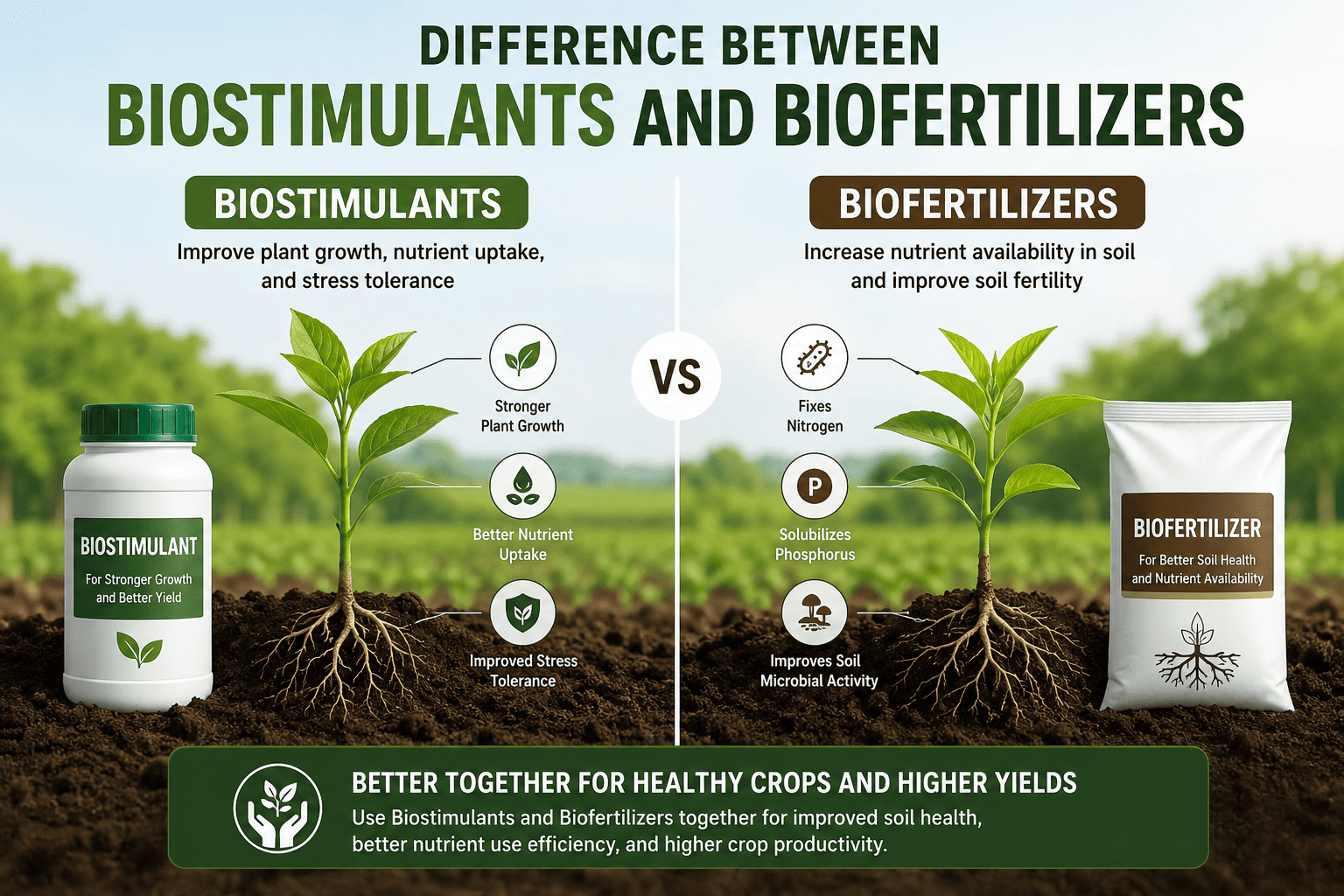
Difference Between Biostimulants And Bio-fertilizers
Farmers use many biological products to improve crop growth and soil health. Two of the most popular products are biostimulants and biofertilizers. Both are eco-friendly and help improve farming, but they work in different ways.
Understanding the difference between biostimulants and biofertilizers helps farmers choose the right product for their crops, improve fertilizer efficiency, and achieve better yields.
What are Biostimulants?
Biostimulants are products that improve the natural growth processes of plants. They do not directly supply nutrients. Instead, they help plants absorb nutrients better, grow healthier, develop stronger roots, and tolerate stress such as drought or heat.
Common biostimulant fertilizer ingredients include:
- Humic acid and fulvic acid
- Seaweed or marine algae extracts
- Amino acids and protein hydrolysates
- Plant extracts
- Some beneficial microbes that mainly stimulate plant growth
In simple words, biostimulants work like a health tonic for plants, helping them grow stronger and perform better under different growing conditions.
What are Biofertilizers?
Biofertilizers are products that contain beneficial living microorganisms. These microbes help plants absorb nutrients from the soil and improve soil fertility.
Common types of biofertilizers include:
- Nitrogen-fixing bacteria (Rhizobium, Azotobacter, Azospirillum)
- Phosphate-solubilizing bacteria (PSB) and fungi
- Mycorrhizal fungi, which improve nutrient and water absorption
In simple words, biofertilizers work like natural nutrient providers, helping plants get more nutrients from the soil.
Difference Between Biostimulants and Biofertilizers
Biostimulants and biofertilizers both support healthy crop growth, but they work in different ways to improve plant health and soil fertility.
|
Feature |
Biofertilizers |
Biostimulans |
|
What are they? |
Products that contain beneficial living microorganisms like bacteria and fungi. |
Natural products that help plants grow better but do not directly provide nutrients. |
|
How do they work? |
They help plants get nutrients by fixing nitrogen, making phosphorus available, and improving soil health. |
They help plants absorb nutrients better, grow stronger roots, and improve natural plant processes. |
|
Main Function |
Improve soil fertility and increase nutrient availability. |
Improve plant growth, stress tolerance, and nutrient use efficiency. |
|
Best Use |
To improve soil health and increase nutrient supply naturally. |
To help plants perform better during drought, heat, salinity, and other stress conditions. |
|
Common Examples |
Rhizobium, Azotobacter, Mycorrhiza |
Humic Acid, Seaweed Extract, Amino Acids, Protein Hydrolysates |
Biostimulant vs Biofertilizer - How Do They Work Together?
Biostimulants help plants use nutrients more efficiently, while biofertilizers increase nutrient availability in the soil, making them work effectively together for healthy crop growth.
Biostimulants
Biostimulants help plants by:
- Improving root growth.
- Helping plants absorb nutrients more efficiently.
- Increasing tolerance to drought, heat, salinity, and cold.
- Improving fruit size, colour, quality, taste, and shelf life.
Biofertilizers
Biofertilizers help plants by:
- Fixing nitrogen from the atmosphere.
- Making phosphorus and micronutrients available to plants.
- Improving soil microbial activity.
- Supporting better root growth through beneficial microorganisms like mycorrhiza.
How does Biostimulant Fertilizer improve crop nutrition?
- Biostimulant fertilizers improve Nutrient Use Efficiency (NUE), allowing plants to make better use of the nutrients already present in the soil.
- Stronger roots absorb more water and nutrients, helping plants grow better.
- They improve enzyme activity and other natural functions that help plants grow healthy.
- Biostimulants support useful microorganisms that improve soil health and make nutrients easier for plants to absorb.
- They help crops use applied fertilizers more effectively, leading to better growth, higher yields, and improved crop quality.
When Should Farmers Use Biostimulants?
Farmers should use biostimulants when:
- Crops are affected by drought, heat, salinity, or waterlogging.
- Plants have weak roots or poor growth.
- Growing fruits, vegetables, flowers, or other high-value crops.
- Helping transplanted crops recover quickly.
- Improving crop quality and stress tolerance.
Can Biostimulants and Biofertilizers Be Used Together?
Yes. Farmers can use biostimulants and biofertilizers together for better crop performance.
Using both together provides:
- Stronger root growth.
- Better nutrient availability.
- Improved soil health.
- Better crop quality.
- Higher yield.
- Improved stress resistance.
However, both should be used along with NPK fertilizers and organic manure as part of a complete nutrient management plan.
Always:
- Read the product label.
- Follow the recommended dosage.
- Use the correct application method.
Practical Tips for Farmers
- Choose a biostimulant if plants are weak, stressed, or not responding well to fertilizers.
- Choose a biofertilizer if soil fertility is low or nutrients like nitrogen and phosphorus are deficient.
- Follow the recommended dosage and application method.
- Store biofertilizers in a cool and shaded place to keep the beneficial microbes alive.
- Use soil testing to plan the right combination of NPK fertilizers, manure, biostimulants, and biofertilizers.
Conclusion
Both biostimulants and biofertilizers are important for sustainable farming, but they serve different purposes. Understanding the difference between biostimulants and biofertilizers helps farmers choose the right product based on their crop and soil needs.
Using both products together with balanced fertilizers and organic manure can improve soil health, crop quality, and overall farm productivity. Looking for the right solution to improve crop growth and soil health? SV Agro Solutions offers high-quality biostimulants that help improve nutrient uptake, strengthen plant growth, increase stress tolerance, and boost crop yield. Our products are trusted by farmers across India to support healthier crops and sustainable farming practices.
FAQs
1. What is the main difference between biostimulants and biofertilizers?
Biostimulants improve plant growth, nutrient uptake, and stress tolerance, while biofertilizers contain beneficial microorganisms that help plants absorb nutrients from the soil.
2. Are biostimulants the same as fertilizers?
No. Biostimulants do not mainly supply nutrients. They help plants use nutrients more efficiently and grow healthier.
3. Can biostimulant fertilizer replace NPK fertilizers?
No. Biostimulant fertilizer works along with NPK fertilizers and organic manure. It improves nutrient efficiency but cannot replace essential fertilizers.
4. Can biostimulants and biofertilizers be used together?
Yes. Using both together helps improve soil fertility, nutrient uptake, plant growth, crop quality, and yield.
5. How do I choose between a biostimulant and a biofertilizer?
If plants are weak, stressed, or showing poor growth, choose a biostimulant. If the soil has low fertility or lacks nitrogen and phosphorus, use a biofertilizer. Soil testing helps select the right product.
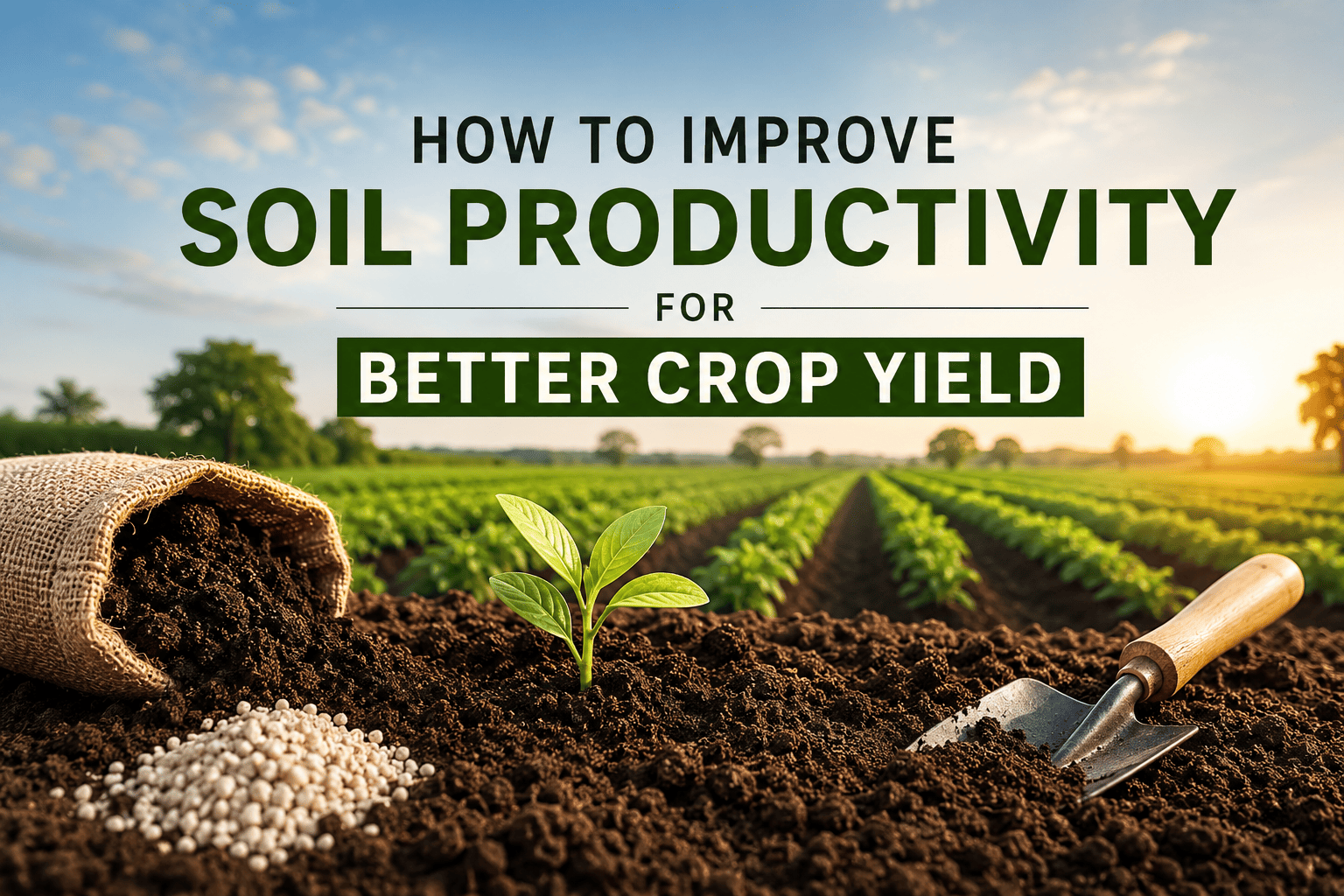
How to Improve Soil Productivity for Better Crop Yield
Healthy soil is the key to successful and profitable farming. Fertile soil helps crops grow healthy, improves yield quality, increases water retention, and reduces the need for excess fertilizers.
When soil health becomes weak due to nutrient loss, erosion, or low organic matter, crop production and farmer income are also affected. Therefore, maintaining good soil productivity is very important for long-term sustainable farming in India.
In this blog, we will list out 10 ways to improve soil fertility and productivity naturally and effectively for better crop growth and higher farm income.
What is Soil Productivity?
Soil productivity means the ability of soil to support healthy plant growth and produce good crop yields over a long period of time. Productive soil contains balanced nutrients, enough organic matter, proper moisture, and beneficial microorganisms.
Better soil productivity helps farmers:
- Increase crop yield
- Improve farm income
- Reduce fertilizer waste
- Save water
- Maintain long-term soil health
Popular Methods to Improve Soil Productivity
Here are the top 10 methods to improve soil productivity.
Regular Soil Testing
Soil testing is the first step to improving soil productivity. Many farmers apply fertilizers without knowing the actual nutrient condition of their soil. This often causes nutrient imbalance and lower yields.
A soil test checks:
- Soil pH
- Electrical Conductivity (EC)
- Nitrogen (N)
- Phosphorus (P)
- Potassium (K)
- Secondary nutrients like Sulphur and Calcium
- Micronutrients like Zinc, Iron, and Boron
After soil testing, farmers can apply the correct amount of fertilizer according to crop requirements.
For example:
- Acidic soils may need lime
- Sodic soils may need gypsum
- Zinc-deficient soils may need zinc sulphate
Instead of using the same NPK dose every year, soil-test-based fertilizer application gives better results and reduces unnecessary expenses.
Farmer Tip: Test soil once every 2 to 3 years for better nutrient management.
Increase Organic Matter
Organic matter improves soil structure and fertility naturally. Adding compost, farmyard manure (FYM), vermicompost, and green manure improves microbial activity and water-holding capacity.
Benefits of organic matter
- Improves soil aeration
- Increases moisture retention
- Reduces soil compaction
- Supplies slow-release nutrients
- Supports beneficial microbes
Indian farmers can use:
- Cow dung manure
- Vermicompost
- Crop residue compost
- Green manure crops like sunhemp and dhaincha
Practical Recommendation
- Apply 5-10 tons of FYM per acre before sowing.
- Grow green manure crops during the off-season and mix them into the soil before flowering.
Regular use of organic matter improves soil productivity year after year.
Crop Rotation and Diversification
- Growing the same crop continuously reduces soil nutrients and increases pest problems. Crop rotation helps maintain soil balance.
- Crop rotation means changing crops season by season.
Example:
|
Rotation Pattern |
Dominant Region |
|
Rice → Wheat |
Punjab, Haryana, Uttar Pradesh |
|
Rice → Pulses (Gram/Lentil) |
Eastern Uttar Pradesh, Bihar, Central India |
|
Cotton → Jowar (Sorghum) |
Maharashtra, Gujarat, and parts of Central India |
|
Maize → Wheat → Moong (Mungbean) |
Punjab, Haryana, Uttar Pradesh |
|
Bajra → Mustard → Moong |
Rajasthan, Gujarat |
|
Sugarcane → Wheat → Moong |
Western Uttar Pradesh, Maharashtra |
Legume crops like pulses fix nitrogen naturally in the soil. This reduces fertilizer requirements for the next crop.
Benefits of crop rotation
- Breaks pest and disease cycles
- Improves soil fertility
- Balances nutrient use
- Reduces weed growth
- Improves soil structure
Diversified farming improves long-term soil productivity and farm sustainability.
Cover Cropping and Green Manuring
Bare soil loses nutrients quickly due to erosion and heat. Cover crops protect soil between cropping seasons.
Common cover crops:
- Mustard
- Sorghum
- Cowpea
- Sunhemp
- Dhaincha
Benefits:
- Prevents soil erosion
- Suppresses weeds
- Adds organic matter
- Improves soil microbes
- Conserves moisture
Green manure crops should be ploughed into the soil before flowering for maximum nutrient benefit.
Simple Practice
- After harvesting the main crop, sow a quick-growing cover crop and incorporate it into the soil after 40-50 days.
- This improves soil fertility naturally.
Reduced Tillage and Mulching
Excessive ploughing damages soil structure and kills beneficial microorganisms. Reduced tillage or conservation tillage keeps soil healthier.
Benefits
- Maintains soil moisture
- Reduces erosion
- Improves microbial life
- Saves fuel and labour costs
Mulching is another useful method. Farmers can use:
- Crop residues
- Straw
- Dry leaves
- Sugarcane trash
Mulching helps:
- Reduce evaporation
- Control weeds
- Improve organic matter
- Maintain soil temperature
Farmer-Friendly Adoption
Farmers can start by reducing the number of ploughing operations and leaving crop residues on the field instead of burning them.
Balanced Use of Fertilizers and Soil Amendments
Only applying urea is not enough for healthy crops. Crops need balanced nutrition.
Important nutrients include:
- Nitrogen (N)
- Phosphorus (P)
- Potassium (K)
- Sulphur (S)
- Calcium (Ca)
- Magnesium (Mg)
- Zinc (Zn)
- Iron (Fe)
Balanced fertilizer use improves crop growth and soil health.
Important Practices
- Use split fertilizer doses
- Apply fertilizers at the right growth stage
- Use slow-release fertilizers where possible
- Apply micronutrients based on soil tests
Excess fertilizer use damages soil and increases farming costs. Balanced application gives better productivity and nutrient efficiency.
Use of Biofertilizers and Beneficial Microbes
- Biofertilizers improve nutrient availability naturally.
Common biofertilizers:
- Rhizobium
- Azospirillum
- Azotobacter
- Phosphate Solubilizing Bacteria (PSB)
- Mycorrhiza fungi
- Biostimulants such as seaweed extract, humic acid, and amino acid products also improve root growth and nutrient absorption.
Application Methods
- Seed treatment
- Soil application with FYM
- Root dipping
- Soil drenching
Benefits
- Improves root development
- Increases nutrient uptake
- Enhances stress tolerance
- Reduces chemical fertilizer dependence
Biofertilizers are affordable and suitable for small farmers.
Efficient Water Management
Poor irrigation management reduces soil productivity. Too much water causes waterlogging and salinity, while too little water reduces crop growth.
Better irrigation methods include:
- Drip irrigation
- Sprinkler irrigation
- Sub-surface drip systems
Benefits
- Saves water
- Improves nutrient efficiency
- Prevents salinity
- Reduces weed growth
Additional Practices
- Rainwater harvesting
- Field bunding
- Mulching
- Irrigation scheduling
Farmers should irrigate according to crop stage and soil moisture conditions.
Prevent and Control Soil Salinity
Salinity is becoming a major problem in many parts of India.
Common Signs
- White salt crust on soil
- Poor germination
- Yellowing leaves
- Stunted crop growth
Solutions
- Improve drainage
- Use good-quality irrigation water
- Apply gypsum in sodic soils
- Leach salts with fresh water
- Grow salt-tolerant crops initially
Regular monitoring helps prevent permanent soil damage.
Soil Erosion Control and Agroforestry
Soil erosion removes fertile topsoil and reduces productivity.
Erosion Control Methods
- Contour bunding
- Grass strips
- Terracing
- Mulching
- Cover crops
Agroforestry means growing trees along with crops.
Benefits
- Prevents erosion
- Improves soil organic matter
- Provides shade and extra income
- Increases biodiversity
Trees like neem, subabul, gliricidia, and drumstick can be planted along farm boundaries.
Benefits and Economic Advantages
Improving soil productivity provides many long-term benefits:
- Higher crop yield
- Better soil fertility
- Reduced fertilizer cost
- Improved drought resistance
- Lower pest and disease pressure
- Better water efficiency
Examples
- Balanced nutrient management can increase yield by 10-25%.
- Drip irrigation may save 30-50% water.
- Organic matter addition can improve moisture retention significantly.
- Healthy soil acts like long-term farm capital.
Conclusion
Soil productivity is the backbone of profitable and sustainable farming. Healthy soil produces healthy crops and better income for farmers. By following methods like soil testing, organic matter addition, crop rotation, balanced fertilization, efficient irrigation, and erosion control, Indian farmers can improve both short-term yield and long-term soil health.
Are you looking for sustainable farming solutions for better crop growth and healthy soil?
SV Agro Solutions supports sustainable agriculture with advanced biostimulants, fertilizers, and micronutrients that improve soil fertility, plant health, and farm productivity while protecting the environment. Our solutions help farmers achieve higher yields through balanced and healthy farming practices.
FAQs
1. Which is most important for agricultural productivity?
High-yield crop varieties and proper use of fertilizers are very important for increasing agricultural productivity.
2. What are the five factors that influence soil productivity?
Soil texture, structure, nutrients, pH level, and moisture are the main factors that affect soil productivity.
3. What is the best way to improve soil?
Adding organic matter like compost is one of the best ways to improve soil health and fertility.
4. What properties affect soil productivity?
Physical, chemical, and biological properties of soil together affect its productivity and crop growth.
.jpg)
Difference Between Soil Fertility and Soil Productivity
Every farmer knows that healthy soil is the base of a good harvest. Even with good seeds and sufficient water, if the soil lacks fertility or productivity, crops cannot grow to their full potential. In Indian agriculture, especially in Maharashtra, understanding these two terms soil fertility and soil productivity is very important.
This article explains in simple words what each term means, how they are different, and how you can improve both to achieve better yields and profit from your farm.
What is Soil Fertility?
Soil fertility means the ability of soil to provide essential nutrients and favorable conditions for plant growth.
Fertile soil has the right balance of nitrogen, phosphorus, potassium (NPK), and micronutrients like zinc, iron, and boron. It also contains sufficient organic matter (such as compost and farmyard manure), which improves soil texture, retains moisture, and supports beneficial microorganisms.
The pH level of fertile soil is also suitable not too acidic or too alkaline so that plants can absorb nutrients easily. For example, a soil rich in organic matter and nutrients supports strong root growth and high crop performance.
What is Soil Productivity?
Soil productivity refers to the soil’s capacity to produce a good crop yield under specific farming practices and conditions.
Even if a soil is fertile, productivity can remain low if other factors like irrigation, pest control, or seed quality are not properly managed. Productivity depends not only on the nutrients in the soil but also on how well the farmer manages water, seeds, weeds, and weather challenges.
For instance, two farmers may have equally fertile soil, but the one who uses proper irrigation, improved seeds, and timely management will achieve higher yields.
Difference Between Soil Fertility and Soil Productivity
|
Feature |
Soil Fertility |
Soil Productivity |
|
Meaning |
The soil’s ability to supply nutrients and favorable conditions for plant growth |
The soil’s ability to produce crops and yield under specific conditions |
|
Focus |
Soil nutrients, structure, and health |
Crop yield and farm output |
|
Dependent On |
Soil properties such as nutrients, pH, and organic matter |
Fertility plus water, seeds, weather, and management |
|
Improved By |
Adding compost, organic matter, balanced fertilizers |
Efficient irrigation, pest control, good farming practices |
|
Example |
Soil has enough nitrogen and phosphorus |
Yield remains low due to lack of water or poor seed quality |
In short:
- Soil fertility shows the potential of soil to support plant growth.
- Soil productivity reflects the actual result how much crop you get from that soil.
Factors Affecting Both Fertility and Productivity
1.Organic Matter and Compost
Adding farmyard manure, compost, and crop residues increases nutrients and improves soil texture.
2. Balanced Fertilizers
Use fertilizers that include both major (NPK) and micronutrients (Zn, Fe, B). Avoid overuse of any single nutrient.
3. Soil pH
Maintain a neutral pH (around 6.5–7.5). Highly acidic or alkaline soil prevents plants from absorbing nutrients effectively.
4. Water and Irrigation
Fertile soil cannot produce high yields without proper irrigation. Balanced water management increases productivity.
5. Crop Rotation and Green Manure
Growing different crops in sequence and using green manures (such as legumes) helps restore soil nutrients and reduce diseases.
6. Soil Structure and Tillage
Avoid over-plowing. Good soil structure allows roots to grow deep and improves water retention.
7. Pest, Disease, and Weed Management
Pests and weeds reduce productivity even in fertile soil. Regular monitoring and control are essential.
8. Climate and Weather
Drought, heavy rainfall, or temperature extremes can affect yield, even when soil fertility is high.
How Farmers Can Improve Soil Fertility and Productivity
1. Regular Soil Testing
Test soil every 2–3 years to identify nutrient levels, pH, and deficiencies. Apply fertilizers and micronutrients according to test results.
2. Use Organic Matter and Compost
Add compost, vermicompost, or green manure regularly. This increases fertility and helps soil retain water.
3. Balanced Fertilization
Avoid excessive use of urea or DAP. Apply nutrients based on crop and soil requirements.
4. Green Manure and Crop Rotation
Grow legume crops such as moong or sunn hemp before main crops. These fix nitrogen naturally and improve soil health.
5. Efficient Irrigation
Use drip or sprinkler systems to ensure even water distribution and reduce wastage.
6. Good Seeds and Timely Sowing
Use certified seeds of high-yielding varieties. Follow recommended sowing time and spacing for each crop.
7. Reduce Chemical Overuse
Overuse of chemical fertilizers and pesticides harms soil microorganisms. Combine organic and inorganic inputs for balanced soil health.
8. Weed and Pest Management
Keep your field clean and monitor for pests. Timely action ensures higher productivity.
Example from Maharashtra
For example, a farmer in Ahmednagar district tested his soil and found a zinc deficiency. He added zinc sulphate and organic compost, and used drip irrigation for better water management. The next season, his soybean yield increased from 15 to 18 quintals per hectare.
This example shows that when soil fertility (nutrient correction) and productivity factors (irrigation and management) work together, yields improve significantly.
Conclusion
For sustainable farming, both soil fertility and soil productivity must be improved together. Fertility builds the foundation for healthy soil, while productivity ensures profitable harvests.
Start by testing your soil, using balanced fertilizers, adding organic matter, and improving irrigation. These small steps can lead to a big difference in crop yield and long-term soil health.
To learn more about effective soil management or to find the right agricultural inputs for your farm, visit our Agri Products page or contact our team at SV Agro Solutions for expert guidance.
.jpg)
What is Salinization of Soil
Soil salinization is the process of salt accumulation in the top layers of soil, making it less fertile and unsuitable for healthy plant growth. It occurs due to natural factors like low rainfall and high evaporation, or human activities like poor irrigation and drainage.
Soil Salinization
Soil is the backbone of farming, but when it becomes salty, crops suffer. This condition is called salinization of soil, and it is one of the biggest threats to agriculture in Maharashtra. Farmers face reduced yield, rising costs, and weaker soil health if this issue is left untreated.
This guide explains what is salinization of soil, its causes, effects, solutions, and benefits of managing it effectively to protect your farmland. By the end, you will know how to protect your land and boost your harvest.
What is Salinization of Soil?
What is salinization of soil? It is the process where salts build up in the top layers of soil over time. When the salt content increases beyond a safe level, soil becomes less fertile, crops cannot absorb enough water or nutrients, and farming productivity goes down.
In short, it is soil becoming salty and unsuitable for healthy plant growth.
What is Saline Soil?
Saline soil is a type of salt-affected soil that contains high amounts of soluble salts like chlorides and sulfates of sodium, calcium, and magnesium. These salts build up in the soil to levels that harm most crop plants.
The key characteristics of saline soil are:
- Electrical conductivity (EC) of soil water extract above 4 dS/m (decisiemens per meter)
- pH usually less than 8.5 (neutral to slightly alkaline)
- Exchangeable sodium percentage (ESP) below 15%, which means sodium is not the dominant salt
Saline soils often appear with white or greyish salt crusts on the surface. In the field, crops may grow unevenly, with some areas showing poor germination or stunted growth due to salt toxicity.
Unlike sodic soils, saline soils usually have good physical structure and drainage but become harmful due to the excessive salt concentration affecting plant water uptake.
Saline soils are common in arid and semi-arid regions, including parts of Maharashtra, where irrigation with salty water and high evaporation rates increase salt buildup in farms.
Causes of soil salinity
Salinization in soil happens due to both natural conditions and human activities. Farmers in Maharashtra should understand these causes to prevent crop damage.
Natural causes:
- Low rainfall: Limited rain reduces the washing away of salts, causing salt buildup in soil.
- High evaporation: In hot climates, water evaporates quickly, leaving salts behind on the soil surface.
- Geological factors: Some soils naturally contain salt layers that rise to the top over time.
Human causes:
- Irrigation with salty water: Using groundwater or poor-quality water increases salt content in the soil.
- Poor drainage: Without a good drainage system, salts remain trapped in the root zone instead of being washed away.
- Excess fertilizer use: Heavy use of chemical fertilizers adds more salts, creating long-term soil problems.
Consequences of Salinization of Soil
When too much salt builds up, crops and soil health get affected.
Main consequences:
- Reduced plant growth: Salty soil increases osmotic pressure, making it harder for plants to absorb water and nutrients.
- Soil degradation: High salt damages soil texture, reduces fertility, and harms beneficial organisms.
- Desertification risk: In severe cases, productive farmland can turn barren, losing all vegetation.
Types of Salinization of Soil
Farmers should know the main forms of salinization in soil:
- Saline soils: Mostly salt crystals like chloride and sulfate.
- Sodic soils: High sodium content damaging soil structure.
- Saline-sodic soils: A combined condition that is difficult to treat.
Salinization of Water?
Salinization of water means the increase of salt content in water bodies like rivers, lakes, and groundwater. When water becomes salty, it is less useful for drinking, irrigation, and supporting healthy crops.
Causes of Water Salinization
-
Natural causes: Weathering of rocks releases salts into water. Sea spray and coastal flooding add salt to freshwater.
-
Human activities: Excessive irrigation using salty water raises salt content in groundwater. Over-extraction of groundwater near the sea leads to seawater intrusion. Land clearing and poor drainage worsen salinization. Use of chemical fertilizers adds salts to water runoff.
Effects of Water Salinization
-
Reduced water quality for drinking and farming.
-
Harm to crops due to salt toxicity when irrigated with saline water.
-
Damage to freshwater ecosystems, reducing biodiversity.
-
Lower fish production and aquatic life health.
-
Increased soil salinization when salty water is used for irrigation, creating a harmful cycle for farmland.
For Maharashtra farmers, salinization of water is a serious concern because it limits the availability of fresh, clean water for crops and livestock, increasing costs and reducing productivity.
Benefits of Managing Salinization
Managing salinity has both short-term and long-term benefits for farmers.
- Improved soil fertility and healthier crops
- Higher yields with less input cost
- Better crop quality and market value
- Reduced water waste and efficient irrigation
- Protection of land from turning barren
Solutions for Salinization of Soil
Farmers can manage salinity by using correct soil management methods.
Practical solutions:
- Apply gypsum to reduce sodium in soil
- Use drip irrigation instead of flooding fields
- Ensure good drainage system
- Grow salt-tolerant crops like barley or cotton
- Use clean water harvested from rain
SV Agro Solutions provides expert advice and farming products to help farmers overcome salinity in soil effectively.
To protect crop productivity and soil health in Maharashtra, every farmer must understand what is salinization of soil. This growing issue reduces yields and harms farmland, but it can be controlled.
Salinization of soil is a growing challenge for farmers in Maharashtra, caused by a mix of natural factors and human activities like excessive irrigation and poor drainage. If untreated, it drastically reduces soil fertility, crop yield, and ultimately farmer income.
However, with the right knowledge and management techniques such as gypsum application, improved drainage, drip irrigation, and crop rotation salinization can be controlled effectively. These methods not only protect the soil but also boost productivity and ensure the sustainability of farmlands.
The experience of many farmers in Maharashtra shows that adopting modern farming practices along with expert help from organizations like SV Agro Solutions can reclaim saline soils and revive farming success.
.jpg)
What Makes Soil Fertile
Soil fertilise simply means soil that is rich in nutrients, has good water-holding capacity, and supports strong crop growth.
Healthy soil is the foundation of good farming. Every farmer wants to know what makes soil fertile because fertile soil produces more crops and improves income.
In Maharashtra, farming depends heavily on soil health. Black cotton soil, red soil, and alluvial soil cover most of the state. By understanding what makes soil fertile, farmers can grow more crops, save costs, and improve income.
This detailed guide will explain everything in simple words: what soil fertility means, why it matters, how it works, and how to maintain it for better crop production.
What is Soil Fertility?
Soil fertility means the soil has the ability to supply all the nutrients, water, and support needed for crops to grow healthily. Fertile soil has organic matter, minerals, good texture, and many beneficial microorganisms.
Farmers often call fertile soil “jivanta zamin” (living land) because it sustains crops naturally and reduces the need for external inputs.
What Makes Soil Fertile?
Soil becomes fertile when it has enough nutrients, good structure, water-holding capacity, and living organisms to support healthy crop growth.
Soil fertility is not about one single thing. Several factors combine to make soil fertile:
Nutrient Content
Soil becomes fertile when it has all the essential plant nutrients like Nitrogen (N), Phosphorus (P), and Potassium (K), along with micronutrients such as Zinc and Iron. These nutrients play a vital role in growth, flowering, and resistance to diseases. Maintaining a balanced nutrient content ensures consistent yields season after season.
Organic Matter
Humus improves soil fertility by holding nutrients and water, releasing them slowly for crops. It also improves soil texture and prevents erosion. Farmers can build humus naturally through composting, crop residue recycling, and farmyard manure application. Higher organic matter leads to healthier soil and reduced dependency on chemical fertilizers.
Soil Structure
The structure of soil affects root growth and nutrient absorption. A loose, crumbly soil holds water and air better, while compact, hard soil restricts roots. Good structure improves microbial activity and helps crops withstand droughts and heavy rains. Farmers should avoid over-tilling and keep adding organic matter to maintain structure.
Balanced pH
Soil pH decides nutrient availability. For most crops, slightly acidic to neutral soil (6–7 pH) works best. If soil is too acidic, nutrients like phosphorus get locked; if too alkaline, zinc and iron become unavailable. Farmers can correct soil pH through lime (for acidic) or gypsum (for alkaline) application.
Biological Activity
Soil is alive, and its fertility largely depends on microorganisms and earthworms. They decompose organic matter, fix nitrogen, and release nutrients in plant-available forms. Healthy biological activity keeps soil fertile naturally. Farmers can boost soil biology by minimizing chemical overuse and promoting organic inputs such as biofertilizers and green manure.
Water and Air
Fertile soil always maintains a balance between water retention and free air spaces. Roots need both water and oxygen for growth. Sandy soils lose water quickly, while clayey soils trap too much moisture. Adding compost and maintaining proper irrigation ensures soil neither suffocates crops nor dries them too fast.
Soil Depth
Deep soils provide more space for roots, better nutrient storage, and improved water retention. Shallow soils reduce crop growth and are more prone to erosion.
For example, sugarcane and cotton grow best in deep soils, while onion and wheat can adjust to medium-depth soils. Soil depth is crucial for crop planning.
Soil Texture
Soil texture is the proportion of sand, silt, and clay. Fertile soils usually have loamy texture, meaning they hold water and nutrients but also allow drainage. In contrast, sandy soils lose nutrients fast, and clay soils get waterlogged. Maintaining texture with organic matter improves overall fertility and stability of farmland.
Presence of Micronutrients
Micronutrients like Zinc, Boron, Sulphur, and Iron, though required in small quantities, are critical for fertility and crop quality. Maharashtra soils often face zinc and sulphur deficiencies. Applying biofertilizers, micronutrient-rich compost, and mineral supplements helps restore these missing elements and makes soil healthier for long-term farming.
Salinity Control
Excess salt in soil reduces fertility because it prevents roots from absorbing water properly. This is often seen in over-irrigated or canal command areas. Managing salinity by adding gypsum, ensuring good drainage, and using organic matter keeps soil fertile. Farmers should monitor soil salinity levels regularly through testing.
Temperature and Climate Impact
Soil temperature and rainfall patterns affect fertility. Microbes work best in warm, moist soils. Too much heat slows decomposition, while excess rain can wash nutrients away. Mulching, timely irrigation, and seasonal crop rotation help farmers manage these climate-related impacts and keep soil fertile even in changing weather conditions.
Importance of Soil Fertility in Farming
Without fertile soil, farming becomes expensive and risky. Farmers may add chemical fertilizers, but if soil health is poor, crops will not give expected results.
Key importance of soil fertility in farming:
- Higher yield: Fertile soil means better harvests with the same or less effort.
- Better crop quality: Nutrient-rich soil produces healthier, tastier, and more nutritious crops.
- Reduced costs: Less dependency on chemical fertilizers and pesticides.
- Long-term productivity: Fertile soil can keep producing crops year after year without damaging land.
- Environmental balance: Healthy soil prevents erosion, saves water, and protects biodiversity.
For Maharashtra, where crops like sugarcane, cotton, soybean, bajra, and onion are lifelines, soil fertility is the foundation of a stable agricultural economy.
Types of Soil Fertility
Soil fertility is usually classified into two main types:
-
Natural Fertility:
The soil’s original ability to support crops without any external fertilizer. For example, black cotton soil of Maharashtra naturally supports cotton and soybean.
-
Acquired Fertility:
When farmers improve soil using manure, biofertilizers, crop rotation, or chemical fertilizers. You can check how and why do farmers add fertilizers to the soil
Both types are important, but long-term farming requires balancing natural and acquired fertility through soil fertility management.
For a detailed explanation of these types and how they impact your farm, please visit our full guide on Types of Soil Fertility.
Soil Fertility in Maharashtra
Maharashtra has a diverse soil base. Farmers need different fertility management depending on their region.
Types of Soil in Maharashtra:
- Black Cotton Soil (Regur): Rich in clay, good water retention, suitable for cotton, soybean, and jowar.
- Red Soil: Found in eastern parts, needs more organic matter for fertility.
- Laterite Soil: Low fertility and acidic, needs lime and organic manure.
- Alluvial Soil: Highly fertile, found near river basins, suitable for sugarcane, wheat, and rice.
Knowing the local soil type helps farmers decide how to maintain fertility.
Soil Fertility and Crop Production
Good soil fertility is directly linked to crop production. Poor fertility leads to low yields no matter how much fertilizer is applied. Sustainable crop production depends on balanced soil fertility management.
Fertile soil helps crops grow without heavy dependence on chemicals. When farmers talk about what makes the soil fertile, they usually mean how soil naturally provides what the crop needs.
For example:
- Sugarcane requires high Nitrogen and Potassium.
- Soybean needs balanced NPK with special attention to Zinc.
- Onion and garlic benefit from soils rich in Phosphorus and Sulphur.
Thus, fertility management should be crop-specific and soil-specific.
Soil Fertility Management
Soil fertility management means using the right combination of practices to maintain and improve soil health continuously for better crop yields. Effective fertility management includes:
-
Regular Soil Testing:
Knowing nutrient levels guides farmers to add the correct fertilizers and avoid wastage. Soil tests reveal deficiencies in macronutrients and micronutrients for targeted intervention.
-
Use of Organic Matter:
Adding compost, farmyard manure, and green manure enriches soil with humus, improves moisture retention, and feeds beneficial microbes that promote fertility naturally.
-
Crop Rotation:
Rotating crops, especially including legumes like tur or soybean, replenishes nitrogen in soil through biological nitrogen fixation. Crop rotation also breaks pest cycles and improves soil structure.
-
Balanced Fertilizer Use:
Applying the right amounts of chemical fertilizers based on crop and soil needs prevents nutrient imbalances and reduces environmental pollution. Micro-dose fertilizer application helps minimize losses.
-
Cover Crops and Mulching:
Growing cover crops protects soil from erosion, adds organic matter, and keeps soil moist. Mulching reduces evaporation and lowers soil temperature for healthy root systems.
-
Reduced Tillage:
Minimizing plowing keeps soil structure intact, preserves microbial life, and prevents soil erosion. No-till or minimum tillage methods are especially helpful during dry seasons.
-
Biofertilizers:
Using natural fertilizers with beneficial bacteria such as Rhizobium and Azotobacter helps fix nitrogen and improve nutrient availability without chemicals.
-
Water Management:
Efficient irrigation practices prevent waterlogging or drought stress, both of which reduce soil fertility by harming microbes and roots.
By combining these methods, Maharashtra farmers can keep their soil fertile and productive across multiple cropping seasons, ensuring sustainable farming and better incomes.
Benefits of Fertile Soil
Fertile soil offers both short-term and long-term benefits to farmers:
- Higher productivity: More crops, better quality.
- Cost efficiency: Less spending on fertilizers and pesticides.
- Sustainability: Farms remain productive for decades.
- Soil health: Better microbial activity and balanced nutrients.
- Water efficiency: Fertile soil holds water better, reducing irrigation needs.
For farmers in Maharashtra, understanding what makes soil fertile is the key to better farming. Fertile soil means better crops, lower costs, and higher profits.
By adopting soil fertility management practices, using organic manures, applying balanced fertilizers, and connecting with trusted suppliers like SV Agro Solutions, farmers can protect their land and future generations. Invest in soil fertility management today with trusted partners like SV Agro Solutions and secure your farm’s future.
2.jpg)
How to Control Bacterial Blight in Pomegranate
bacterial blight in pomegranate is one of the biggest problems for pomegranate growers in India. Farmers in Maharashtra, Karnataka, Andhra Pradesh, and Gujarat know how quickly this disease can spoil fruits and reduce income.
The disease is caused by a bacteria called Xanthomonas axonopodis pv. punicae. It spreads fast in warm and wet conditions, especially during the monsoon. If not controlled, it can damage 50–60% of the crop.
You can control it. With regular care, clean orchard practices, and timely spraying, your trees will stay healthy, and your fruits will fetch a better price in the market.
How to Identify Bacterial Blight
Look for these signs:
- Leaves – Small water-soaked spots that turn brown or black with yellow edges.
- Fruits – Black, sunken spots that may crack.
- Branches – Cankers or black patches; in severe cases, branches dry up.
If you see these symptoms, act immediately. The earlier you start control measures, the better.
Effective Management Strategies for Bacterial Blight in Pomegranate
Managing bacterial blight (Xanthomonas axonopodis pv. punicae) in pomegranate requires a combination of practical, easy-to-implement strategies. These methods are designed to be straightforward and cost-effective, especially for small-scale Indian farmers.
1. Regular Pruning and Sanitation
- Prune Infected Parts: Regularly remove and destroy infected leaves, stems, and fruits to prevent the spread of the bacteria.
- Sanitize Tools: Clean pruning tools with a disinfectant solution (e.g., 1% sodium hypochlorite) between cuts to avoid cross-contamination.
- Maintain Orchard Hygiene: Clear fallen plant debris and weeds that can harbor the pathogen.
2. Use of Resistant Varieties
- Plant Resistant Varieties: Opt for pomegranate varieties known for their resistance to bacterial blight, such as 'Bhagwa' and 'Ganesh'.
- Source Certified Plants: Ensure planting material is disease-free by purchasing from reputable nurseries.
3. Timely and Targeted Chemical Application
- Copper-Based Fungicides: Apply copper oxychloride or copper hydroxide during the early stages of infection.
- Antibiotics: Use antibiotics like streptomycin or tetracycline under expert guidance to control bacterial populations.
- Follow Label Instructions: Adhere strictly to recommended dosages and application timings to avoid resistance development.
4. Biological Control Agents
- Pseudomonas-Based Bioformulations: Studies have shown that Pseudomonas-based formulations can effectively control bacterial blight in pomegranate.
- Endophytic Bacteria: Utilize native endophytic bacteria such as Bacillus spp. to suppress the pathogen.
5. Soil and Water Management
- Improve Drainage: Ensure proper drainage in the orchard to reduce waterlogging, which can promote bacterial growth.
- Avoid Overhead Irrigation: Use drip irrigation to minimize leaf wetness, reducing the chances of infection.
- Water Management: Water early in the day to allow foliage to dry before evening, reducing humidity levels.
6. Monitoring and Early Detection
- Regular Inspections: Conduct weekly inspections of plants for early signs of infection.
- Use Diagnostic Tools: Employ simple diagnostic tools like sticky traps or visual symptom charts to identify potential outbreaks early.
7. Community Collaboration
- Share Knowledge: Engage with local agricultural extension services and fellow farmers to share experiences and solutions.
- Participate in Training: Attend workshops and training sessions on disease management to stay updated with the latest practices.
Prevention is Always Better
Bacterial blight is easier to stop before it spreads. Remember:
- Keep orchard clean and dry.
- Train workers to use clean tools.
- Check trees weekly in rainy months.
- Use disease-tolerant varieties when available.
Bacterial blight in pomegranate is a serious problem, but it can be controlled if farmers take the right steps at the right time. Simple practices like pruning infected parts, keeping orchards clean, using copper sprays carefully, and choosing resistant varieties can make a big difference. Adding bio-products like Pseudomonas formulations and following an integrated disease management schedule will protect crops and improve yield.
at SV Agro Solution , we work closely with farmers to provide scientifically tested crop protection solutions and practical field guidance. With the right knowledge and support, you can keep your orchard safe and productive.
How to Increase Soil Fertility for Better Crop Growth
Healthy and fertile soil is important for good crop growth and better yields. Soil fertility means the ability of soil to provide plants with the nutrients, water, air, and conditions they need to grow properly. Continuous farming, soil erosion, poor drainage, and loss of organic matter can reduce soil fertility over time.
Knowing how to increase soil fertility helps farmers improve crop growth, increase yields, reduce unnecessary input costs, and maintain healthy soil for future crops.
What is Soil Fertility and Why Is It Important?
Soil fertility is the ability of soil to provide essential nutrients and suitable conditions for healthy plant growth.
Fertile soil can help farmers achieve:
- Better crop growth and higher yields.
- Better quality of grains, fruits, and vegetables.
- Stronger roots and healthier plants.
- Better tolerance to drought, pests, diseases, and other stresses.
- Improved use of water and fertilizers.
Poor soil fertility can lead to weak plant growth, low yields, poor crop quality, and higher farming costs.
How to Increase Soil Fertility for Healthy Crops
Improving soil fertility requires regular care, balanced nutrition, organic matter, and proper soil management practices to support healthy crops and better yields.
1. Add Organic Matter Regularly
- Add compost, farmyard manure (FYM), vermicompost, and suitable crop residues to the soil.
- Organic matter improves soil structure, helps the soil hold water, and increases nutrient availability.
- It also supports beneficial microorganisms.
2. Practice Crop Rotation
- Grow different crops in rotation instead of growing the same crop continuously.
- For example, farmers can rotate cereals with legumes such as wheat–gram or rice–moong.
- Legumes help add nitrogen to the soil and can improve soil fertility for the following crop.
- Crop rotation also helps reduce pest and disease problems.
3. Use Green Manuring and Cover Crops
- Grow crops such as sunhemp, dhaincha, and cowpea during suitable periods.
- Mix the green plants into the soil before flowering to add organic matter and nutrients.
- Cover crops also protect the soil from erosion and help maintain soil moisture.
4. Apply Balanced Fertilizers
- Use soil test results to decide the required amount of nitrogen (N), phosphorus (P), potassium (K), and micronutrients.
- Avoid applying too much urea or any single nutrient.
- Combining organic manure with chemical fertilizers can help provide balanced crop nutrition.
5. Use Biofertilizers
Biofertilizers can support nutrient availability and beneficial microbial activity in the soil.
- Use Rhizobium mainly for pulse crops.
- Use Azotobacter or Azospirillum for suitable crops.
- Use phosphate-solubilizing bacteria (PSB) to improve phosphorus availability.
Use biofertilizers according to the crop and soil requirements.
6. Manage Soil pH
Soil pH affects nutrient availability and plant growth. Test the soil regularly to understand its pH level.
- Lime can be used to correct acidic soils when recommended.
- Gypsum or sulphur may be used for certain alkaline soil conditions.
- Always make pH corrections based on soil testing and expert recommendations.
7. Reduce Tillage and Protect Soil
- Excessive tillage can damage soil structure and reduce organic matter.
- Minimum or zero tillage can help protect the soil.
- Use crop residues as mulch to conserve moisture and reduce erosion.
- Avoid burning crop residues because they contain valuable organic matter.
8. Prevent Soil Erosion
Soil erosion removes the nutrient-rich topsoil from the field. Farmers can reduce erosion by using:
- Contour bunding.
- Terracing on suitable slopes.
- Cover crops.
- Field bunds.
- Proper drainage channels.
These practices help reduce water runoff and protect fertile topsoil.
9. Recycle Crop Residues and Organic Waste
- Return straw, stalks, leaves, and other suitable crop residues to the soil instead of burning them.
- Farm waste and suitable organic waste can also be used to prepare compost.
- Recycling these materials adds organic matter and nutrients back to the soil.
10. Test Soil Regularly
- Regular soil testing helps farmers understand the nutrient levels and pH of their soil.
- Soil can be tested every 2-3 years or as recommended.
- Use the test results to plan fertilizer, manure, and soil amendment applications.
- This helps prevent both nutrient deficiency and unnecessary fertilizer use.
How Are Fertilizers Applied to the Soil?
Fertilizers are applied to the soil using methods such as broadcasting, band placement, side-dressing, and fertigation to provide essential nutrients for healthy plant growth.
1. Broadcasting
Fertilizer is spread evenly across the field before sowing or transplanting. It can then be mixed into the soil. This method is commonly used for basic NPK application.
2. Placement or Banding
Fertilizer is placed in bands near the seeds or plant roots. This can reduce nutrient wastage and improve nutrient uptake.
3. Side Dressing
Fertilizer is applied beside growing plants. This method is commonly used for applying nitrogen during crop growth.
4. Foliar Application
Fertilizer, especially suitable micronutrients, is mixed with water and sprayed directly on plant leaves. It can help correct some nutrient deficiencies quickly during important growth stages.
5. Fertigation
Fertilizer is mixed with irrigation water and supplied through drip or sprinkler systems. This provides nutrients and water directly to the crop and is useful for vegetables, orchards, and other high-value crops.
6. Starter Solutions
Young seedlings or transplants can be treated with a suitable nutrient solution before planting. This provides early nutrient support and can help improve crop establishment.
Benefits of Increasing Soil Fertility
Improving soil fertility can provide several benefits:
- Higher and more stable crop yields.
- Better grain, fruit, and vegetable quality.
- Improved water absorption and retention.
- Stronger root growth and healthier plants.
- Better nutrient use.
- Reduced dependence on excessive chemical fertilizer use.
- Better soil performance during drought, heat, and other stresses.
Common Mistakes to Avoid
Farmers should avoid these common mistakes:
- Using only chemical fertilizers without adding organic matter.
- Applying fertilizers without soil testing.
- Using excessive amounts of one nutrient.
- Burning crop residues.
- Excessive tillage.
- Growing the same crop continuously.
- Ignoring soil pH and nutrient balance.
Best Practices to Improve Soil Fertility
For better long-term results, farmers should:
- Start with regular soil testing.
- Apply fertilizers according to soil and crop requirements.
- Combine organic and inorganic nutrient sources when required.
- Practice crop rotation and green manuring.
- Use suitable biofertilizers.
- Protect soil from erosion and compaction.
- Recycle suitable crop residues and organic matter.
- Monitor soil health regularly.
Conclusion
Knowing how to increase soil fertility is important for healthy crops, better yields, and sustainable farming. Adding organic matter, practicing crop rotation, using balanced fertilizers, applying biofertilizers, protecting soil from erosion, and testing soil regularly can improve soil fertility over time.
Improve soil fertility and support healthy crop growth with SV Agro Solutions' biostimulants and organic fertilizers. Products like SV Fruiter, SV Canter, and SV 59 help support better plant growth, nutrient availability, and overall crop development. Choose SV Agro Solutions for effective crop nutrition and healthier farming.
FAQs
1. How to increase soil fertility naturally?
Farmers can increase soil fertility naturally by using compost, manure, green manure, crop rotation, biofertilizers, and suitable crop residues.
2. How are fertilizers applied to the soil?
Fertilizers can be applied through broadcasting, banding, side dressing, foliar spray, fertigation, and starter solutions depending on the crop and nutrient requirement.
3. How to improve soil fertility in poor or degraded soils?
Poor soils can be improved by adding organic matter, using green manure, reducing excessive tillage, managing soil pH, and applying balanced fertilizers based on soil test results.
4. Can soil fertility be improved quickly?
Some nutrient deficiencies can be corrected within one crop season, but improving overall soil fertility and organic matter usually requires regular management over several years.
5. Why is soil testing important for increasing soil fertility?
Soil testing shows nutrient levels and soil pH, helping farmers choose the right fertilizers and soil amendments and avoid unnecessary applications.
What are the Different Types of Soil Fertility
Soil fertility is very important for healthy crop growth and good yields. Fertile soil provides the nutrients, water, and proper conditions that plants need to grow. However, not all soils are equally fertile. Some soils are naturally fertile, while others become fertile only after proper farming practices.
There are different types of soil fertility, including Natural Fertility, Acquired Fertility, and Biological Fertility. Understanding these types helps farmers improve crop production, maintain soil health, and increase farm income.
What is Soil Fertility?
Soil fertility is the ability of soil to provide the nutrients, water, and suitable conditions needed for healthy plant growth. A fertile soil contains essential nutrients such as Nitrogen (N), Phosphorus (P), Potassium (K), Calcium (Ca), Magnesium (Mg), Sulphur (S), Zinc, Iron, Boron, and other micronutrients.
It also has good water-holding capacity without waterlogging, allows proper air circulation for healthy root growth, and supports beneficial soil organisms. Soil fertility is influenced by factors such as soil type, climate, organic matter, soil microorganisms, farming practices, irrigation, and fertilizer use.
Types of Soil Fertility
There are three main Types of Soil Fertility.
1. Natural Fertility (Inherent Fertility)
Natural Fertility is the fertility that the soil already has without any human effort.
It depends on:
- Soil texture (sand, silt, and clay)
- Organic matter present naturally
- Minerals available in the soil
- Climate and rainfall
Examples
- Alluvial soils usually have high natural fertility.
- Sandy and rocky soils usually have low natural fertility.
Although naturally fertile soil supports good crop growth, continuous farming removes nutrients. Therefore, farmers need proper soil management to maintain fertility.
2. Acquired Fertility (Induced Fertility)
Acquired Fertility is created by farmers through proper soil management.
Farmers improve soil fertility by:
- Applying FYM and compost
- Using balanced fertilizers
- Growing green manure crops
- Following crop rotation
- Using mulching and soil conservation methods
Even poor soils can produce good crops if managed properly.
However, acquired fertility decreases when farmers:
- Use too much fertilizer without organic matter
- Grow the same crop repeatedly
- Ignore soil conservation
- Allow soil erosion
3. Biological Fertility
Biological Fertility comes from beneficial living organisms present in the soil.
These include:
- Earthworms
- Rhizobium bacteria
- Azotobacter
- Mycorrhizal fungi
- Decomposer microorganisms
These organisms help by:
- Releasing nutrients into the soil
- Improving soil structure
- Increasing water holding capacity
- Supporting healthy root growth
- Protecting plants from some soil diseases
Biological fertility reduces when:
- Soil is tilled excessively.
- Too many pesticides are used.
- Organic matter is very low.
Maintaining biological fertility is important for sustainable farming.
Soil Types and Fertility
Different soils have different fertility levels.
Loamy Soil
- Best soil for farming.
- Holds the right amount of water and air.
- Rich in nutrients and suitable for most crops.
Sandy Soil
- Has large soil particles and drains water quickly.
- Low in nutrients because they wash away easily.
- Needs regular fertilizers and organic manure for better crop growth.
Clay Soil
- Has very fine particles and holds more water.
- Rich in nutrients but can become hard and waterlogged.
- Needs proper drainage and organic matter to improve soil condition.
Silty Soil
- Soft and smooth soil with good moisture retention.
- Naturally fertile and suitable for many crops.
- Can become compact, so regular soil management is important.
Peaty Soil
- Contains a high amount of organic matter.
- Holds plenty of water but is usually acidic.
- Lime is often added to improve soil quality for farming.
Chalky Soil
- Alkaline soil with stones and quick drainage.
- Often lacks nutrients like iron and manganese.
- Needs proper nutrient management to improve fertility and crop growth.
Why is Soil Fertility Management Important?
Continuous farming removes nutrients from the soil.
- Helps plants get the nutrients they need for healthy growth and better yields.
- Improves crop quality, resulting in healthier and better-quality produce.
- Maintains soil fertility for future crops and supports long-term farming.
- Reduces soil erosion and prevents nutrient loss from the field.
- Provides a balanced supply of nutrients like nitrogen (N), phosphorus (P), potassium (K), and micronutrients.
- Promotes strong root development, helping crops tolerate drought, pests, and diseases.
- Improves soil structure by adding organic matter such as FYM and compost, which increases water-holding capacity and supports beneficial soil organisms.
- Regular soil testing helps farmers understand nutrient deficiencies and apply the right fertilizers in the correct amount.
Best Soil Fertility Management Practices
- Test your soil regularly to know the nutrient levels and soil pH.
- This helps apply the right fertilizer in the right amount.
- Use both organic manure and chemical fertilizers together for balanced crop nutrition and better soil health.
- Add organic matter like FYM, compost, vermicompost, and green manure to improve soil fertility and water-holding capacity.
- Follow crop rotation and grow legume crops like gram, soybean, or moong to naturally increase nitrogen in the soil and reduce pests and diseases.
- Avoid excessive tillage to protect soil structure, reduce erosion, and support beneficial soil microorganisms.
- Use drip or sprinkler irrigation to supply water and water-soluble fertilizers directly to the plant roots, reducing water and nutrient loss.
- Apply biofertilizers such as Rhizobium, Azotobacter, Azospirillum, and Phosphate Solubilizing Bacteria (PSB) to improve nutrient availability and support healthy crop growth.
Conclusion
Soil fertility is the ability of soil to provide nutrients, water, and a healthy environment for crop growth. There are three main Types of Soil Fertility, and Good Soil Fertility Management includes soil testing, balanced fertilizers, organic manures, crop rotation, biofertilizers, and soil conservation, helps farmers maintain healthy soil, improve crop yield, and achieve better farming results.
Looking for high-quality biostimulants to improve crop growth and soil health? SV Agro Solutions is a trusted biostimulants manufacturer and supplier in Pune, offering reliable products that help improve plant growth, nutrient uptake, stress tolerance, and overall crop productivity. Our biostimulants support sustainable farming and are trusted by farmers across India as well as customers in international markets.
Frequently Asked Questions
1. What is soil fertility?
Soil fertility is the ability of soil to supply nutrients, water, and a suitable environment for healthy plant growth.
2. How do soil types affect fertility?
Different soils have different nutrient and water-holding capacities. Loam soil is generally the most fertile, while sandy and clay soils need proper management.
3. What is Soil Fertility Management?
Soil Fertility Management includes soil testing, balanced fertilizer use, adding organic matter, crop rotation, biofertilizers, and soil conservation to improve soil fertility.
4. Can soil fertility be improved?
Yes. Farmers can improve soil fertility by adding compost and organic matter, using balanced fertilizers, following crop rotation, applying biofertilizers, and protecting the soil from erosion.
_(2)1.jpg)
Biostimulants in Agriculture: Benefits & Uses
Biostimulants are transforming the way Indian farmers grow crops without relying heavily on chemicals. If you’re a farmer looking to improve yield, reduce stress on plants, and build long-term soil health, biostimulants offer a sustainable and effective solution.
This guide breaks down what biostimulants are, how they work, where and how to use them, and what real-world results look like especially in Indian agricultural conditions.
What Are Biostimulants?
Biostimulants are substances or microorganisms that, when applied to seeds, plants, or soil, stimulate natural processes to enhance nutrient uptake, crop quality, and stress tolerance. They are not fertilizers or pesticides, but they complement both.
Common Types of Biostimulants:
- Humic and fulvic acids – Improve root structure and nutrient absorption.
- Seaweed extracts – Encourage plant growth and help manage environmental stress.
- Amino acids and peptides – Help plants recover from drought, heat, and salinity.
- Microbial inoculants (e.g., mycorrhizae, Bacillus strains) – Enhance soil microbiology and nutrient cycling.
- Protein hydrolysates – Improve seedling vigor and flowering.
Key Benefits of Biostimulants in Indian Agriculture
1. Increase Crop Yield
Biostimulants improve plant metabolism and nutrient use, leading to higher and more consistent yields.
Example:
In field trials in Haryana, foliar application of amino acid-based biostimulants in wheat led to an 8–12% increase in grain output.
2. Enhance Soil Health
Biostimulants support soil microbial life and improve organic matter content, making the soil more fertile over time.
3. Improve Plant Resilience to Climate Stress
India's diverse climates drought in the west, high humidity in the east pose stress to crops. Biostimulants help crops manage heat, salinity, and water stress better.
Case Study:
In Maharashtra, cotton treated with seaweed-based biostimulants during a dry spell had better boll retention and 10–15% higher yield.
4. Improve Fertilizer Efficiency
Biostimulants increase the plant’s ability to absorb and utilize nutrients, which can reduce dependency on chemical fertilizers.
5. Environmentally Safe
Most biostimulants are biodegradable and leave no harmful residue in the soil or water, making them ideal for organic and sustainable farming.
Where and How to Use Biostimulants Effectively
Recommended Crops for Use:
- Cereal crops: Wheat, Rice, Maize
- Cash crops: Cotton, Sugarcane
- Fruits: Banana, Mango, Pomegranate
- Vegetables: Tomato, Brinjal, Chilli, Onion
Best Application Stages:
- Seed Treatment: Improves germination and root establishment.
- Foliar Spray: Applied during vegetative and flowering stages for growth and yield.
- Soil Drench: At planting or early growth to support root development.
Practical Application Tips:
- Use early morning or late afternoon for best absorption.
- Do not mix with strong pesticides unless compatibility is clearly mentioned.
- Start with small trial plots to observe performance before scaling.
Biostimulants vs. Traditional Fertilizers
|
Aspect |
Biostimulants |
Chemical Fertilizers |
|
Main Function |
Stimulate natural plant processes |
Supply nutrients directly |
|
Long-term Soil Health |
Improves |
May degrade with overuse |
|
Environmental Impact |
Low |
Moderate to high |
|
Return on Investment |
High with consistent use |
Variable, depends on efficiency |
|
Cost Over Time |
Slightly higher initially |
May increase with soil depletion |
Biostimulants offer a smart, science-backed way to improve productivity, particularly under India's climate challenges. When used correctly, they enhance both short-term yield and long-term sustainability.
Start small. Choose one crop, apply a tested biostimulant, and monitor results. With the right approach, biostimulants can become an essential part of your integrated farming practice.
[accordion title="Can I use biostimulants in organic farming?"] Yes. Many biostimulants are approved for organic certification and are safe for sustainable practices.[/accordion]
[accordion title="Do biostimulants replace fertilizers?"]They work best when used in combination with fertilizers by improving their effectiveness.[/accordion]
[accordion title="Are biostimulants costly?"] They may cost more upfront, but savings in fertilizer use and increased crop yield often offset the investment[/accordion]
[accordion title="Where can I get quality biostimulants?"]Look for government-approved products from reliable suppliers like IFFCO, UPL, Biostadt, or your local Krishi Vigyan Kendra (KVK).[/accordion]
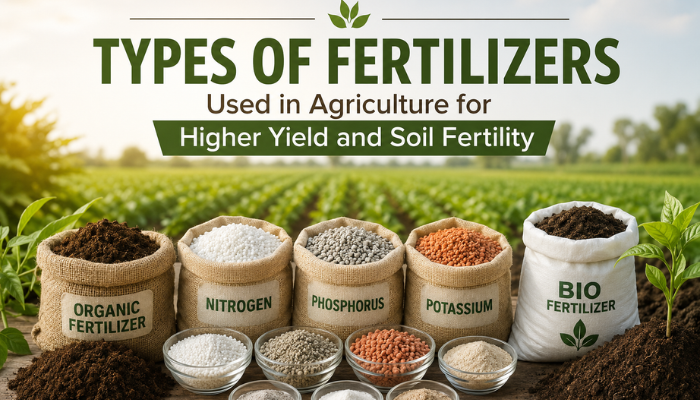
Types of Fertilizers Used in Agriculture for Higher Yield and Soil Fertility
Every season, farmers put in effort, money, and time to grow good crops. But no matter how well you work your land, crops cannot grow well without proper nutrition. Just like humans need food to stay healthy and strong, plants also need nutrients to grow, flower, and give good yields.
Every time a crop grows and is harvested, it takes important nutrients out of the soil. Over time, if these nutrients are not put back, the soil becomes weak, and crop production goes down. This is where fertilizers come in.
Fertilizers are one of the most important tools a farmer has. They help restore the nutrients that crops take from the soil, so the land stays fertile and productive year after year. In this blog, we will explain the different types of fertilizers used in agriculture, how they work, and how you can use them wisely on your farm.
Types of Fertilizers Used in Agriculture
There are several types of fertilizers used in agriculture. Each type serves a different purpose and is suited to different crops, soils, and farming situations.
1. Nitrogen Fertilizers
- Nitrogen (N) is one of the most important nutrients for plants.
- It is responsible for leafy, green growth and helps in the formation of proteins, which are essential for plant development.
- When a plant does not get enough nitrogen, its leaves turn yellow and growth slows down.
Examples
- Urea (46% nitrogen)- the most commonly used nitrogen fertilizer by farmers
- Ammonium Sulfate- good for crops that also need sulfur
- Calcium Ammonium Nitrate (CAN)- releases nitrogen slowly and is gentle on the soil
2. Phosphorus Fertilizers
- Phosphorus (P) plays a key role in root development, flowering, and fruit setting.
- It also helps in energy transfer within the plant.
- Crops that do not get enough phosphorus have weak roots, delayed flowering, and poor fruit or grain development.
Common examples:
- DAP (Diammonium Phosphate) contains both nitrogen and phosphorus, very popular among farmers
- SSP (Single Super Phosphate) also provides sulfur and calcium along with phosphorus
3. Potassium Fertilizers
- Potassium (K) helps improve fruit quality, regulate water use in plants, and build resistance against diseases and stress.
- It is especially important for fruit and vegetable crops.
- Plants low in potassium show brown leaf edges and poor fruit quality.
Common examples:
- Muriate of Potash (MOP)- the most widely used potassium fertilizer
- Sulfate of Potash (SOP)- preferred for sensitive crops like fruits and vegetables
4. Complex or Compound Fertilizers
- Complex or compound fertilizers contain two or more nutrients in a single product.
- This makes them very convenient for farmers because one application provides multiple nutrients at the same time.
- They save time, reduce labour, and ensure that plants get a balanced supply of nutrients.
Examples:
- 10:26:26 - commonly used for oilseeds and pulses
- 12:32:16 - suitable for cereals and vegetables
- 19:19:19 - a balanced formula used in foliar sprays
5. Organic Fertilizers
- Organic fertilizers come from natural plant or animal sources.
- They improve the overall health of the soil over time, not just the current crop.
- They release nutrients slowly, which reduces the risk of over-fertilizing, and they also improve soil structure, water holding capacity, and the activity of beneficial microorganisms.
Examples:
- Compost- made from decomposed plant and household waste; improves soil structure
- Farm Yard Manure (FYM)- made from animal dung and urine; one of the oldest and most trusted fertilizers
- Vermicompost- produced by earthworms; nutrient-rich and excellent for soil health
- Green Manure- crops like dhaincha or sunhemp grown and plowed back into the soil
6. Biofertilizers
- Biofertilizers are products that contain living microorganisms, tiny helpful organisms that live in the soil and help plants absorb more nutrients, especially nitrogen and phosphorus.
- They are eco-friendly, affordable, and help reduce dependence on costly chemical fertilizers.
Examples:
- Rhizobium- fixes nitrogen from the air and works best with legume crops like pulses and beans
- Azotobacter- a free-living bacteria that fixes nitrogen and is good for cereals and vegetables
- Phosphate-Solubilizing Bacteria (PSB) makes locked phosphorus in soil available to plants
7. Micronutrient Fertilizers
- Just as the human body needs vitamins in small amounts, crops also need small but important quantities of nutrients called micronutrients.
- Even if your soil has good levels of nitrogen, phosphorus, and potassium, a lack of micronutrients can cause hidden deficiencies that reduce yield and quality.
Important micronutrients for crops:
- Zinc- Most commonly deficient in Indian soils; important for grain formation and crop growth
- Iron- It is needed for chlorophyll formation and green leaf color
- Boron- It is essential for flowering, pollination, and fruit setting
- Manganese - It helps in photosynthesis and disease resistance
Fertilizers and Pesticides Used in Agriculture
Fertilizers provide essential nutrients for healthy crop growth, while pesticides protect crops from pests, diseases, and weeds.
|
Category |
Type |
Benefits |
Common Examples |
|
Fertilizers |
Inorganic (Chemical) Fertilizers |
Promote fast crop growth, correct nutrient deficiencies, and increase crop yield. |
Urea, Ammonium Nitrate, Single Super Phosphate (SSP), Muriate of Potash (MOP) |
|
Fertilizers |
Organic and Biofertilizers |
Improve soil fertility, increase water-holding capacity, enhance microbial activity, and support sustainable farming. |
Farmyard Manure (FYM), Vermicompost, Bone Meal, Fish Meal |
|
Pesticides |
Insecticides |
Protect crops from insect attacks and reduce yield losses. |
Organophosphates, Pyrethroids |
|
Pesticides |
Herbicides |
Help crops utilize nutrients efficiently and improve productivity. |
Glyphosate |
|
Pesticides |
Fungicides |
Protect crops from diseases such as blight, rust, and powdery mildew. |
Copper-based Fungicides |
|
Pesticides |
Biopesticides |
Safe for the environment, reduce chemical usage, and support sustainable agriculture. |
Neem Oil, Garlic Extract Spray |
How to Choose the Right Fertilizer
Choosing the right fertilizer is not easy. Here are the important factors to consider:
Based on Soil Test Results
- Always get your soil tested before applying fertilizers.
- A soil test tells you exactly which nutrients are lacking and in what quantity.
- This prevents wastage and overspending.
Based on Crop Type and Growth Stage
- Different crops need different nutrients.
- Also, a crop's need changes as it grows, for example, it may need more nitrogen in the early stage and more potassium and phosphorus during flowering and fruiting.
Based on Nutrient Deficiency Symptoms
- Learn to read your crops.
- Yellow leaves, weak stems, poor flowering, or small fruits can all be signs of specific nutrient deficiencies.
Based on Farm Budget and Sustainability Goals
- If you are on a tight budget, start with organic options like compost or biofertilizers.
- These are low-cost and help build long-term soil health.
Conclusion
Fertilizers are a vital part of modern farming. Whether you are growing rice, wheat, vegetables, or fruits, proper fertilizer use can make the difference between a poor harvest and an excellent one.
In this blog, we covered the major types of fertilizers used in agriculture nitrogen, phosphorus, potassium, compound, organic fertilizers, biofertilizers, and micronutrient fertilizers. Each has its own role and benefits. The key is to understand your soil, know your crop's needs, and apply the right fertilizer at the right time and in the right amount.
Looking for high-quality fertilizers to improve crop growth and productivity?
SV Agro Solutions is a trusted fertilizer manufacturer and supplier in Pune, offering reliable fertilizer solutions for farmers and agricultural businesses. Our products are designed to improve soil fertility, support healthy crop growth, and increase farm productivity. We serve farmers across India and also export our high-quality fertilizers to international markets, helping growers achieve better yields and sustainable farming results.
Frequently Asked Questions (FAQs)
1. Why do farmers use fertilizers?
Farmers use fertilizers to provide essential nutrients that improve crop growth, yield, and soil fertility.
2. What are the types of fertilizers used in agriculture?
The main types include nitrogen fertilizers, phosphorus fertilizers, potassium fertilizers, complex fertilizers, organic fertilizers, biofertilizers, and micronutrient fertilizers.
3. Are fertilizers and pesticides used in agriculture the same thing?
No, fertilizers provide nutrients to crops, while pesticides protect crops from pests, diseases, and weeds.
4. Which fertilizer is best for crop growth?
There is no single best fertilizer. The right fertilizer depends on crop type, soil condition, nutrient requirement, and growth stage.
What is Soil Conditioner & How it Differs from Fertilizer
Healthy soil is the foundation of successful farming. No matter how good the seed or fertilizer is, crops cannot perform well if the soil is hard, compacted, or lacks proper structure. Poor soil affects root growth, water movement, and nutrient absorption, which finally reduces crop yield.
This is where many farmers ask, what is soil conditioner and why is it important? Soil conditioners are special materials added to soil to improve soil structure, water movement, aeration, and root development. They help make soil healthier and more productive over time.
In this blog, we will understand soil conditioner meaning, its types, examples, benefits, and how it differs from fertilizer.
What is Soil Conditioner?
A soil conditioner is a natural or man-made material added to soil to improve its quality. It helps make the soil loose, improves air and water movement, increases water-holding capacity, and supports beneficial microbes.
Unlike fertilizers that directly provide nutrients to plants, soil conditioners improve the soil so plant roots can grow better and absorb water and nutrients more easily.
It helps:
- Loosen hard and compacted soil
- Improve water drainage
- Increase water-holding capacity
- Support beneficial microbes
- Promote better root growth
Healthy roots grow better in conditioned soil, which leads to stronger plants and better crop production.
Soil Conditioner Examples
Soil conditioners are of two main types: organic and inorganic.
- Compost - Made from decomposed organic waste. It improves soil fertility, structure, and microbial activity.
- Peat Moss - Helps soil hold more water and improves soil looseness.
- Vermicompost - Made by earthworms. It is rich in nutrients and improves soil health.
- Biochar - A carbon-rich material that helps soil store water and nutrients for a longer time.
- Perlite - Improves air movement in soil and prevents soil compaction.
- Vermiculite - Helps soil hod water and nutrients while keeping it light.
- Gypsum- Breaks hard clay soil and improves water drainage without changing soil pH.
- Agricultural Lime- Reduces soil acidity and adds calcium for better soil health.
Soil Conditioner vs Fertilizer
Many farmers think soil conditioner and fertilizer are the same, but they have different roles.
|
Feature |
Fertilizer |
Soil Conditioner |
|
Main Purpose |
Provides essential nutrients like Nitrogen (N), Phosphorus (P), and Potassium (K) directly to plants. |
Improves the physical, chemical, and biological condition of soil. |
|
How It Works |
Gives quick nutrition to plants and helps improve growth, flowering, and fruit production. |
Improves soil texture, aeration, drainage, and water-holding capacity for better root growth. |
|
Use |
Used to correct nutrient deficiency and support crop growth. |
Used to improve poor, compact, sandy, or damaged soil. |
|
Best Time to Apply |
During crop growth stages when plants need nutrients. |
Before planting or during soil preparation. |
|
Main Benefit |
Faster plant growth and better crop yield. |
Healthier soil and better long-term crop performance. |
|
Examples |
NPK fertilizers, urea, DAP, liquid fertilizers |
Compost, peat moss, leaf mold, biochar, gypsum, lime |
Types of Soil Conditioners
Soil conditioners are mainly of two types:
Organic Soil Conditioners
- Organic soil conditioners are made from natural plant and animal materials.
- Common examples are compost, manure, vermicompost, and biochar.
- They improve soil fertility naturally.
- They increase beneficial microbial activity in the soil.
- They help soil hold water for a longer time.
- They are very useful for improving poor and damaged soil.
- These conditioners support sustainable and eco-friendly farming.
Inorganic Soil Conditioners
- Inorganic soil conditioners are made from minerals or other non-organic materials.
- Common examples are gypsum, lime, and soil polymers.
- Gypsum helps reduce soil salinity and improves heavy soil structure.
- Lime helps balance acidic soil and improves soil pH.
- Soil polymers help sandy soil retain more water.
- They improve soil structure and support better root growth.
- These conditioners help crops get proper moisture and nutrients.
These are mainly used for correcting drainage problems, adjusting soil pH, and improving heavy soils.
Benefits of Soil Conditioners
Using soil conditioners provides many long-term benefits for farmers.
- Improves Soil Structure
Soil conditioners make hard and compact soil loose and improve sandy soil structure. This helps roots grow easily and allows proper air and water movement. - Increases Water Retention
They help soil hold water for a longer time. This reduces water stress and lowers the need for frequent irrigation. - Improves Nutrient Absorption
Soil conditioner fertilizer helps soil store nutrients better and allow plants to absorb them easily for healthy growth. - Increases Beneficial Microbes
They support useful soil bacteria and fungi that naturally improve soil fertility and help plants grow stronger. - Prevents Soil Erosion
Soil conditioners bind soil particles together, which helps prevent soil loss caused by heavy rain and strong wind.
When to Use a Soil Conditioner?
- Mix the soil conditioner into the soil before planting to make the soil loose, fertile, and healthy for better root growth.
- Apply it regularly to old or weak soil to restore soil fertility and improve soil health.
- Add soil conditioner when the field is empty to refill nutrients used by previous crops and prepare the soil for the next season.
How to Use Soil Conditioners?
- Improves Soil Quality
Soil conditioners improve soil structure, drainage, and water-holding capacity for better plant growth. - Mix Before Planting
Mix the soil conditioner evenly into the top 4-6 inches of soil before sowing or planting. - Use in Established Crops or Gardens
Spread an even layer on the soil surface around existing plants. - Water After Application
Water the soil properly after applying the conditioner to help it mix well and start improving the soil.
Conclusion
A soil conditioner is not a replacement for fertilizer. If you are wondering what is soil conditioner, it is a soil-improving material that helps improve the physical condition of soil. While fertilizers directly provide nutrients to plants, soil conditioners improve soil structure and create a better environment for root growth, beneficial microbes, and efficient nutrient absorption.
Looking for an effective soil conditioner for healthier soil and better crop yield?
SV 59 by SV Agro Solutions is an advanced soil conditioner that improves soil structure, boosts root development, increases microbial activity, and improves water-holding capacity. It helps make fixed nutrients available to plants, improves aeration, reduces chemical fertilizer use by up to 50-70%, and increases crop resistance and yield. This EcoCert-certified organic soil conditioner supports sustainable and profitable farming.
Frequently Asked Questions
1. What does a soil conditioner do?
Soil conditioner improves soil structure, water retention, aeration, and overall soil health for better plant growth.
2. Is soil conditioner good for drainage?
Yes, soil conditioner improves drainage by loosening compacted soil and allowing better water movement.
3. Is soil conditioner the same as fertilizer?
No, fertilizer feeds plants directly, while soil conditioner improves soil quality for better nutrient absorption.
4. Which plant material is often used as a soil conditioner?
Compost and peat moss are commonly used plant-based soil conditioners that improve soil fertility and moisture retention.
.jpg)
Plant growth regulators and their functions
A plant growth regulator helps farmers guide how a plant grows. It tells the plant when to grow roots, when to flower, when to ripen fruits, or how to handle stress like drought. These regulators are now a key part of modern agriculture.
What is a Plant Growth Regulator?
A plant growth regulator (PGR) is a natural or synthetic substance used to control a plant's growth, flowering, fruiting, and stress responses. These chemicals work like hormones in plants and are widely used in agriculture to improve crop performance and farming outcomes.
These regulators are used in many areas:
- Field crops
- Horticulture (vegetables, fruits, flowers)
- Tissue culture
- Greenhouse farming
In this guide, we will explain everything in simple terms no complicated science, just practical knowledge for everyday farming
Classification of Plant Growth Regulators
1. Plant Growth Promoters
These help the plant grow faster or stronger.
|
Regulator |
Function |
|
Auxins |
Root development, fruit formation, cell elongation |
|
Gibberellins |
Stem elongation, seed germination, fruit size |
|
Cytokinins |
Shoot growth, cell division, delay in leaf aging |
2. Plant Growth Inhibitors
These slow down certain processes or help plants handle stress.
|
Regulator |
Function |
|
Abscisic Acid (ABA) |
Drought resistance, stomatal closure, seed dormancy |
|
Ethylene |
Fruit ripening, flower opening, leaf fall |
What are the 5 types of plant growth regulators and their functions
There are five main types of plant growth regulators. Some help the plant grow faster, while others slow it down or prepare it for stress.
1. Auxins – Promote Root and Fruit Growth
Main Functions:
- Stimulate root development in seedlings and cuttings
- Help in cell elongation (plant stems grow longer)
- Support fruit formation, especially in seedless fruits
- Control leaf and flower fall (can delay or promote)
- Used in weed control (at high doses)
Example Crops:
- Tomato (rooting in nursery)
- Pineapple (fruit development)
- Cotton (control leaf drop before harvest)
2. Gibberellins – Increase Plant Height and Fruit Size
Main Functions:
- Promote stem elongation (plants grow taller)
- Break seed dormancy and support germination
- Encourage flowering in long-day plants
- Improve fruit size and quality
- Used to make fruits grow without pollination
Example Crops:
- Grapes (bigger fruit size)
- Sugarcane (increase height and yield)
- Barley (germination in malt industry)
3. Cytokinins – Help Shoots and Delay Aging
Main Functions:
- Promote cell division (plants grow faster)
- Encourage shoot growth and branching
- Help in the development of buds
- Delay yellowing of leaves (keeps them green)
- Useful in tissue culture for growing plantlets
Example Crops:
- Leafy vegetables (keep leaves fresh)
- Banana and brinjal (better branching)
- Used in plant labs for micropropagation
4. Abscisic Acid (ABA) – Helps Plants Handle Stress
Main Functions:
- Promotes stomatal closure to prevent water loss during drought
- Maintains seed dormancy until conditions are good for growth
- Helps plants tolerate stress like drought, salt, or cold
- Slows down plant growth in unfavorable conditions
Example Crops:
- Rice and wheat (drought resistance)
- Maize and groundnut (stress management)
- Used in research for climate-resilient crops
5. Ethylene – Controls Ripening and Shedding
Main Functions:
- Speeds up fruit ripening (especially in climacteric fruits)
- Promotes flower opening
- Triggers leaf and fruit drop before harvest
- Helps in uniform ripening in commercial production
- Induces flowering in some crops like pineapple
Example Crops:
- Banana, mango, tomato (quick ripening)
- Cotton and citrus (pre-harvest leaf drop)
- Pineapple (flower induction)
Plant Growth Regulators and Their Role in Sustainability
Sustainability in agriculture means growing food with less harm to the environment, better use of resources, and long-term productivity. Here's how plant growth regulators support this:
Efficient Use of Resources
- Reduce the need for extra water or fertilizer
- Boost crop performance under drought or salinity
Less Crop Wastage
- Help crops ripen at the same time, improving harvest planning
- Reduce fruit drop before harvest
Support Organic and Eco Farming
- Some PGRs (like natural auxins or ABA) are used in organic systems
Improve Climate Resilience
- ABA helps plants survive heat and water stress
- Ethylene supports ripening during short growing seasons
A plant growth regulator is a powerful tool that helps farmers manage plant growth and improve farm productivity. Each regulator plays a unique role from root growth to fruit ripening and together they make farming smarter, faster, and more sustainable.
Farmers looking to reduce crop loss, improve yield, or grow better-quality produce can greatly benefit from understanding and using PGRs correctly.
For high-quality agricultural solutions, farmer-friendly advice, and trusted plant growth regulators, visit Sv Agro Solution your partner in modern farming.
What is Organic Fertilizer - The Natural Solution for Farming
Farmers want two things: higher crop yields and healthy soil for the future. However, overusing chemical fertilisers can degrade soil quality over time. Therefore, farmers are increasingly adopting natural solutions. If you are wondering what is organic fertilizer, it is a safe and natural way to improve soil fertility and grow better crops without harming the environment.
Organic fertilizers not only help increase crop production but also improve soil health for long-term farming. In areas like Pune, where soil quality plays a big role in farming success, using organic fertilizer for plants can make a noticeable difference. It helps crops grow stronger, improves water retention, and supports sustainable agriculture.
What is Organic Fertilizer?
Organic fertilizer is made from natural materials such as compost, cow dung, vermicompost, poultry manure, plant waste, and other organic matter. Organic fertilizer for plants provides essential nutrients like nitrogen, phosphorus, potassium, and micronutrients needed for plant growth.
Unlike chemical fertilizers, organic fertilizers release nutrients slowly. This means plants get a steady supply of nutrients over time, which reduces waste and improves efficiency.
How Organic Fertilizers Increase Crop Yield
Many farmers search for natural ways to improve productivity. Organic fertilizers are one of the best solutions because they support both plant growth and soil health.
1. Slow and Steady Nutrient Release
Organic fertilizers break down gradually in the soil. This ensures that plants receive nutrients throughout their growth cycle instead of all at once.
This steady supply helps improve crop quality, fruit size, and overall yield.
2. Improves Soil Structure
Organic matter makes the soil soft, loose, and well-aerated. This allows roots to grow deeper and stronger.
Better soil structure helps:
- Improve air circulation
- Increase water absorption
- Reduce soil compaction
Healthy soil directly leads to better crop yield.
3. Boosts Microbial Activity
Soil contains helpful microorganisms that play a key role in plant growth. Organic fertilizers feed these microbes, making the soil more active and fertile.
More microbes mean:
- Better nutrient breakdown
- Improved nutrient availability
- Healthier crops
4. Strong Root Development
Healthy soil conditions lead to stronger root systems. Strong roots can absorb more nutrients and water, which improves plant growth.
Deep roots also help plants survive drought conditions and remain stable.
5. Better Water Holding Capacity
Organic fertilizers increase the soil’s ability to hold water. This is especially useful in areas where rainfall is uncertain.
With better moisture retention:
- Crops face less stress during dry periods
- Growth remains consistent
- Yield improves
6. Improved Resistance to Diseases and Stress
Plants grown with organic fertilizers are generally stronger and more resistant to pests and diseases.
How to Use Organic Fertilizer for Better Results
Using organic fertilizer correctly is important to get the best results. Here are some simple practices farmers can follow:
1. Choose the Right Fertilizer
Different crops require different nutrients. Selecting the right organic fertilizer is important.
Examples:
- Compost for improving soil structure
- Cow dung for balanced nutrients
- Vermicompost for quick nutrient availability
2. Apply at the Right Time
Organic fertilizers should be applied:
- Before sowing
- During soil preparation
- During crop growth, as needed
3. Use Proper Application Methods
Common application methods include:
- Broadcasting before planting
- Mixing with soil during ploughing
- Side dressing near plant roots
- Using liquid organic fertilizers through drip systems
4. Do Soil Testing
Soil testing helps identify nutrient deficiencies. This ensures that the right type and amount of fertilizer is used.
5. Maintain Soil Regularly
Adding organic matter every season keeps the soil fertile and productive for a long time.
Challenges of Organic Fertilizers
Although organic fertilizers offer many benefits, farmers may face some challenges:
1. Slow Results: Organic fertilizers release nutrients slowly, so results may take time compared to chemical fertilizers.
2. Nutrient Variation: The nutrient content in organic materials may vary, which can affect consistency.
3. More Labour Required: Preparing and applying organic fertilizers may require more effort. However, this reduces over time as soil health improves.
Role of a Trusted Organic Fertilizer Manufacturer
The quality of fertilizer directly impacts crop growth, soil health, and overall farm productivity. Choosing a reliable organic fertilizer manufacturer ensures that farmers get safe, effective, and high-quality products that deliver consistent results.
A trusted manufacturer not only provides fertilizers but also supports farmers with the right knowledge and solutions for better farming outcomes.
SV Agro Solutions is a trusted name for high-quality organic fertilizers. They are committed to helping farmers achieve better yields while maintaining soil health and sustainability.
SV Agro Solutions offers:
- Premium organic fertilizer products made from natural ingredients
- Solutions designed for different crops and farming needs
- Expert support to guide farmers on correct usage
- A focus on eco-friendly and sustainable farming practices
By choosing us, farmers can improve crop productivity, increase soil quality, and move towards long-term sustainable farming with confidence.
Conclusion
Organic fertilizers are a natural and effective way to improve soil fertility, increase crop yield, and support sustainable agriculture. What is Organic Fertilizer? It is a type of fertilizer made from natural sources like plant and animal waste that enriches the soil without harmful chemicals.
By using organic fertilizer for plants correctly and choosing a trusted organic fertilizer manufacturer, farmers can achieve better results without harming the environment.
Although it may take time to see full results, the long-term benefits are much greater. Organic fertilizers help build healthy soil, grow stronger crops, and ensure farming success for future generations.
Frequently Asked Questions
1. What are 5 examples of organic fertilizer?
Ans: Some common examples of organic fertilizers are:
- Compost
- Cow dung manure
- Vermicompost
- Poultry manure
- Seaweed fertilizer
These are natural and help improve soil health over time.
2. What is the difference between organic fertilizer and regular fertilizer?
Ans: Organic fertilizer is made from natural materials and releases nutrients slowly. It improves soil health and supports long-term farming. Regular (chemical) fertilizer gives quick nutrients but may harm the soil if used too much.
3. How long does organic fertilizer take to work?
Ans: Organic fertilizers work slowly. You may start seeing results in a few weeks, but full benefits usually take one or more growing seasons.
4. Do I need organic fertilizer?
Ans: Yes, if you want healthy soil and long-term crop growth. Organic fertilizer is especially useful for improving soil quality and growing crops naturally.
5. Can you overfeed with organic fertilizer?
Ans: Yes, but it is less harmful compared to chemical fertilizers. Too much organic fertilizer can still affect plant growth, so it’s important to use the right amount.
.jpg)
17 essential plant nutrients and their functions
Essential plant nutrients are the key elements that plants need to grow healthy and strong. Without these nutrients, plants cannot develop properly or produce good fruits and flowers.
Plants need certain nutrients from the soil, air, and water to grow well. There are17 essential plant nutrients and their functions that every plant requires. Each nutrient has a special job to help the plant grow, stay healthy, and produce fruits or seeds. Knowing these nutrients and what they do can help gardeners and farmers take better care of their plants.
What Are macro and micro nutrients?
Essential plant nutrients are special elements in the soil that plants need to grow from seed to harvest. If any one is missing, the plant cannot complete its life cycle.
There are two main types:
- Macronutrients: Needed in large amounts (like Nitrogen, Phosphorus, Potassium).
- Micronutrients: Needed in small amounts (like Iron, Zinc, Copper).
How Many Essential Plant Nutrients Are There?
There are 17 essential nutrients that every plant needs:
- Basic nutrients: Carbon (C), Hydrogen (H), Oxygen (O) (plants get these from air and water)
- Primary macronutrients: Nitrogen (N), Phosphorus (P), Potassium (K)
- Secondary macronutrients: Calcium (Ca), Magnesium (Mg), Sulfur (S)
- Micronutrients: Iron (Fe), Manganese (Mn), Zinc (Zn), Copper (Cu), Boron (B), Molybdenum (Mo), Chlorine (Cl), Nickel (Ni)
17 essential plant nutrients and their functions
|
Nutrient |
Type |
Main Functions |
|
Carbon (C) |
Basic |
Building block of organic molecules; energy and structure. |
|
Hydrogen (H) |
Basic |
Component of water and organic compounds; energy transfer. |
|
Oxygen (O) |
Basic |
Required for respiration and energy release. |
|
Nitrogen (N) |
Primary Macro |
Leafy growth, chlorophyll, proteins, nucleic acids, enzymes. |
|
Phosphorus (P) |
Primary Macro |
Root development, energy transfer (ATP), flowering, fruiting, DNA/RNA synthesis. |
|
Potassium (K) |
Primary Macro |
Water regulation, enzyme activation, photosynthesis, stress resistance, fruit quality. |
|
Calcium (Ca) |
Secondary Macro |
Cell wall structure, growth, nutrient transport, enzyme activation. |
|
Magnesium (Mg) |
Secondary Macro |
Central to chlorophyll, enzyme activation, energy transfer. |
|
Sulfur (S) |
Secondary Macro |
Amino acids, proteins, vitamins, enzyme activation, chlorophyll synthesis. |
|
Iron (Fe) |
Micronutrient |
Chlorophyll synthesis, electron transport, enzyme function. |
|
Manganese (Mn) |
Micronutrient |
Photosynthesis, enzyme activation, nitrogen metabolism. |
|
Zinc (Zn) |
Micronutrient |
Enzyme activation, hormone production, protein synthesis. |
|
Copper (Cu) |
Micronutrient |
Enzyme activation, photosynthesis, lignin synthesis, vitamin A production. |
|
Boron (B) |
Micronutrient |
Cell wall formation, sugar transport, reproductive growth. |
|
Molybdenum(Mo) |
Micronutrient |
Nitrogen fixation, enzyme activation, nitrate to amino acid conversion. |
|
Chlorine (Cl) |
Micronutrient |
Osmotic and ionic balance, photosynthesis, disease resistance. |
|
Nickel (Ni) |
Micronutrient |
Nitrogen metabolism, enzyme activation, seed germination. |
Essential Plant Nutrients and Their Deficiency Symptoms
Here are some common problems you might see:
- Nitrogen deficiency: Leaves turn light yellow, plants look weak and do not grow well.
- Phosphorus deficiency: Leaves may look dark green or purple, roots are weak, plants flower late.
- Potassium deficiency: Edges of leaves turn brown or look burnt, stems are weak.
- Iron deficiency: Young leaves turn yellow but veins stay green.
- Zinc deficiency: Leaves are small, narrow, and may have dark spots.
Signs of Nutrient Deficiency
When plants don’t get enough of these nutrients, they show signs like:
- Yellow or pale leaves (Nitrogen, Magnesium)
- Poor root growth (Phosphorus)
- Brown edges on leaves (Potassium)
- Weak stems or distorted new leaves (Calcium)
- Stunted growth or poor flowering (Boron, Zinc)
Sources of Essential Nutrients
- Natural sources: Soil minerals, organic matter, water, and air.
- Fertilizers: Synthetic or organic products supplementing nutrient supply.
- Soil amendments: Compost, manure, lime, and gypsum.
How to Keep Plants Healthy with Nutrients
- Soil Testing: Regularly test soil to identify nutrient levels and deficiencies.
- Fertilization: Apply nutrients based on plant needs and soil test results.
- Organic Matter: Incorporate compost and organic materials to improve soil fertility.
- Crop Rotation: Helps balance nutrient use and prevent depletion.
- Mulching: Conserves moisture and adds nutrients as it decomposes.
Plants need 17 essential nutrients to grow well and stay healthy. By understanding these nutrients and how to provide them, you can help your plants flourish and produce better fruits, flowers, and leaves. Regular care, soil testing, and balanced feeding are the keys to successful gardening and farming.
[accordion title="What are the 17 essential nutrients vital to plant health?"]
Plants require 17 essential nutrients for proper growth, development, and reproduction. These nutrients include:
- Basic nutrients: Carbon (C), Hydrogen (H), Oxygen (O)
- Primary macronutrients: Nitrogen (N), Phosphorus (P), Potassium (K)
- Secondary macronutrients: Calcium (Ca), Magnesium (Mg), Sulfur (S)
Micronutrients: Iron (Fe), Manganese (Mn), Zinc (Zn), Copper (Cu), Boron (B), Molybdenum (Mo), Chlorine (Cl), Nickel (Ni)[/accordion]
[accordion title="What are the 17 macro and micro nutrients?"]
- Macronutrients (required in larger quantities):
Carbon (C), Hydrogen (H), Oxygen (O), Nitrogen (N), Phosphorus (P), Potassium (K), Calcium (Ca), Magnesium (Mg), Sulfur (S)
- Micronutrients (required in smaller quantities):
Iron (Fe), Manganese (Mn), Zinc (Zn), Copper (Cu), Boron (B), Molybdenum (Mo), Chlorine (Cl), Nickel (Ni)
[/accordion]
[accordion title="What are the 18 nutrients required for plant growth?"]
Most plant scientists recognize 17 essential nutrients as vital to plant growth. However, Cobalt (Co) is sometimes considered the 18th nutrient, particularly important for legumes, as it helps in nitrogen fixation through beneficial microbes. While not essential for all plants, cobalt can be crucial for certain species.[/accordion]
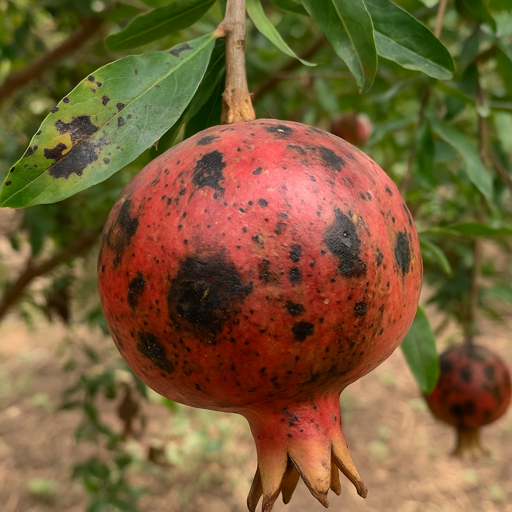
Telya Disease in Pomegranate
What is Telya Disease in Pomegranate?
Telya disease, also called oil disease or तेल्या रोग, is a serious problem that affects pomegranate trees. In this disease, dark oily spots appear on leaves, fruits, and branches. These spots may spread and cause the leaves to turn yellow and fall off. The fruits become black or sticky and drop before ripening, leading to heavy loss. It is caused by a combination of unhealthy soil, poor farm practices, and bacteria that grow well in warm and humid weather. Once this disease enters the orchard, it spreads quickly if not controlled on time.
Telya disease makes the plant weak and reduces fruit quality and size. If not treated, it can destroy a large portion of your crop. Early detection and proper treatment are very important. Farmers should learn how to identify the symptoms and follow good practices to prevent this disease.
Why Does Telya Disease Happen?
Here are the main reasons why pomegranate trees get this disease:
- Hot and Humid Weather
- When the weather is warm (28–32°C) and air is humid (above 70%), the disease spreads fast.
- When the weather is warm (28–32°C) and air is humid (above 70%), the disease spreads fast.
- Using Infected Plants
- If you plant saplings from trees already infected with oil disease, the new plants will also get it.
- If you plant saplings from trees already infected with oil disease, the new plants will also get it.
- Too Much Nitrogen Fertilizer
- Rainwater, air, and even canal/river water already contain nitrogen.
- Too much nitrogen from fertilizers weakens the plant and attracts disease.
- Rainwater, air, and even canal/river water already contain nitrogen.
- High Chloride in Soil
- Water and fertilizers can add too much chloride to the soil, which is harmful.
- Water and fertilizers can add too much chloride to the soil, which is harmful.
- Poor Soil Health
- Less organic matter and overuse of chemical fertilizers reduce soil health.
- If organic carbon is less than 0.6%, the plant becomes weak.
- Less organic matter and overuse of chemical fertilizers reduce soil health.
- Injuries to Plants
- When you prune, remove water shoots, or use machines like blowers or trolleys, plants get injured.
- Hailstorms or too much nitrogen can also damage plants.
- When you prune, remove water shoots, or use machines like blowers or trolleys, plants get injured.
- Weak Plants
- If plants don’t get enough nutrients or are attacked by soil worms (nematodes), they become weak and easily infected.
- If plants don’t get enough nutrients or are attacked by soil worms (nematodes), they become weak and easily infected.
- Dirty Tools
- Using the same pruning tools on different trees without cleaning spreads the disease.
How to Control Telya Disease – SV Agro Solutions' Simple Plan
1. Before Planting
- Use healthy saplings from disease-free nurseries.
- Don’t buy plants from gardens with oil disease history.
2. During Pruning or Injury
- Always clean and sterilize tools before use.
- After pruning or removing tops, spray SV Rounder P – 2.5 g per liter of water.
- For soil problems like nematodes or disease, apply SV Rounder P to the soil with the first watering.
3. When Fruit Changes Color
- Apply SV Rounder P (1 kg per acre) + SV Excitum (1 kg per acre).
- Do this twice – once when the fruit is green and once when it turns red.
4. During Wet and Humid Conditions
- In rainy or humid days, spray alternate doses of:
SV Rounder P + Rounder L
- SV Defense
- SV Defense
5. Nutrient and Soil Management
- Don’t give too much nitrogen. Count nitrogen from rain, water, and soil bacteria.
- Use green manure and sugarcane mulch to keep soil healthy.
- Apply SV Fruiter (100–150 kg per acre) with SV 59 + SVK drip to increase organic matter.
- If soil becomes salty, use SV Terminus (1 liter per acre every 2 months).
- In limestone soils, give extra sulfur, phosphorus, and manganese.
6. Long-Term Prevention
- Start using SV Agro's schedule early in orchards already affected by telya disease.
If you follow this simple schedule and check your soil and plants regularly, you can prevent telya disease and grow healthy pomegranate fruits with better yield and income.
.jpg)
Bacterial Blight in Pomegranate: Causes, Symptoms, Prevention
Pomegranate bacterial blight is a harmful and fast spreading disease that requires Indian farmers a lot of money. This can have an impact on the pomegranate plant's leaves, fruits, branches, and general health. Up to 80% of your crop may be damaged by this disease if treatment is not received.
Everything you need to know about bacterial blight in pomegranates, including its symptoms, causes, organic maintain ways , will be covered in this blog. Helping you safeguard your crop and boost the profits is our goal.
What is Bacterial Blight in Pomegranate?
Pomegranate bacterial blight is an infectious disease of plants that has a direct impact on crop health and yield. A bacterium called Xanthomonas axonopodis pv. punicae is the cause of this disease; it infects the tissues of the plant and results in obvious damage.
In India, it is the most frequent causes of declining pomegranate quality and quantity. Although farmers generally assume it for fungal infections, bacterial blight is more aggressive and spreads more quickly. It can quickly infect different parts of the plant system once it gets there, especially in humid or rainy environments.
This disease attacks multiple parts of the pomegranate plant:
- Leaves
- Fruits
- Flowers
- Twigs and branches
It spreads through water splashes, infected tools, and insects.
What Causes Bacterial Blight Disease in Pomegranate?
The cause of bacterial blight in pomegranates is Natural holes or wounds on leaves, stems, and fruits allow this bacterium to enter the plant. Once they inside, it spreads quickly, particularly in warm, humid environments or during the rainy season. which increases the disease in farms that are not properly maintained .
The most frequent ways this bacteria spreads are through infected pruning tools, rainwater splashes, creatures activity, and infected plant material. Bacterial blight thrives in fields with poor drainage, crowded plants, and limited sunlight.
Key causes of bacterial blight in pomegranate:
- Presence of Xanthomonas punicae bacteria
- Rain splash and high humidity
- Unclean pruning or cutting tools
- Injured plant tissues
- Infected nursery plants or suckers
- Poor orchard ventilation and drainage
To prevent this disease, always use clean tools, maintain good field hygiene, and begin protective spraying before monsoon starts.
Bacterial Blight in Pomegranate Symptoms:
The most important step in preventing your crop from bacterial blight is to identify the symptoms early. Checking Carefully is essential because this disease can be mistaken for other fungal or nutritional problems. when they started showing different sign check properly for obvious symptoms in the leaves, fruits, and branches of your pomegranate plants .
Pomegranate bacterial blight symptoms typically start out as minor changes and slowly become worse. Delays in treatment can cause the disease to spread rapidly and destroy an important portion of the crop.
Look for these common symptoms:
- Small, dark, water-soaked spots on leaves
- Yellow rings around black or brown spots
- Fruit cracking or splitting
- Sticky fluid on fruit or leaves
- Sudden leaf fall
- Twig drying and branch die-back
Regular inspection can help identify the disease early and reduce crop damage.
How Bacterial Blight Spreads
Understanding how Bacterial Blight spreads is essential to stop the infection before it damages healthy plants. The bacteria that cause this disease are highly contagious and can move from plant to plant in multiple ways.
Many farmers unknowingly help the disease spread by not cleaning tools or ignoring the first signs. Once the blight enters your field, it can multiply rapidly especially in wet and humid conditions.
Here's how the disease spreads and infects other plants:
- Rain splash spreads bacteria to healthy plants
- Unclean pruning tools transfer bacteria from one plant to another
- Insects can carry and spread bacteria
- Overwatering and poor air circulation worsen the disease
Bacterial Blight in Pomegranate: Preventive Measures
Preventing bacterial blight in pomegranate is much easier and more cost-effective than trying to cure it after infection. With proper care, clean farming practices, and timely action, farmers can avoid major crop losses caused by this harmful bacterial disease.
The bacteria spread quickly through water, infected tools, and plant wounds especially during monsoon or in humid conditions. Taking the right preventive steps ensures your orchard stays healthy and productive.
Follow these key preventive measures:
- Use disease-free planting material
Always select healthy, certified saplings from a trusted nursery to avoid starting with infected plants.
- Clean and disinfect pruning tools
Always clean your tools using Dettol, bleach, or any disinfectant before and after use to prevent spreading the bacteria.
- Avoid overwatering the field
Excess moisture supports the growth of bacteria. Make sure the orchard has proper drainage to keep the root zone dry.
- Maintain enough spacing between plants
Adequate plant spacing ensures good airflow, which lowers humidity and reduces the chances of infection.
- Remove infected leaves and fruits immediately
Infected parts should be removed from the field and destroyed to prevent further spread.
- Start preventive spraying before the rainy season
Use organic products like SV Defence, Sugarban, and Mr. Micro‑G as part of your regular crop protection program.
- Follow a weekly monitoring schedule
Inspect plants regularly for black spots, fruit cracking, or unusual leaf fall. Early detection helps in fast control.
By following these simple yet effective steps, you can keep your pomegranate orchard free from bacterial blight and maintain both yield and fruit quality.
Bacterial blight in pomegranate is a major threat to farmers across India, especially during the monsoon season. But with the right preventive measures such as clean pruning, organic sprays, biological agents, and timely treatment you can protect your crop, improve yield, and ensure better quality fruits. It is always better to act early than wait for symptoms to appear.
At SV Agro Solutions, we offer trusted organic and biological products like SV Defence, Sugarban, and Mr. Micro‑G that help control bacterial blight naturally and safely. Our farmer-friendly solutions are designed to improve plant health, reduce crop loss, and promote sustainable agriculture.
For expert guidance and high-quality crop protection products, visit : www.svagrosolutions.com or speak directly with our agri-experts.
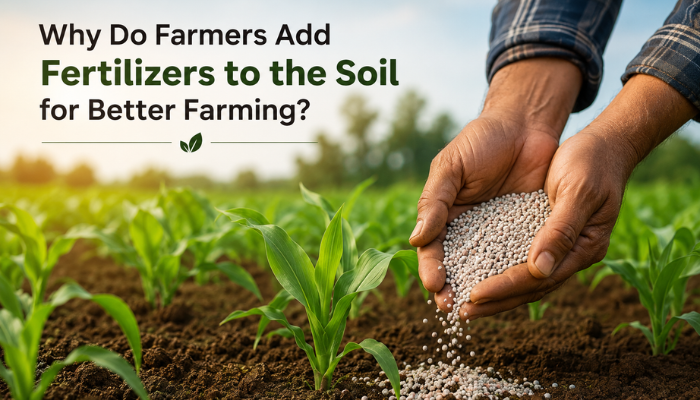
Why Do Farmers Add Fertilizers to the Soil for Better Farming
Plants need nutrients to grow healthy, just like people need food. The soil naturally contains nutrients, but when farmers grow crops every season, these nutrients gradually get used up. Every time crops are harvested, nutrients are removed from the field along with the grains, fruits, vegetables, or straw.
As a result, the soil becomes less fertile, and crop growth slows down. That is why farmers add fertilizers to the soil. Fertilizers replace the lost nutrients, improve soil fertility, and help produce healthy crops with higher yields.
What are Fertilizers?
Fertilizers are natural or chemical products added to the soil or plants to provide essential nutrients needed for healthy plant growth. They mainly supply nitrogen (N), phosphorus (P), and potassium (K), which help improve soil fertility, support better crop growth, and increase yield.
Types of Fertilizers
- Organic fertilizers are made from natural materials such as farmyard manure, compost, vermicompost, and plant residues.
- Chemical fertilizers are made in factories or obtained from natural minerals.
- Organic fertilizers are made from natural materials such as farmyard manure, compost, vermicompost, and plant residues.
Why Do Farmers Add Fertilizers to the Soil?
Farmers add fertilizers to the soil to replace lost nutrients, improve soil fertility, support healthy crop growth, and increase both yield and crop quality.
1. To Replace Nutrients Lost from the Soil
- Crops absorb nutrients from the soil as they grow.
- After harvesting, these nutrients leave the field with the crop.
- If nutrients are not replaced, the soil becomes weak and less fertile.
- Fertilizers restore these nutrients so the next crop can grow properly.
2. To Improve Soil Fertility
- Fertile soil contains enough nutrients for healthy crop growth.
- Fertilizers increase the nutrient level in the soil.
- They help maintain soil productivity even after continuous farming.
- Healthy soil produces stronger plants and better harvests.
3. To Increase Crop Yield
- Fertilizers help plants grow faster and healthier.
- Healthy plants produce more grains, fruits, vegetables, and fodder.
- Higher production helps farmers earn more income.
- It also helps meet the increasing demand for food.
4. To Correct Nutrient Deficiency
Some soils naturally lack important nutrients. Fertilizers help correct these deficiencies.
Common deficiency symptoms include:
- Yellow leaves due to nitrogen deficiency.
- Poor root growth because of phosphorus deficiency.
- Weak stems and small fruits due to potassium deficiency.
- Poor flowering and fruit development due to micronutrient deficiency.
Applying the correct fertilizer helps overcome these problems.
5. To Improve Crop Quality
Balanced fertilizer application not only increases yield but also improves crop quality.
Benefits include:
- Bigger and healthier fruits.
- Better grain quality.
- Sweeter fruits with better colour.
- Improved shelf life.
- Higher market value.
Why is Fertilizer Used in Agriculture?
Fertilizers are used in agriculture to provide essential nutrients that help crops grow healthier, increase yields, improve produce quality, and maintain soil fertility.
1. Food Security
- Fertilizers help produce more food for the growing population.
- Without fertilizers, crop production would be much lower.
2. Sustainable Farming
- Fertilizers help farmers grow more crops on existing farmland.
- This reduces the need to clear forests for agriculture.
3. Better Stress Tolerance
- Healthy plants can better withstand drought, heat, cold, and diseases.
- Balanced nutrition makes crops stronger.
4. Soil Improvement
- Fertilizers, along with organic manure, help restore poor soils.
- This keeps farmland productive for many years.
Why Do Farmers Use Fertilizers Instead of Only Manure?
Many farmers use both manure and fertilizers because both have different benefits.
- Manure improves soil health and increases organic matter, but it releases nutrients slowly.
- Organic Fertilizers provide nutrients quickly, helping crops grow faster when they need them the most.
- Manure contains lower amounts of nitrogen (N), phosphorus (P), and potassium (K), while fertilizers supply these nutrients in higher concentrations.
- Fertilizers are available with specific NPK ratios, allowing farmers to correct nutrient deficiencies based on crop and soil requirements.
- Nutrient levels in manure vary depending on the animal source and composting process, making it difficult to know the exact nutrient content.
- Fertilizers provide a balanced and measured supply of nutrients, making nutrient management easier.
- Manure is bulky, heavy, and difficult to transport and apply on large farms, whereas fertilizers are easier to store, carry, and use.
- Many farmers use both manure and fertilizers together.
- Manure improves long-term soil fertility, while fertilizers provide quick nutrients for healthy crop growth and higher yields.
Risks of Improper Use
Using too much fertilizer can create problems.
- Nutrient imbalance in the soil.
- Loss of nutrients through leaching.
- Water pollution due to fertilizer runoff.
- Reduced soil health over time.
- Unnecessary increase in farming costs.
Following the recommended fertilizer dose helps avoid these problems.
Best Practices for Using Fertilizers
- Test your soil every year before applying fertilizers.
- A soil test helps you know which nutrients are needed and prevents unnecessary fertilizer use.
- Apply fertilizers according to the crop growth stage, such as early growth, flowering, or fruit development, when plants need nutrients the most.
- Avoid applying fertilizers before heavy rainfall, as nutrients can wash away with rainwater.
- Divide the total fertilizer into smaller split doses instead of applying it all at once.
- This improves nutrient absorption and reduces nutrient loss.
- Place fertilizers close to the root zone (band or side application) so plants can absorb nutrients more efficiently.
- If you use a drip irrigation system, apply water-soluble fertilizers through fertigation for better nutrient use.
- Spray liquid fertilizers on leaves (foliar spray) to quickly correct micronutrient deficiencies like zinc, iron, or boron.
- Apply fertilizers when the soil is slightly moist.
- Avoid applying them to very dry or waterlogged soil, as this reduces nutrient absorption and increases nutrient loss.
Conclusion
Farmers add fertilizers to the soil mainly to replace lost nutrients, improve soil fertility, and increase crop yield and quality. Fertilizers help plants grow stronger, produce better harvests, and improve farmers' income. When used in the right amount and at the right time, fertilizers support healthy soil, sustainable farming, and higher agricultural productivity.
Are you looking for high-quality fertilizers to improve crop growth and increase yield? Then SV Agro Solutions is a reputed fertilizer manufacturer and supplier in Pune, offering high-quality fertilizer solutions for farmers and agribusinesses. Our products help improve soil fertility, support healthy crop growth, and increase farm productivity. We proudly serve farmers across India and also export our fertilizers to international markets.
Frequently Asked Questions
1. Why do farmers add fertilizers to the soil?
Farmers add fertilizers to replace nutrients lost from the soil, improve soil fertility, and increase crop yield and quality.
2. Why are fertilizers added to the soil instead of only using manure?
Fertilizers provide nutrients quickly and in concentrated amounts, while manure improves soil health. Using both together gives better results.
3. Why is fertilizer used in agriculture?
Fertilizers are used to improve crop growth, increase production, maintain soil fertility, and support profitable farming.
4. Why do farmers use fertilizers in modern farming?
Modern crop varieties need more nutrients to produce higher yields. Fertilizers help meet these nutrient requirements.
5. Can too much fertilizer harm the soil?
Yes. Excessive fertilizer use can damage soil health, pollute water, and reduce long-term productivity. Farmers should always follow soil test recommendations and apply the correct amount.
1.jpg)
Best Agriculture Company in Pune
If you are searching for the best agriculture company in Pune in 2025, SV Agro Solutions stands out as a leading name in the field. As a top agriculture company in Pune, SV Agro Solutions has established itself as a pioneer in sustainable farming solutions, helping thousands of farmers achieve higher yields and healthier crops through innovative and eco-friendly products.
Why SV Agro Solutions is the Leading Agriculture Company in Pune
- Commitment to Sustainable Agriculture
SV Agro Solutions is dedicated to promoting sustainability in agriculture by providing high-quality organic agricultural inputs. Their mission, “Save Soil – Save Lives,” reflects their focus on soil health, ecosystem conservation, and maximizing agricultural yield without compromising the environment. This agriculture company in Pune specializes in nano-technology-based solutions that nourish the soil and reduce the risk of declining yields, supporting both farmers and the broader community.
- Research-Driven Innovation
With a state-of-the-art research and development facility in Indapur tehsil, Pune, SV Agro Solutions continuously innovates to deliver products that address the evolving needs of the farming community. Their R&D efforts ensure that every product is designed for maximum efficiency and sustainability, making them a trusted agriculture company in Pune for farmers seeking reliable solutions.
Wide Range of Certified Products
SV Agro Solutions offers a comprehensive portfolio of Ecocert-certified products, including:
- Organic fertilizers
- Micronutrients
- Biostimulants
These products are carefully crafted to enhance plant health, improve stress resistance, and ensure toxin-free produce, positioning SV Agro Solutions as a top agriculture company in Pune for quality and safety.
Farmer-Centric Approach
What sets SV Agro Solutions apart from other agriculture companies in Pune is their strong support system for farmers. They provide free consultations, on-field guidance from sowing to harvest, and continuous education on best practices. With over 80,000 satisfied farmers across Maharashtra, Karnataka, Gujarat, Odisha, and beyond, SV Agro Solutions has built a reputation for trust and reliability.
Comprehensive Agribusiness Support
SV Agro Solutions not only supplies products but also offers agribusiness opportunities, helping farmers and entrepreneurs grow their ventures. Their expert support ensures that clients receive the best advice and products tailored to their unique agricultural needs.
SV Agro Solutions vs. Other Agriculture Companies in Pune
|
Feature |
SV Agro Solutions |
Other Agriculture Companies in Pune |
|
Focus on Sustainability |
Yes |
Varies |
|
Nano-technology Inputs |
Yes |
Rare |
|
Ecocert Certification |
Yes |
Not always |
|
Free Farmer Consultation |
Yes |
Limited |
|
R&D Facility in Pune |
Yes |
Varies |
|
Farmer Support (Sowing-Harvest) |
Yes |
Varies |
|
Wide Farmer Network |
80,000+ |
Varies |
What Makes SV Agro Solutions the Best Agriculture Company in Pune?
- Strong focus on sustainable and organic farming
- Advanced research and innovation in agricultural inputs
- Comprehensive support for farmers at every stage
- Certified, high-quality products for safe and healthy crops
- Proven track record and trust among thousands of farmers.
For anyone seeking the best agriculture company in Pune, SV Agro Solutions is the top choice in 2025. Their commitment to sustainability, research-driven products, and unwavering farmer support make them the leading agriculture company in Pune, driving the future of Indian agriculture towards healthier and more productive outcomes.
If you want to experience the difference that a truly innovative agriculture company in Pune can make, connect with SV Agro Solutions today and take your farming to the next level!
1.jpg)
How to Apply Micronutrients for Plants in India
Healthy plants need proper nutrition. Just like humans need vitamins and minerals, plants need nutrients to grow strong. These nutrients are divided into two types: macronutrients and micronutrients. While macronutrients are needed in large amounts, micronutrients are needed in small quantities but are just as important.
Micronutrients like zinc, iron, boron, and manganese help plants grow properly. In India, many soils are low in these micronutrients. This leads to poor crop health, low yield, and weak plants.
In this blog, we will explain how to apply micronutrients for plants in India. You will learn what they are, when to apply them, and how to apply them the right way.
Micronutrients for Plants
Plants require a mix of nutrients to grow healthy and produce good yields. While major nutrients like nitrogen, phosphorus, and potassium are widely known, micronutrients are often overlooked. However, these are just as essential, even if needed in smaller amounts. Lack of these can severely affect plant performance.
Essential Plant Micronutrients
The primary micronutrients are essential for completing a plant's life cycle. Micronutrients are small elements that play a big role in plant health. Here are the essential micronutrients ones:
-
Zinc (Zn) - helps in hormone production and growth
-
Iron (Fe) - helps in photosynthesis and energy
-
Boron (B) - needed for flowers and fruits
-
Manganese (Mn) - helps in making food in leaves
-
Copper (Cu) - supports seed and fruit formation
-
Molybdenum (Mo) - needed for nitrogen use
Micronutrients support strong root growth, flowering, and seed formation. If your plants lack these, you will see yellow leaves, weak stems, and poor fruits.
In many Indian farms, soil has lost important nutrients due to continuous farming and the wrong use of fertilizers. This leads to poor crop health and low yield. Micronutrient deficiency is a silent problem many farmers don’t notice it until it's too late. Understanding which nutrients are lacking in your region can help take the right action.
Functions of Micronutrients in plants
These elements, though required in small amounts, are essential for plant physiology:
- Enzymatic & Metabolic Roles:
Micronutrients are involved in numerous enzymatic reactions and metabolic functions. - Overall Growth:
They ensure balanced crop nutrition, supporting all biological processes necessary for healthy growth. - Specific Contributions:
For example, iron, zinc, and manganese assist in seed germination and root development, while boron plays a key role in flower and fruit formation.
Micronutrient Deficiency Symptoms
- Yellow leaves
- Small or less fruits
- Weak flowering
- Plants not growing well
Knowing these signs early helps you fix the problem by learning how to apply micronutrients for plants.
Soil Testing: The First Step to Smart Application
Before using any fertilizer, first do soil testing. It tells you which nutrients your soil needs. Many farmers apply fertilizers without knowing what their land actually lacks, which leads to waste of money and poor results. Soil testing is the smart first step it helps you give only what your crop really needs.
Where to do soil testing:
- Go to Krishi Vigyan Kendras (KVK)
- Use government soil testing labs
- Contact private labs in your area
How to read soil test report:
- Check levels of Zinc, Iron, Boron, Copper
- See your soil pH – it affects how nutrients work
- Use the report to choose correct nutrients
Soil testing saves money and improves crop results
Micronutrient Mixture Fertilizer Application Methods
A. Soil Application
This means putting nutrients into the soil directly. Good for all crops like wheat, rice, sugarcane, and vegetables.
Steps to Apply:
- Take the required amount of micronutrient powder or granules.
- Mix it with sand or soil for even spreading.
- Apply it in the field before sowing.
- Or, if the crop is already growing, apply near the plant roots.
- Water the field after application.
Types of Products:
- Granular – Cheaper, works slowly, long-lasting
- Chelated – Costly but works fast, good in hard (alkaline) soils
B. Foliar Spray
This method gives nutrients through the leaves. It helps plants absorb nutrients quickly.
Good for: Flowering, fruiting stage or when deficiency signs appear.
Steps to Apply:
- Take the right amount of micronutrient (read the label).
- Mix it in water (as per instructions).
- Pour into a hand sprayer or pump.
- Spray on both sides of the leaves.
- Do it in the morning or evening (never during hot sun or rain).
- Repeat spray every 10–15 days if needed.
Important Tips:
- Don’t use too much – it may burn the leaves.
- Always mix fresh before spraying.
- Wear gloves or cover your hands.
C. Fertigation (Drip Irrigation Method)
In this modern method, you mix micronutrients in drip water. Best for fruits, vegetables, and greenhouse crops.
Steps to Apply:
- Take water-soluble micronutrient powder.
- Mix it well in water tank of your drip system.
- Let the drip system run and feed plants with water + nutrients.
- After use, clean the pipes with plain water.
Why Use This Method:
- Saves water and time
- Sends nutrients straight to roots
- Gives better yield in high-value crops
Micronutrient Application Schedule for Major Indian Crop
|
Crop |
When to Apply |
Nutrients Needed |
|
Rice |
Tillering, flowering |
Zinc, Iron, Boron |
|
Wheat |
Early root stage |
Zinc, Manganese |
|
Cotton |
Growth and flowering |
Boron, Zinc, Iron |
|
Vegetables |
Every 15 days |
All micronutrients |
|
Fruits |
Before flowers and fruits |
Boron, Zinc, Calcium |
Mistakes to Avoid During Micronutrients Application
Avoid these common mistakes:
- Using too much nutrient it can harm plants
- Mixing wrong nutrients together
- Spraying in hot sun or rainy time
- Not checking label for correct dose
- Not repeating spray when needed
To succeed, you must know the correct way of how to apply micronutrients for plants.
Applying micronutrients the right way can greatly improve plant health, crop yield, and quality. Always begin with a soil test to know which nutrients your field needs. Choose the correct product based on your crop and soil type.
Use the right method whether it's soil application, foliar spray, or fertigation depending on your farming system. Make sure to apply micronutrients at the correct stage of crop growth and avoid common mistakes like overuse or spraying at the wrong time. When you understand how to apply micronutrients for plants, you take a strong step toward healthy farming and higher profits.For trusted and crop-specific micronutrient solutions, visit SV Agro Solutions today.
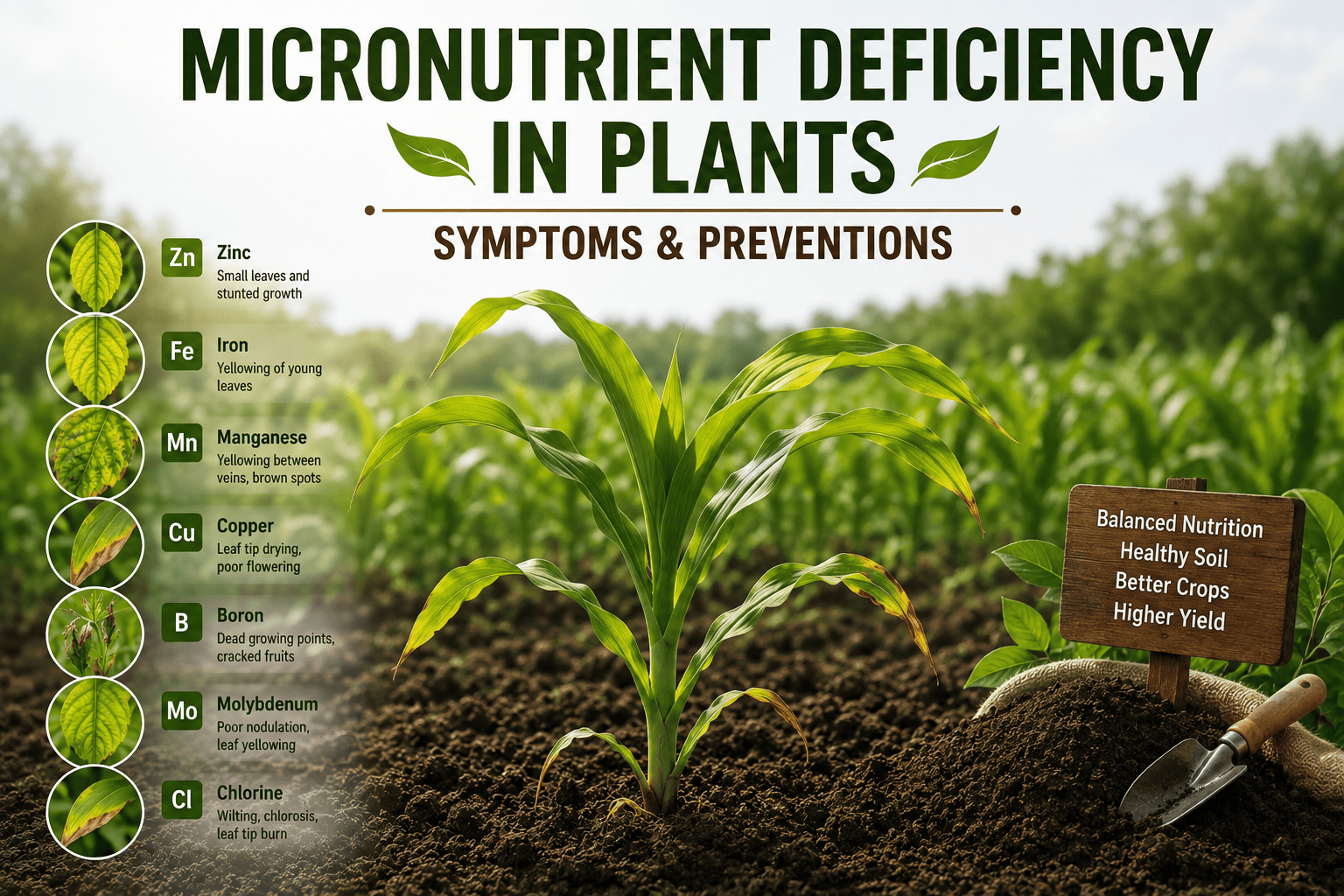
Micronutrient Deficiency in Plants - Symptoms & Preventions
Plants need more than just nitrogen (N), phosphorus (P), and potassium (K) for healthy growth. They also need small amounts of other essential nutrients called micronutrients. Even a small shortage of one micronutrient can affect plant growth, crop yield, quality, and the ability to handle stress.
Understanding micronutrient deficiency in plants helps farmers identify nutrient problems early and take the right steps before they affect the crop and reduce production.
What is Micronutrient Deficiency in Plants?
Micronutrient deficiency in plants occurs when crops do not get enough essential nutrients such as zinc (Zn), iron (Fe), boron (B), manganese (Mn), copper (Cu), molybdenum (Mo), and chlorine (Cl).
Plants need these nutrients only in small amounts, but they are important for normal growth and development. Sometimes, a micronutrient may be present in the soil but plants cannot absorb it properly. This can also lead to deficiency.
Micronutrient deficiency is sometimes called “hidden hunger” because the symptoms may not be clearly visible in the early stages, even though crop growth and yield may already be affected.
Common Causes of Micronutrient Deficiency
Micronutrient deficiency can occur due to low soil nutrients, improper soil pH, nutrient imbalance, poor soil health, continuous cropping, and unfavourable weather conditions.
1. Low Nutrient Levels in Soil
Some soils naturally contain low amounts of certain micronutrients.
- Sandy soils may have low zinc and boron levels.
- Continuous farming can further reduce available nutrients.
- Without proper nutrient replacement, soil fertility can decline.
2. High or Low Soil pH
Soil pH affects how easily plants can absorb nutrients.
- High or alkaline soil pH can reduce the availability of iron, zinc, manganese, and copper.
- Low or acidic soil pH can affect the availability of molybdenum and boron.
- Proper soil pH management helps plants absorb nutrients more effectively.
3. Excess Use of Other Nutrients
Using too much of one nutrient can affect the absorption of another.
- Excess phosphorus can reduce zinc and iron uptake.
- High nitrogen application can increase the plant's demand for other nutrients.
- Unbalanced fertilizer use can create nutrient deficiencies.
4. Low Organic Matter in Soil
Soil with low organic matter may not hold nutrients properly.
- It can reduce nutrient availability.
- It may reduce beneficial microbial activity.
- It can affect overall soil health and plant growth.
5. Continuous Cropping Without Nutrient Replacement
Growing crops repeatedly on the same land removes nutrients from the soil.
- Harvested crops take nutrients away from the field.
- If these nutrients are not replaced, deficiency can develop.
- Continuous cropping can gradually reduce soil fertility.
6. Unfavourable Weather and Soil Conditions
Weather and soil conditions can also affect nutrient absorption.
- Waterlogging can reduce root activity.
- Drought can limit nutrient movement to plant roots.
- Cold soil can slow root growth and nutrient uptake.
Deficiency Symptoms of Micronutrients
Different micronutrient deficiencies produce different symptoms. However, some symptoms can look similar, so soil and leaf testing is important for accurate identification.
Zinc (Zn) Deficiency
- Leaves may become small and narrow.
- Plants may show short internodes and stunted growth.
- Tillering may be reduced.
- In crops such as maize, yellowing and white areas may appear.
- Overall plant growth and development may be slow.
Iron (Fe) Deficiency
- Young leaves may become yellow while the veins remain green.
- In severe cases, leaves may turn completely yellow or almost white.
- Low iron availability can reduce chlorophyll formation.
- Photosynthesis and plant growth may be affected.
Manganese (Mn) Deficiency
- Yellowing may appear between the leaf veins.
- Small brown spots may develop on leaves.
- Some plants may show a pattern that looks like a Christmas tree.
- Root growth and overall plant vigour may decrease.
Copper (Cu) Deficiency
- Young leaves may wilt or dry from the tips.
- Leaves may become small or distorted.
- Flowering and fruit or grain formation may be poor.
- Plants may show reduced tillering and stunted growth.
Boron (B) Deficiency
- Growing points of roots and shoots may die.
- Stems may become hollow or weak.
- Fruits may develop cracks.
- Fruit set may be poor.
- Leaves may become brittle.
- Seed development and viability may decrease.
Molybdenum (Mo) Deficiency
- Legume crops may show poor nodulation.
- Leaves may turn yellow.
- Plant growth may become stunted.
- Leaf margins may roll and turn brown.
- Nitrogen fixation and protein formation may be affected.
Chlorine (Cl) Deficiency
- Plants may show wilting.
- Leaves may develop chlorosis or yellowing.
- Root growth may be reduced.
- Severe deficiency may cause leaf tip burn.
How to Prevent Micronutrient Deficiency
Preventing micronutrient deficiency requires regular soil testing, balanced fertilization, proper nutrient application, good soil health, and timely crop management.
1. Test Soil and Leaves
- Test soil before sowing to identify nutrient deficiencies.
- Use leaf testing when needed.
- Apply nutrients based on crop and soil requirements.
2. Use Balanced Fertilizers
- Apply N, P, and K in the right amounts.
- Avoid excessive use of any nutrient.
- Add secondary nutrients and micronutrients when required.
3. Use Micronutrient Mixtures
- Use Zn, Fe, Mn, Cu, B, and Mo as needed.
- Choose the right form, such as granular or water-soluble products.
4. Apply Foliar Spray
- Spray micronutrients directly on leaves for quick correction.
- Apply during important stages like vegetative growth and flowering.
- Follow the recommended dose.
5. Treat Seeds
- Use suitable micronutrients for seed treatment.
- Helps improve germination and early seedling growth.
6. Improve Soil Health
- Add organic manure and compost.
- Maintain good soil structure and moisture.
- Support beneficial soil microorganisms.
7. Maintain Soil pH
- Test soil regularly.
- Use suitable materials to correct acidic or alkaline soil as recommended.
8. Follow Crop Rotation
- Rotate cereals with legumes and other crops.
- Grow different crops to maintain better nutrient balance and soil health.
Best Practices for Managing Micronutrient Deficiency
Farmers can follow these simple practices to manage micronutrients effectively:
- Identify deficiency symptoms early.
- Confirm nutrient deficiency through soil or leaf testing.
- Apply the right micronutrient at the right growth stage.
- Use the recommended dose for the crop.
- Avoid excessive micronutrient application.
- Do not mix products that are not compatible in the same spray tank.
- Keep records of soil tests, fertilizer applications, and crop response.
- Monitor the crop after nutrient application.
Conclusion
Micronutrient deficiency in plants is a common reason for poor crop growth, lower yield, and reduced crop quality. Plants need micronutrients in small amounts, but nutrients such as Zinc, Iron, Boron, Manganese, Copper, Molybdenum, and Chlorine perform important functions throughout the crop growth cycle.
Want to prevent micronutrient deficiency in plants and support healthier crop growth? SV Agro Solutions offers high-quality micronutrient fertilizers designed to provide essential nutrients such as Zinc, Iron, Boron, Manganese, and other micronutrients required for healthy roots, strong plant growth, better flowering, fruit development, and improved crop quality. Our solutions help improve nutrient availability, correct deficiencies, and support balanced crop nutrition at different growth stages. Choose SV Agro Solutions for better crop health, improved yield, and sustainable farming.
FAQs
1. What is micronutrient deficiency in plants?
It occurs when plants do not get enough essential micronutrients like Zn, Fe, B, Mn, Cu, Mo, and Cl for healthy growth.
2. What are the common deficiency symptoms of micronutrients?
Common symptoms include yellow leaves, small or distorted leaves, stunted growth, poor flowering, fruit drop, and poor grain development.
3. How can farmers prevent micronutrient deficiency?
Farmers can prevent it through soil testing, balanced fertilization, micronutrient mixtures, foliar sprays, seed treatment, and good soil management.
4. Can too much micronutrient harm the crop?
Yes, excess micronutrients can cause toxicity, leaf damage, and poor plant growth, so the recommended dose should always be followed.
5. Which crops are most affected by micronutrient deficiency?
High-yielding crops and crops grown repeatedly in poor, sandy, acidic, or alkaline soils are more likely to face micronutrient deficiency.
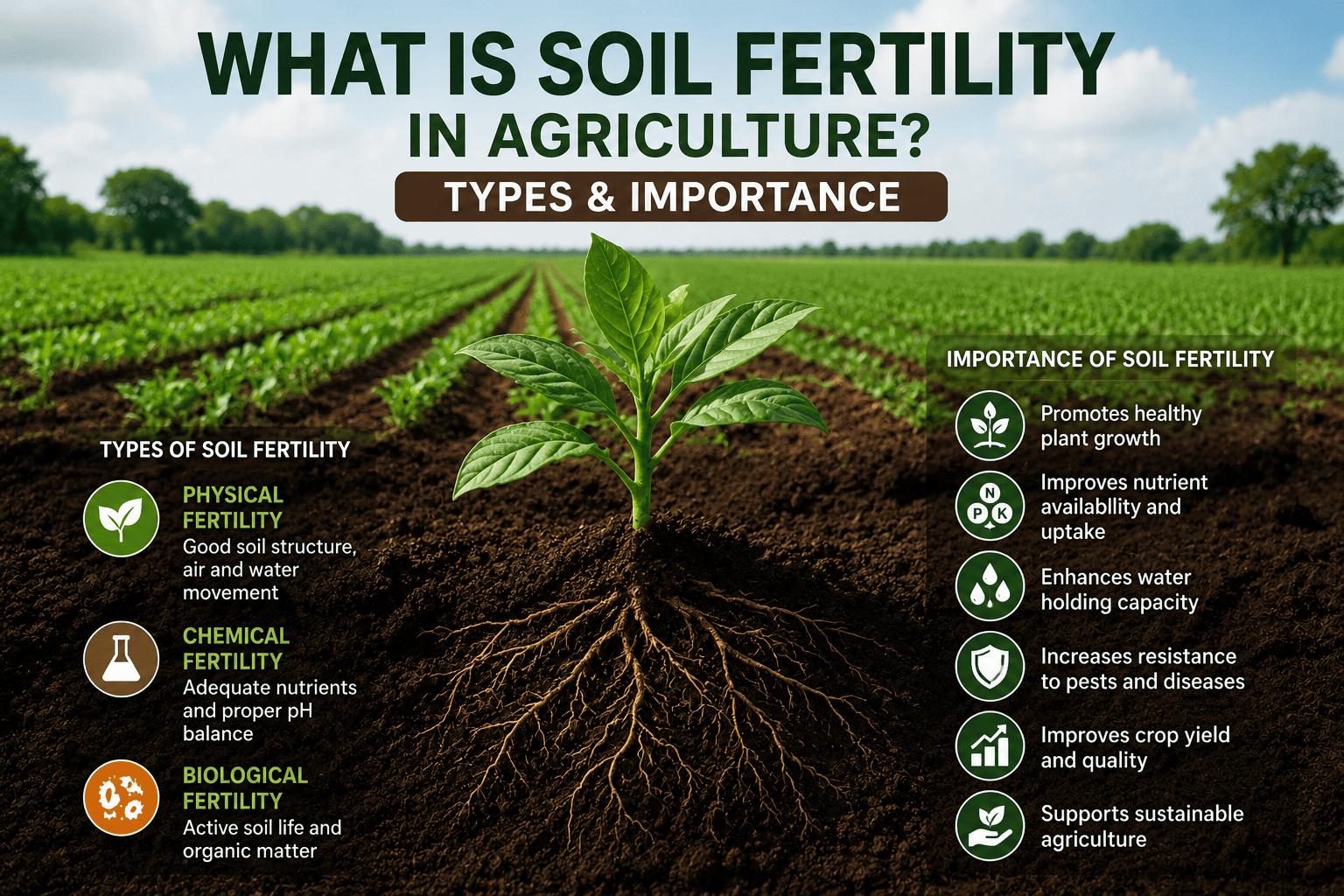
What is Soil Fertility in Agriculture - Types & Importance
Soil is one of the most important resources in agriculture. No matter how good the seed, fertilizer, or irrigation system is, crops cannot grow properly without healthy and fertile soil. Soil fertility is the foundation of successful farming because it directly affects plant growth, crop yield, and farm productivity.
Understanding what is soil fertility in agriculture helps farmers make better decisions about nutrient management, soil improvement, and sustainable farming practices. Fertile soil provides plants with the nutrients, water, air, and root environment they need for healthy growth. It also supports long-term agricultural productivity and helps farmers achieve better profits.
What is Soil Fertility in Agriculture?
Soil fertility is the ability of soil to supply essential nutrients and provide favourable conditions for healthy plant growth. A fertile soil contains the right balance of nutrients, sufficient moisture, proper aeration, and active biological life.
In simple words, soil fertility means how well the soil can support crop growth and development.
Fertile soil provides:
- Essential nutrients for plant growth
- Adequate water-holding capacity
- Good air movement around roots
- Proper root development
- Beneficial microorganisms that improve soil health
Soil fertility is not only about nutrient content. It also depends on the physical, chemical, and biological conditions of the soil.
What Makes the Soil Fertile?
Several factors work together to make soil fertile and productive.
Balanced Nutrient Supply
- Plants require nutrients such as nitrogen (N), phosphorus (P), potassium (K), calcium, magnesium, sulfur, and micronutrients.
- A balanced supply of these nutrients helps crops grow properly and produce better yields.
Good Organic Matter Content
- Organic matter improves soil structure, increases water retention, and supplies nutrients slowly over time.
- Compost, crop residues, and farmyard manure help increase organic matter in the soil.
Proper Soil Structure and Drainage
- Healthy soil should be loose and well-aerated.
- Good soil structure allows roots to grow easily and improves water infiltration and drainage.
Suitable Soil pH
- The pH level affects nutrient availability.
- Most crops grow well when soil pH is within the optimum range.
- Extremely acidic or alkaline soils can reduce nutrient uptake.
Active Microbial Life
- Beneficial microorganisms help break down organic matter and release nutrients for plants.
- Earthworms, bacteria, and fungi play an important role in maintaining soil fertility.
Types of Soil Fertility in Agriculture
Types of Soil Fertility in Agriculture include natural fertility, acquired fertility, and biological fertility, which together support healthy soil and better crop growth.
1. Natural Fertility
- Natural fertility refers to the fertility that exists naturally in soil without any human intervention.
- It depends on the parent rock material, climate, natural organic matter, and soil-forming processes
- Some soils naturally contain higher nutrient levels and therefore support better crop growth.
2. Acquired Fertility
- Acquired fertility is developed through farming practices and management techniques.
- Farmers improve soil fertility by applying fertilizers, adding compost and manure, practicing irrigation, growing cover crops, and improving soil management
- Most agricultural fields depend on acquired fertility to maintain good yields.
3. Biological Fertility
- Biological fertility is related to the living organisms present in the soil.
- These include earthworms, beneficial bacteria, fungi, and other microorganisms
- These organisms improve nutrient cycling, organic matter decomposition, and soil structure.
Factors Affecting Soil Fertility
Several factors influence soil fertility in agriculture.
Soil Texture and Structure
The amount of sand, silt, and clay in soil affects nutrient retention, water-holding capacity, and root growth.
Organic Matter and Humus
Higher organic matter levels improve nutrient availability, soil structure, and microbial activity.
Soil pH and Salinity
Soil pH influences nutrient availability. Excess salinity can reduce crop growth and lower soil fertility.
Moisture and Drainage
Adequate moisture is essential for nutrient uptake. Poor drainage can lead to waterlogging and root damage.
Nutrient Availability and Microbial Activity
Healthy microbial activity helps release nutrients and improve soil fertility naturally.
Farming Intensity and Cropping Pattern
Continuous cultivation without proper nutrient replacement can reduce soil fertility over time.
Importance of Soil Fertility in Agriculture
- Fertile soil supplies the nutrients required for healthy plant growth and higher production.
- Healthy plants grown in fertile soil are often more resistant to pests, diseases, and environmental stress.
- Good soil fertility reduces the need for excessive fertilizer applications and lowers production costs.
- Healthy soil continues to support crop growth season after season without significant decline.
- Maintaining soil fertility helps protect natural resources and improves long-term farm profitability.
Most Fertile Soil in India
Alluvial soil is considered the most fertile and widely found soil in India. It covers about 43% to 46% of the country's total land area. This soil is mainly found in the Indo-Gangetic plains and river delta regions.
Key Features of Alluvial Soil
- It is formed by sand, silt, and clay deposited by rivers over many years.
- It has a loamy texture, which helps retain water while allowing proper drainage.
- It is rich in potash, lime, and organic matter.
- It generally contains lower amounts of nitrogen and phosphorus.
Types of Alluvial Soil
Khadar (New Alluvial Soil):
- Found near river floodplains.
- Receives fresh silt deposits every year.
- More fertile and suitable for crop cultivation.
Bhangar (Old Alluvial Soil):
- Found away from the river floodplains.
- Contains lime nodules known as kankar.
- Slightly less fertile than Khadar soil.
Major Areas Where Alluvial Soil Is Found
- Punjab
- Haryana
- Uttar Pradesh
- Bihar
- West Bengal
- Assam
- Deltas of the Mahanadi, Godavari, Krishna, and Kaveri rivers
Major Crops Grown in Alluvial Soil
- Rice
- Wheat
- Sugarcane
- Jute
- Maize
- Pulses
- Oilseeds
Conclusion
Soil fertility in agriculture is the soil's ability to provide nutrients, water, air, and favourable conditions for healthy crop growth. It is one of the most important factors influencing crop yield, soil health, and farm profitability.
Looking for high-quality fertilizers to improve your soil fertility?
SV Agro Solutions is a trusted fertilizer company in Pune that provides quality fertilizers for farmers and agricultural businesses. As a leading fertilizer manufacturer and supplier in Pune, we offer effective solutions that help improve soil health, plant growth, and farm productivity. We support farmers across India and also export our products to international markets, ensuring reliable and high-quality agricultural solutions for different crops and farming needs.
FAQs
1. What is soil fertility in simple words?
Soil fertility is the ability of soil to provide plants with the nutrients and conditions needed for healthy growth.
2. What are the types of soil fertility?
The main types are natural fertility, acquired fertility, and biological fertility.
3. Which soil is most fertile in India?
Alluvial soil is considered the most fertile soil in India.
4. How can farmers improve soil fertility?
Farmers can improve soil fertility by adding compost, manure, balanced fertilizers, crop rotation, and proper irrigation.
5. Why is soil fertility important in agriculture?
Soil fertility is important because it supports healthy crop growth, improves yields, and helps maintain long-term soil productivity.
.jpg)
Why Are Fertilizers Used in Agriculture
Have you ever wondered how farmers grow so many crops on the same land year after year? The answer is simple they use agriculture fertilizer.
Fertilizers are very important in farming. They give plants the food they need to grow quickly and stay healthy.
In this blog, we will explore what fertilizers are, why farmers use them, and how they help in agriculture fertilizer practices.
What Are Fertilizers
Fertilizers are special materials added to the soil to help plants grow better. They provide important nutrients that the soil may not have enough of.
Types of Fertilizers
- Organic fertilizers: Made from natural sources like compost, animal manure, or plant waste.
- Chemical (inorganic) fertilizers: Made in factories and contain exact amounts of nutrients.
Fertilizers vs. Natural Soil Nutrients
Soil naturally has some nutrients, but after growing crops again and again, these nutrients get used up. Fertilizers help bring those nutrients back to the soil.
Main Nutrients in Agriculture Fertilizer
- Nitrogen (N)
- Phosphorus (P)
- Potassium (K)
These are the most common nutrients found in agriculture fertilizer.
Why Do Farmers Use Fertilizers
Soil loses nutrients every time a crop is harvested. If farmers keep planting without adding nutrients back, plants won’t grow well.
Fertilizers Help Because:
- Natural soil may not have enough nutrients.
- They replace lost nutrients after harvesting.
- Help crops grow faster and stronger.
- Improve the size, color, and taste of food.
- Make it possible to feed more people.
Fertilizers make farming more successful and efficient. That is why agriculture fertilizer is widely used.
Key Nutrients in Fertilizers
Different nutrients help plants in different ways. Here is a quick look at what they do:
|
Nutrient |
What It Helps With |
|
Nitrogen |
Makes leaves and stems grow faster |
|
Phosphorus |
Builds strong roots and flowers |
|
Potassium |
Helps plants fight diseases and stay strong |
|
Calcium |
Strengthens plant cell walls |
|
Magnesium |
Helps in making food (photosynthesis) |
|
Sulfur |
Needed for protein in plants |
Good agriculture fertilizer gives plants all these nutrients.
How Fertilizers Support Agriculture
Fertilizers help farmers grow more food in less time. They also allow farming on land that may not be very rich.
Fertilizer Benefits in Farming:
- Increases food production
- Improves plant growth, even in weak soil
- Reduces time needed to grow crops
- Supports farming all year long
- Helps small farms produce more food
Agriculture fertilizer has helped farmers feed growing populations.
Fertilizers and Food Security
Food security means everyone has enough to eat. Fertilizers are a big part of the solution to world hunger.
How Fertilizers Help Feed People:
- More crops = more food
- Better crops = better nutrition
- Farmers in poor areas can grow more food with fertilizer
- Yara, a global company, says fertilizer helps stop hunger
That’s why agriculture fertilizer is used around the world.
Risks and Responsible Use of Fertilizers
Fertilizers are useful, but using too much can cause harm.
Problems from Overusing Fertilizer:
- Water pollution when extra fertilizer enters rivers
- Soil damage from too many chemicals
- Harm to animals and nearby plants
Safe Ways to Use Agriculture Fertilizer:
- Use only what the soil needs
- Apply it at the best time for crops
- Test the soil before adding fertilizer
- Follow government guidelines (like from USDA)
Responsible use of agriculture fertilizer keeps farming and nature safe.
Future of Fertilizer Use in Agriculture
Farmers are finding better, smarter ways to use fertilizers thanks to science and technology.
New Trends in Agriculture Fertilizer:
- Slow-release fertilizers feed plants over time
- Precision farming uses machines to add fertilizer only where needed
- Eco-friendly fertilizers are safer for the planet
- Soil sensors help farmers know exactly when to fertilize
The future of agriculture fertilizer is smart, clean, and more helpful than ever.
Fertilizers play a key role in farming today. They help plants grow strong and healthy and help farmers grow more food.
We learned that:
- Fertilizers add nutrients to the soil
- They improve crop quality and quantity
- They support food security
- They must be used carefully to avoid harm
Fertilizers are used in agriculture to make sure plants get the nutrients they need to grow well and give a good yield. Over time, soil can lose important elements like nitrogen, phosphorus, and potassium and fertilizers help bring them back.
When used correctly, fertilizers support healthy crops and better farming results. For reliable fertilizer options and expert advice, SV Agro Solutions is here to help you grow better, naturally.
.jpg)
Benefits of Organic Fertilizer for Plants
Fertilizers play an important role in farming because they help crops grow better and give higher yields. In recent years, many farmers have been moving towards organic fertilizers instead of chemical fertilizers. Organic fertilizers are made from natural plant and animal materials like compost, cow dung, poultry manure, and plant waste.
Unlike chemical fertilizers that give quick results but damage soil over time, organic fertilizers work slowly and improve soil health in the long run. Understanding the benefits of organic fertilizer for plants helps farmers adopt sustainable farming practices, reduce costs, and protect their land for future generations.
What is Organic Fertilizer for Plants?
Organic fertilizer for plants is made from natural sources like plants and animals, such as manure, compost, bone meal, and seaweed. These fertilizers release nutrients slowly as soil microbes break them down.
These fertilizers provide essential nutrients like nitrogen (N), phosphorus (P), and potassium (K), but they release these nutrients slowly. Unlike chemical fertilizers, organic fertilizers feed both the soil and the plant, helping maintain long-term soil fertility and healthy plant growth.
4 Benefits of Organic Fertilizers for Plants
One of the biggest benefits of organic fertilizer is its positive effect on soil health.
1. Soil Health & Structure
- Adds organic matter that makes soil soft, loose, and easy for roots to grow.
- Helps soil keep moisture for a longer time, reducing the need for frequent irrigation.
- Keeps soil particles together and protects topsoil from wind and rain.
2. Plant Nutrition & Growth
- Gives nutrients slowly, so plants get food over time without root damage.
- Helps good bacteria and fungi grow, which makes nutrients available to plants.
- Healthy soil leads to strong roots and crops that resist pests and diseases.
3. Environmental Benefits
- Made from natural materials, so it causes less pollution and water contamination.
- Reduces the use of chemicals and helps recycle organic farm waste.
4. Safety & Long-Term Value
- Does not harm humans, animals, or wildlife.
- Even if it costs more at first, it improves soil health and reduces other input costs later.
Nutrient Release and Availability
Organic fertilizers release nutrients slowly and steadily.
- Organic fertilizers release nutrients slowly over time as soil microbes break them down
- This gives plants a steady supply of nutrients instead of a sudden boost.
- They help improve soil health, structure, and water-holding capacity.
- Organic fertilizers increase good microbes in the soil.
- They reduce nutrient loss and prevent pollution caused by leaching.
- Nutrient release depends on soil moisture, temperature, and microbial activity.
- They are best for long-term plant nutrition and soil fertility.
- For quick results, larger amounts may be needed compared to chemical fertilizers.
Environmental and Safety Benefits
Organic fertilizers are non-toxic and environmentally safe.
|
Environmental Benefits |
Safety Benefits |
|
Improves soil health by making soil soft, fertile, and full of useful microbes |
Safer for farmers to use with little or no protective gear |
|
Releases nutrients slowly, reducing water pollution and nutrient loss |
Produces healthier crops with fewer chemical residues |
|
Helps store carbon in soil and reduces harmful climate gases |
Reduces health risks for farmers, animals, and nearby communities |
|
Supports beneficial insects, pollinators, and soil organisms |
Breaks down naturally and does not harm soil or water |
|
Recycles farm waste like compost and manure back into the soil |
— |
These fertilizers are ideal for organic farming, greenhouse cultivation, and natural farming systems, where environmental safety is a priority.
Organic vs Chemical Fertilizers
Learn how organic and chemical fertilizers differ in nutrients, soil health, and crop growth.
|
Point |
Organic Fertilizers |
Chemical Fertilizers |
|
Source |
Made from plants and animals, like manure, compost, and bone meal |
Made in factories using chemicals and minerals |
|
Nutrient Release |
Nutrients are released slowly over time |
Nutrients are available quickly |
|
Effect on Soil |
Improves soil health, structure, and good microbes |
Can damage soil and reduce useful microbes |
|
Water Holding |
Helps soil hold water for longer |
Does not improve water-holding capacity |
|
Risk to Plants |
Low risk of burning crops |
High risk of crop damage if overused |
|
Applications Needed |
Fewer applications over time |
Needs frequent application |
|
Cost |
May cost more initially |
Usually cheaper |
|
Nutrient Strength |
Lower nutrient content but balanced |
High nutrient concentration |
|
Environmental Impact |
Eco-friendly and safe |
It can cause water and soil pollution |
|
Long-Term Benefit |
Improves soil fertility in the long run |
Does not improve long-term soil health |
Practical Applications and Tips
- Organic fertilizers work slowly, so apply them before sowing.
- Use nitrogen-rich fertilizers during early plant growth and phosphorus or potassium during flowering and fruiting.
- Always use composted manure properly.
- Fresh manure can damage crops and bring weeds or diseases.
- Mix organic fertilizer into the top layer of soil so roots and microbes can use it easily.
- Even organic fertilizers can harm plants if used too much.
- Always follow the recommended quantity.
- Test your soil to know if it is too acidic or alkaline.
- Correct pH helps plants absorb nutrients better.
- Keep soil moist so microbes can break down nutrients and plants can absorb them well.
- Keep organic fertilizers in a cool, dry place and use them within a few months for best results.
Conclusion
The benefits of organic fertilizer for plants go beyond better crop growth. They improve soil health, protect the environment, reduce farming costs, and support sustainable agriculture. By choosing organic fertilizers, farmers invest not only in today’s harvest but also in the future of their land and livelihood.
Looking for smarter nutrition to improve crop growth?
SV Agro introduces India’s first micronutrients made with SRF (Slow Release Fertilizer) Technology, suitable for all types of crops. These nutrients release slowly, prevent leaching and nutrient loss, and ensure better absorption by plants. With advanced nano polymer coating, Mr. Micro G does not get fixed with other nutrients in the soil, helping crops receive balanced nutrition for healthier growth and better yields.
FAQs
1. Is organic fertilizer really better?
Yes, organic fertilizer helps improve soil health and can reduce the need for chemical fertilizers and pesticides over time.
2. Why is organic fertilizer important for plant growth?
It improves soil quality, gives plants natural nutrients, and adds good microbes to the soil.
3. How does organic fertilizer improve soil structure?
It adds organic matter that makes the soil loose, improves water holding, and helps roots grow easily.
4. How long does it take for organic fertilizer to work?
Organic fertilizer works slowly and usually starts showing results in about 2 to 7 days.
5. What happens if you apply organic fertilizer to plants?
It improves soil health, supports plant growth, and helps crops grow stronger naturally.
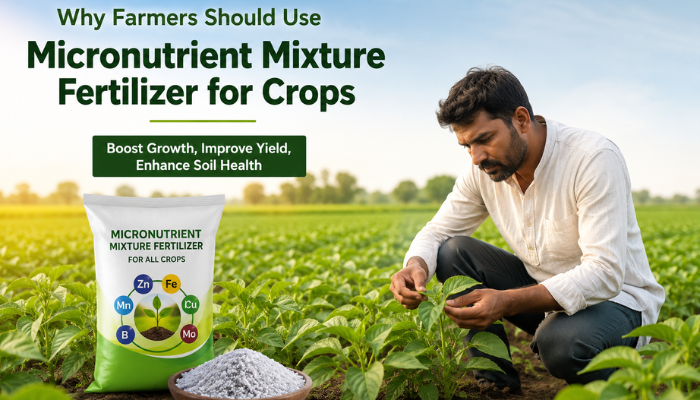
Why Farmers Should Use Micronutrient Mixture Fertilizer for Crops
Crops need more than just Nitrogen (N), Phosphorus (P), and Potassium (K) to grow well. They also need small amounts of nutrients called micronutrients. Even though plants need these nutrients in very small quantities, they are essential for healthy growth, flowering, fruit development, and better yields. If even one micronutrient is missing, crops may not grow properly, and both yield and quality can decrease.
Micronutrient Mixture Fertilizer provides a balanced combination of important micronutrients in one product. It helps prevent and correct nutrient deficiencies, supports healthy crop growth, and improves overall farm productivity.
What is Micronutrient Mixture Fertilizer?
Micronutrient Mixture Fertilizer is a fertilizer that contains several essential micronutrients in one formulation. Instead of buying different micronutrients separately, farmers can apply one product that supplies all the important trace elements together.
It usually contains:
- Zinc (Zn)
- Iron (Fe)
- Manganese (Mn)
- Copper (Cu)
- Boron (B)
- Molybdenum (Mo)
- Sometimes Chlorine (Cl) and other micronutrients, depending on the product
Although these nutrients are needed in small amounts, they are essential for healthy plant growth, flowering, fruiting, and overall crop development.
Why are Micronutrients Important for Plants?
Each micronutrient performs a specific function in plant growth.
Zinc (Zn)
- Supports enzyme activity and protein formation.
- Helps produce plant growth hormones.
- Promotes healthy leaves and proper plant growth.
- Deficiency causes small leaves and stunted growth.
Iron (Fe)
- Helps produce chlorophyll.
- Supports photosynthesis.
- Prevents yellowing between leaf veins, especially in young leaves.
Manganese (Mn)
- Helps in photosynthesis and nutrient metabolism.
- Supports healthy plant growth.
- Deficiency causes yellow leaves with brown or grey spots.
Copper (Cu)
- Supports enzyme activity.
- Helps improve flowering and grain formation.
Boron (B)
- Essential for flowering, pollination, and fruit development.
- Helps strengthen plant cell walls.
- Deficiency leads to poor fruit set and fruit drop.
Molybdenum (Mo)
- Helps plants use nitrogen efficiently.
- Important for nitrogen fixation in legume crops.
- Deficiency reduces nodulation and crop yield.
Using a Micronutrient Mixture Fertilizer ensures that plants receive all these nutrients together, saving time and improving balanced crop nutrition.
Micronutrient Fertilizer Uses
Micronutrient Mixture Fertilizer is used for several purposes, including:
- Helps overcome problems like yellow leaves, poor root growth, stunted plants, poor flowering, and fruit drop caused by a lack of micronutrients.
- Ensures plants receive all essential micronutrients, helping them grow healthier and produce higher yields.
- Helps plants absorb and use Nitrogen (N), Phosphorus (P), and Potassium (K) more effectively, reducing nutrient loss.
- Produces bigger fruits, better grain filling, improved colour, taste, and longer shelf life, increasing market value.
- Makes plants stronger and better able to withstand drought, heat, cold, pests, diseases, and other environmental stresses.
- Promotes better root development, stronger stems, greener leaves, and improved flowering and fruit formation.
- Supplies multiple micronutrients in one application, preventing hidden nutrient deficiencies and supporting overall crop development.
Types of Micronutrient Mixture Fertilizers
Micronutrient mixture fertilizers are available in different forms, allowing farmers to choose the most suitable option based on their crop, soil condition, and method of application.
1. Granular or Powder Micronutrient Mixture
- Applied directly to the soil.
- Can be mixed with NPK fertilizers or FYM.
- Suitable for field crops, vegetables, and orchards.
- Helps improve soil nutrient levels over time.
2. Water-Soluble Micronutrient Mixture
- Dissolves easily in water.
- Used for foliar spray or fertigation.
- Quickly absorbed by plants.
- Best for vegetables, fruits, and greenhouse crops.
3. Chelated Micronutrient Mixture
- Micronutrients are protected with chelating agents like EDTA.
- Helps nutrients remain available even in alkaline soils.
- Suitable for fertigation and foliar spraying.
4. Liquid Micronutrient Mixture
- Available as ready-to-use or concentrated liquid.
- Easy to apply through foliar spray or drip irrigation.
- Commonly used in horticultural crops.
When to Use Micronutrient Mixture Fertilizer?
Farmers should use Micronutrient Mixture Fertilizer when:
- Apply if you notice yellow leaves (chlorosis), slow growth, poor flowering, or low fruit set.
- Use during vegetative growth, flowering, and fruit development when plants need more nutrients.
- Apply in sandy, alkaline, or nutrient-deficient soils where micronutrients like zinc, iron, and boron are less available.
- Use regularly in high-yield farming to avoid hidden micronutrient deficiencies before visible symptoms appear.
- Apply the recommended micronutrient mixture if soil testing shows a deficiency of one or more micronutrients.
How to Apply Micronutrient Mixture Fertilizer?
Micronutrient mixture fertilizer can be applied through soil application, foliar spray, fertigation, or seed treatment, depending on the crop, soil condition, and stage of plant growth.
1. Soil Application
- Mix the fertilizer with FYM, compost, or NPK fertilizers.
- Apply before sowing or transplanting.
- Mix well into the topsoil.
- Helps improve soil fertility for a long time.
2. Foliar Spray
- Mix the recommended quantity with water.
- Spray during early morning or evening.
- Best applied during:
- Vegetative stage
- Flowering stage
- Fruit development stage
- Repeat every 10-15 days if needed.
3. Fertigation
- Apply water-soluble fertilizer through a drip irrigation system.
- Ensures even nutrient distribution.
- Suitable for bananas, grapes, vegetables, orchards, and greenhouse crops.
4. Seed Treatment
- Coat seeds with a small quantity of micronutrient fertilizer before sowing.
- Improves seed germination.
- Promotes healthy early plant growth.
Common Mistakes to Avoid
Avoid these mistakes while using Micronutrient Mixture Fertilizer:
- Applying fertilizer without soil or leaf testing.
- Using more than the recommended dose.
- Mixing incompatible fertilizers or pesticides.
- Spraying during hot afternoon hours.
- Ignoring water quality and soil pH during foliar spray or fertigation.
Always follow the product instructions and local agricultural recommendations.
Conclusion
Micronutrient Mixture Fertilizer is an effective way to provide essential micronutrients required for healthy crop growth. Although plants need these nutrients in small amounts, they play a major role in improving flowering, fruit development, crop quality, and yield.
Looking for high-quality micronutrient fertilizers? SV Agro Solutions is a trusted Micronutrient manufacturer in Pune, offering quality micronutrient fertilizers that improve plant growth, correct nutrient deficiencies, and increase crop yield. As a reliable Micronutrient supplier in Pune, we serve farmers across India and international markets.
FAQs
1. Can I mix Micronutrient Mixture Fertilizer with NPK fertilizer?
Yes. Granular micronutrient mixtures can usually be mixed with NPK fertilizers for soil application. Always check the product label before mixing fertilizers for foliar spraying.
2. How much Micronutrient Mixture Fertilizer should I apply?
The required dose depends on the crop, soil condition, and product. Always follow soil test recommendations and the instructions given on the product label.
3. Can plants survive without micronutrients?
No. Plants need micronutrients in small amounts for healthy growth, and a deficiency can reduce growth, yield, and overall plant health.
4. How to increase micronutrients in soil?
Test the soil first, then apply the required micronutrient fertilizers or soil amendments based on the test results.
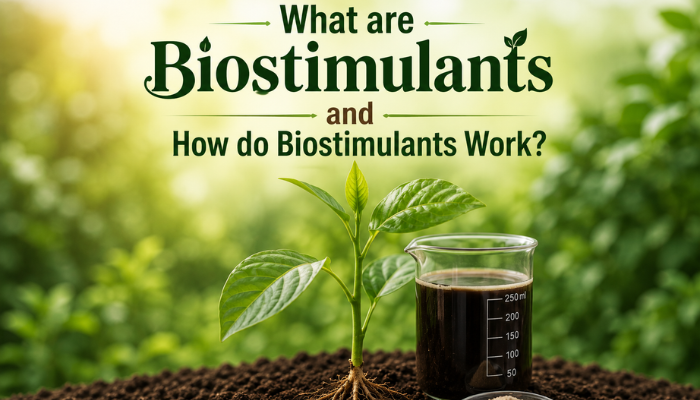
What is Biostimulant and How do Biostimulants Work?
Biostimulant products in agriculture are becoming increasingly popular among farmers because they help improve crop growth, increase nutrient efficiency, and support plants during stressful conditions. With changing weather patterns, declining soil fertility, and rising input costs, farmers are looking for sustainable ways to improve crop productivity.
A biostimulant is a product that helps plants grow better, stay healthy, absorb nutrients more efficiently, and handle stress such as drought, heat, or salinity.
In this blog, we will explain what is biostimulant, how they work, their benefits, and how farmers can use biostimulant products in agriculture for better crop performance.
What is Biostimulant?
A biostimulant is a natural substance or beneficial microorganism that helps plants grow better and stay healthier. It is applied to seeds, soil, or plant leaves to support the plant’s natural growth processes.
Unlike fertilizers, biostimulants do not directly provide nutrients such as nitrogen, phosphorus, or potassium. Instead, they help plants use available nutrients more efficiently and improve their ability to handle different environmental stresses.
Biostimulants work like a health booster for plants. They strengthen the plant from within and help it perform better throughout the crop cycle.
How Do Biostimulants Work?
Biostimulants help plants grow better by supporting their natural processes. They do not directly provide nutrients like fertilizers or control pests like pesticides. Instead, they help plants use available nutrients more efficiently and stay healthy under stress.
- Improve Nutrient Absorption- Biostimulants help plants absorb and use nutrients from the soil more effectively, making fertilizers work better.
- Support Better Root Growth- They encourage stronger and deeper root development, helping plants take up more water and nutrients.
- Increase Stress Tolerance- Biostimulants help crops cope with drought, heat, salinity, and other environmental stresses, allowing plants to remain healthy during difficult conditions.
- Boost Soil Microbial Activity- Many biostimulants support beneficial soil microorganisms that improve nutrient availability and overall soil health.
- Improve Soil-Plant Interaction- They help create a healthier root zone, which enhances the relationship between plant roots and the soil.
- Stimulate Plant Growth Processes- Ingredients such as seaweed extracts, amino acids, humic acids, and fulvic acids activate natural plant functions that support healthy growth and development.
- Increase Chlorophyll Production- Biostimulants help plants produce more chlorophyll, resulting in greener leaves and improved photosynthesis.
- Enhance Crop Quality and Yield- By improving nutrient use, root growth, and stress tolerance, biostimulants help crops produce better-quality fruits, vegetables, and grains with higher yield potential.
Main Types of Biostimulant Products in Agriculture
Several types of biostimulant products are available for different crops and farming conditions.
1. Seaweed and Botanical Extracts
- Made from seaweed and natural plant extracts.
- Rich in natural plant growth compounds, vitamins, and minerals.
- Help crops grow healthier and stronger.
- Improve tolerance to drought, heat, and other environmental stresses.
- Support better flowering, fruiting, and crop quality.
Examples
- SV SN 40 - A seaweed-based biostimulant that promotes root growth, improves plant health, and helps crops withstand stress.
- SV Sugarban - A natural plant growth enhancer that supports flowering, improves crop quality, and boosts nutrient uptake.
2. Humic and Fulvic Acids
- Natural substances formed from decomposed organic matter.
- Help improve soil structure and fertility.
- Promote strong root growth.
- Increase nutrient availability and absorption by plants.
- Improves soil health and overall plant growth.
Examples
- SV Fulora- A humic and fulvic acid-based product that improves soil fertility, enhances root growth, and increases nutrient uptake.
- SV Size Builder -A plant growth promoter that supports nutrient absorption, improves crop development, and helps achieve better yield and crop quality.
3. Protein Hydrolysates and Amino Acids
- Contain amino acids that help plants grow and develop.
- Improve photosynthesis and plant metabolism.
- Help crops recover quickly from stress.
- Enhance nutrient use efficiency, especially nitrogen.
- Promote healthy growth and higher productivity.
Example
- SV Canter - An amino acid-based biostimulant that improves plant growth, nutrient absorption, and crop productivity.
4. Microbial Biostimulants
- Contain beneficial microorganisms such as bacteria and fungi.
- Improve root development and nutrient uptake.
- Help make nutrients like phosphorus more available to plants.
- Support soil fertility and microbial activity.
- Promote healthier and stronger crop growth.
5. Chitosan and Other Biopolymers
- Natural compounds obtained from biological sources.
- Help activate the plant's natural defense system.
- Improve resistance to heat, cold, and other stresses.
- Support healthier crop growth and better plant strength.
Benefits of Biostimulants
Biostimulants offer several advantages for farmers.
- Biostimulants help plants absorb and use nutrients more efficiently, making fertilizers work better and reducing nutrient loss.
- They help crops handle difficult conditions such as drought, high temperatures, salinity, and other environmental stresses.
- Biostimulants can enhance crop color, size, taste, nutritional value, and shelf life, resulting in better-quality produce.
- They encourage the growth of beneficial soil microbes, improve soil fertility, and promote healthy soil activity over time.
- Biostimulants help develop larger and healthier root systems, allowing plants to absorb more water and nutrients from the soil.
- Strong roots and better nutrient use help plants grow healthier, greener, and more vigorous throughout the crop cycle.
- By supporting overall plant health and reducing stress, biostimulants can contribute to higher crop productivity and better harvests.
- Crops become stronger and recover faster from environmental challenges, helping maintain consistent growth and performance.
Factors to Consider Before Choosing a Biostimulant Product
Before selecting a product, farmers should consider:
- First, understand why you need a biostimulant.
- Some products help improve root growth, while others support flowering, stress recovery, or overall crop development.
- Different crops respond differently to biostimulants.
- Choose a product that is suitable for your specific crop.
- Some biostimulants work best during seedling growth, while others are more effective during flowering, fruiting, or harvest stages.
- Select products based on soil health and environmental challenges such as drought, heat, salinity, or nutrient deficiency.
- Make sure the biostimulant can be safely used along with fertilizers, pesticides, or other crop protection products already being applied.
- Always read the product label and follow the recommended dose and application method for the best results.
- Choose a product that provides visible benefits such as better growth, improved yield, or higher crop quality, helping you get a good return on investment.
Conclusion
Understanding what is biostimulant helps farmers make better decisions for crop management. Biostimulants are valuable tools that improve nutrient use efficiency, support root growth, increase stress tolerance, and enhance crop quality.
Looking for reliable biostimulant products to improve crop growth and productivity?
SV Agro Solutions is a trusted biostimulant manufacturer and supplier in Pune, offering high-quality products that help improve plant health, nutrient uptake, stress tolerance, and crop yield. Our innovative biostimulant solutions support sustainable farming and are trusted by farmers across India as well as international markets.
Frequently Asked Questions
1. What is biostimulant in simple words?
A biostimulant is a natural product or beneficial microorganism that helps plants grow better by improving nutrient uptake, root growth, and stress tolerance.
2. How do biostimulants work in crops?
Biostimulants stimulate natural plant processes that improve nutrient efficiency, root development, and resistance to environmental stress.
3. Are biostimulant products in agriculture safe to use?
Yes, most biostimulants are safe when used according to the manufacturer's recommendations.
4. Can biostimulants replace fertilizers?
No, biostimulants cannot completely replace fertilizers because they do not supply all essential nutrients required by crops.
5. Which crops benefit most from biostimulants?
Almost all crops, including cereals, vegetables, fruits, plantation crops, and horticultural crops, can benefit from biostimulant applications.
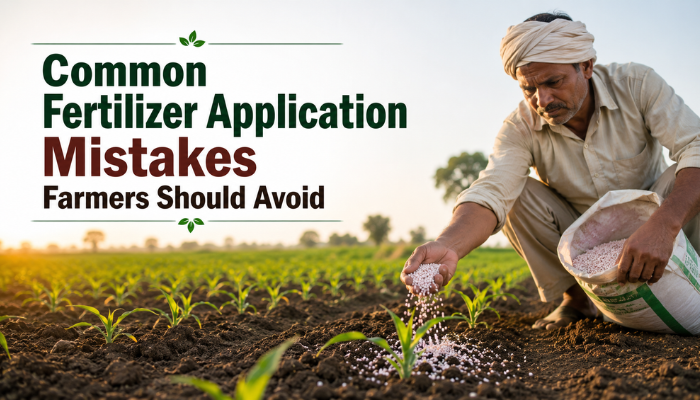
Common Fertilizer Application Mistakes Farmers Should Avoid
Fertilizer is an important input for healthy crop growth. It provides crops with essential nutrients and helps improve yield and quality. However, using the wrong fertilizer, applying too much, or applying it at the wrong time can waste money and affect crop and soil health.
Many farmers face lower yields and higher input costs because of simple fertilizer application mistakes. Understanding these common mistakes can help farmers use fertilizers more effectively, reduce waste, protect soil health, and improve farm income.
Why Correct Fertilizer Application Matters?
Correct fertilizer application helps crops receive the nutrients they need at the right time and in the right amount. Proper fertilizer management can provide several benefits:
- Better nutrient uptake by crops
- Improved crop growth, yield, and quality
- Lower fertilizer and input costs
- Better soil health
- Less nutrient loss and environmental pollution
On the other hand, poor fertilizer application can cause nutrient loss through runoff, leaching, or evaporation. It can also create nutrient imbalances, reduce soil quality, and cause fertilizer burn that may damage crops.
Common Fertilizer Application Mistakes Farmers Should Avoid
Here are some of the most common fertilizer application mistakes and simple ways to fix them.
1. Applying Fertilizer Without Soil Testing
- Many farmers apply fertilizers based on past experience or simply use the same fertilizer that nearby farmers are using.
- However, nutrient levels can vary from one field to another.
- Applying fertilizer without knowing the soil condition may result in too much of one nutrient and not enough of another.
How to fix it:
Test the soil every 2-3 years. Use the soil test results to decide the right type and amount of fertilizer required for the crop.
2. Over-Fertilization
Using more fertilizer does not always mean getting a higher yield. Excess fertilizer can harm both crops and soil.
Over-fertilization can lead to:
- Fertilizer burn and root damage
- Leaf yellowing
- Nutrient leaching
- Soil salinity
- Nutrient imbalance
- Higher production costs
How to fix it:
Follow the recommended fertilizer dose for the crop and soil. Where suitable, divide fertilizer into multiple applications instead of applying the entire quantity at once.
3. Under-Fertilization
- Using too little fertilizer can also affect crop growth.
- When crops do not receive enough nutrients, their growth and yield potential may decrease.
- Some farmers reduce fertilizer use to lower costs, but this may result in poor crop performance and lower returns.
How to fix it:
Use a balanced fertilizer dose based on soil test results and the nutrient requirements of the crop.
4. Applying Fertilizer at the Wrong Time
- The timing of fertilizer application is important because crops need different nutrients at different growth stages.
- For example, too much nitrogen before flowering can encourage excessive vegetative growth and increase the risk of lodging.
- Applying fertilizer just before heavy rainfall can also result in nutrient runoff.
How to fix it:
Match fertilizer application with the crop growth stage and weather conditions. Apply nutrients when crops can use them effectively.
5. Incorrect Fertilizer Placement
- Simply spreading fertilizer on the soil surface may result in nutrient losses through runoff or evaporation.
- At the same time, placing fertilizer too close to seeds can damage young seedlings.
How to fix it:
Use suitable methods such as banding, side dressing, or fertigation. Place fertilizer where crop roots can access the nutrients without causing seed or root damage.
6. Using the Wrong Type of Fertilizer
- Different crops and soils have different nutrient requirements.
- For example, using urea when phosphorus is required or applying NPK when the main problem is a micronutrient deficiency may not solve the nutrient problem.
- Some fertilizers may also be less suitable for certain soil conditions, such as high-pH soils.
How to fix it:
Select fertilizer based on the soil test, crop requirements, and local agricultural recommendations.
7. Ignoring Weather Conditions
- Weather can have a major effect on fertilizer efficiency.
- Heavy rain can wash nutrients away, while high temperatures can increase nitrogen losses through volatilization.
- Applying fertilizer during drought or on waterlogged soil can also reduce nutrient uptake.
How to fix it:
Apply fertilizer when the soil has suitable moisture. Avoid applying it just before heavy rain, during waterlogging, or when the soil is extremely dry.
8. Poor Calibration of Application Equipment
- Incorrect settings on spreaders and other fertilizer application equipment can result in uneven distribution.
- Some parts of the field may receive too much fertilizer while others receive too little.
How to fix it:
Calibrate spreaders, sprayers, and fertigation equipment regularly. Check the distribution pattern to ensure fertilizer is applied evenly.
9. Mixing Incompatible Fertilizers or Chemicals
- Some fertilizers may not be compatible with pesticides or other agricultural inputs.
- Mixing incompatible products can cause unwanted chemical reactions, reduce effectiveness, or damage crops.
How to fix it:
Always check product labels and compatibility information before mixing fertilizers with other inputs. When unsure, take advice from an agricultural expert.
10. Relying Only on Chemical Fertilizers
- Chemical fertilizers provide important nutrients, but depending only on them for a long period may affect soil health.
- Continuous use without proper nutrient management can reduce organic matter and affect beneficial microbial activity.
How to fix it:
Use chemical fertilizers along with suitable organic sources such as farmyard manure (FYM), compost, and green manure. Biofertilizers can also be included where appropriate as part of an integrated nutrient management approach.
How to Avoid Fertilizer Application Mistakes
Farmers can improve fertilizer efficiency by following a few practical steps.
- Check spreaders, sprayers, and fertigation systems regularly.
- Proper calibration helps ensure that the recommended amount of fertilizer reaches the field evenly.
- Maintain records of the fertilizer type, quantity, application date, crop, and field.
- These records can help farmers understand what works best and plan future fertilizer applications.
- Agronomists, soil scientists, and local agriculture officers can provide useful advice on fertilizer selection, dosage, timing, and application methods.
- Farmers should also stay updated about recommended farming practices.
Benefits of Avoiding Fertilizer Application Mistakes
Proper fertilizer management can help farmers achieve:
- Higher crop yield and better quality
- Lower fertilizer costs and less waste
- Better soil health
- Improved long-term farm productivity
- Less nutrient runoff and leaching
- Better return on investment
Conclusion
Avoiding common fertilizer application mistakes is important for profitable and sustainable farming. Simple practices such as soil testing, using the correct dose, choosing the right fertilizer, applying nutrients at the right time, and using proper placement methods can make a major difference.
Looking for a reliable organic fertilizer to support healthier crops and better soil health? SV Agro Solutions offers quality fertilizer solutions developed to meet the nutritional needs of different crops and farming conditions. As a trusted fertilizer manufacturer in Pune, SV Agro Solutions focuses on research-based and quality-tested products that support better crop growth, nutrient management, and sustainable farming.
Its fertilizer range, including SV Mr. Micro-G, can help farmers improve crop nutrition and overall farm productivity. Learn more about SV Agro Solutions’ fertilizer solutions and choose the right option for your farming needs.
FAQs
1. What are the most common fertilizer application mistakes?
The most common mistakes include applying fertilizer without soil testing, using too much or too little fertilizer, choosing the wrong fertilizer, applying it at the wrong time or place, and ignoring weather conditions.
2. How can I avoid fertilizer burn in crops?
Follow the recommended fertilizer dose, use split applications where suitable, and maintain proper soil moisture.
3. Is soil testing necessary before fertilizer application?
Yes. Soil testing helps identify nutrient deficiencies and excesses. It allows farmers to select suitable fertilizers and avoid unnecessary applications, helping save costs and maintain soil health.
4. What is the best time to apply fertilizer?
The best time depends on the crop, fertilizer, soil, and growth stage. Generally, fertilizer should be applied according to crop nutrient requirements, with basal application at sowing or transplanting and top dressing during suitable active growth stages.
5. Can I mix fertilizers with pesticides?
Only when the products are compatible. Always check the product label and mixing instructions before combining fertilizers with pesticides. If there is any doubt, consult an agricultural expert.

Understanding Plant Nutrient Deficiencies and How to Fix Them
Plants need a balanced supply of nutrients to grow strong and healthy. When they lack essential nutrients, they show signs like discoloration, stunted growth, or poor yield. Understanding plant nutrient deficiencies and how to fix them is important for maintaining healthy crops. In this blog, we will discuss how to identify different deficiencies, their causes, and the best solutions to restore plant health.
Plants, like all living things, need nutrients to grow healthy and strong. When they don’t get enough of the right nutrients, they can show signs of deficiency. Just like people feel tired and weak when they don’t eat the right food, plants become unhealthy when they lack important nutrients.
In this blog, we'll take a look at common plant nutrient deficiencies, how to spot them, and how you can fix them. Let's dive in!
What Is Plant Nutrient Deficiency?
Plant nutrient deficiency occurs when plants do not get the necessary nutrients from the soil. This can lead to weak growth, lower yields, and increased vulnerability to pests and diseases. Common reasons for plant deficiencies include poor soil quality, incorrect pH levels, excessive watering, or lack of proper fertilization.
Causes of Plant Nutrient Deficiencies
Several factors can contribute to plant nutrient deficiency:
Poor soil quality: Over time, soil loses essential nutrients if not replenished.
Imbalanced pH levels: If soil pH is too high or too low, it can block nutrient absorption.
Overwatering or underwatering: Too much or too little water affects nutrient uptake.
Nutrient imbalance: Excess of one nutrient can hinder the absorption of others.
Common Signs of Nutrient Deficiencies
Different nutrient deficiencies show up in different ways, so it’s important to know what to look for. Here are a few common signs of nutrient deficiencies in plants:
Yellowing Leaves (Chlorosis)
This often means the plant is lacking nitrogen, iron, or magnesium.
Stunted Growth
When a plant isn’t growing properly, it might be missing phosphorus or potassium.
Brown or Burnt Edges on Leaves
This could be a sign of potassium deficiency.
Purple or Red Leaves
This usually points to a phosphorus shortage.
Weak Roots
If the roots are not growing strong, the plant might be lacking phosphorus or nitrogen.
Identifying Common Plant Nutrient Deficiencies
Recognizing plant deficiencies is key to fixing them. Below are some common nutrient deficiencies and their symptoms:
Macronutrient Deficiencies
Nitrogen (N) Deficiency
Symptoms: Yellowing of older leaves, weak stems, slow growth.
Solution: Apply nitrogen-rich fertilizers like urea or organic compost.
Phosphorus (P) Deficiency
Symptoms: Purple or reddish leaves, poor root development, slow flowering.
Solution: Use phosphate fertilizers like rock phosphate.
Potassium (K) Deficiency
Symptoms: Brown leaf edges, weak stems, poor fruit formation.
Solution: Apply potassium sulfate or compost rich in potassium.
Calcium (Ca) Deficiency
Symptoms: Leaf tip burns, distorted new leaves, blossom-end rot in fruits.
Solution: Use calcium nitrate or gypsum to improve calcium levels.
Magnesium (Mg) Deficiency
Symptoms: Yellowing between veins of older leaves, leaf curling.
Solution: Apply Epsom salt (magnesium sulfate) or dolomitic lime.
Micronutrient Deficiencies
Iron (Fe) Deficiency
Symptoms: Yellowing of young leaves while veins remain green.
Solution: Use iron chelates or iron sulfate.
Zinc (Zn) Deficiency
Symptoms: Small, deformed leaves, stunted growth, poor fruit production.
Solution: Apply zinc sulfate or organic compost.
Boron (B) Deficiency
Symptoms: Brittle leaves, hollow stems, weak flowering.
Solution: Use borax or boric acid.
How to Fix Plant Nutrient Deficiencies
If a plant deficiency is identified, these solutions can help restore health
1. Balanced Fertilization
Using the right fertilizer is essential for fixing plant deficiencies. A well-balanced NPK fertilizer provides essential macronutrients, while organic fertilizers help improve soil quality for organic plants.
2. Adjusting Soil pH
Soil pH affects nutrient absorption. If the pH is too high, nutrients become unavailable. Test soil regularly and use lime to raise pH or sulfur to lower it.
3. Organic Soil Amendments
Adding organic matter like compost, manure, or biofertilizers enhances soil fertility and prevents plant nutrient deficiencies.
4. Foliar Sprays for Quick Fixes
For fast results, foliar sprays help plants absorb nutrients quickly. For example, Epsom salt spray can fix the deficiency of magnesium in plants.
5. Proper Watering Practices
Overwatering and underwatering both lead to plant deficiencies. Ensure a consistent watering schedule to maintain proper nutrient absorption.
Preventing Future Plant Deficiencies
To avoid plant nutrient deficiency in the future, follow these best practices:
Regular soil testing to monitor nutrient levels.
Crop rotation to maintain soil fertility.
Using organic fertilizers to replenish essential nutrients.
Proper irrigation to prevent nutrient leaching.
Environmental Factors That Affect Nutrient Absorption
Apart from soil conditions, external environmental factors also play a role in nutrient absorption.
1. Temperature
Cold soil slows root activity, making it harder for plants to take up nutrients like phosphorus and iron.
Extreme heat increases evaporation, causing nutrient loss from the soil.
2. Rainfall and Waterlogging
Heavy rain can wash away essential nutrients like nitrogen, potassium, and sulfur.
Waterlogged soil reduces oxygen availability, making it difficult for roots to absorb nutrients.
3. Soil Compaction
Hard, compacted soil restricts root growth and nutrient movement.
Poor soil aeration leads to deficiencies in calcium, iron, and magnesium.
4. Excessive Light Exposure
High-intensity sunlight can increase plant stress, leading to deficiencies in iron and manganese.
Shade-loving plants may struggle to absorb phosphorus when exposed to too much sunlight.
Soil Testing Tools and Kits for Nutrient Diagnosis
To detect nutrient deficiencies early, soil testing is essential. Here are some tools and kits that can help:
Soil pH Meters – Helps check if soil pH is too high or too low.
Soil Test Kits – Measures levels of nitrogen, phosphorus, and potassium.
Digital Soil Testers – Provides instant nutrient analysis for quick adjustments.
Mobile Apps for Soil Testing – Apps like ‘Soil Test Pro’ and ‘Ag PhD help analyze soil reports and recommend fertilizers.
Before You Start Treatment: A Simple Checklist
Before you begin treating a plant for a nutrient deficiency, it's important to rule out other possible issues that could be affecting its health. Use this checklist to make sure you're covering all your bases:
Look for Pests or Diseases
Check your plants for signs of insects or diseases. Pests like worms or spider mites can cause leaves to change color or have holes. Certain diseases, such as mosaic virus or mold, can also make your leaves look different.
Check the Soil
If you’re growing your plants in soil, make sure you're not over- or underwatering. Too much or too little water can lead to leaf discoloration and weak growth. Poorly draining soil or compacted soil can also cause problems. You can also test your soil to check its nutrient levels and figure out if there’s a deficiency.
Check the Water
The quality of your water matters for healthy plants. For example, hard water might already have some nutrients in it, which can change how much fertilizer you need. Testing your water can help you know exactly what’s in it.
Check the Temperature
If the temperature is too hot or too cold, it can slow down your plants' growth and affect how they flower or fruit. Make sure your plants are in the right environment for their needs.
Check Nutrient Strength
It’s important to balance your plant nutrients. Too much fertilizer can “scorch” your plants, while too little can make them grow slowly or stop growing altogether.
Check the pH Level
Plants have a preferred pH range for absorbing nutrients. If your soil or water is too acidic or too alkaline, your plants won’t be able to get the nutrients they need. Make sure the pH is in the right range for your plants.
Call an Expert
If you’re growing valuable crops and think you have a nutrient problem, it’s best to consult a plant nutrition expert. They can help you figure out what’s wrong and guide you on how to fix it.
Real-World Examples of Fixing Nutrient Deficiencies
Case Study 1: Fixing Nitrogen Deficiency in Corn Fields
A farmer in Maharashtra noticed his corn plants turning yellow with slow growth. After a soil test, it was found that the nitrogen levels were low. He applied organic compost and urea, and within two weeks, the plants turned green and healthy again.
Case Study 2: Solving Calcium Deficiency in Tomatoes
A greenhouse farmer in Karnataka had tomatoes with black spots on the bottom (blossom-end rot). A soil test showed calcium deficiency. By adding gypsum and adjusting watering, the issue was resolved within a few weeks.
Conclusion
Plant nutrient deficiencies can weaken crops and reduce yield. By identifying symptoms early and applying the right solutions like fertilization, organic amendments, and proper watering—you can restore plant health. Regular soil testing and balanced nutrition are the best ways to prevent plant deficiencies and ensure healthy, productive plants.
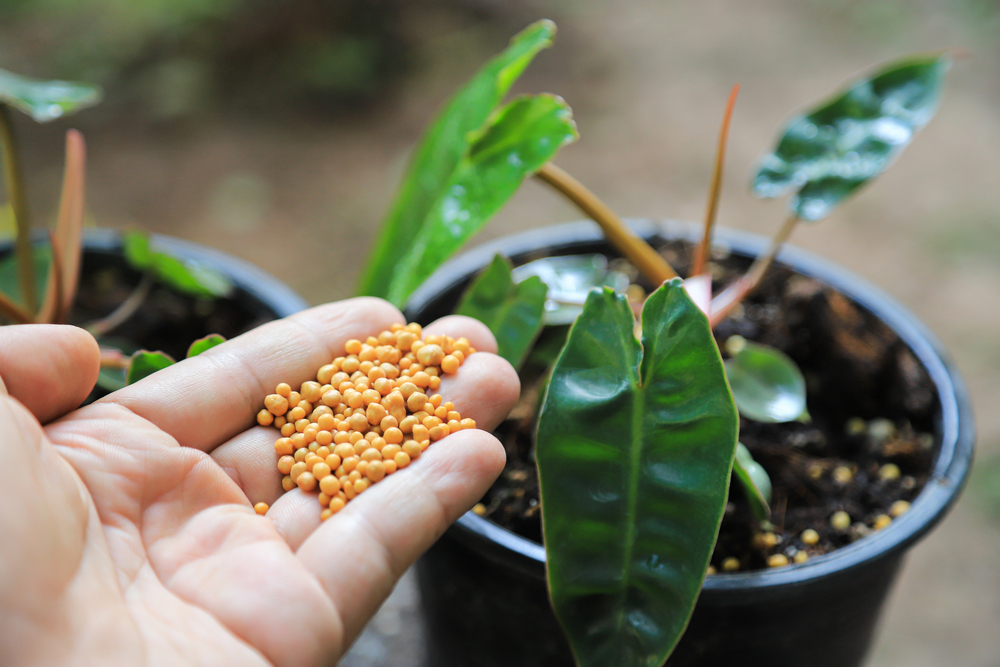
Benefits of Micronutrients for Healthier Plants
Micronutrients play a vital role in plant growth and overall health. Just like humans need vitamins and minerals to stay healthy, plants also require essential nutrients for proper development. Using the best micronutrients for plants ensures stronger roots, greener leaves, and better yields.
Micronutrients are essential elements that plants need in small amounts to grow strong and healthy. These nutrients play a significant role in plant growth, ensuring they develop properly, resist diseases, and produce better yields. While plants require macronutrients like nitrogen, phosphorus, and potassium in large amounts, micronutrients are just as important for overall plant health.
SV Agro Solutions is a well-known micronutrient company in Pune that helps improve farming with high-quality micronutrient products. As a leading micronutrient manufacturer in Pune, we create effective solutions to support sustainable farming. Being a trusted micronutrient supplier in Pune, we serve local farmers and also export our products to other countries.
What Are Micronutrients for Plants?
Micronutrients are essential nutrients for plants that are needed in small amounts but have a big impact. Iron, zinc, manganese, boron, copper, molybdenum, and chlorine are among them. Each micronutrient has a unique role in plant growth and helps in various biological processes.
Why Are Micronutrients Important for Plants?
1. Improves Photosynthesis
Iron and magnesium help in chlorophyll production, which is essential for photosynthesis. With enough micronutrients for plants, they can absorb sunlight better and grow healthier.
2. Stronger Roots and Better Nutrient Absorption
Zinc and boron contribute to strong root development. Healthy roots help plants absorb water and other nutrients efficiently, improving their growth.
3. Enhances Flowering and Fruit Production
The best plants need the right balance of micronutrients to produce flowers and fruits. Boron and molybdenum play a key role in flower formation, increasing yield in fruit-bearing plants.
4. Boosts Disease Resistance
Using the best micronutrient fertilizer strengthens plant immunity. Manganese and copper help plants fight off diseases and pests, making them more resistant to infections.
The Role of Micronutrient Fertilizers
A balanced supply of nutrients is key to growing the best plants. Using a micronutrient fertilizer for plants ensures that they receive the necessary elements for proper growth.
Best micronutrient fertilizers contain a mix of essential elements that help plants absorb nutrients effectively. These fertilizers can be applied in different ways:
Soil Application
Micronutrients are mixed into the soil to provide long-term nourishment.
Foliar Spray
Liquid micronutrients are sprayed on leaves for quick absorption.
Hydroponic Solutions
Nutrient-rich water solutions help plants grow without soil.
Signs of Micronutrient Deficiencies
If plants do not receive the necessary micronutrients, they may show visible signs of deficiencies. Here are some common symptoms:
Yellowing leaves (chlorosis)
Common with iron and zinc deficiency.
Slow or stunted growth
Often caused by a lack of zinc or copper.
Poor flowering and fruiting
Indicates boron deficiency.
Weak stems and drooping leaves
This could be due to manganese or copper deficiency.
Choosing the Best Micronutrient Fertilizer for Plants
To ensure your plants get all the essential nutrients, using a high-quality micronutrient fertilizer for plants is important. A good fertilizer provides the right balance of micronutrients for different crops.
If you are looking for reliable products, a trusted micronutrient manufacturer in Pune can provide high-quality solutions for your farming needs.
How Micronutrients Help Plants Grow Better
Micronutrient fertilizers are important for plant health. They help plants grow properly, stay strong, and fight off diseases. When plants get the right amount of micronutrients, farmers can see benefits like:
Better Energy Production
Micronutrients like Zinc, Iron, and Manganese help plants make chlorophyll, which is needed for photosynthesis. This helps plants grow faster and healthier.
Stronger Roots and Stems
Copper and Boron help plants develop strong roots and sturdy stems, making them more resistant to wind and weather.
Protection from Diseases
Micronutrients improve a plant’s ability to fight off pests and diseases, keeping crops healthier.
Higher Crop Yields
When plants get the right nutrients, they grow better and produce more food, leading to bigger harvests and better-quality crops.
Conclusion
Micronutrients are small but powerful elements that support plant growth, flowering, and resistance against diseases. By using the best micronutrients for plants and the right micronutrient fertilizer for plants, you can ensure healthier and more productive crops. Choose high-quality products from a reputed micronutrient manufacturer in Pune to give your plants the best care.
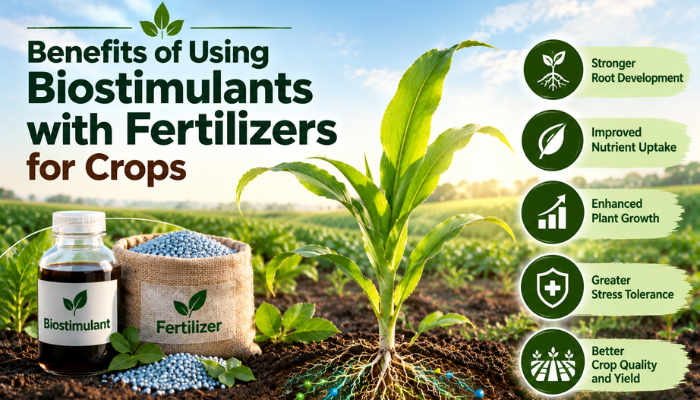
Benefits of Using Biostimulants with Fertilizers for Crops
Fertilizers provide important nutrients such as nitrogen, phosphorus, potassium, and micronutrients. These nutrients help crops grow, develop roots, produce flowers, and form fruits or grains.
However, plants may not always use all the nutrients given through fertilizers. Problems such as poor root growth, drought, heat, unsuitable soil pH, salinity, and nutrient fixation can reduce nutrient uptake.
Biostimulants can support natural processes in plants and around the roots. They may help improve nutrient use, plant growth, stress tolerance, crop quality, and yield. Research shows that biostimulants can improve nutrient use efficiency and crop performance, although results can vary depending on the crop, soil, product, and growing conditions.
The main benefit of using biostimulants with fertilizers is simple: fertilizers provide nutrients, while biostimulants can help plants use available nutrients more effectively.
What are Biostimulants?
Biostimulants are substances or microorganisms that support natural processes in plants or around the roots. They are different from fertilizers because their main purpose is not to supply nutrients.
Common types of biostimulants include:
- Humic and fulvic acids.
- Seaweed extracts.
- Amino acids and protein hydrolysates.
- Beneficial microorganisms.
- Chitosan and plant extracts.
Why Use Biostimulants with Fertilizers?
-
Fertilizers provide nutrients, but plants need healthy roots and suitable soil conditions to absorb these nutrients.
- For example, drought can reduce root activity, while soil pH or nutrient fixation can affect nutrient availability.
- Biostimulants may support root growth and nutrient uptake. This means using biostimulants with fertilizers can provide both nutrients and additional support for better plant performance.
- However, biostimulants are an add-on to a balanced fertilizer programme. They should not be treated as a complete replacement for fertilizers, organic manure, irrigation, or good farming practices.
Major Biostimulants Benefits When Used with Fertilizers
Biostimulants support better nutrient use, root growth, crop development, stress tolerance, and overall plant health when used with fertilizers.
1. Better Nutrient Use
One of the important biostimulants benefits is improved nutrient use efficiency.
Biostimulants may help plants absorb and use nutrients such as nitrogen, phosphorus, potassium, and micronutrients more effectively.
Better nutrient use can help with:
- Less nutrient wastage.
- More uniform crop growth.
- Better use of fertilizer investment.
- Better nutrient availability around the roots.
Farmers should still follow soil test recommendations and the recommended fertilizer dose.
2. Stronger Root Growth
Some biostimulants can support root growth. Stronger roots can explore more soil and take up more water and nutrients.
Good root growth can help with:
- Early crop growth.
- Better plant establishment.
- Improved nutrient absorption.
- Better water uptake.
- Better growth during mild drought conditions.
3. Better Crop Growth and Plant Vigour
When plants get nutrients properly, they can develop healthier leaves, stems, and roots.
Farmers may see:
- Better early growth.
- More uniform plants.
- Stronger stems.
- Better leaf development.
- Better recovery after transplanting.
The results can differ based on the crop, soil, weather, product, and application method.
4. Better Yield Potential
Better nutrition and healthy root growth can support good crop development and yield.
In fruit and vegetable crops, biostimulants may support:
- Flowering.
- Fruit setting.
- Fruit development.
- Fruit size.
- Crop quality.
In grains and pulses, they may support crop growth and grain filling.
However, yield improvement is not guaranteed in every crop or field. It is better to test a product on a small area before using it on the complete farm.
5. Helps Crops Handle Environmental Stress
Farmers may face problems such as:
- Drought.
- Heat.
- Salinity.
- Cold.
- Waterlogging.
- Transplanting stress.
Biostimulants may help crops tolerate and recover from some environmental stresses.
They can support crops during stressful conditions, but they cannot replace proper irrigation, drainage, mulching, or other important farm practices.
6. Better Crop Quality
Biostimulants may support better crop quality, including:
- Fruit size.
- Fruit colour.
- Firmness.
- Uniformity.
- Sugar content.
- Shelf life.
The results depend on crop variety, soil condition, nutrition, weather, and harvesting practices.
7. Supports Soil and Root-Zone Health
- Some biostimulants can support useful activity around the plant roots. This may help nutrient availability and root development.
- Using biostimulants along with organic matter, crop rotation, and good soil management can support healthy crop production.
- However, biostimulants should not be considered a replacement for compost, farmyard manure, or regular soil testing.
8. May Help Reduce Nutrient Loss
When crops use nutrients more efficiently, there may be less unused fertilizer available for loss through leaching or runoff.
For better results, farmers should combine biostimulants with:
- Correct fertilizer dose.
- Proper fertilizer placement.
- Split fertilizer application where suitable.
- Proper irrigation.
- Regular soil testing.
Types of Biostimulants Commonly Used with Fertilizers
Common types of biostimulants used with fertilizers include seaweed extracts, humic substances, amino acids, beneficial microorganisms, and plant-based extracts
Humic and Fulvic Acids
These substances can support root growth and nutrient availability and are commonly used in crop production.
Seaweed Extracts
Seaweed extracts are used to support plant growth and help crops manage environmental stress.
Amino Acids and Protein Hydrolysates
These can support crop growth and metabolism and may help plants recover during stressful conditions.
Microbial Biostimulants
These contain useful microorganisms that can support the root zone and nutrient-related processes.
Chitosan and Plant Extracts
These substances may support natural plant defence responses and plant resilience.
How to Use Biostimulants with Fertilizers
Learn how to use biostimulants with fertilizers in the right quantity and at the right stage to support nutrient use, crop growth, and plant health.
1. Test the Soil First
Before applying fertilizers and biostimulants, understand the soil condition.
Check:
- Soil pH.
- Nutrient levels.
- Soil Salinity.
- Organic matter.
- Other important soil conditions.
This helps farmers prepare a better fertilizer plan.
2. Choose the Right Product
Select a biostimulant according to the:
- Crop.
- Soil condition.
- Crop growth stage.
- Problem or stress condition.
- Application method.
Always check the product label for ingredients, dose, compatibility, expiry date, and storage instructions.
3. Apply at the Right Crop Stage
Depending on the product, suitable stages may include:
- Seed treatment or planting.
- Early crop growth.
- Vegetative stage.
- Before flowering.
- Fruit setting.
- Fruit development.
- After stress.
The correct timing depends on the product and crop.
4. Use the Correct Application Method
Biostimulants may be applied through:
- Foliar spray.
- Soil application.
- Fertigation.
- Seed treatment.
Always follow the application method given on the product label.
5. Check Product Compatibility
If you plan to mix a biostimulant with fertilizer or pesticide, check whether the products are compatible.
6. Follow the Recommended Dose
Use the recommended dose and apply the product under suitable weather conditions. For foliar sprays, cooler hours are generally preferred.
Conclusion
The main benefits of using biostimulants with fertilizer include better nutrient use, stronger root growth, improved crop growth, better stress tolerance, and support for crop quality. Biostimulants in agriculture work best when used along with balanced fertilizers, soil testing, organic matter, proper irrigation, and good crop management.
Want Better Crop Growth with the Right Biostimulants and Fertilizers? SV Agro Solutions Pvt. Ltd. offers quality biostimulants, fertilizers, and micronutrients to support healthy crop growth and better nutrient use. Its biostimulant range includes SV Fruiter, SV Canter, SV 59, SV Fulora, SV SN 40, SV Cofez, SV Rounder, SV Defence, SV Sugarban, and SV Size Builder.
With a focus on research, product quality, and sustainable farming, SV Agro Solutions serves 80,000+ farmers across India with agricultural inputs designed for different crop needs and farming conditions.
FAQs
1. What are the benefits of using biostimulants with fertilizers?
The main benefits include better nutrient use, stronger root growth, improved crop growth, better stress tolerance, and support for crop quality.
2. Do biostimulants replace chemical fertilizers?
No. Biostimulants support plant processes and nutrient use, but they do not replace the nutrients supplied by fertilizers.
3. Can biostimulants be mixed with NPK fertilizers?
Some biostimulants can be used with NPK fertilizers, but compatibility depends on the product. Always check the product label before mixing.
4. When should farmers apply biostimulants?
They can be applied at stages such as seed treatment, early growth, vegetative growth, flowering, fruit setting, or after stress, depending on the crop and product.
5. Are biostimulants useful during drought or heat stress?
Biostimulants may support plant tolerance and recovery during drought, heat, salinity, and other environmental stresses. However, they should be used along with proper irrigation, drainage, and other crop management practices.
The importance of fertilizer in modern agriculture
Agriculture has seen many scientific and technological innovations that have boosted crop productivity, especially in the second half of the 20th century. One of the most impactful advancements has been the development and use of fertilizer, which revolutionized food production across the world.
Agriculture has seen many scientific and technological innovations that have significantly boosted crop productivity, particularly in the second half of the 20th century. One of the most important advancements in this field is fertilizer, which has revolutionized food production globally. But what is fertilizer, and why is it so critical in agriculture?
Looking for a reliable fertilizer manufacturer in Pune? At SV Agro Solutions, we specialize in producing high-quality fertilizers tailored to meet the needs of modern agriculture. As a trusted fertilizer company in Pune, we offer a wide range of products designed to improve crop yield, soil health, and overall productivity. Our fertilizers are created using the latest technology and sustainable practices, ensuring that farmers get the best results while supporting the environment. Partner with us for all your fertilizer manufacturing needs and experience excellence in agriculture. Contact us today to learn more about our services and products.
What is Fertilizer?
A resource that gives plants the vital nutrients they need to grow is fertilizer. These nutrients are important for the development of plants and their ability to produce high-quality crops. There are two main types of fertilizers: organic fertilizers (such as compost and manure) and inorganic (mineral) fertilizers, which are typically rich in essential elements like nitrogen (N), phosphorus (P), and potassium (K)—the core components of NPK fertilizers.
These nutrients play a vital role in plant growth:
Nitrogen promotes leafy growth and helps in the photosynthesis process.
Phosphorus supports root development and flowering.
Potassium improves overall plant health, resistance to diseases, and water regulation.
The Role of Fertilizers in Feeding the World
Fertilizers have been a game changer in modern agriculture. They allow farmers to produce more food on the same amount of land, helping meet the growing demand for food. With the global population expected to hit 10 billion by 2050, farmers will need to produce 70% more food than they did a decade ago. Since arable land is limited, improving productivity on existing farmland is the key—and fertilizers are essential to making this possible.
Fertilizers help meet the rising global demand for food by allowing farmers to maximize yields on existing farmland. In many countries, especially in regions with low crop yields, the introduction of the right fertilizer solutions has proven to be a game-changer. Fertilizers have helped farmers increase crop yields, break out of poverty cycles, and improve resilience against climate change.
Meeting the Demand of a Growing Global Population
As the global population continues to expand, the demand for food grows. Fertilizers help farmers produce more crops with the same land, which is critical in feeding the world. Many countries, especially those with low crop yields per hectare, can increase their production with access to the right agricultural fertilizer solutions. In low-income, smallholder farming communities, fertilizers can be transformative. By improving productivity, farmers can increase their resilience, lift themselves out of poverty, and contribute to global food security.
Fertilizers: Feeding Plants, Fueling Health
Fertilisers give plants the vital nutrients they require to grow healthily. These nutrients include nitrogen, phosphorus, and potassium (NPK), which are vital for crops to reach their full potential. Without them, yields would decrease, and the quality of crops would suffer.
Not only do fertilizers improve crop yield, but they also contribute to human health. By enhancing plants with nutrients like calcium, zinc, and magnesium, fertilizers help improve the nutritional value of food. This process, known as biofortification, ensures that the food people consume is richer in essential nutrients for healthy living.
Fertilizer Solutions for Sustainable Agriculture
Fertilizers are essential for increasing the food supply, but they must be used responsibly. The key to fertilizer efficiency is understanding the right fertilizer solutions for specific crops and soil types. Improper use of fertilizers can lead to environmental damage, including nutrient runoff, water pollution, and soil degradation.
Farmers should adopt best practices, such as
Applying fertilizer in the appropriate quantity and at the appropriate time.
Using targeted precision farming methods to apply fertilizers exactly where they’re needed, minimizing waste and environmental impact.
Implementing sustainable practices, such as using organic fertilizers, crop rotation, and cover crops, to maintain long-term soil health and reduce dependency on chemical fertilizers.
Benefits of Using Fertilizers
The use of fertilizers in agriculture brings numerous benefits to both agriculture and the environment. Here are some of the key advantages:
Boosting Food Production
Fertilizers increase crop yields per unit of land, allowing farmers to produce more food without expanding into new areas. This reduces the pressure on forests and helps maintain ecosystem stability.
Supporting Sustainability
Fertilizers help maintain soil fertility, ensuring that the land remains productive over time. This promotes sustainable agriculture, allowing farmers to continue producing high-quality crops without depleting the soil.
Improving Profitability
The efficient use of fertilizers, using the 4R approach (right source, right rate, right time, and right place), helps farmers maximize crop growth and minimize waste. This reduces production costs and leads to higher profits, providing a strong economic benefit for farmers.
As Bill Gates well said, "It's a magical innovation (fertilizers) that's responsible for raising millions out of poverty by boosting agricultural productivity and saving millions from hunger."
The Importance of Fertilizers in Regenerative Agriculture
Fertilizers also play a crucial role in regenerative agriculture. They help farmers enhance soil health and maintain a sustainable balance in the ecosystem. However, when fertilizers are misused, they can cause environmental harm, including nutrient runoff and water pollution. Therefore, it is essential to use fertilizers responsibly, following best practices to maximize their benefits while minimizing any negative environmental impact.
Step-by-Step Guide for How to Apply Fertilizers for Specific Crops
Step 1: Identify Nutrient Needs
Determine what your crop needs (e.g., high nitrogen for leafy vegetables or high phosphorus for flowering plants).
Step 2: Choose the Right Fertilizer
Based on your soil test and crop requirement, choose a balanced fertilizer or one tailored to your crop.
Step 3: Application Timing
Apply fertilizers at the right stages of plant growth. For example, apply nitrogen during the vegetative stage and potassium when the plants are in flowering.
Step 4: Correct Method
Use the broadcasting method for large fields or the banding method for row crops to ensure even application.
Step 5: Monitor and Adjust
After applying fertilizers, monitor plant growth and adjust application rates based on plant response
Conclusion
In conclusion, fertilizers play an important part in modern agriculture. They provide the essential nutrients that crops need for healthy growth, leading to higher yields and better food quality. As we face the challenge of feeding a growing population with limited land, fertilizers will continue to be a key solution.
When used responsibly, fertilizers not only boost food production but also support sustainable farming practices, improve farmers' livelihoods, and contribute to global food security. In the future, the use of fertilizer will remain one of the most important tools in agriculture, helping us meet the demands of a growing world while protecting the environment.

Importance of Organic Farming
In today's world, where environmental concerns are becoming increasingly important, organic farming stands out as a key solution. It focuses on sustainable practices that prioritize soil health, biodiversity, and the well-being of both consumers and farmers. Let's explore the importance of organic farming and why it is essential for a better future.
Organic farming is more than just a trend; it’s a way of life that benefits our health, the environment, and future generations. In this blog, we’ll explore why organic farming is important, its uses, and why it’s relevant in today’s world. Let’s look in!
SV Agro Solutions Pvt. Ltd. is an agriculture company in Pune that has been leading agricultural innovation since its establishment in 2016. Dedicated to enhancing crop production, the company specializes in providing the best agro products and organic inputs. With a strong focus on research and development, SV Agro Solutions delivers high-quality organic agricultural products in Pune designed to boost farming productivity sustainably. Their products are created to support farmers in achieving better yields while promoting eco-friendly farming practices. Trust SV Agro Solutions for all your agricultural needs, offering solutions that enhance both quality and quantity.
What is Organic Farming?
Organic farming is a method of growing crops and raising livestock without using synthetic chemicals like pesticides, fertilizers, or genetically modified organisms (GMOs). Instead, it relies on natural processes, composting, crop rotation, and eco-friendly practices to maintain soil health and produce nutritious food.
Why is Organic Farming Important?
Healthier Food
Organic farming produces food free from harmful chemicals, pesticides, and synthetic additives. This means cleaner, safer, and more nutritious food for you and your family.
Protects the Environment
By avoiding synthetic chemicals, organic farming reduces soil, water, and air pollution. It also promotes biodiversity by creating a balanced ecosystem for plants, animals, and insects.
Improves Soil Health
Organic farming relies on natural fertilizers like compost and manure, which enrich the soil with essential nutrients. Healthy soil means better crops and a sustainable future for farming.
Saves Water
Organic farming practices, such as mulching and crop rotation, help retain soil moisture. This reduces the need for excessive irrigation and conserves water.
Supports Farmers
Organic farming encourages fair trade practices and provides farmers with better income opportunities. It also reduces their exposure to harmful chemicals.
Fights Climate Change
Organic farming reduces greenhouse gas emissions by avoiding synthetic fertilizers and promoting carbon sequestration in the soil.
The Need for Organic Farming
With the growing population and increasing demand for food, conventional farming methods have led to soil degradation, water pollution, and health issues. Organic farming offers a sustainable solution by:
Preserving natural resources.
Reducing the carbon footprint.
Ensuring food security for future generations.
Uses of Organic Farming
Food Production
Organic farming produces fruits, vegetables, grains, and dairy products that are free from harmful chemicals.
Medicinal Plants
Many medicinal herbs are grown organically to ensure their purity and effectiveness.
Sustainable Livestock Farming
Organic farming includes raising animals without antibiotics or growth hormones, ensuring healthier meat and dairy products.
Eco-Friendly Textiles
Organic cotton and other natural fibers are grown without pesticides, making them safer for the environment and consumers.
Relevance of Organic Farming in Today’s World
In a world facing climate change, health crises, and environmental degradation, organic farming is more relevant than ever. It addresses critical issues like:
Food safety and nutrition.
Environmental conservation.
Sustainable agriculture.
Significance of Organic Farming
Promotes healthier lifestyles.
Protects ecosystems and wildlife.
Reduces dependency on non-renewable resources.
Encourages sustainable living.
Builds a greener, cleaner planet.
Why Organic Farming is Important for Future Generations
As the global population continues to rise, the demand for food will also increase. Organic farming plays a crucial role in addressing the challenges of food security. By focusing on sustainable and environmentally friendly practices, we can ensure that future generations inherit a healthy, thriving planet.
Conclusion
Organic farming is not just a choice; it’s a responsibility we owe to ourselves and the planet. By choosing organic, we support healthier lives, a cleaner environment, and a sustainable future. Let’s embrace organic farming and take a step toward a better tomorrow.
Start small choose organic products, support local farmers, or even grow your organic garden. Every step counts in making the world a healthier place.
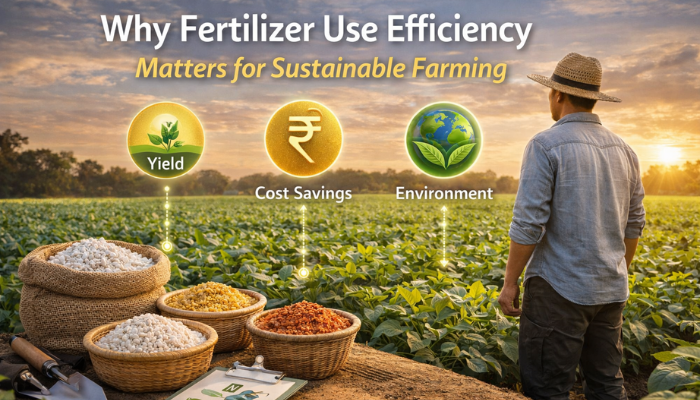
Why Fertilizer Use Efficiency Matters for Sustainable Farming
Did you know that a large part of fertilizers used in farming often goes to waste? This not only increases costs but also harms the environment.
Fertilizer efficiency means using the right nutrients, in the right amount, at the right time. When done correctly, it helps farmers grow healthy crops, improve soil quality, and reduce pollution. With better fertilizer application and the right types of fertilizers, farmers can increase yields while protecting natural resources.
In today’s agriculture, improving fertilizer use efficiency is the smart way to achieve both productivity and long-term sustainability.
Importance of Fertilizers in Agriculture
Fertilizers provide essential nutrients like nitrogen, phosphorus, and potassium that plants need to grow. Over time, soil loses these nutrients due to continuous farming.
- Continuous farming reduces soil nutrients, making fertilizers necessary to restore soil fertility.
- Using the right types of fertilizers ensures balanced nutrition for crops.
- Helps improve plant growth and overall crop health.
- Supports strong root development and better nutrient absorption.
- Proper fertilizer application increases crop yields and improves quality.
- Maintains long-term soil productivity and farming sustainability.
- Ensures consistent food production to meet growing demand.
Understanding Nutrient Management
Nutrient management is about giving crops exactly what they need. Farmers test the soil and then plan proper fertilizer application.
Good nutrient management helps to:
- Maintain soil fertility
- Reduce pollution
- Prevent nutrient loss
- Support long-term farming
Modern methods like precision farming and fertigation systems improve fertilizer efficiency by delivering nutrients directly to plants.
Enhancing Soil Fertility
Healthy soil is the base of successful farming. Continuous cropping reduces soil nutrients, making fertilizers necessary.
Efficient fertilizer use:
- Restores lost nutrients
- Improves soil structure
- Supports beneficial microbes
This leads to better soil fertility and long-term productivity.
Boosting Crop Yields
One of the main benefits of fertilizers is higher crop production. When used correctly, fertilizers help plants grow faster and stronger.
Proper fertilizer application ensures:
- Better nutrient absorption
- Healthy crop development
- Increased yield and quality
This is essential for meeting global food demand.
Optimizing Nutrient Uptake
Fertilizers work best when plants can easily absorb nutrients. Efficient use ensures nutrients reach the root zone.
Techniques like fertigation:
- Deliver nutrients through irrigation
- Reduce fertilizer loss
- Improve crop performance
This increases overall fertilizer use efficiency.
Challenges of Improper Fertilizer Use
Using fertilizers incorrectly can harm the environment. Common issues include:
- Nutrient runoff into rivers and lakes
- Groundwater contamination
- Soil degradation
This is why improving fertilizer efficiency is necessary for sustainable farming.
Sustainable Practices for Better Efficiency
Farmers can improve fertilizer efficiency by adopting simple and smart practices:
- Soil testing before fertilizer application
- Using the right types of fertilizers
- Applying fertilizers at the correct time
- Using organic options like compost and manure
- Practicing crop rotation
- Using fertigation systems
These methods reduce waste and protect the environment.
Choosing the right supplier is also important. A trusted fertilizer company in Pune, like SV Agro Solutions, provides high-quality and eco-friendly products that support efficient farming.
They offer:
- Advanced fertilizer solutions
- Products suited for different crops
- Support for sustainable agriculture
This helps farmers improve productivity while maintaining soil health.
Conclusion
Fertilizers are important for healthy crops, but using them wisely is the key to sustainable farming. When farmers focus on fertilizer use efficiency and proper fertilizer application, they can grow more while protecting the soil and environment.
Choosing the right types of fertilizers and following smart farming practices helps ensure better yields and long-term success.
Are your crops not getting the right nutrients despite regular fertilisation? SV Mr. Micro-G is an advanced micronutrient fertilizer made with SRF (Slow Release Fertilizer) Technology, ensuring gradual nutrient release for better crop growth. Suitable for all crops, it improves yield and prevents nutrient loss through leaching. Its nano polymer coating helps nutrients stay available for better absorption. Choose SV Mr. Micro-G for healthier crops and higher productivity.
Frequently Asked Questions
1. What is the role of fertilizers in sustainable agriculture?
Ans: Fertilizers provide essential nutrients that help crops grow healthy and strong. In sustainable agriculture, they are used carefully to improve soil fertility, increase crop yields, and reduce environmental impact.
2. What is fertilizer efficiency?
Ans: Fertilizer efficiency means using fertilizers in a way that plants absorb the maximum nutrients with minimum waste. It focuses on applying the right amount, at the right time, and in the right method.
3. How to improve fertilizer use efficiency?
Ans: Farmers can improve fertilizer use efficiency by:
- Testing soil before use
- Choosing the right types of fertilizers
- Applying fertilizers at the correct time
- Using proper fertilizer application methods like fertigation
- Combining organic and chemical fertilizers
4. Does fertilizer lose its effectiveness?
Ans: Yes, fertilizers can lose effectiveness if not used properly. Overuse and poor timing, can lead to nutrient loss, reduced plant absorption, and lower crop productivity.
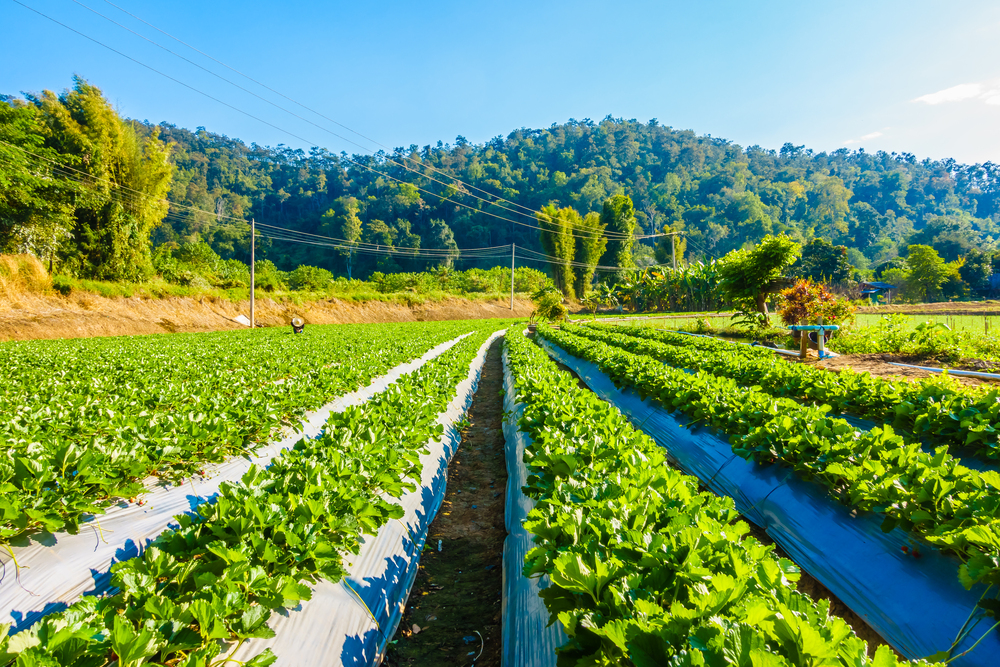
The Importance of Micronutrients for Healthy Crop Growth
Micronutrients play an important role in plant nutrition, and understanding the Importance of Micronutrients is key to growing healthy crops. Many farmers focus mainly on NPK fertilisers, but crop performance also depends on small yet powerful elements like Zinc, Iron, Boron, Copper, and Manganese.
These micronutrients help with photosynthesis, enzyme activity, nutrient uptake, and root growth, making them essential for strong and productive plants. Even a small deficiency can reduce crop yield and quality. Regular soil testing and using the right micronutrient fertilisers help keep plants healthy and improve overall productivity.
What Are Micronutrients for plants?
Micronutrients are essential elements required by plants in very small quantities. Despite their lower requirement, they play vital roles in:
- Enzyme activation
- Chlorophyll formation
- Photosynthesis
- Hormone regulation
- Strengthening plant immunity
- Nutrient uptake and movement
Without micronutrients, plants experience slowed growth, poor yield, and reduced resistance to environmental stress.
Why Micronutrients Are Important in Farming
Most farmers focus mainly on NPK (Nitrogen, Phosphorus, and Potassium). However, even when NPK is sufficient, crops often fail to reach their full yield potential due to hidden micronutrient deficiencies. Indian soils, especially in Maharashtra, Karnataka, and Gujarat, are becoming increasingly low in Zinc, Iron, and Boron. This leads to pale leaves, poor root growth, reduced yields, and weaker plant immunity.
Micronutrients are essential for several important plant functions, including growth, development, energy production, and disease resistance. They act as catalysts in metabolic processes, help plants produce vital enzymes and hormones, and support strong roots, healthy leaves, and overall plant strength.
Functions of Micronutrients in Plants
Micronutrients help plants grow properly, stay healthy, and produce good yields. Although plants require these nutrients in small amounts, they play crucial roles in everyday plant functions.
Enzyme activity: Micronutrients help activate enzymes that control different growth processes in plants.
Chlorophyll and leaf colour: Nutrients like iron and manganese help plants make chlorophyll, which keeps leaves green and healthy.
Photosynthesis: Micronutrients support the plant’s ability to turn sunlight into energy.
Nutrient movement: They help plants absorb nutrients from the soil and move them to where they are needed.
Root growth: Zinc and boron support strong root development, helping plants take in water and nutrients more effectively.
Flowering and fruiting:
Boron and zinc help plants form flowers, set fruits, and produce better yields.
Disease resistance: Copper, zinc, and manganese help plants fight diseases and stay stronger during stress.
Plant structure: Boron helps build strong cell walls, making plants more sturdy and healthy.
Essential Micronutrients Required by Plants
1. Zinc (Zn)
Supports enzyme activity, root development, and growth regulation.
Deficiency signs: stunted growth, smaller leaves, reduced grain size.
2. Iron (Fe)
Key component in chlorophyll formation and photosynthesis.
Deficiency signs: yellowing between leaf veins (interveinal chlorosis).
3. Boron (B)
Required for flowering, fruit setting, pollen production, and cell wall strength.
Deficiency signs: flower or fruit drop, hollow stems, and cracking in fruits.
4. Manganese (Mn)
Helps in nitrogen utilisation and photosynthesis.
Deficiency signs: pale leaves with brown or black spots.
5. Copper (Cu)
Enhances disease resistance and strengthens plant cells.
Deficiency signs: leaf curling, wilting, and dieback.
6. Molybdenum (Mo)
Assists in nitrogen fixation and protein formation.
Deficiency signs: yellowing of leaves in legumes.
7. Chlorine (Cl)
Assists in water regulation and photosynthesis.
How Micronutrients Improve Crop Growth
Micronutrients support key plant functions such as photosynthesis, root development, and nutrient absorption. When plants receive the right balance of micronutrients, they grow stronger, stay healthier, and produce higher-quality yields.
1. Enhanced Photosynthesis
Iron, Manganese, and Copper help plants produce chlorophyll and capture sunlight efficiently.
2. Stronger Root Development
Zinc and Boron improve root strength and nutrient transport.
3. Higher Disease Resistance
Micronutrients build plant immunity, reducing crop loss.
4. Better Flowering and Fruiting
Boron and Zinc help in better flower formation, seed setting, and overall crop productivity.
5. Improved Soil Health
Micronutrients boost beneficial microbial activity, improving soil fertility and structure.
Micronutrient Deficiency in Indian Soils
Many regions of India face micronutrient depletion due to:
- Single-crop farming practices
- Excessive use of chemical fertilisers
- Low organic matter in soil
- Improper irrigation practices
- Soil erosion and nutrient leaching
Common deficiencies:
- Zinc
- Iron
- Boron
- Manganese
How to Ensure Adequate Micronutrient Supply
1. Soil Testing
Regular soil testing (every 6–12 months) helps identify specific nutrient deficiencies.
2. Use Chelated Micronutrient Fertilisers
Chelated forms are highly absorbable and correct deficiencies faster.
3. Foliar Sprays
Useful for immediate correction of micronutrient deficiencies, especially Zinc, Iron, and Manganese.
4. Organic Amendments
Adding compost or micronutrient-rich organic matter improves soil quality over time.
5. Crop Rotation
Helps maintain nutrient balance and prevents depletion of specific micronutrients.
Signs of Micronutrient Deficiency in Crops
Micronutrient deficiencies often show up through visible symptoms in leaves, roots, and overall plant growth, making early detection essential for healthy crops.
|
Micronutrient |
Visible Symptoms |
Impact on Crop |
|---|---|---|
|
Zinc |
Small leaves, stunted growth |
Poor yield and grain size |
|
Iron |
Yellowing of young leaves |
Reduced photosynthesis |
|
Boron |
Flower and fruit drop |
Lower production and quality |
|
Manganese |
Pale leaves with spots |
Weak plant structure |
|
Copper |
Wilted, curled leaves |
Higher disease vulnerability |
Conclusion
Micronutrients are essential for achieving healthy crops, strong roots, better immunity, and higher yields. While macronutrients like NPK support basic plant needs, micronutrients ensure complete, balanced growth. The importance of micronutrients lies in their ability to complete the plant’s nutritional balance
By adopting proper micronutrient management through soil testing, chelated fertilizers, foliar sprays, and crop rotation, farmers can improve productivity and maintain soil health for sustainable farming. As a leading Micronutrient Manufacturer in Pune, SV Agro Solutions provides scientifically formulated micronutrient blends that support healthy plant growth and long-term soil fertility.
.jpg)
Benefits of Biostimulant Fertilizer for Sustainable Farming
Modern farming faces many challenges such as poor soil, changing weather, drought, and heat stress. To overcome these problems, many farmers are using biostimulant fertilizer as part of their crop nutrition programme.
The benefits of biostimulant fertilizer include stronger root growth, better nutrient uptake, improved stress tolerance, and healthier crop development. Although biostimulant fertilizer does not directly supply nutrients like regular fertilizers, it helps plants use available nutrients more efficiently, resulting in better crop growth, higher yields, and improved produce quality.
Explore this blog to learn about the benefits of biostimulant fertilizer, how it works, and why it has become an important part of modern farming.
What is Biostimulant Fertilizer?
Biostimulant fertilizer is a product that helps plants grow by improving their natural biological processes. Instead of supplying nutrients directly, it helps plants absorb nutrients more efficiently, develop stronger roots, and recover from stress.
Common types of biostimulant fertilizers include:
- Humic acid and fulvic acid
- Seaweed extracts
- Amino acids and protein hydrolysates
- Beneficial microbial products
These products are commonly used with regular fertilizers to improve overall crop performance.
Why Farmers Use Biostimulant Fertilizer
Farmers use biostimulant fertilizer to improve crop growth, increase yield, and maintain healthy plants under different growing conditions. It works well when used along with NPK fertilizers, organic manure, proper irrigation, and good farming practices.
It is widely used in:
- Field crops like wheat, rice, maize, cotton, and soybean
- Fruits like banana, grapes, mango, and citrus
- Vegetables such as tomato, onion, chilli, cabbage, and cucumber
- Flowers and other high-value horticultural crops
It helps farmers get better results from the same land while improving fertilizer efficiency.
Major Benefits of Biostimulant Fertilizer
Biostimulant fertilizer helps crops grow healthier by improving root development, nutrient absorption, stress tolerance, crop quality, and overall yield.
1. Promotes Strong Root Growth
- Biostimulant fertilizer helps plants develop strong and healthy roots.
- Improves root growth and branching
- Helps roots absorb more water and nutrients
- Supports faster plant establishment
- Improves early crop growth after sowing or transplanting
- Healthy roots help plants grow stronger throughout the season.
2. Improves Nutrient Use Efficiency
- One of the biggest benefits of biostimulant fertilizer is that it helps plants use fertilizers more efficiently.
- Increase nutrient absorption
- Reduce fertilizer loss
- Improve the use of Nitrogen (N), Phosphorus (P), and Potassium (K)
- Give better results from the same amount of fertilizer
- This helps farmers improve crop growth while reducing nutrient wastage.
3. Increases Stress Tolerance
- Plants often face environmental stress during the growing season.
- Promotes deeper root growth, helping plants absorb more water and survive dry conditions.
- Reduces heat stress and helps plants continue healthy growth during hot weather.
- Supports nutrient uptake and helps crops recover faster from low temperatures.
- Improves nutrient absorption and reduces the harmful effects of excess salts in the soil.
- Protects root health and helps plants recover quickly after excess water in the field.
- Encourages faster root establishment, reducing transplant stress and improving early plant growth.
- Healthy plants can continue growing even under difficult conditions.
4. Increases Crop Yield and Quality
- Biostimulants support healthy crop development, leading to better production.
- Helps plants grow healthier, resulting in more produce at harvest.
- Increases the number of flowers that develop into fruits, reducing flower and fruit drop.
- Supports proper grain development, producing fuller and heavier grains.
- Encourages uniform growth, leading to larger fruits and vegetables.
- Improves the natural colour, shine, and overall market appeal of the produce.
- Improves the flavour and quality of fruits and vegetables by supporting balanced plant growth.
- Helps produce stay fresh for a longer time after harvest, reducing post-harvest losses
- Better-quality produce often gives farmers a higher market price.
5. Helps Crops Recover Faster
- After stress caused by weather or poor soil conditions, plants often recover slowly.
- Recover quickly after drought or heavy rain
- Reduce transplant stress
- Continue healthy growth
- Maintain crop performance throughout the season
- This helps reduce crop losses.
6. Supports Soil Health
Some biostimulant fertilizers improve the soil environment by encouraging beneficial microorganisms.
They help to:
- Increase microbial activity
- Improve soil structure
- Support healthy root development
- Improve long-term soil fertility
Healthy soil supports healthy crops year after year.
Best Time to Use Biostimulant Fertilizer
- Promotes faster root development and better crop establishment.
- Apply before drought, heat, cold, or salinity to help plants tolerate stress better.
- Supports healthy plant growth and improves nutrient uptake.
- Encourages better flowering, fruit set, and crop development.
- Helps improve seed germination and early seedling vigour.
- Applying biostimulants at the right time helps maximize crop growth, resilience, and yield.
How to Use Biostimulant Fertilizer Correctly?
Follow these simple practices for better results:
- Read and follow the product label.
- Use the recommended dosage.
- Apply through soil application, foliar spray, or seed treatment as recommended.
- Apply at the correct crop growth stage.
- Avoid applying more than the recommended amount.
- Test the product on a small area before using it on the entire field.
Correct application gives better results than simply using more product.
Biostimulant Fertilizer vs Regular Fertilizer
Although both products help crops grow, they work differently.
|
Regular Fertilizer |
Biostimulant Fertilizer |
|
Supplies nutrients directly to plants |
Helps plants absorb and use nutrients more efficiently |
|
Provides Nitrogen, Phosphorus, Potassium, and other nutrients |
Improves natural plant growth processes |
|
Mainly feeds the crop |
Helps the crop use nutrients better |
|
Essential for crop nutrition |
Supports healthier growth and stress tolerance |
Both products should be used together for the best farming results.
Common Mistakes to Avoid
Avoid these common mistakes when using biostimulant fertilizer:
- Applying without understanding the crop's needs
- Expecting immediate results like chemical fertilizers
- Mixing with incompatible fertilizers or pesticides
- Applying during very hot weather
- Using more than the recommended dose
Using the right product at the right time gives the best results.
Conclusion
The benefits of biostimulant fertilizer make it an important part of modern farming. Biostimulant fertilizer helps improve root growth, nutrient uptake, fertilizer efficiency, crop yield, and produce quality while increasing plant tolerance to drought, heat, salinity, and other environmental stresses. It also supports healthier soil by encouraging beneficial microbial activity.
Want to improve crop health and productivity with the right biostimulant fertilizer? SV Agro Solutions offers a range of high-quality biostimulant fertilizers designed to improve root growth, nutrient uptake, crop health, stress tolerance, and overall productivity. Our products, including SV Fruiter, SV Cofez, SV Defence, SV Sugarban, and SV Size Builder, help crops perform better under different growing conditions while supporting sustainable farming.
FAQs
1. Can biostimulants reduce fertilizer use?
Yes, biostimulants help plants use nutrients more efficiently, which can reduce fertilizer requirements while maintaining healthy crop growth and yield.
2. Can biostimulant fertilizer replace NPK fertilizers?
No. Biostimulant fertilizer supports crop growth but should be used along with NPK fertilizers, not as a replacement.
3. When should biostimulant fertilizer be applied?
It is best applied before sowing, during early growth, flowering, fruit development, and during stress conditions like drought or heat.
4. Does biostimulant fertilizer improve crop quality?
Yes. It helps improve fruit size, colour, taste, shelf life, and overall crop quality.
5. Is biostimulant fertilizer safe for crops?
Yes. When used according to the recommended instructions, biostimulant fertilizer is safe and supports healthy crop growth.
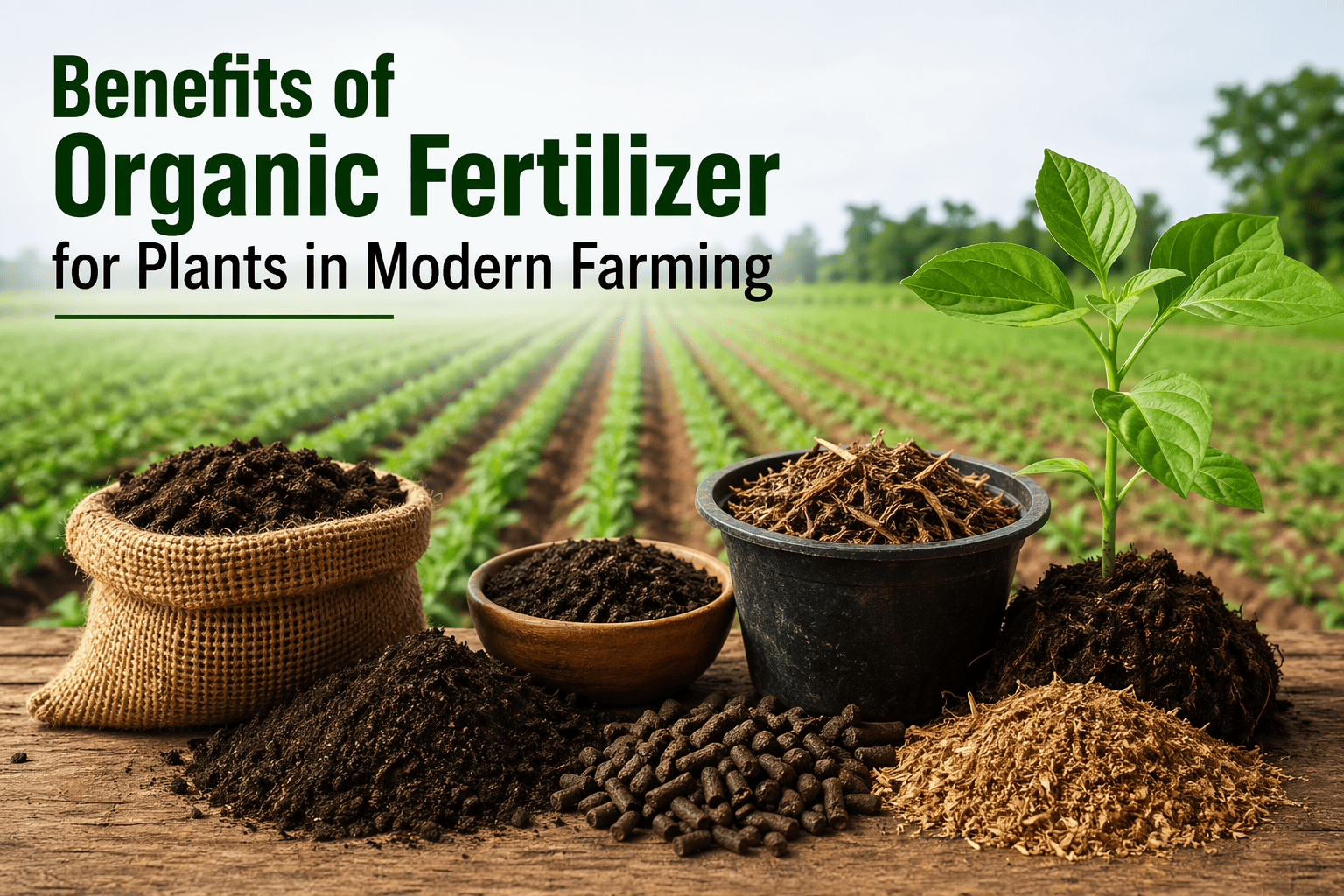
Benefits of Organic Fertilizer for Plants in Modern Farming
Organic fertilizer for plants is becoming very popular among farmers in India. Today, many farmers are moving towards natural farming methods because they want better soil health, safe crops, and long-term benefits. Unlike chemical fertilizers, organic fertilizers are made from natural materials and do not harm the environment.
When we talk about organic fertilizer for plants, we also understand the benefits of organic fertilizer and the advantages of organic fertilizer in improving soil and crop quality.
Choosing the right organic fertilizer company is also important to get good results. Organic fertilizers not only provide nutrients to plants but also improve soil fertility for future crops.
Benefits of Organic Fertilizer for Plants
Organic fertilizers offer many benefits for both plants and soil:
1. Improves Soil Structure and Health
- Organic fertilizers add natural matter (like compost and manure) to the soil
- This makes hard soil loose and easy to work with, so roots can grow deeper
- Soil becomes better at holding water, which helps crops during dry periods
- Nutrients stay in the soil for a longer time, reducing loss
- Overall, it improves long-term soil fertility and productivity
2. Slow Release of Nutrients
- Nutrients are not given all at once; they are released slowly over time
- Soil microorganisms break down the organic material step by step
- Plants get a continuous and balanced supply of nutrients
- This avoids sudden overfeeding and reduces nutrient wastage
- Helps maintain steady plant growth without stress
3. Feeds Useful Soil Microbes
- Organic fertilizers increase the number of beneficial microbes in the soil
- These microbes convert nutrients into forms that plants can easily absorb
- They also help improve soil structure and protect plants from harmful organisms
- Healthy microbial activity leads to better soil fertility and crop growth
4. Prevents Root Burn
- Organic fertilizers are mild and less concentrated compared to chemical fertilizers
- They do not cause root burn or leaf damage, even if used regularly
- This makes them safer for young plants and sensitive crops
- Reduces the risk of crop loss due to over-fertilization
5. Provides Micronutrients
- Along with the main nutrients (NPK), they also supply important micronutrients
- Nutrients like calcium, magnesium, zinc, and iron are essential for plant health
- These nutrients help in processes like photosynthesis, growth, and flowering
- Prevents common deficiency problems in crops
6. Environment-Friendly
- Organic fertilizers do not contain harmful chemicals
- They reduce pollution of soil, water, and air
- There is less risk of nutrients washing away into rivers and groundwater
- Supports eco-friendly and sustainable farming practices
7. Supports Strong Plant Growth
- By improving soil health, plants grow stronger and healthier
- Roots become deeper and more developed
- Plants become more resistant to pests, diseases, and weather stress
- Results in better crop yield and improved quality of produce
These benefits make organic fertilizers ideal for long-term farming.
How to Choose the Right Organic Fertilizer?
Choosing the right fertilizer depends on your crop and soil conditions.
- Test your soil first to know which nutrients (N, P, K) are needed and avoid using too much fertilizer.
- Fast fertilizers like fish meal, blood meal, seaweed, and poultry manure give quick results.
- Slow fertilizers like compost, bone meal, and hoof/horn meal work for a longer time and improve soil.
- Use nitrogen-rich fertilizers (like blood meal or manure) for leafy plants.
- Use phosphorus and potassium fertilizers (like bone meal or rock phosphate) for flowers and fruits.
- Dry fertilizers are easy to spread on large areas.
- Liquid fertilizers are quickly absorbed by plants through leaves or roots.
- Compost makes soil healthy and improves its quality.
- Choose good quality compost that is dark brown, even in size, and properly prepared (certified like FCO, NPOP).
What to Look for in an Organic Fertilizer Company?
Choosing the right organic fertilizer company is very important.
- Make sure the product is approved by the government (like FCO in India) or certified by trusted organic bodies (NPOP, USDA NOP, EcoCert) so you know it is truly organic.
- Check the nutrient details (NPK) and see if the product improves soil health and works for a longer time.
- Choose companies that offer different types of fertilizers like compost, vermicompost, bone meal, neem cake, and biofertilizers.
- Pick a company with a good reputation and clear information about where its raw materials come from.
- Go for products that agricultural universities or research centers test.
- Choose companies that follow eco-friendly methods and reduce waste.
- Select brands that provide proper guidance on how to use the product and help with crop-related issues.
Conclusion
Organic fertilizer for plants is the best choice for farmers who want sustainable and profitable farming. It improves soil fertility, supports healthy crop growth, and reduces dependency on chemicals.
Instead of looking for quick results, farmers should focus on long-term soil health. Organic fertilizers not only increase yield but also improve crop quality.
Start your organic farming journey with trusted solutions from SV Agro Solutions, a leading organic fertilizer company offering high-quality products like organic fertilizers, biostimulants, CRF (controlled-release) fertilizers, and micronutrients to improve soil health and boost crop productivity.
FAQs
1. How long does organic fertilizer take to work?
Organic fertilizer takes about 2-6 weeks to work as it slowly breaks down in the soil.
2. Why is it important to apply organic fertilizer?
It helps improve soil health, supports plant growth, and is safe for the environment.
3. Can I use too much organic fertilizer?
Yes, too much can still harm plants even though it is safer than chemical fertilizers.
4. What are the three major types of organic fertilizer?
The main types are dry fertilizers, liquid (foliar) fertilizers, and growth enhancers.
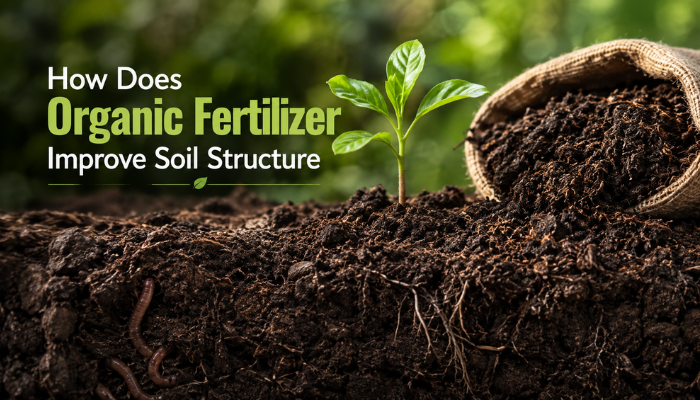
How Does Organic Fertilizer Improve Soil Structure & Crop Yield
Healthy soil is important for good crop growth and better yields. Soil structure affects how water moves through the soil, how air reaches the roots, and how easily roots can grow. Poor soil structure can cause compression, poor drainage, waterlogging, and weak plant growth.
Understanding how does organic fertilizer improve soil structure can help farmers choose better soil management practices. Organic fertilizers add organic matter to the soil, improve soil condition, support beneficial microorganisms, and help maintain long-term soil fertility.
What is Soil Structure and Why Does It Matter?
Soil structure refers to how soil particles such as sand, silt, and clay join together to form small clumps or aggregates.
Good soil structure provides:
- Better movement of air and water through the soil.
- Enough space for roots to grow.
- Better water absorption and retention.
- Improved nutrient availability.
- A better environment for beneficial soil microorganisms.
What are Organic Fertilizers?
Organic fertilizers are made from natural plant and animal materials. Common examples include farmyard manure, compost, vermicompost, green manure, and crop residues.
These materials provide nutrients and add organic matter to the soil. Organic matter plays an important role in improving soil structure, water retention, microbial activity, and overall soil health.
How Does Organic Fertilizer Improve Soil Structure
Organic fertilizers improve soil structure by adding organic matter, supporting beneficial microorganisms, increasing water retention, improving aeration, and reducing soil compaction.
1. Adds Organic Matter to the Soil
Organic fertilizers add organic matter to the soil, which helps soil particles stick together and form stable aggregates.
This can:
- Improve soil health.
- Make the soil softer and easier to work.
- Increase soil porosity.
- Improve water and air movement.
- Support better root growth.
2. Helps Form Stable Soil Aggregates
Organic fertilizers provide food for beneficial microorganisms in the soil. These microorganisms produce natural substances that help bind soil particles together.
As a result:
- Soil becomes more crumbly.
- Soil aggregates become stronger.
- Compaction can be reduced.
- Soil becomes easier for roots to penetrate.
3. Improves Soil Porosity and Aeration
As organic matter breaks down, it creates small spaces and channels in the soil.
Better soil porosity helps:
- Air reach plant roots.
- Water move through the soil.
- Roots grow deeper.
- Beneficial microorganisms remain active.
- Nutrients move more effectively through the soil.
4. Improves Water Infiltration and Retention
Organic matter helps soil absorb and hold water.
It can:
- Improve water infiltration.
- Reduce surface water runoff.
- Increase water-holding capacity.
- Provide moisture to plants during dry periods.
- Reduce the effects of water stress on crops.
5. Reduces Soil Compaction
- Repeated farming, heavy machinery, and low organic matter can make soil hard and compacted.
- Organic fertilizers help increase pore space and make the soil looser.
- This allows roots to grow more easily and reach water and nutrients deeper in the soil.
6. Supports Beneficial Soil Microorganisms
Organic fertilizers for plants provide food for beneficial bacteria, fungi, earthworms, and other soil organisms.
These organisms help:
- Break down organic matter.
- Release nutrients into the soil.
- Improve nutrient cycling.
- Create natural channels in the soil.
- Support stable soil aggregates.
7. Helps Reduce Soil Erosion and Crusting
Healthy soil aggregates are less likely to break apart during heavy rain or strong winds.
Organic matter can help:
- Reduce soil erosion.
- Prevent surface crusting.
- Improve water infiltration.
- Support better seed germination.
- Reduce nutrient loss from the field.
Types of Organic Fertilizers That Improve Soil Structure
Different types of organic fertilizers add organic matter, improve soil structure, increase water retention, and support healthy soil microorganisms.
Farmyard Manure (FYM)
Farmyard manure adds organic matter and nutrients to the soil. Regular use can improve soil aggregation, water retention, and overall soil condition.
Compost and Vermicompost
Compost and vermicompost contain well-decomposed organic matter that supports beneficial microorganisms and helps improve soil structure.
Green Manure
Green manure crops add plant material to the soil when they are incorporated. They can increase organic matter and improve soil structure.
Crop Residues and Mulch
Crop residues such as straw, leaves, and stalks add organic matter while protecting the soil surface from erosion and moisture loss.
Biochar and Organic Amendments
Biochar and other organic amendments can improve soil porosity, water retention, and long-term organic carbon levels when used correctly.
How Long Does It Take for Organic Fertilizers to Improve Soil Structure?
The improvement in soil structure usually takes time and depends on soil type, climate, crop practices, and the amount of organic matter added.
- Short term: Better soil texture, water infiltration, and reduced surface crusting may be noticed within one or two seasons.
- Medium term: Regular application can improve soil aggregation, organic matter, and root growth over several years.
- Long term: Consistent use can improve water retention, soil structure, and the soil's ability to handle drought and other stresses.
Regular application gives better results than using organic fertilizers only once.
Best Practices for Using Organic Fertilizers to Improve Soil Structure
Farmers can follow these simple practices:
- Use suitable organic fertilizers regularly based on soil and crop requirements.
- Leave suitable crop residues in the field to add organic matter.
- Grow suitable green manure crops and incorporate them into the soil.
- Burning removes valuable organic matter and can harm soil life.
- Use organic and mineral fertilizers together when required for balanced crop nutrition.
- Less disturbance helps protect soil aggregates and maintain good soil structure.
- Check soil condition and nutrient levels before deciding on fertilizer application.
Conclusion
Organic fertilizers can improve soil structure by adding organic matter, supporting beneficial microorganisms, improving soil aggregation, increasing water retention, and reducing compaction. Better soil structure creates a healthier environment for roots and helps crops use water and nutrients more effectively.
Want to improve soil structure and support healthier crop growth? SV Agro Solutions offers high-quality organic fertilizers that add organic matter, improve soil health, increase nutrient availability, support beneficial microorganisms, and enhance water retention. Our organic fertilizer solutions help farmers maintain healthy soil, stronger roots, better crop growth, and improved productivity through sustainable farming practices.
FAQs
1. How does organic fertilizer improve soil structure?
Organic fertilizers add organic matter that helps bind soil particles, improve porosity, increase water retention, reduce compaction, and support beneficial microorganisms.
2. Which organic fertilizers are best for improving soil structure?
Farmyard manure, compost, vermicompost, green manure, crop residues, and biochar can help improve soil structure when used properly and regularly.
3. How long does it take to improve soil structure?
Some improvements may be noticed within one or two seasons, while major improvements in soil structure and organic matter can take several years.
4. Can organic fertilizers completely replace chemical fertilizers?
In some farming system they can provide a large part of crop nutrition, but for high-yield crops, using organic and mineral fertilizers together may provide better nutrient balance and soil health.
5. How can farmers protect improved soil structure?
Farmers can protect soil structure by reducing excessive tillage, using crop residues and cover crops, avoiding soil compaction, maintaining organic matter, and following proper soil management practices.
.jpg)
Why is Soil Important for Plants?
Soil is the foundation of farming. It is not just mud or dirt under our feet. Soil is a living and active layer made of minerals, organic matter, water, air, and millions of small living organisms. Almost all crops that farmers grow depend directly on soil for their life and growth.
Many farmers ask the question, “Why is soil important?” and “What is the importance of soil” in agriculture. The simple answer is this: without healthy soil, crops cannot grow well, yields reduce, and farming becomes difficult. Soil plays a key role in food production, farm income, and long-term food security.
What is Soil and How Does it Form?
Soil is formed very slowly over thousands of years. It develops when rocks break down due to wind, water, heat, and cold. Over time, dead plants and animals mix with these rock particles. Microorganisms, water, and air also become part of it. This process creates soil that can support plant life.
Healthy soil has five main components:
- Mineral particles (sand, silt, clay)
- Organic matter (crop residues, compost, manure)
- Water
- Air
- Living organisms like bacteria, fungi, insects, and earthworms
All these components work together to support crop growth.
Why is Soil Important for Plants?
1. Stores nutrients: Soil works like a natural storehouse. It keeps important nutrients and slowly gives them to plants as organic matter breaks down.
2. Holds water and air: Soil stores moisture for plant roots and also has air spaces so roots can breathe properly.
3. Supports plants: Soil holds the roots firmly, helping plants stand strong against wind and rain.
4. Home for helpful microbes: Soil contains good bacteria and fungi that help change nutrients into a form plants can easily use.
5. Protects roots: Soil protects plant roots from too much heat, cold, and physical damage, and helps clean water as it passes through.
6. Base of all life: Healthy soil supports plant growth, which provides food and oxygen for animals and humans.
Soil Health & Crop Productivity
Soil health means the ability of soil to work as a living system that supports plants, animals, and people. Healthy soil produces better crops with fewer problems.
When soil has good structure, enough organic matter, and active microorganisms:
- Crop yields increase
- Crop quality improves
- Nutrients are used more efficiently
- Crops tolerate drought and stress better
Poor soil health leads to weak plants, low yields, and higher input costs.
Role of Soil Microorganisms
Soil is full of life. Billions of beneficial microorganisms live in healthy soil. These include bacteria, fungi, and earthworms.
They help farmers by:
- Breaking down organic matter into plant-available nutrients
- Fixing nitrogen naturally in the soil
- Improving root growth
- Protecting plants from harmful diseases
Importance of Soil in Agriculture and Environment
Good soil management benefits both farmers and nature.
|
Importance in Agriculture |
Importance in the Environment |
|
Helps in growing food crops, cotton, and animal fodder |
Naturally cleans water before it reaches groundwater |
|
Stores nutrients and water needed for plant growth |
Stores carbon and helps fight climate change |
|
Holds plant roots firmly and supports crop growth |
Helps reduce flooding by absorbing rainwater |
|
Protects plant roots from extreme heat and cold |
Supports insects, microbes, and other living organisms |
|
Improves crop yield and farm productivity |
Helps recycle nutrients in nature |
Signs of Healthy vs. Degraded Soil
Understanding these signs helps farmers take timely action.
|
Feature |
Healthy Soil |
Degraded (Poor) Soil |
|
Soil Colour |
Dark in colour because it has good organic matter |
Light or pale colour due to a lack of nutrients |
|
Soil Structure |
Soft and crumbly, easy for roots to grow |
Hard and compact, roots find it difficult to grow |
|
Living Organisms |
Earthworms and helpful microbes are present |
Very few or no earthworms and microbes |
|
Water Absorption |
Water goes inside the soil easily and stays longer |
Water runs off or stands on the surface |
|
Root Growth |
Roots grow deep and strong |
Roots remain shallow and weak |
|
Crop Health |
Crops grow healthy and strong |
Crops become weak and stressed |
|
Yield |
Gives a stable and good yield every season |
Gives low and uneven yield |
|
Use of Chemicals |
Needs less chemical fertiliser |
Needs more chemical inputs to grow crops |
How Farmers Can Improve Soil Health?
Farmers can improve soil health by following simple and practical methods:
- Avoid frequent ploughing. Less ploughing keeps soil soft, protects useful microbes, and prevents soil loss.
- Always keep soil covered using mulch, crop waste, or cover crops. This protects soil from the sun, wind, and rain.
- Rotate crops and grow mixed crops to reduce pests, improve nutrients, and keep soil healthy.
- Grow cover crops so roots stay in the soil for a longer time and feed soil organisms.
- Use compost, cow dung, farm waste, or fruit fertiliser to improve soil strength, water holding, and fertility.
- Controlled grazing helps mix manure into the soil naturally and improves soil health.
- Test the soil before applying fertilisers. Use the right amount and support soil life with bio-products.
- Grow trees and shrubs along with crops to protect soil, add nutrients, and support nature.
Conclusion
Healthy soil is the foundation of sustainable farming and a strong future for agriculture. Why is soil important? Because it helps crops handle drought, floods, and heat stress as the weather becomes more unpredictable. When farmers protect and improve their soil today, they ensure better yields and food security for future generations.
Want to improve soil quality and get better crop results? Choose SV Agro Biostimulants to support healthy soil and strong crop growth. Our biostimulants not only improve crop production but also protect the environment. They are eco-friendly, biodegradable, and safe for both crops and soil, helping farmers achieve sustainable and long-term productivity.
For more information, contact us at +91 96377 81012 or email info@svagrosolutions.com
FAQS
1. What do plants get from soil?
Plants get water, nutrients, and strong support for their roots from the soil.
2. Why is soil an important resource?
Soil is important because it helps grow food, supports many living organisms, stores water, and protects the environment.
3. Why do plants grow better in soil?
Plants grow better in soil because it gives them water, nutrients, and a firm base to grow strong roots.
4. What is the healthiest soil?
Healthy soil is rich in organic matter, has good air spaces, holds water well, and is free from harmful chemicals.
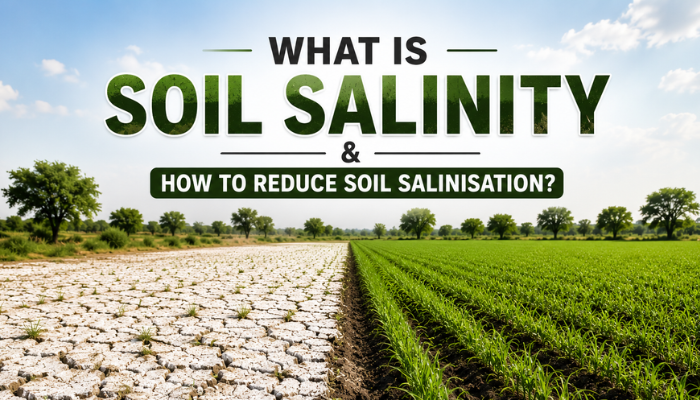
What is Soil Salinity & How to Reduce Soil Salinisation?
Healthy soil helps crops absorb water and nutrients, resulting in better growth and higher yields. However, one major problem affecting agricultural land in many regions is soil salinity.
Soil salinity occurs when excess salts accumulate in the soil. High salt levels can reduce plant growth, decrease water absorption, damage soil structure, and lower crop productivity. If left unmanaged, salinity can make farmland less productive over time.
Understanding what is soil salinity, its causes, effects, and management methods can help farmers protect their soil and maintain long-term agricultural productivity.
What is Soil Salinity?
Soil salinity is the accumulation of soluble salts in the root zone of the soil. These salts may include sodium, calcium, magnesium, and potassium compounds. When salt levels become too high, plants struggle to absorb water and nutrients properly. As a result, crop growth slows down and yields decrease.
The buildup of salts in soil is called soil salinization. It develops gradually and can become a serious problem if not identified and managed early.
In simple words, soil salinity means that the soil contains too much salt for healthy crop growth.
What Causes Soil Salinity?
Soil salinity can develop due to both natural and human-related factors.
Human Causes
- Using salty irrigation water can increase salt buildup in the soil.
- Over-irrigation and poor drainage can cause waterlogging and salt accumulation.
- Excessive use of chemical fertilizers may raise soil salt levels.
- Continuous irrigation without proper drainage speeds up soil salinization.
Natural Causes
- Some soils naturally contain salts from rocks and minerals.
- Dry climates with high evaporation leave salts behind in the soil.
- Low rainfall prevents salts from being washed away.
- Seawater intrusion in coastal areas can increase soil salinity.
How to Reduce Salinity in Soil?
Managing salinity requires a combination of soil improvement and proper water management.
Leaching Salts from the Soil
- Apply fresh water to the field to wash excess salts below the plant root zone.
- This helps reduce salt concentration around crop roots.
Improve Drainage
- Maintain proper drainage so salts can move out of the soil.
- Good drainage prevents waterlogging and salt accumulation.
Apply Gypsum
- Use gypsum in salt-affected soils to reduce sodium levels.
- It improves soil structure and helps roots grow better.
Add Organic Matter
- Add compost, manure, or crop residues to improve soil health.
- Organic matter improves water movement and supports beneficial microbes.
Reduce Water Evaporation
- Use mulch or crop residues to cover the soil surface.
- This helps retain moisture and prevents salts from rising to the topsoil.
Grow Salt-Tolerant Crops
- Grow crops such as barley, alfalfa, or cotton in saline soils.
- These crops can perform better in areas affected by salinity.
Avoid Excessive Chemical Fertilizers
- Use fertilizers carefully to prevent additional salt buildup.
- Organic fertilizers can help improve soil health naturally.
Follow Proper Irrigation Practices
- Avoid over-irrigation and waterlogging.
- Apply the right amount of water at the right time to reduce salinity problems.
Types of Soil Salinity
There are two main types of Soil Salinity
Primary Soil Salinity (Natural Salinity)
- Occurs naturally due to climate and soil conditions.
- Common in dry and semi-arid regions where evaporation is higher than rainfall.
- Salts build up in the soil over many years from rocks and minerals.
- Coastal winds can also carry salt particles inland and increase soil salinity.
Secondary Soil Salinity (Human-Induced Salinity)
- Caused by farming and land management practices.
- Over-irrigation and poor drainage can lead to salt accumulation in the root zone.
- Using saline irrigation water increases soil salt levels.
Soil Salinity Solutions for Farmers
Several practical solutions can help farmers manage soil salinity effectively.
Leaching and Drainage
- Apply fresh water to the field to wash excess salts below the root zone.
- Maintain proper drainage so salty water can move out of the field easily.
Use Gypsum and Organic Matter
- Apply gypsum to reduce sodium levels and improve soil structure.
- Add compost, manure, or other organic matter to improve water movement and soil health.
Improve Irrigation Practices
- Use drip irrigation to supply water directly to plant roots.
- Avoid over-irrigation and waterlogging to prevent salt buildup.
Grow Salt-Tolerant Crops
- Grow salt-tolerant crops such as barley, cotton, and sugar beet in affected areas.
- Follow crop rotation to improve soil health and maintain productivity.
Monitor Soil Regularly
- Test soil regularly to check salinity levels.
- Take corrective measures early to prevent long-term soil damage.
Conclusion
Understanding soil salinisation is the first step toward protecting farmland and improving crop production. Soil salinity occurs when excess salts accumulate in the soil, making it difficult for plants to absorb water and nutrients.
Looking for solutions to improve soil health and crop performance?
SV Agro Solutions provides high-quality fertilizers, biostimulants, and soil improvement products that help farmers maintain healthy soil and achieve better crop yields. Our products are designed to support sustainable farming practices and improve long-term agricultural productivity across different crops and farming conditions.
FAQs
1. Which fertilizer causes soil salinity?
Excessive use of salt-based chemical fertilizers can increase soil salinity over time.
2. What is a solution to prevent soil salinization?
Proper irrigation, good drainage, and regular soil management help prevent soil salinization.
3. Which vegetable is most tolerant of salt?
Spinach, beetroot, turnip, and cabbage-family vegetables are highly tolerant of salty soils.
4. What is the best way to flush salts from the soil?
Apply fresh water and ensure proper drainage to wash salts below the plant root zone.
.jpg)
How Micronutrient Mixtures Improve Soil Health and Crop Yield
How Micronutrient Mixtures Improve Soil Health and Crop Yield
In today’s agriculture, every farmer aims to increase crop yield while maintaining soil health. One of the most effective yet simple ways to achieve this is using micronutrient mixtures. Though often overlooked, these tiny nutrients have a huge impact on plant health, soil quality, and ultimately, the yield of crops. Let’s dive into how micronutrient mixtures work and why they’re essential for both crops and soil.
In modern agriculture, every farmer aims to increase crop yield while maintaining soil health. One of the most effective yet often overlooked solutions is using micronutrient mixtures. These essential nutrients, although needed in small quantities, have a significant impact on plant health, soil quality, and, ultimately, crop productivity. In this article, we’ll explore how micronutrient fertilizers work and why they’re crucial for enhancing both soil and crop vitality.
If you are looking for a micronutrient manufacturer in Pune then SV Agro Solutions Pvt. Ltd. is a leader in nanotechnology-based, high-quality organic agricultural inputs. Based in Pune, Maharashtra, we have been dedicated to advancing agricultural practices for over a decade. Our products are designed to enhance plant health, increase resilience against pests, and boost crop yields, supporting farmers in producing healthier, more sustainable crops.
What Are Micronutrients?
Micronutrients are vital minerals required by plants in trace amounts, but they play a key role in various plant processes such as photosynthesis, enzyme production, and nutrient absorption. Zinc, iron, copper, manganese, boron, and molybdenum are important micronutrients. While they are needed in small quantities, their impact on overall plant health and productivity is immense.
Why Micronutrients Matter for Soil Health
For crops to yield well, the soil must be healthy. Over time, soil can lose its natural fertility, especially when the same crops are grown repeatedly. Traditional fertilizers provide essential macronutrients like nitrogen, phosphorus, and potassium (NPK), but they often neglect the importance of micronutrient fertilizers.
Incorporating micronutrient mixtures into the soil helps restore the balance of these vital nutrients and supports the soil ecosystem. Here’s how micronutrient mixtures can significantly improve soil health.
Enhanced Microbial Activity
Micronutrients encourage the growth of beneficial soil microbes that help plants absorb nutrients more effectively. Healthier microbes lead to richer soil, creating an environment where plants thrive.
Improved Soil Structure
Certain micronutrients, such as calcium, help improve soil structure by binding soil particles together, enhancing water retention and air circulation. This gives roots better access to nutrients.
Optimal pH Balance
Micronutrient mixtures help maintain an optimal pH level in the soil, creating a favorable environment for nutrient absorption, which supports healthy plant growth.
Reduced Soil Degradation
Continuous crop production depletes essential soil minerals. Adding micronutrient mixtures helps prevent soil degradation, preserving its fertility for future planting cycles.
How Micronutrient Mixtures Boost Crop Yield
While healthy soil is essential, achieving higher crop yields is the ultimate goal. Here’s how micronutrient mixtures directly contribute to improved crop productivity.
Improved Root Development
Micronutrients like zinc and boron support root growth, enabling plants to access water and nutrients more efficiently. Stronger, healthier roots lead to more resilient plants.
Enhanced Disease Resistance
Micronutrients strengthen plant immunity, making crops more resistant to common diseases and pests. This reduces the reliance on pesticides and promotes healthier crops.
Better Photosynthesis
One essential micronutrient that is essential to photosynthesis is iron. When plants can efficiently convert sunlight into energy, they grow faster and produce higher yields.
Increased Flowering and Fruiting
Certain micronutrients support flower and fruit production, resulting in improved crop quality and higher yields, especially in fruit and vegetable farming.
Nutrient Density
Crops grown with a balanced supply of micronutrients are often richer in vitamins and minerals, providing healthier food for consumers and increasing market value for farmers.
Why Micronutrient Mixtures Are a Smart Choice for Sustainable Farming
Using micronutrient fertilizers is not just about improving crops it’s also about practicing sustainable farming. By replenishing soil with these essential nutrients, farmers can promote long-term soil fertility and reduce reliance on chemical fertilizers. Over time, micronutrient mixtures contribute to soil conservation, reduce soil erosion, and promote biodiversity, making farming practices more environmentally friendly.
How to Use Micronutrient Mixtures Effectively
When it comes to applying micronutrients, balance is key. Too little won’t show results, but too much can harm the plants. Here are some tips for effective use.
Soil Testing
Before applying micronutrients, conduct a soil test to determine which nutrients are deficient. This ensures the right mix for your soil’s needs.
Choose the Right Mixture
Select a micronutrient mixture that suits your specific crop and soil requirements. Different crops may need different micronutrients for optimal growth.
Follow Application Guidelines
It’s important to follow the recommended dosage and timing for applying micronutrient fertilizers. Overuse can disrupt soil chemistry.
Monitor Results
Regularly assess crop growth and soil health to ensure that the micronutrients are having the desired effect. Adjust the application as needed.
Conclusion
Micronutrient mixtures are a simple yet powerful tool for improving both soil health and crop yield. They support root development, enhance disease resistance, and help plants grow stronger and healthier. By integrating these micronutrient fertilizers into farming practices, farmers can boost productivity sustainably, resulting in nutrient-rich crops while maintaining soil fertility for future generations.
As more farmers embrace the benefits of micronutrients, these mixtures are becoming essential for improving yields and promoting eco-friendly agriculture. Micronutrient mixtures are the future of high-yield farming, creating a path toward healthier crops and more resilient farming practices.
.jpg)
How to Choose the Right Biostimulant for Your farm
How to Choose the Right Biostimulant for Your Farm?
Choosing the right biostimulant for your farm is an important decision that can significantly impact your crop health and overall yield. Biostimulants are natural or organic substances that enhance plant growth, improve nutrient uptake, and increase resilience against environmental stresses. With a variety of products available on the market, understanding how to select the most suitable biostimulant tailored to your specific agricultural needs is essential for achieving optimal results.
In this blog, we will explore key factors to consider when choosing a biostimulant, including the specific needs of your crops, soil type, and climate conditions. By evaluating these elements and understanding the mechanisms of different biostimulants, you can make informed decisions that align with sustainable farming practices. Whether you're looking to boost crop yields or improve soil health, this guide will help you navigate the selection process to find the best biostimulant for your farm.
SV Agro Solutions Pvt. Ltd. is a leading name in the agricultural company in Pune, established in 2016 and dedicated to enhancing crop production through innovative organic inputs. Located in Indapur, Pune, we focus on research and development to create high-quality biostimulants and fertilizers that support sustainable farming practices.
What are the biostimulants in agriculture?
When applied to crops or soils, biostimulants—which can be found in nature or artificially produced—improve plant growth, development, and general health. They work through various mechanisms, such as improving nutrient uptake, enhancing stress tolerance, and stimulating beneficial microbial activity. Here’s a detailed look at biostimulants, their components, and their benefits in agriculture based on the search results.
1. Understand What Are Biostimulants
Biostimulants are natural products derived from sources like seaweed, beneficial microorganisms, and organic matter that enhance plant growth and resilience. They work by improving nutrient uptake, promoting faster and healthier development, and helping plants withstand environmental stresses such as drought and extreme temperatures. By understanding what biostimulants are and how they function, farmers can better appreciate their potential benefits for crop health and productivity.
2. Identify Your Specific Needs
Before selecting a biostimulant, it’s essential to assess the unique challenges your farm faces. This includes evaluating soil quality, identifying crop types, and recognizing environmental stressors that may affect plant growth. By pinpointing these specific needs, you can choose a biostimulant that effectively addresses your farm's particular conditions, leading to improved outcomes.
3. Check the Ingredients
When evaluating biostimulants, reviewing their ingredients is crucial. Opt for products made from natural sources like seaweed extracts or humic acids, as these tend to be more effective and environmentally friendly. Additionally, look for biostimulants that contain beneficial bacteria or fungi, which can enhance root systems and nutrient cycling in the soil. Understanding the ingredients helps ensure you select a product that aligns with your farming practices.
4. Evaluate Product Effectiveness
Researching the effectiveness of a biostimulant is vital before making a purchase. Look for scientific studies that validate the product's claims regarding improved crop yield and health. User reviews and testimonials from other farmers can also provide insights into real-world performance. By choosing products backed by evidence of effectiveness, you can make informed decisions that benefit your farming operations.
5. Consider Application Methods
Different biostimulants come with various application methods, which can influence your choice based on convenience and effectiveness. Some products are designed for seed treatment to enhance germination, while others can be applied as foliar sprays during the growing season or mixed into the soil for ongoing support. Understanding these application methods allows you to select a biostimulant that fits seamlessly into your existing farming practices.
6. Look for Sustainability
Sustainability is an important consideration when choosing biostimulants, as eco-friendly practices contribute to long-term agricultural health. Opt for products that use environmentally friendly ingredients and promote beneficial soil microorganisms to improve overall soil fertility. By prioritizing sustainability in your selection process, you can support not only your farm’s productivity but also the health of the surrounding ecosystem.
7. Consult with Experts
If you're uncertain about which biostimulant is best suited for your farm, consulting with agricultural experts can provide valuable guidance. Agronomists can offer insights tailored to your specific crops and conditions, while local agricultural extensions often have resources based on regional farming practices. Engaging with these experts helps ensure you make informed choices that align with best agriculture practices.
Benefits of Biostimulants in Agriculture
Biostimulants are gaining recognition in modern agriculture for their ability to enhance plant growth and resilience while promoting sustainable farming practices. Here are some key benefits of using biostimulants in agriculture
1. Improved Nutrient Uptake
Biostimulants help plants absorb nutrients more effectively from the soil. They enhance the microbial activity in the rhizosphere, which increases the availability of essential nutrients like nitrogen, phosphorus, and potassium. This improved nutrient mobilization leads to healthier plants and better crop yields.
2. Enhanced Stress Tolerance
Extreme temperatures, salt, and dryness are just a few of the abiotic challenges that plants frequently face. Biostimulants can improve a plant's ability to withstand these stresses by promoting physiological changes that enhance resilience. For example, they can increase the accumulation of osmolytes and antioxidant compounds, which protect plant cells from damage during stressful conditions.
3. Increased Crop Quality
The application of biostimulants not only boosts crop yield but also improves the quality of the produce. By enhancing plant metabolism and nutrient uptake, biostimulants can lead to fruits and vegetables that are richer in vitamins and minerals, ultimately benefiting consumers.
4. Soil Health Improvement
Biostimulants contribute to soil health by promoting beneficial microbial communities. They enhance soil fertility by nurturing the development of microorganisms that improve soil structure and nutrient cycling. This leads to a more balanced ecosystem within the soil, supporting sustainable agricultural practices.
5. Reduced Dependency on Chemical Fertilizers
Using biostimulants can decrease reliance on chemical fertilizers and pesticides, making farming more environmentally friendly. By improving nutrient uptake and plant health naturally, farmers can reduce their input costs while minimizing chemical runoff into the environment.
6. Versatile Application Methods
Biostimulants can be applied through various methods, including seed treatments, foliar sprays, or soil amendments. This versatility allows farmers to choose the most effective application method based on their specific crop needs and farming practices.
7. Enhanced Microbial Activity
Biostimulants stimulate beneficial microbial activity in the soil, which plays a crucial role in nutrient cycling and plant health. Increased microbial populations can lead to improved soil structure, enhanced organic matter decomposition, and better overall soil fertility.
8. Support for Sustainable Practices
As agricultural practices shift toward sustainability, biostimulants offer an eco-friendly solution that aligns with these goals. Their use promotes biodiversity in the soil and reduces environmental impacts associated with traditional chemical inputs.
Conclusion
Choosing the right biostimulant for your farm involves understanding your specific needs, evaluating product ingredients, and consulting with experts. By selecting high-quality, effective biostimulants, you can enhance your crop health, increase yields, and promote sustainable farming practices. Remember that every farm is unique, so take the time to find the best solution for your agricultural goals!
.jpg)
Why Micronutrients are Essential Elements for Agriculture
Why Micronutrients are Essential Elements for Agriculture
In the world of farming, we often hear about macronutrients like nitrogen, phosphorus, and potassium. However, there's a group of nutrients that deserve just as much attention as micronutrients. These essential elements, needed in tiny amounts, play an important role in plant growth and health. Let’s dive into why micronutrients are so important for agriculture and how they can make a significant difference in crop production.
Are you looking to enhance your agricultural productivity and ensure healthier crops? Look no further than SV Agro Solutions Pvt. Ltd. is a leading micronutrient manufacturer in Pune Established in 2016, we have dedicated ourselves to researching and producing high-quality organic inputs that are essential for sustainable farming practices.
What Are Micronutrients?
Micronutrients include elements such as boron (B), copper (Cu), iron (Fe), manganese (Mn), zinc (Zn), molybdenum (Mo), chlorine (Cl), and nickel (Ni). Even though plants require these nutrients in small quantities, their impact on plant health is enormous. Each micronutrient has a unique function.
Boron helps with pollen germination and cell wall formation.
Iron is vital for chlorophyll production and energy transfer.
Zinc plays a key role in growth regulation and enzyme function.
The Importance of Micronutrients
Boosting Nutrient Uptake
Micronutrients enhance the ability of plant roots to absorb
macronutrients like nitrogen and phosphorus. When these trace elements are present, plants can make the most of the nutrients available in the soil.
Strengthening Disease Resistance
A healthy supply of micronutrients contributes to a plant's immune system. This means that crops can better defend themselves against diseases and pests, leading to healthier plants and higher yields.
Supporting Photosynthesis
Micronutrients are integral to photosynthesis—the process by which plants convert sunlight into energy. They participate in essential reactions that ensure effective energy transfer within plant cells.
Improving Crop Quality
The presence of micronutrients affects the quality of the harvested crops. From the taste and color of fruits to the nutrient content of grains, these tiny elements play a big role in what we eat.
Benefits of Micronutrient Application
Micronutrients, though required in small quantities, play a crucial role in promoting healthy plant growth and enhancing agricultural productivity. Here are some key benefits of applying micronutrients to crops.
1. Enhanced Nutrient Uptake
Micronutrients facilitate the absorption of macronutrients, leading to improved overall plant health. For example, zinc is essential for root development and helps plants utilize phosphorus more effectively. This enhanced nutrient uptake results in stronger plants that can better withstand environmental stresses.
2. Increased Disease Resistance and Stress Tolerance
Crops fortified with micronutrients exhibit greater resilience against diseases and adverse weather conditions. Micronutrients like manganese and copper contribute to the plant's immune response, enabling it to fend off pathogens more effectively. This increased resistance translates to healthier plants and reduced crop losses.
3. Improved Crop Quality
The application of micronutrients significantly enhances the quality of harvested crops. Research shows that micronutrient application can improve various quality parameters, such as:
Size: Crops tend to be larger and more uniform.
Color: Enhanced pigmentation leads to more visually appealing produce.
Flavor: Nutrient-rich crops often have better taste profiles, which can meet consumer preferences.
For instance, applying boron can enhance the aroma of rice, while zinc can increase the protein content in wheat and pulses, contributing to higher nutritional value.
4. Contribution to Sustainable Agricultural Practices
Incorporating micronutrient fertilizers into farming practices supports sustainable agriculture by promoting soil health and reducing reliance on chemical inputs. By ensuring that crops receive a balanced diet of nutrients, farmers can maintain soil fertility over time, leading to more sustainable crop production systems.
Availability of Micronutrients
While micronutrients are naturally found in soil, their availability can be influenced by several factors
Soil pH
The acidity or alkalinity of soil can affect how much of these nutrients plants can access. For example, iron becomes less available in alkaline soils.
Organic Matter
Soils rich in organic matter tend to hold onto micronutrients better than those with low organic content.
Soil Texture
Finer-textured soils often retain more nutrients compared to sandy soils.
Farmers can improve micronutrient availability through practices like crop rotation and adding organic matter to the soil.
Challenges in Micronutrient Management
Despite their importance, managing micronutrients comes with challenges.
Lack of Awareness
Many farmers may not realize how important these nutrients are or how to effectively manage them.
Economic Barriers
The cost of micronutrient fertilizers can be a hurdle for some farmers, especially in developing areas.
Soil Variability
Different soil types require tailored approaches to micronutrient management, complicating applications across diverse fields.
Conclusion
Micronutrients are essential elements for agriculture that significantly impact plant growth and crop quality. As we strive for sustainable farming practices and increased food security, understanding and prioritizing the role of these trace nutrients is vital. By incorporating effective micronutrient management strategies into farming practices, farmers can enhance their crop yields and contribute to healthier food systems. Embracing the power of micronutrients could be the key to unlocking greater agricultural success!
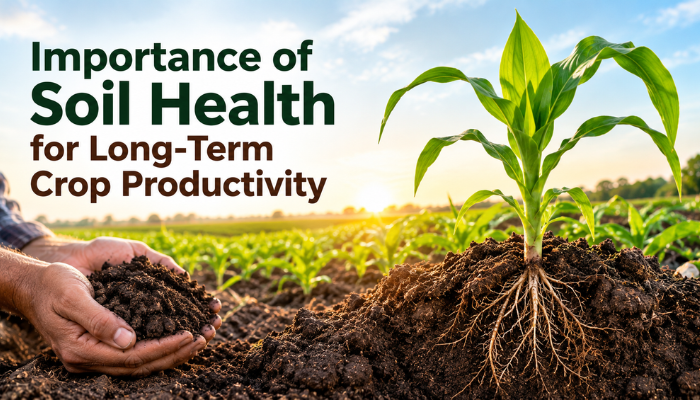
Importance of Soil Health for Long-Term Crop Productivity
Soil is not just the place where crops grow. It is a living part of the farm that provides plants with nutrients, water, air, and support for healthy root growth.
Good soil health helps farmers get better crop growth, crop yield, produce quality, and water management. Healthy soil can also help crops handle drought, heavy rainfall, and other weather problems.
Understanding the importance of soil health helps farmers take better care of their land and maintain good crop production for many years.
What is Soil Health?
Soil health means the ability of soil to support healthy plants and maintain its natural functions. Healthy soil can hold water, provide nutrients, support useful microorganisms, and allow roots to grow properly. Soil health mainly has three parts like physical health, chemical health and, biological health.
Importance of Soil Health
Learn how healthy soil improves crop growth, nutrient availability, water use, and long-term farm productivity.
1. Supports Healthy Crop Growth
- Healthy soil gives crops the nutrients, water, air, and support they need. Good soil structure also helps roots grow deeper and stronger.
- Strong roots help plants take up water and nutrients better and handle short periods of water shortage.
2. Improves Crop Yield and Quality
- Healthy soil can support better and more stable crop yield.
- Proper nutrient availability can also improve the quality of grains, fruits, vegetables, and other farm produce.
- Good soil health may help improve fruit size, colour, quality, and shelf life, depending on the crop.
3. Improves Water Management
- Good soil structure allows rainwater and irrigation water to enter the soil properly. It also helps the soil store water for later use.
This can help reduce:
- Water runoff
- Soil erosion
- Waterlogging
- Water loss
Good water management can also help crops during dry periods.
4. Supports Soil Biodiversity
Healthy soil contains useful bacteria, fungi, earthworms, and other organisms.
These organisms help:
- Break down organic matter
- Recycle nutrients
- Improve soil structure
- Support healthy root growth
- Suppress some soil-related diseases
5. Helps Reduce Farm Input Costs
- Healthy soil can use fertilizers and irrigation water more efficiently.
- Better nutrient holding can reduce fertilizer loss, while good water-holding capacity can reduce unnecessary irrigation.
- This can help farmers reduce input wastage and improve farm profitability.
6. Protects the Environment
- Healthy soil helps reduce soil erosion, nutrient runoff, and water pollution.
- It can also store carbon and support different soil organisms.
- Therefore, protecting soil health is good for both the farm and the surrounding environment.
7. Helps Crops Handle Weather Stress
Soil with good organic matter and structure can hold more water and handle heavy rainfall better. Healthy soil can help crops manage conditions such as:
- Drought
- Heat
- Heavy rainfall
- Water shortage
- Changing weather conditions
This can help farmers maintain more stable crop production.
Factors Affecting Soil Health
Many physical, chemical, biological, farming, and environmental factors can affect soil health.
Physical Factors
Important physical factors include:
- Soil texture, such as sand, silt, and clay
- Soil structure
- Soil compaction
- Water infiltration and drainage
- Frequent or deep tillage
- Heavy machinery use
- Soil erosion and topsoil loss
Chemical Factors
Chemical factors include:
- Soil pH
- Nutrient levels and balance
- Salinity and sodicity
- Organic carbon
- Harmful chemicals and waste
Biological Factors
Biological factors include:
- Soil microorganisms
- Earthworms
- Organic matter
- Soil biodiversity
- Crop residues
- Root activity
- Beneficial organisms
These factors play an important role in nutrient cycling and maintaining soil fertility.
Farming and Environmental Factors
Some farming and environmental practices can also affect soil health:
- Growing the same crop continuously
- Excessive use of fertilizers and pesticides
- Burning crop residues
- Poor irrigation and drainage
- Heavy rainfall
- Drought
- Heat
- Flooding
Soil Health Management Practices
Soil health management means using farming practices that improve soil structure, fertility, nutrient balance, water management, and biological activity.
1. Add Organic Matter
Add materials such as:
- Compost
- Farmyard manure
- Vermicompost
- Green manure
- Suitable crop residues
Organic matter can improve soil structure, water-holding capacity, nutrient retention, and microbial activity.
2. Practice Crop Rotation
Avoid growing the same crop continuously. Rotate cereals with legumes and other suitable crops.
Crop rotation can:
- Improve soil fertility
- Improve nutrient availability
- Reduce pest and disease problems
- Reduce nutrient imbalance
Legume crops can also help improve nitrogen availability in the soil.
3. Use Cover Crops and Green Manure
Grow cover crops between main crops to protect the soil surface. Green manure can be added to the soil before flowering to increase organic material and nutrients.
These practices can help:
- Reduce soil erosion
- Improve soil structure
- Increase organic matter
- Support soil organisms
4. Reduce Soil Disturbance
- Use minimum or conservation tillage where suitable for the crop and soil.
- Avoid unnecessary deep ploughing and avoid working the soil when it is too wet.
- Reduced soil disturbance can help protect soil structure and useful microorganisms.
5. Apply Balanced Fertilizers
- Test the soil before applying fertilizers.
- Use fertilizers according to the crop requirement and soil test results.
Follow the right:
- Source
- Rate
- Time
- Place
Avoid using too much nitrogen or depending only on one nutrient.
6. Control Soil Erosion and Compaction
Farmers can use practices such as:
- Mulching
- Contour bunds
- Terracing
- Grass strips
Avoid unnecessary movement of heavy machinery, especially when the soil is wet. These practices help protect topsoil and reduce soil erosion and compaction.
7. Improve Irrigation and Drainage
- Give water according to the crop requirement and soil condition.
- Avoid excessive irrigation and waterlogging. Where suitable, drip irrigation can help improve water-use efficiency.
- Proper drainage is also important to prevent excess water from staying in the root zone.
8. Protect Soil Biology
- Avoid unnecessary use of pesticides and provide organic matter to support soil organisms.
- Biofertilizers and other biological inputs can be used where they are suitable and recommended for the crop.
9. Test and Monitor Soil Regularly
- Regular soil testing helps farmers understand the condition of their soil.
Farmers can check:
- Soil pH
- Organic carbon
- Nutrient levels
- Salinity
- Other important soil indicators
Keep records of soil test results, fertilizer use, crop performance, and soil management practices. This makes it easier to track changes in soil health over time.
Benefits of Good Soil Health Management
Good soil health management can provide several benefits:
- Better and more stable crop yield
- Improved nutrient use
- Better water-use efficiency
- Reduced soil erosion and runoff
- Less wastage of farm inputs
- Better crop performance during drought and heavy rainfall
- Improved soil fertility
- Better soil condition for future crops
- Improved biodiversity and environmental quality
Conclusion
The importance of soil health is directly linked to crop growth, crop yield, produce quality, farm income, water management, and long-term soil fertility. Soil health depends on physical, chemical, and biological conditions working together. Practices such as adding organic matter, crop rotation, cover crops, balanced fertilizers, reduced tillage, erosion control, proper irrigation, and regular soil testing can help farmers maintain healthy soil.
Want to Improve Soil Health and Crop Growth? SV Agro Solutions offers biostimulant products such as SV 59, SV Sugarban, SV Fruiter, SV Canter, and SV Defence that support better nutrient uptake, plant growth, and overall crop health. These products can be used as part of a balanced farming approach to help maintain healthy and productive crops.
Choose SV Agro Solutions for quality biostimulant products that support better plant health, efficient nutrient use, and sustainable farming practices.
FAQs
1. How to keep soil healthy?
Keep soil healthy by adding organic matter, reducing tillage, keeping the soil covered, and rotating crops.
2. What are the 5 principles of soil health?
The 5 principles are soil armor, minimal soil disturbance, plant diversity, continuous living roots, and livestock integration.
3. What are the main factors affecting soil health?
The main factors affecting soil health include soil structure, compaction, pH, nutrient balance, organic matter, microorganisms, erosion, water management, and farming practices.
4. What is soil health management?
Soil health management includes practices such as adding organic matter, crop rotation, cover crops, reduced tillage, balanced fertilization, erosion control, proper irrigation, and regular soil testing.
5. How can farmers improve soil health quickly?
Farmers can start by testing their soil, adding well-decomposed organic matter, reducing soil compaction, using mulch to protect the soil surface, and applying fertilizers according to soil and crop requirements.
.jpg)
The Vital Role of Micronutrients in Sustainable Agriculture
The Vital Role of Micronutrients in Sustainable Agriculture
Micronutrients are small but powerful elements that play a crucial role in the health and growth of plants. Just like humans need vitamins, plants require micronutrients such as iron, zinc, copper, and manganese in tiny amounts to thrive. These nutrients are essential for various plant functions, including photosynthesis, enzyme activity, and overall health.
In sustainable agriculture, the use of micronutrients is vital for improving crop quality and yield.
When plants receive the right balance of micronutrients, they can absorb other essential nutrients more effectively. This leads to stronger plants that are better equipped to resist diseases and cope with environmental stresses like drought or extreme temperatures.
SV Agro Solutions is a leading company based in Pune, Maharashtra, that makes high-quality organic farming products using advanced nano-technology. For over ten years, we have focused on research and development to help farmers grow better crops while protecting the environment. Our mission is "Save Soil – Save Lives," and we are dedicated to providing farmers with safe, effective, and affordable inputs to improve their harvests and livelihoods. By choosing our products, you support healthier farming practices that benefit both the soil and the community. Join us in making a positive impact on agriculture in India!
At SV Agro Solutions, a leading micronutrient manufacturer in Pune, we offer organic micronutrient products designed to support farmers and gardeners. Our products improve plant health by making them stronger against pests and diseases. When plants receive the right micronutrients, they can produce more fruits and vegetables, leading to better yields for farmers.
We provide various ways to apply micronutrients, including adding them to fertilizers, improving soil quality, using foliar sprays for quick absorption, or coating seeds before planting. By using our organic micronutrient products, you can help your plants thrive and achieve healthier crops while promoting sustainable farming practices. Choose SV Agro Solutions for effective solutions that benefit both your crops and the environment!
What Are Micronutrients?
Micronutrients are nutrients that plants require in trace amounts. While macronutrients like nitrogen, phosphorus, and potassium are necessary in larger quantities, micronutrients are just as important for plant health. Each micronutrient has a specific role; for example, iron is essential for making chlorophyll, which helps plants convert sunlight into energy. Zinc supports plant growth by aiding in DNA synthesis and cell division.
Why Are Micronutrients Important?
Micronutrients help plants absorb other nutrients more efficiently. When they are present in the soil, plants can use macronutrients better, leading to stronger growth.
What is the importance of micronutrients in Indian agriculture?
Micronutrients play a vital role in Indian agriculture, significantly influencing crop health, productivity, and soil fertility. Here are four key aspects of their importance.
1. Enhancing Crop Yield and Quality
Micronutrients such as zinc, boron, and iron are essential for the proper growth and development of plants. They contribute to various physiological processes, including photosynthesis, nitrogen fixation, and enzyme activity. For instance, boron is crucial for flowering and fruiting, while zinc aids in protein synthesis and growth regulation. Deficiencies in these micronutrients can lead to stunted growth and reduced crop yields, impacting food security in a country where agriculture is a primary livelihood.
2. Soil Fertility Improvement
The application of micronutrient fertilizers helps restore soil fertility, particularly in regions where soil is deficient due to extensive farming practices. In India, many soils are found to be deficient in essential micronutrients like boron about 24% of soils are reported to lack this nutrient. By incorporating micronutrients into the soil management practices, farmers can enhance the nutrient profile of the soil, leading to healthier crops and improved agricultural sustainability.
3. Economic Benefits for Farmers
The balanced use of micronutrient fertilizers can significantly increase farmer incomes by improving crop quality and yield. The Indian government is promoting the use of these fertilizers as part of its initiative to double farmers' incomes by 2023. Enhanced productivity not only benefits individual farmers but also contributes to the overall agricultural economy by increasing food supply and reducing dependency on imports.
4. Mitigating Nutritional Deficiencies
Micronutrients in crops directly influence human health by enhancing the nutritional quality of food. For example, crops enriched with zinc can help combat zinc deficiency in populations that rely heavily on staple foods with low micronutrient content. This is particularly important in India, where malnutrition remains a significant public health challenge. By improving the micronutrient content of agricultural produce, farmers can contribute to better health outcomes for consumers.
In summary, the integration of micronutrients into Indian agriculture is crucial for boosting crop yields, improving soil health, enhancing farmer livelihoods, and addressing nutritional deficiencies in the population.
What is the general role of micronutrients in plants?
Micronutrients are essential elements required by plants in small quantities, yet they play critical roles in various physiological and biochemical processes. Here are the general roles of micronutrients in plants.
1. Enzyme Activation
Micronutrients such as zinc, copper, and manganese are vital for activating enzymes that facilitate numerous metabolic reactions. For instance, zinc is crucial for the activation of enzymes involved in protein synthesis and energy production, while manganese plays a role in photosynthesis and nitrogen metabolism.
2. Photosynthesis and Energy Transfer
Chlorophyll, the pigment that is involved in photosynthesis, is primarily made up of iron. It aids in the transfer of energy within the plant and is essential for the synthesis of various enzymes that support this process. Without adequate iron, plants can exhibit chlorosis (yellowing of leaves) due to impaired chlorophyll production.
3. Cell Structure and Function
Boron is important for cell wall formation and stability, influencing sugar transport and cell division. It is particularly vital during flowering and fruiting stages, impacting crop quality and yield. Additionally, micronutrients like calcium (though often classified as a macronutrient) contribute to maintaining cell membrane integrity and overall plant structure.
4. Nutrient Uptake and Regulation
Micronutrients also play a role in regulating the uptake of other nutrients. For example, molybdenum is essential for nitrogen fixation in legumes, while chlorine helps maintain osmotic balance within plant cells. These functions ensure that plants can efficiently absorb and utilize macronutrients like nitrogen, phosphorus, and potassium.
Role of Micronutrients in Sustainable Agriculture
Disease Resistance
Adequate levels of micronutrients enhance a plant's immune system, making it more resilient to diseases and pests. This is crucial for maintaining healthy crops without relying heavily on chemical pesticides.
Better Crop Quality
Micronutrients directly affect the quality of the produce. They influence the taste, color, and nutritional value of fruits and vegetables, making them more appealing to consumers.
Sustainable Practices
Using micronutrients can reduce the need for chemical fertilizers and pesticides. This not only benefits the environment but also promotes sustainable farming practices that protect soil health.
Using micronutrients also helps reduce the need for chemical fertilizers, making farming more environmentally friendly. Healthier plants lead to better harvests, which not only benefits farmers but also contributes to food security for communities.
In summary, micronutrients are essential for sustainable agriculture. They help improve plant health, increase yields, and support environmental sustainability. By choosing the right micronutrient products, you can ensure your crops thrive while protecting our planet for future generations. Explore our range of organic micronutrient solutions today and see the difference they can make in your farming practices!
How to Apply Micronutrients
Farmers can apply micronutrients through various methods
Soil Amendments
Adding micronutrient-rich fertilizers to the soil before planting.
Foliar Sprays
Spraying a solution containing micronutrients directly onto plant leaves for quick absorption.
Seed Coating
Coating seeds with micronutrient solutions to give them a nutrient boost right from the start.
Challenges in Managing Micronutrients
Despite their importance, managing micronutrient levels can be challenging. Soil tests are essential to determine the existing levels of these nutrients and ensure they are applied correctly. Over-application can lead to toxicity, while under-application can cause deficiencies.
Conclusion
In sustainable agriculture, micronutrients are vital for promoting healthy plant growth and improving crop yields. By understanding their roles and applying them effectively, farmers can enhance their crop quality while supporting environmental health. As we move towards more sustainable farming practices, prioritizing micronutrient management will be key to achieving agricultural success.
The Role of Biostimulants in Sustainable Agriculture
The Role of Biostimulants in Sustainable Agriculture
Biostimulants are gaining recognition as vital components in sustainable agriculture. They offer promising solutions to enhance crop growth and resilience while minimizing environmental impacts. These natural or biologically derived substances improve plant health, nutrient absorption, and stress tolerance, making them essential in addressing the challenges posed by climate change and increasing food demands.
SV Agro Solutions is a top biostimulant manufacturer in Pune. We create special products called biostimulants that help plants grow better and healthier. These biostimulants are made from natural ingredients like seaweed and helpful microorganisms.
Get the benefits of biostimulants with SV Agro Solutions! Our natural products, made from seaweed and helpful microbes, help plants grow better and healthier. They make plants grow faster, absorb nutrients more effectively, and handle tough conditions like dry weather and diseases. Our biostimulants also improve soil health by encouraging good microorganisms, which can lead to more fruits and vegetables. They're easy to use just treat seeds, spray on leaves, or mix them into the soil. With our biostimulants, you can enjoy thriving crops and support sustainable farming!
What Are Biostimulants?
Biostimulants include a variety of organic compounds, microorganisms, and natural extracts that stimulate plant growth and enhance their ability to cope with environmental stresses. Unlike fertilizers, which provide essential nutrients directly, biostimulants work by improving the efficiency of nutrient uptake and promoting beneficial physiological processes within plants. This can lead to healthier crops that require fewer chemical inputs.
Types of Biostimulants
Microbial Biostimulants
These include beneficial bacteria and fungi that enhance soil health and plant growth by improving nutrient availability and root development.
Natural Extracts
Substances derived from plants, such as seaweed or humic acids, which can stimulate growth and improve soil structure.
Organic Compounds
These may include amino acids or other organic substances that support plant metabolism and stress responses.
What are the advantages of biostimulants in agriculture?
Enhanced Crop Productivity
By improving nutrient uptake and overall plant vigor, biostimulants can significantly boost crop yields.
Stress Resistance
They help plants withstand abiotic stresses such as drought, salinity, and extreme temperatures, which are becoming more common due to climate change.
Soil Health Improvement
Biostimulants can enhance soil chemistry and biology, leading to better root function and nutrient cycling.
Reduced Chemical Dependency
Utilizing biostimulants can decrease the need for synthetic fertilizers and pesticides, promoting environmentally friendly farming practices.
Better Quality Produce
Crops treated with biostimulants often show improved nutritional quality and shelf life, benefiting both farmers and consumers.
The Role of Biostimulants in Sustainable Practices
As global populations rise, the demand for food increases. Traditional agricultural methods relying heavily on chemical inputs are proving unsustainable due to their negative effects on soil health and the environment. Biostimulants present a viable alternative by fostering sustainable farming practices that align with ecological principles.
By enhancing plant resilience against environmental challenges, biostimulants contribute to food security without compromising the health of ecosystems. They enable farmers to produce more with less impact on natural resources, thus supporting a more sustainable agricultural future.
SV Agro Solutions is introducing SV Canter. This powerful product is designed to boost plant growth and health. Made with natural ingredients, SV Canter helps your plants absorb nutrients better and grow stronger. With SV Canter, you can enjoy bigger, healthier crops while supporting sustainable farming practices. Give your plants the boost they need today!
Conclusion
In summary, biostimulants play an important role in modern agriculture by enhancing plant growth, resilience, and soil health while reducing reliance on chemical inputs. Their many uses make biostimulants an important part of moving towards sustainable farming. As research discovers more about their benefits, biostimulants could change how we farm, helping to ensure food security while also protecting our planet for future generations.
What is Fertilizer in Agriculture?
Fertilizers play a critical role in modern agriculture. Every farmer wants healthy crops, higher yields, and better quality produce. But without proper nutrients, even fertile soil cannot provide optimal growth. Understanding what is fertilizer in agriculture is essential for farmers to ensure their crops grow strong, healthy, and profitable.
Fertilizers supply essential nutrients to the soil, support plant growth, and help maintain soil fertility. For farmers in Maharashtra and across India, knowing how to use fertilizers correctly can make the difference between an average harvest and a bumper crop.
What is Fertilizer in Agriculture?
A fertilizer is a substance added to the soil or directly to plants to supply essential nutrients for plant growth. Fertilizers are designed to improve the availability of nutrients in the soil, enabling crops to grow efficiently and produce higher yields.
Essential nutrients in fertilizers include:
- Macronutrients: Nitrogen (N), Phosphorus (P), Potassium (K)
- Secondary nutrients: Calcium, Magnesium, Sulfur
- Micronutrients: Zinc (Zn), Iron (Fe), Boron (B), Manganese (Mn), Copper (Cu)
Fertilizers can be divided into two main types:
- Chemical or Inorganic Fertilizers:
These are manufactured substances that contain specific nutrients in concentrated form. Examples include urea (Nitrogen), DAP (Nitrogen and Phosphorus), and MOP (Potassium).
- Organic Fertilizers:
These come from natural sources such as farmyard manure, compost, green manure, and bio-fertilizers. Organic fertilizers improve soil structure, retain moisture, and promote beneficial microbial activity.
Importance of Fertilizers in Agriculture
Fertilizers are essential for modern farming and have several important benefits:
- Provide Essential Nutrients:
Fertilizers supply nutrients that might be deficient in the soil, ensuring healthy plant growth.
- Increase Crop Yield:
Crops grown with balanced fertilization produce higher yields than unfertilized crops.
- Improve Crop Quality:
Proper fertilization improves the size, color, and nutritional value of fruits, vegetables, and grains.
- Maintain Soil Fertility:
Fertilizers help replenish nutrients removed by previous crops, maintaining long-term soil productivity.
- Support Pest and Disease Resistance:
Healthy plants grown with proper nutrients are better able to resist pests and diseases.
- Enhance Economic Returns:
Higher yields and better-quality crops increase farm profitability, making fertilizers a key investment in agriculture.
Types of Fertilizers
Understanding the types of fertilizers helps farmers choose the right product for their soil and crops.
- Nitrogen Fertilizers
- Examples: Urea, Ammonium Sulfate, Ammonium Nitrate
- Purpose: Promotes leaf growth and green biomass
- Best for leafy crops like spinach, wheat, and sugarcane
- Phosphorus Fertilizers
- Examples: DAP (Diammonium Phosphate), SSP (Single Super Phosphate)
- Purpose: Supports root development, flowering, and fruiting
- Best for crops like maize, pulses, and oilseeds
- Potassium Fertilizers
- Examples: MOP (Muriate of Potash)
- Purpose: Strengthens plants, improves drought tolerance, enhances fruit and grain quality
- Ideal for sugarcane, potato, and fruit crops
- Micronutrient Fertilizers
- Examples: Zinc Sulfate, Borax, Iron Sulfate
- Purpose: Correct nutrient deficiencies, essential for enzyme and metabolic functions
- Important for crops like rice, wheat, and pulses
- Organic Fertilizers
- Examples: Farmyard manure, compost, vermicompost, green manure
- Purpose: Improve soil structure, retain moisture, support soil microbial life
- Can be combined with chemical fertilizers for best results
Use of Fertilizers in Agriculture
The use of fertilizers in agriculture must be done carefully to maximize crop growth and avoid wastage. Proper use includes:
- Basal Application
- Applied at sowing or transplanting
- Provides nutrients for early crop growth
- Top Dressing
- Applied during the growth stage of crops
- Ensures continuous nutrient supply
- Foliar Application
- Sprayed directly on leaves for quick nutrient absorption
- Useful for micronutrients
- Balanced Use
- Combining organic and chemical fertilizers maintains soil fertility and ensures sustainable crop production
- Combining organic and chemical fertilizers maintains soil fertility and ensures sustainable crop production
- Following Recommended Doses
- Excess fertilizers can harm soil health and reduce yields
- Correct doses depend on soil testing and crop requirements
Benefits of Proper Fertilizer Use in Agriculture
- Higher Crop Yield: Crops grow healthier and produce more output.
- Improved Soil Health: Maintains nutrient balance and promotes microbial activity.
- Better Crop Quality: Larger fruits, grains, and vegetables fetch better market prices.
- Economic Benefit: Efficient use increases profitability and reduces wastage.
- Sustainable Farming: Combining organic and inorganic fertilizers protects soil in the long term.
Common Mistakes Farmers Should Avoid
- Applying fertilizers without soil testing
- Overusing chemical fertilizers
- Ignoring micronutrients
- Applying fertilizers at the wrong time or in the wrong method
- Not combining organic matter with chemical fertilizers
Fertilizer Management Tips for Maharashtra Farmers
- Conduct soil testing to know nutrient deficiencies
- Follow crop-specific recommendations
- Combine organic fertilizers (like compost and green manure) with chemical fertilizers
- Apply fertilizers at the right growth stages
- Monitor crops and adjust fertilizer use according to growth and soil health
- Consult experts or suppliers like SV Agro Solutions for customized fertilizer solutions
Conclusion
Understanding what fertilizer in agriculture is and using it correctly is essential for higher yields, better quality crops, and long-term soil health. Farmers in Maharashtra and across India can benefit from soil testing, balanced fertilizer application, and combining organic and chemical fertilizers for sustainable, profitable farming.
To explore high-quality fertilizers and personalized agricultural solutions, visit SV Agro Solutions and contact our team for expert guidance.
.jpg)
Bacterial Blight (Telya Disease) in Pomegranates
Bacterial Blight (Telya Disease) in Pomegranates
Bacterial blight, also known as Telya disease, is a serious problem for pomegranate growers. This disease can cause significant damage to pomegranate trees, affecting both the leaves and fruits. Here, we'll break down what bacterial blight is, how to identify it, and what you can do to manage and prevent it.
SV Agro Solutions Pvt. Ltd. is an Indian agriculture company founded in 2016 that focuses on improving agricultural production. Based in Indapur, Maharashtra, the company specializes in producing organic inputs for farming and has a dedicated research and development facility. SV Agro Solutions supports over 80,000 farmers across various states, including Maharashtra, Karnataka, Gujarat, and Odisha.
What is Bacterial Blight?
Bacterial blight is caused by the bacterium Xanthomonas axonopodis pv. punicae. This bacterium infects the pomegranate tree, leading to a range of symptoms that can reduce the quality and quantity of the fruit.
Symptoms of Bacterial Blight
Identifying bacterial blight early is crucial for managing the disease. Here are the common signs to look out for:
Leaf Spots: Small, water-soaked spots appear on the leaves. These spots turn brown and may have a yellow halo around them.
Fruit Spots: The fruits develop dark brown to black spots. These spots can be slightly raised and may crack open, leading to fruit rot.
Stem Cankers: Dark, sunken lesions can appear on the stems and branches, which can girdle the stems and kill them.
How Does Bacterial Blight Spread?
Bacterial blight spreads through various means
Rain Splash: Rain can splash the bacteria from infected areas to healthy parts of the tree.
Insects: Insects can carry the bacteria from one tree to another.
Pruning Tools: Using contaminated pruning tools can spread the bacteria.
Managing Bacterial Blight
Managing bacterial blight involves several steps. Here's what you can do:
Sanitation: Remove and destroy infected leaves, fruits, and branches. This helps reduce the spread of the bacteria.
Pruning: Prune the trees to improve air circulation, which can help reduce the humidity levels that the bacteria thrive in. Always disinfect pruning tools before and after use.
Chemical control: Copper-based bactericides can be used to control the disease. It's important to follow the recommended application rates and timings.
Resistant Varieties: Planting pomegranate varieties that are resistant to bacterial blight can help reduce the impact of the disease.
Preventing Bacterial Blight
Prevention is always better than cure. Here are some preventive measures:
Proper Irrigation: Avoid overhead watering, which can splash the bacteria onto healthy
parts of the tree. Drip irrigation is a better option.
Healthy Soil: Maintain healthy soil with good drainage to support strong tree growth.
Regular Monitoring: Regularly inspect your pomegranate trees for any signs of disease. Early detection can help manage the disease more effectively.
Conclusion
Bacterial blight, or Telya disease, is a challenging issue for pomegranate growers, but with proper management and preventive measures, it can be controlled. By keeping a close eye on your trees and taking action at the first signs of infection, you can help ensure a healthy and productive pomegranate orchard.
.jpg)
How Farmers Can Manage Soil Salinity Effectively?
Soil is the backbone of farming. But when too much salt builds up in the soil, crops cannot grow properly. This problem is called soil salinity. It is common in dry and irrigated areas of India and is a major reason for low crop yield.
Understanding what is soil salinity and learning proper soil salinity management can help farmers protect their land and improve production.
What is Soil Salinity?
Soil salinity means there is too much salt in the soil. When salt levels become high, plants cannot take in water and nutrients properly, so their growth becomes weak and crop yield decreases.
Farmers may see white salt layers on the soil surface. This problem happens due to natural reasons or human activities like over-irrigation and too much fertilizer use, especially in dry areas where water evaporates quickly, leading to poor soil health.
- Normal soil EC: Below 2 dS/m
- Saline soil EC: Above 4 dS/m
Types of Soil Salinity
There are 3 different types of soil salinity: primary, secondary, and dryland salinity, and how each type affects soil health.
1. Primary Salinity (Natural)
- Happens naturally, not because of farmers
- Rocks in the soil slowly release salts
- Wind or seawater can also bring salts
- Common in dry areas with less rainfall
- Water dries fast, but salts stay in the soil
2. Secondary Salinity (Caused by People)
- Happens due to farming activities
- Too much irrigation adds extra water and salts
- Poor drainage does not allow salts wash away
- Too many fertilizers increase the salt level
- Cutting trees makes the underground water rise
- Salty water comes up and stays in the topsoil
3. Dryland Salinity
- A type of secondary salinity
- Happens after removing deep-rooted trees
- Crops have shallow roots and can’t absorb deep water
- Underground water rises to the surface
- This water carries salts
- Salts collect near plant roots and damage crops
Causes of Soil Salinity in India
Soil salinity happens due to both natural and human reasons:
- Too Much Irrigation & Waterlogging: When farmers use too much water, the underground water level rises. This water brings salts up to the root area. When water dries, salts stay in the soil.
- High Heat in Dry Areas: In hot places with less rain, water dries very fast. But salts do not dry; they stay in the top soil and build up.
- Sea Water Mixing (Coastal Areas): In places near the sea, salty seawater can mix with fresh water. This makes the soil more salty.
- Poor Drainage: If extra water cannot flow out of the field, salts cannot be washed away. So, they collect in the soil.
- Using Salty Groundwater: When farmers use salty or brackish water for irrigation, salts directly enter the soil.
- Natural Soil & Rocks: Some soils and rocks naturally contain salts. Over time, these salts come into the soil.
- Farming Practices: Too much chemical fertilizer increases salt levels. Also, cutting deep-rooted plants and growing shallow-root crops makes underground water rise, bringing salts to the surface.
Soil Salinity Management Strategies
Practical methods like proper drainage, leaching, soil amendments, and salt-tolerant crops can control soil salinity and improve crop productivity.
1. Leaching (Washing salts down)
- Farmers can use extra fresh water to wash salts from the topsoil down below the root area.
- This helps roots grow in soil with less salt.
- But the water must be of good quality (not salty).
- Leaching works best after harvest or before sowing.
2. Drainage (Removing salty water)
- When salts are washed down, that salty water must move out of the field.
- For this, farmers need proper drainage systems like underground pipes, open channels, or field drains.
- Without drainage, salts will come back to the surface again.
3. Growing Salt-Tolerant Crops
- Some crops can survive better in salty soils.
- Farmers can grow crops like barley, mustard, cotton, sugar beet, and some fodder grasses.
- These crops give better yields in saline fields compared to sensitive crops like beans.
4. Using Salt-Tolerant Rootstocks
- In fruit farming (like citrus or mango), special roots that tolerate salt can be used.
- These roots help plants survive even if the soil has some salt.
5. Mulching
- Covering soil with straw, dry leaves, or plastic mulch reduces water evaporation.
- When less water evaporates, fewer salts rise to the soil surface.
- This keeps salts deeper in the soil and protects roots.
6. Adding Manure, Compost, and Biochar
- Organic materials like bio-stimulants make soil soft and improve its structure.
- They help soil hold water better and support good microbes.
- This improves root growth and reduces the harmful effects of salts.
7. Gypsum Use
- Gypsum (calcium sulfate) is very useful in salty and sodic soils.
- It replaces harmful sodium with calcium.
- This improves soil structure, allows water to pass easily, and helps wash salts away.
8. Do Not Over-Irrigate
- Too much water raises the underground water level and brings salts up.
- Farmers should give only the required water based on the crop's needs.
9. Proper Water Management
- Sometimes a small extra amount of water is needed to wash salts down.
- This is called the leaching requirement. But it must be planned properly.
10. Avoid Deep Tillage
- Deep ploughing can bring hidden salts from lower soil to the surface.
- Light and controlled tillage is better.
11. Removing Salt Crusts
- If white salt layers are seen on the soil surface, farmers can scrape off the top salty layer and remove it from the field.
- This gives quick relief, but it is only a temporary solution.
Conclusion
Soil salinity is a serious problem, but it can be controlled with proper care. By improving irrigation, drainage, crop choice, and soil management, farmers can restore soil health and increase crop yields. Good soil salinity management means better productivity, better income, and long-term soil protection.
Want higher crop yield with healthier soil and lower cost?
SV Agro is a trusted fertilizer manufacturer in Pune, helping farmers grow strong and productive crops. Our CRF fertilizers provide the essential nutrients plants need for better growth, improved soil fertility, and higher yields. We focus on quality products and practical solutions that support sustainable and profitable farming.
FAQs
1. What is soil salinity?
It is the buildup of excess salts in soil that reduces plant growth.
2. How can farmers test soil salinity?
Through soil lab testing and electrical conductivity measurement.
3. Which crops tolerate saline soil?
Barley, cotton, mustard, rice, and sugarcane.
4. What causes soil salinity?
Poor irrigation, low rainfall, waterlogging, and excess fertilizers.
5. How much land in India is affected?
About 6.7 million hectares of land face salinity problems.
.jpg)
Biostimulants in Agriculture: Benefits & Uses
What are Biostimulants?
Biostimulants are special products that help plants grow better and become healthier. They are made from natural or artificial materials and are applied to crops or soils. Biostimulants work in different ways to promote plant growth.
Biostimulants are a special type of agricultural products that are designed to help plants grow better, stay healthier, and become more productive. They are different from traditional fertilizers, which mainly provide the essential nutrients like nitrogen, phosphorus, and potassium (NPK) that plants need.
Biostimulants are natural substances or microorganisms that are applied to plants or soil. They help plants grow better and become healthier in several ways:
Improve the plant's ability to take up and use nutrients
Increase the plant's tolerance to stress, like drought or extreme temperatures
Enhance the quality and yield of crops.
SV Agro Solutions is a leading manufacturer of high-quality organic agricultural inputs based on nanotechnology. The company is located in Pune, Maharashtra, India.
For over a decade, SV Agro Solutions has been dedicated to research and development in the agricultural sector. Their mission is "Save Soil - Save Lives", which aims to improve soil health and significantly reduce the risk of lower agricultural yields.
Biostimulant Products in Agriculture
Companies like SV Agro Solutions Pvt. Ltd. offer a wide range of biostimulant products for various agricultural applications.
Fruit and Vegetable Biostimulants
Products like SV Fruiter and SV Cantor help improve the quality and yield of fruits and vegetables.
Field Crop Biostimulants
SV 59 and SV Fullora are designed to boost the growth and productivity of field crops.
Soil Conditioners and Plant Strengtheners
SV Defense and the SV Fighter series help improve soil health and plant tolerance to stresses.
Promoting Sustainable Agriculture
SV Agro Solutions promotes sustainable agriculture by maintaining a balance between the needs of farmers, consumers, and the environment. They support the entire chain of healthy farming and living.
SV Agro Solutions believes that soil health depends on
Carbon transformations
Nutrient management
Maintaining soil structure
Regulating pests and diseases
By addressing these factors, the company aims to provide solutions that empower farmers and contribute to the overall sustainability of the agricultural system.
What are Biostimulants Made Of?
Biostimulants can contain various natural ingredients, such as
Seaweed extracts
Amino acids and proteins
Beneficial bacteria and fungi
Humic and fulvic acids
Plant hormones and growth regulators
How do Biostimulants Work?
Biostimulants work by promoting the inherent functions of the plant to
Improve root growth and nutrient uptake
Enhance tolerance to stressful conditions like drought or extreme temperatures
Increase crop quality and yields.
Benefits and Uses of Biostimulants in Agriculture
1. Better Nutrient Absorption
Biostimulants help plants take up and use nutrients from the soil more effectively. This means plants can get the nutrients they need even if the soil doesn't have a lot of them. As a result, plants treated with biostimulants are healthier and grow better.
2. Stronger Root Growth
Biostimulants encourage the development of healthier, more extensive root systems. Strong roots are essential for plants to thrive. With better roots, plants can absorb more water and nutrients, making them more resistant to stress.
3. Increased Tolerance to Stress
Plants face various stresses, such as drought, extreme temperatures, and diseases. Biostimulants enhance a plant's ability to withstand these stresses by improving its overall health and vigor. Better-quality produce and increased crop yields may result from this.
4. Improved Soil Health
Using biostimulants can help improve soil quality over time. They promote the growth of beneficial microorganisms in the soil, which can break down organic matter and make nutrients more available to plants. Richer, more productive soil may result from this
5. Reduced Need for Chemicals
By enhancing plant health and reducing stress, biostimulants can help minimize the need for chemical pesticides and fertilizers. This makes farming and gardening more sustainable and environmentally friendly.
Overall, biostimulants offer a natural way to boost plant growth, improve crop yields, and promote sustainable agricultural practices. However, it's important to choose high-quality biostimulant products and use them according to the manufacturer's instructions for best results.
6. Reduced Need for Chemicals
Biostimulants can be used together with regular fertilizers to help plants grow well. They allow farmers to use fewer chemical products because they improve the plant's ability to take up nutrients and stay healthy. This has good effects on the environment and saves money.
7. Better Crop Quality
Biostimulants don't just increase crop yields, they also improve the quality of the crops. This makes the fruits, vegetables, grains, etc. more nutritious and appealing to people buying the food.
8. Environmentally Friendly
Protecting the environment is very important today. Biostimulants are a good choice for farmers because they reduce the need for chemical fertilizers and pesticides. This lowers agriculture's impact on the environment.
In summary, biostimulants have become very useful for farmers and gardeners in recent years. They help plants grow to their full potential, keep soils healthy, and cut back on chemical products. Whether you grow crops commercially or have a home garden, biostimulants are a valuable tool to produce healthy plants and support sustainability. The benefits to the plants, the environment, and the farmer's bottom line make biostimulants an important part of modern agriculture.
Here is a simplified explanation of how biostimulants are applied
Applying Biostimulants
Biostimulants can be applied to plants and soil in different ways, such as:
Seed treatment - Applying the biostimulant directly to the seeds before planting
Soil application - Mixing the biostimulant into the soil
Foliar sprays - Spraying the biostimulant directly onto the leaves and stems of the plants
Irrigation systems - Adding the biostimulant to the water used for irrigation
The best application method depends on the type of biostimulant and the needs of the crop.
Integrating Biostimulants into Crop Management
Incorporating biostimulants into overall crop management practices can provide significant benefits:
Promotes sustainable agriculture by reducing the need for synthetic fertilizers and chemicals
Improves the overall health and resilience of the agricultural system
Boosts crop productivity and quality in an environmentally-friendly way
By using biostimulants as part of a comprehensive crop management plan, farmers can reduce their reliance on synthetic inputs while improving the long-term productivity and sustainability of their operations.
The Future of Biostimulants in Agriculture
As the demand for sustainable and environmentally friendly farming practices grows, the use of biostimulants is expected to continue increasing. By working in harmony with the plant's natural processes, biostimulants offer a promising solution to boost crop productivity and quality while reducing the reliance on synthetic inputs. With ongoing research and innovation, biostimulants are poised to play an increasingly important role in the future of modern agriculture.
Conclusion
Biostimulants are a vital tool in modern agriculture, offering numerous benefits for plant growth, development, and sustainability. By incorporating biostimulants into integrated crop management practices, farmers can reduce their reliance on synthetic inputs, improve overall productivity, and contribute to a more sustainable agricultural system. Whether you are a farmer looking to enhance crop yields or an environmentalist concerned about the impact of agriculture on the environment, biostimulants are an innovative solution worth exploring.
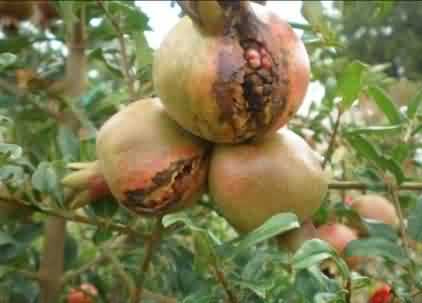
Pomegranate Oil Disease:
Causes of oil disease on pomegranate trees:
1. When the temperature is 28 to 32 degrees Celsius
2. Air humidity should be more than 70%
3. If planted from seedlings prepared from oil-bearing mother trees
4. Excessive use of nitrogenous fertilizers
Nitrogen application should be taken into consideration when using nitrogen from air/rainwater in rainy season.
Consider the amount of nitrogen fixed by bacteria in the soil
If river or canal water is used, the amount of nitrate available to the crop from such water should be assumed.
5. Chloride content in the soil is more than required.
The amount of chloride added to the soil by water / the amount of chloride added by fertilizer and the amount of chloride added to the soil should be checked.
6. Organic carbon content should be less than 0.6
Excessive use of chemical fertilizers
Less use of organic fertilizers
Decreasing bacterial population in soil
7. Injuries to trees
Injury to trees after pruning
Injury to plants after removal of tops or watershoots
Injury to plants by agricultural implements like blowers, trolleys and other implements
Damage to trees caused by hail after a hailstorm,
Yellow leaves and fruits due to excess nitrogen (this is also a wound)
8. Weakness of plants due to nematode infestation or insufficient nutrition.
9. Diseased implements used in the field, such as pruning shears.
SV Agro Solutions Oil Control Activities:
Consider the above and prepare a schedule of what to do and what not to do while going out
Sterilize pruning shears
When planting a new plant, check the history of the garden in which the seedlings are produced, do not use seedlings from oil-infested gardens.
After pruning, top removal or other injury to the trees as above, immediately spray with SV Rounder P 2.5 g per liter of water.
(Soil application of Rounder P at first watering: for nematode control, soil oil bacteria control and to enhance plant immunity.)
Apply SV Rounder P 1 kg and SV Excitum 1 kg per acre at the rate of 1 kg per acre at the stage of changing color of the fruit i.e. once when the fruit is green and once when the fruit turns red.
After moisture has increased in oil-infected orchards, alternating sprays of SV Rounder P + Rounder L, SV Defense should be applied when the environment is fertile for oil disease bacteria.
Control the amount of nitrogen given to the plants (considering all factors as shown above).
Green manure should be mulched with sugarcane mulch.
Measures should be planned to increase the organic curb of the soil, increase the use of organic matter, cow dung and use of SV Fruiter 100 to 150 kg per acre in basal dose and use of SV 59 + SVK drip helps to increase the organic curb of the soil.
S. V. Terminus 1 liter per acre should be applied through the soil once in 2 months to control the increased salinity in the soil.
Although absorption of nutrients by roots is reduced in limestone soil, in such soil, sulfur, phosphorous, manganese should be given in increased amount.
A schedule of S. Vi agro from the beginning in oil-infested orchards can reduce the incidence of oil disease.

The Grapevine and Negative Charge: Part 22
Hello fellow farmers,
Many times vineyards face extreme cold temperatures, even down to the point where ice forms, which scares the farmer into fearing that this extreme cold will damage my vineyard, and if the wrong measures are taken to protect the vineyard, it can sometimes cause damage. Today we will look at the effects of extreme cold temperatures on the vineyard to avoid this damage. In general, the process of ice formation takes place only when the relative temperature of the air falls below 4°C for water or dew point to turn into ice. Generally the temperature does not fall below 4 degrees overnight, after five o'clock in the morning the temperature drops rapidly, we have water and dew point freezing in the early hours of the morning from 5:30 to 7, and then after sunrise the temperature starts to drop slowly. The roots slow down, and the beads in the bunch also stop swelling, if the dew freezes on some of the leaves and the beads and the snow accumulates for more than an hour and a half, the spots appear, the metabolic activity of the grape vine slows down but does not stop, photosynthesis continues, this is why we have Water freezing does not occur throughout the day, this state lasts only from dawn to eight in the morning, and even though the temperature is low throughout the day, the freezing point is not as much. Although the duration of sunlight is reduced, the production of carbohydrates (sugars CHO) with the combination of water, carbon dioxide and sunlight is slow. As the speed continues, one result is that cell division stops in the grape seed, in rare cases deformation may occur, seed swelling slows down, sugar production slows, anthrocyanin levels increase and acidity increases, and the seed begins to turn sour, at the same time that unnecessary chemical reactions occur. Fertilizer bombardment triggers bead cracking, as root function is slowed down, resulting in a lack of nutrient supply, which means bead swelling slows down and the time it takes for grape formation to lengthen. It is as follows, when the dew point freezes in the morning between 5:30 and 7:00 a.m., smoke should be made in the garden at this time and the drip set should be turned on and watered, the water in the well or farm is hot in the morning and the temperature in the garden does not fall below the freezing point due to the smoke. If the fire is smoked in five places, the dew point will not freeze in the garden, and leaves will not be damaged and stained by ice. Photosynthesis will continue, with occasional small doses of NPK sprays, during which time the SV fruiter drip down will keep the roots efficient even at such low temperatures, in fact, during this time the roots should have a negative charge, which the SV fruiter produces unconsciously. , at the same time spraying will produce a small amount of SV Ketone + Chelated Mix Micro Nutrient or 13:00:45 or 19:19:19 to create a positive charge on the leaves. The leaves, roots, and buds will continue to flower and produce sugars, and your garden will be safe even in extreme cold. The detailed measures can be done as follows, 100 kg of SV fruiter per acre should be placed under dripper and watered under low pressure every morning between 5:30 and 7:00, next day five liters of SV size builder per acre should be released, 250 ml of SV ketone + 100 g of chelated mix in 200 liters of water for spraying. Micro Nutrient + 300 g 13:00:45 should be mixed together and sprayed, after three days one liter of SV ketone should be released from the drip, so that the swelling will continue even in extreme cold without any distortion of the beads.
author-
Mr. Subhash Chandra Karale Sir
Director, SV Agro Solutions

The Grapevine and Negative Charge: Part 19
Hello fellow farmers, in yesterday's episode we have learned about the reasons and remedies for grape seed cracking due to extremely cold temperature, we are going to learn about cracking and many other types of deformities in grape seed. In grapes, there are mainly defects such as short berries, water berries, pink berries, stalk necrosis and green leaves. In this disorder of grape seed stem burn, from the time of adding sugar to the grape seed, white brown spots like the tip of the heel first fall on the stem and then they turn dark brown and as the ripeness increases, the size of these spots also increases and the bunches or beads are burnt. This deformity increases with maturity. This affects the transport of sugar, water and other components from the vine and results in soft, greenish, mushy, watery and consequently dry bunches of grapes. Ultimately this results in adverse effects on bunch fresh weight, juice yield, soluble sugars and color components such as anthocyanins, while increasing grape acidity. Quality yield decreases due to adverse effects on yield and quality of grapes. As a result, there are difficulties in producing exportable grapes. This disorder is associated with an imbalance of organisms and nutrients especially the ratio of potash calcium + magnesium.
Ammonic nitrogen and potash should be avoided. Both of these factors adversely affect the absorption of calcium. Mani 8 m. M. Spray calcium chloride 500 g / 200 liters of water while still in shape. After that 2 sprays should be given at 10 days interval. 10 m. M. Magnesium Sulphate spray should be given twice at 10 days interval after berry size. The quantity should be 5 grams of magnesium sulphate per liter of water. Spraying SV Ketone together with Magnesium Sulphate gives good results, at the same time SV Ketone works very effectively to keep the leaf load active. When the positive charge is active on the leaves, the negative charge is active on the roots. And the work of the roots is already going on.
author-
Mr. Subhash Chandra Karale Sir
Director, SV Agro Solutions
Grape Vine and Negative Charge: Part 17
It is beneficial to use fertilizers in a balanced amount in the vineyard, for this it is necessary to plan the harvest after regular soil testing, water testing and examination of cane stalks etc. , thus creating a new problem of not filling the sugar in time, most of the farmers try to reduce the amount of nitrogen and increase the amount of potassium while filling sugar (brix), but the measures taken at the time are not very useful, for that control of nitrogen and use of potassium in the beginning. You have to plan from the beginning. In recent years, the deficiency of phosphorus in the soil in the vineyard has become very serious.
In the last two years, soil samples from many vineyards that have come to me have been tested in the laboratory and found to be below 10 kg of phosphorus per hectare. (40% of the total sample had this low phosphorus). Realistically, this amount of available phosphorus for grape vines should be above 35 kg per hectare. Many soil experts or agricultural advisors recommend the use of phosphorus-solubilizing bacteria such as PSB in the soil, because the phosphorus in the soil is not readily available to the crop, often chemical fertilizers are applied by spray or combination, and the phosphorus combines with other chemicals to form complex compounds, such as Under these conditions, these bacteria are beneficial, but if the phosphorus content in the soil is very low, these bacteria cannot produce phosphorus. To increase the phosphorus level, it is more beneficial to use a fertilizer like rock phosphate or single super phosphate, mixed with single super phosphate compost or organic fertilizers in the soil. If added, the availability of nitrogen and other nutrients in organic manure increases many times. Before October pruning 250 to 300 kg of single super phosphate per acre mixed with organic compost fertilizer and applied near the roots will make it easier for the grape vine to get nutrients from the organic component, if the soil is alkaline (pH above 7.5) then 40-50 kg of bentolite sulfur should be used with this fertilizer. , (18 -20 %) means that the pH will be slightly under control.
author-
Mr. Subhash Chandra Karale Sir
Director, SV Agro Solutions

The Grapevine and Negative Charge: Part 16
Hello farmer friend, It is the dream of every viticulturist to produce good and exportable grapes from his vineyard, and everyone strives to do so, but nowadays many viticulturists seem to be struggling every time, there are many reasons for this, yet in any case the desired production and We have to plan to maintain the quality, for this planning we have to take the help of the grape vine, the strong storage (food stock) in the grape vine is the strength of the vine, the tools to accurately measure the strength and resistance of the grape vine are not yet available (developed) even with a little experience. It can be recognized. A lot of vine resistance depends on the nutrients available to the vine, but if the carb-nitrogen ratio (10 : 1) is achieved, good resistance is built up in the vineyard and yields are easily obtained. Let's come straight to the point of how much fertilizer to give to the vineyard, let's start from the rest period, generally after the harvesting of all the bunches in the vineyard, within two to three days, 100 kg of DAP per acre should be spread evenly in the open space in the middle and leave a lot of free water immediately so that then the first crop The stress of the grape vine will be removed. If there is not enough water to be released, a shallow room should be dug in the middle for an hour and DAP should be placed in it and a drip line should be installed on top and the water should be left from the drip for at least six hours. The dead has come, and when DAP and water are available in the middle belt, the roots move forward with a rush of nutrients and start working again, during this time the first production of the grape vine is made up of the roots. (Due to DAP and water moisture, the negative charge on the roots increases and during this time, the toxic substances accumulated in the trunk and leaves of the vine are thrown out) Then if your soil is black and heavy, you should leave it for twenty days and if your soil is medium to light, leave it for rest for ten or twelve days. During this period, it is not a problem to give light water once or twice a week, if possible, mix and disperse some millet, wheat and sorghum seeds in the open belt before giving free water, so that it will grow up to two to three inches in eight to ten days. Or it should be broken by a tractor (mini green manure) along with this manure, digging a small furrow between two trunks and adding five or six tons of well-rotted mixed compost manure will work. If possible, cover the bed with sugar cane and prune at the right time, if the temperature is high after rough pruning, let the garden have free water two or three times.
author-
Mr. Subhash Chandra Karale Sir
Director, SV Agro Solutions

Grapevine and Negative Charge: Part 6
Although the relationship between nature and plants is very strong, plants have to bear the brunt of nature's whims. (This is the food of man and other creatures) We have seen in the previous parts that the grape vine is ready for the new spring only after a lot of rest, it is during this rest period that the garden needs to be nourished, now we have to determine how much we want to produce, in the first spring. The amount of yield is also important, it has been observed that often if there is a high yield in the first spring, then there is less yield in the next spring and if there is a low yield in the first spring, then there is a higher yield in the next spring, but after rough pruning, if the garden is taken care of regularly, uniform yield can be obtained. Possible, (baggage food and water, proper pruning and management are important). During the rest period, it is necessary to have the correct number of canes on each vine depending on the variety and the leaves to be healthy and plump until the end, many problems arise from partial nutrition, early succumbing to grapevine diseases and pests, malcanes remaining unripe, and then we have to deal with the problems, before pruning each year. Soil testing in the vineyard is necessary to do soil testing in school, it is easy to determine how much nutrients are in your soil then how much to give for the desired production. Many times it is also seen that there is a lot of nutrients in the soil but they are not able to grow the crop or those nutrients are non-degradable, 15-20 years ago this problem was very rare but now it has become a big problem in many places. There are many reasons for this. In my opinion, the main reason is the excess and insoluble salts in the soil. In fact, if there is a lot of regular seasonal rain, these salts should be washed away from the soil by drainage (leachout). are going on and the amount of salts in the soil is increasing. Electrical conductivity (EC) of soil is increasing. As we have seen in the back section, grapevine leaves make their own food with the help of sunlight, carbon dioxide and water, and as the plant does this process, nutrients (NPK, micro and micro) from the soil help the plant, (nutrients supplied from the soil neither the plant nor its own). There is a constant need between different stages) Here a causal event takes place, the plant which is creating food reserves for itself, in the process energy is created in the leaf, shoot and stem, this energy is influenced by positive charge (positive charge) and this energy is further transformed into the main product. After a certain stage (before the end of the rest period and before stress) this energy needs to be stored in the inner part of the vine, but during this time the negative charge is active in the soil, and the positively charged energy in the tree is released into the soil. (This problem is more common in other fruit crops than grapes) Due to the accumulation of easily conductive metallic elements near the roots, there is little food supply left in the vine, and then the vineyard runs from there. Grape vines continue to suffer in some form such as lack of uniformity of shoots, increase in number of barren shoots, blight or diseases. There is only one solution and that is to enrich the soil. "Cultivation only if the soil is rich" is one of the challenges facing vineyards in the future.
author-
Mr. Subhash Chandra Karale Sir
Director, SV Agro Solutions

Grapevines and Negative Charge: Part 4
It is now understood that negative charge is largely responsible for the development of plants and their growth in the opposite direction to the force of gravity, and I think that the relationship between plants and nature must be a mystery. Plants are developing their life cycle only on the behest of nature and due to the proximity of plants, nature is making it like that. There are certain rules set by nature for plants, the principles of commercial agriculture are based on this rule (principle). Natural agriculture and commercial agriculture or modern agriculture are often debated, in fact, for the last several centuries, humans have been farming with the help of plants. It cannot be called natural agriculture. In fact, farmers do not allow plants to grow in a natural way, taking advantage of the laws of nature. Production is taken from the plant at will, hence all agriculture today is "unnatural farming practices". Today we are going to study one such rule that nature has decided for the plant (grape vine). Plants produce only after nature's cues. That law is "Whenever a plant's survival is in question, the plant turns to reproduction" that is the law of nature. In the modern farming system, many fruit crops are harvested using the same principles, in crops like guava, pomegranate, sitafal, after a certain period of rest, the roots are exposed and a few roots are cut and those trees are given a kind of stress (trouble) and induced to produce fruit. goes A similar trace is given by girdling the grape vine resulting in a guaranteed spring. From a scientific point of view, when the negative charge (effect) on the plant is very low, the period after which is suitable for production from the plant, the time to reduce the negative charge on the grape vine (to hold the spring) is the stress given before pruning in October. If the vineyard is properly stressed (if the grape vine has developed strong and mature canes, 15 to 20 days of stress is sufficient depending on the type of soil) a guaranteed and abundant spring will emerge, the leaves of the plant (grape vine) with the help of plenty of sunlight and carbon dioxide air (photosynthesis) ) are continuously producing food, through the process of food production, a positive charge is created, but no force is created in that charge, because basically, the negative charge effect on the grape vine is more, so it immediately goes into neutral state, but This depressed stage stops near the roots of the vine. But when the roots of the grape vine stop neutralizing the charge from above, the internal part of the vine begins to move rapidly and this negative charge begins to turn into a "negative force".
author-
Mr. Subhash Chandra Karale Sir
Director, SV Agro Solutions

Grapevines and Negative Charge: Part 3
Fresh plants are excellent conductors of electricity (metal wire is highly conductive) and roots of plants are also conductors of electricity. But sometimes obstacles are formed in this system, the electrical conductivity of the roots slows down, these roots do not allow the energy to go to the ground, at that time the energy is stored in the trunk itself, as a result the trunk swells (this energy is further used for flower and fruit production). (roots don't have to be active all the time) Now it's important what form this energy is in, this energy is in the medium of different nutrients and hormones, (the job of carrier agents is to maintain the electrical load). Now let's look at the work of the roots of the grapevine, the roots work to control the flow from the leaves and tops to the soil and the roots do both the work of pulling the nutrients up from the soil, while the energy flow is from the top down and at the same time there is a flow from the bottom up ( Above Janara flow is reversed). The confluence of both these currents happens many times, at the same time different hormones are being produced. Hormones called cytokinins and hormones called gibberellins are important hormones, but this is where the role of the root is important, the root has to be active (white root) at this time. anyway When the roots are active, they are discharging minerals from the roots into the soil. These different minerals are taken up from the soil and some of them are released back into the soil, those nutrients are attached to the roots, even at the time when the roots are most active. (Electrical appliances are connected in the house and an earthing wire is buried in the ground to prevent the equipment from getting shocked, this earthing works well only when salt, coal and water are added there, salt is a good conductor of electricity and coal is carbon, both of which make the current flow faster. is discharged) of course roots are active only when there is sufficient nutrients and organic matter available in the soil. Now let's see what nutrients are required at this time, during the resting period in the grapevine, phosphorus, potassium, iron, magnesium and calcium must be in excess. A stream from above moves down carrying heterogeneous elements like nitrogen, sodium, chlorine, ferrous, zinc. It is precisely from this combination that ascorbic acid, cytokinin, components are produced and as a result a chemical called lignin is formed, this lignin and cytokinin then block the flow of energy from top to bottom and then all the energy is trapped in the form of storage in the trunk. After doing exactly that, the roots of the grapevine start to turn brown, but this process is very slow. Negative charge plays an important role in all these processes.
author-
Mr. Subhash Chandra Karale Sir
Director, SV Agro Solutions
The grape vine and negative charge: Part 1
**Grapevines and Negative Charge: Part 1**
**Posted On: January 01, 1970**
This topic is extremely important, but for some unknown reason, no one seems to be discussing it. First, let's understand what negative charge is (in relation to plants). All plants that grow in the soil are under the influence of a negative charge because the Earth itself is the largest source of negative charge. A negative charge is essentially the return flow of electric current (the entire universe, including living beings, is continuously under the influence of negative and positive electric waves). Specifically, plants are under the influence of negative waves (humans also exist between these two charges, with the only difference being that the positive charge in the human heart continuously converts into negative current, which is perhaps referred to as the human soul. Every living being (except plants) is found to be alive in this manner). In reality, positive charge/current/flow is energy. (The electric current flowing through wires is very powerful, while the current found in living beings is very weak). All living beings exist because of this energy. However, this energy is produced only through struggle (some form of friction).
This energy is produced through various conversions, using many types of hormones, and new ones are also generated. The necessary energy is stored in the living body; some energy is used immediately for survival, some for physical movement, and a little leftover energy is destroyed again in the heart (conversion of positive to negative). This occurs in all living beings except plants. Now, let’s see how energy circulates in plants (grapevines). In plants, the role of the heart is performed by the soil/ground. (All living beings except plants need to rely on something else to survive or obtain energy). Nature itself nurtures, nourishes, and takes care of plants. The heart of these plants is directly the soil/ground.
**Author:**
Mr. Subhashchandra Karale Sir