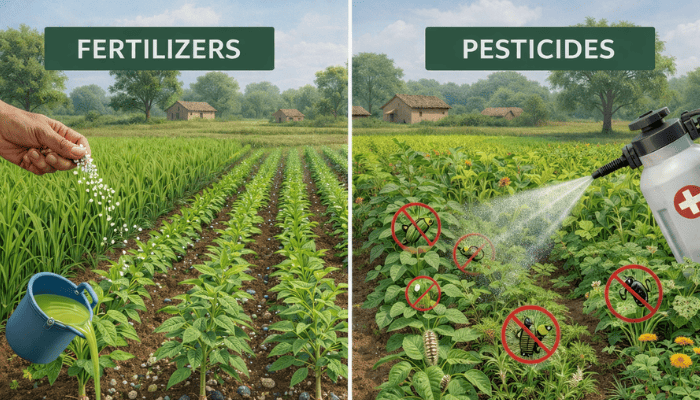
For every farmer, good crop growth and protection are equally important. Plants need nutrients to grow well, and they also need protection from insects, diseases, and weeds. This is where fertilizers and pesticides come in. However, many farmers still get confused between the two.
Understanding the difference between pesticides and fertilizers helps you use them correctly, improve soil health, reduce input costs, and increase productivity. In this blog, we will explain both in very simple words so that every farmer can follow the right farming practices.
What Are Fertilizers?
Fertilizers are natural or chemical materials added to soil or sprayed on crops to give plants the nutrients they need to grow well. The main nutrients are nitrogen (N), phosphorus (P), and potassium (K), which help plants grow strong, flower properly, and give good yields. Fertilizers replace the nutrients that crops take from the soil every season.
They work like vitamins for plants. Fertilizers can be organic, such as manure and compost, or chemical, such as urea and DAP. They also help improve soil fertility and hold moisture in the soil, which makes them very important for farming and food production today.
Main Nutrients in Fertilizers
Fertilizers mostly supply three important nutrients:
- Nitrogen (N) – helps in leafy growth
- Phosphorus (P) – helps in root growth and flowering
- Potassium (K) – helps in overall strength and disease tolerance
Some fertilizers also include micronutrients like zinc, iron, magnesium, and boron.
What Are Pesticides?
Fertilizers are natural or chemical materials added to soil or sprayed on crops to give plants the nutrients they need to grow well. The main nutrients are nitrogen (N), phosphorus (P), and potassium (K), which help plants grow strong, flower properly, and give good yields.
Fertilizers replace the nutrients that crops take from the soil every season. They work like vitamins for plants. Fertilizers can be organic, such as manure and compost, or chemical, such as urea and DAP. They also help improve soil fertility and hold moisture in the soil, which makes them very important for farming and food production today.
Types of Pesticides
- Insecticides: Kill insects such as borers, aphids, and whiteflies.
- Fungicides: Control fungal infections like rust, wilt, and blight.
- Herbicides: Kill unwanted weeds that compete with crops.
- Rodenticides: Control rats and rodents in fields and storage.
Difference between Pesticides and Fertilizers
Learn the key differences between pesticides and fertilizers and how to use them effectively for healthy crops.
|
Feature |
Fertilizers |
Pesticides |
|
Main purpose |
Give food and nutrients to plants |
Protect crops from insects, weeds, and diseases |
|
What they contain |
Nutrients like nitrogen (N), phosphorus (P), potassium (K), and micronutrients |
Chemicals or natural substances that kill or control pests |
|
Who they act on |
Plants and soil |
Insects, weeds, fungi, rodents, and other pests |
|
How they work |
Plants absorb nutrients through roots or leaves to grow better |
Pests die or stop harming crops after contact or eating |
|
When they are used |
Used regularly during crop growth |
Used only when pests or diseases appear |
|
Effect on crop |
Improves plant growth, yield, and quality |
Prevents crop damage and yield loss |
|
Method of application |
Applied to soil, mixed with water, or sprayed on leaves |
Sprayed on crops, soil, or used as seed treatment |
|
Frequency of use |
Applied in planned doses |
Applied only when needed |
|
Risk of overuse |
Can damage soil and pollute water |
Can harm humans, animals, and useful insects |
|
Safety requirement |
Basic care is enough |
Protective clothing and safety rules are needed |
|
Example |
Urea, DAP, compost, manure |
Insecticides, herbicides, fungicides |
|
Simple example |
Like food for plants |
Like medicine or protection for plants |
Application & Safety Tips for Farmers
Practical tips for farmers on using pesticides and fertilizers safely for healthy crops.
Fertilizer Usage Tips
- Always wear protective items like gloves and goggles while applying fertilizers.
- Read the instructions on the fertilizer bag or bottle and follow them carefully.
- Apply fertilizers to slightly moist soil, not on dry land or hard surfaces.
- Keep fertilisers away from rivers, ponds, and drains to prevent water pollution.
- Avoid using more fertilizer than needed to prevent crop damage.
- Do soil testing before application to know the right quantity for your field.
- Using the correct amount helps protect the soil, water, and environment.
- For safer and healthier farming, use Multi Micronutrient Fertilizer to strengthen crops naturally and reduce pest problems.
Pesticide Usage Tips
- First, use non-chemical methods like traps or cleaning.
- Use the right pesticide for the right pest and place.
- Buy only what you need.
- Keep children, pets, and people away during and after spraying.
- Read the label for safety and re-entry time.
- Keep first-aid and emergency numbers ready.
Conclusion
Fertilizers and pesticides play different but equally important roles in farming. Fertilizers help plants grow by providing nutrients, while pesticides protect crops from harmful pests and diseases. By understanding the difference between pesticides and fertilizers, farmers can choose the right input at the right time and avoid common mistakes.
For healthier crops and better soil productivity, choose SV Agro organic fertilizers. Our products help improve soil fertility, strengthen plants naturally, and support long-term sustainable farming. By using SV Agro organic and multi-micronutrient fertilizers, farmers can reduce chemical use and get better yields safely.
For more information and expert guidance, contact SV Agro Solutions at +91 96377 81012 and email us at info@svagrosolutions.com
FAQS
1 What is NPK full form?
NPK stands for Nitrogen (N), Phosphorus (P), and Potassium (K), the main nutrients plants need to grow healthy.
2. What are the two main types of fertilizers?
The two main types are Organic (natural, like compost or manure) and Inorganic (chemical, like urea or NPK).
3. What is farming without pesticides called?
Farming without pesticides is called Natural Farming, which grows crops without chemicals.
4. What is the most common pesticide used in agriculture?
The most common pesticides are herbicides, insecticides, and fungicides used to protect crops.