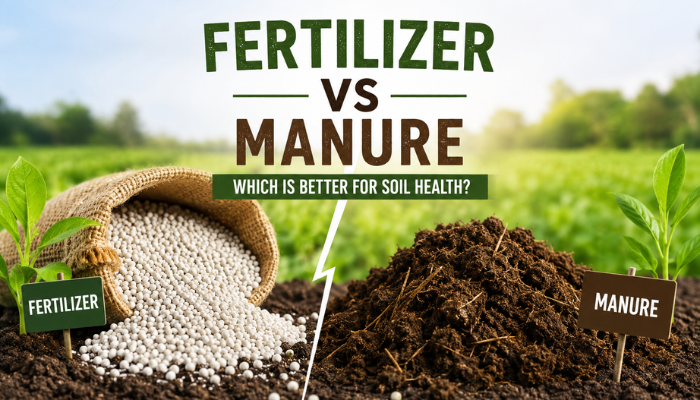
Farmers often compare fertilizer vs manure before applying nutrients to their crops. Both are important for healthy crop growth and better yield, but they work in different ways.
Some farmers prefer fertilizers because they provide nutrients quickly and help crops grow faster. Others choose manure because it improves soil fertility naturally and supports long-term soil health.
The simple difference is that fertilizer gives quick nutrition to crops, while manure improves soil quality over time.
What is Manure?
Manure is a natural organic material used to improve soil fertility. It is made from animal waste, plant waste, and other decomposed organic matter. Farmers add manure to the soil to provide nutrients, improve soil structure, increase water-holding capacity, and support healthy crop growth.
Common examples of manure include:
- Cow dung manure
- Poultry manure
- Compost
- Green manure
- Vermicompost
What is Fertilizer?
A fertilizer is a natural or chemical material added to soil or plants to provide essential nutrients for healthy growth. It helps replace nutrients used by crops, improves plant health, increases crop yield, and supports better food production.
Fertilizers are usually manufactured products designed to supply specific nutrients like:
- Nitrogen (N)
- Phosphorus (P)
- Potassium (K)
These nutrients help crops grow faster and produce better yields.
Fertilizer vs Manure in Farming
Both manure and fertilizer help crops grow, but there are important differences.
|
Feature |
Manure |
Fertilizer |
|
Source |
Natural material made from animal dung, plant waste, and organic matter |
Chemical or factory-made nutrient products |
|
Nutrient Content |
Contains low but balanced nutrients that improve overall soil fertility |
Contains high amounts of specific nutrients like Nitrogen, Phosphorus, and Potassium |
|
Effect on Soil Health |
Improves soil structure, adds humus, and supports useful soil microbes |
Mainly provides nutrients to crops but does not improve soil structure |
|
Water Holding Capacity |
Helps soil hold more water for a longer time |
Does not improve water-holding capacity |
|
Nutrient Release Speed |
Releases nutrients slowly over time |
Provides nutrients quickly for fast crop growth |
|
Plant Absorption |
Nutrients are absorbed slowly by plants |
Nutrients are easily and quickly absorbed by plants |
|
Environmental Impact |
Eco-friendly and helps recycle natural waste |
Overuse can harm soil and pollute water sources |
|
Long-Term Effect |
Improves soil fertility for the long term |
Excessive use may reduce soil quality over time |
|
Cost |
Usually cheaper but needed in large quantity |
Usually costlier but needed in smaller quantity |
|
Best Use |
Best for improving soil health and long-term farming |
Best for quick crop growth and immediate nutrient supply |
Which is Better - Fertilizer or Manure?
There is no single answer to fertilizer vs manure because both are useful.
- Manure is better for long-term soil health because it improves soil fertility, increases organic matter, and makes the soil stronger over time.
- Fertilizer is better for quick plant growth because it gives nutrients to crops immediately and helps plants grow faster.
- Choose manure if you want to improve soil structure, water-holding capacity, and support healthy farming for many years.
- Choose fertilizer if your crops need a quick nutrient boost to correct nutrient deficiency and improve growth fast.
- The best option is to use both together for balanced crop nutrition, better soil health, and higher yield.
How Can Farmers Use Both Smartly?
- Check your soil to know which nutrients are missing and understand soil pH.
- Test manure to know how much Nitrogen, Phosphorus, and Potassium it contains.
- This helps farmers apply the right amount of fertilizer.
- Use manure before sowing so it gets mixed well into the soil and improves soil quality.
- Use fertilizer during crop growth when plants need quick nutrients for fast development.
- Manure already provides some nutrients slowly.
- Farmers can reduce chemical fertilizer use when manure is applied.
- This saves money and protects soil health.
- Mix manure properly into the soil after applying to avoid nutrient loss.
- Apply fertilizers close to plant roots so crops can absorb nutrients easily.
- Farmers can check recommendations from the Indian Council of Agricultural Research (ICAR) or local Krishi Vigyan Kendra (KVK) for correct fertilizer and manure use based on soil and crop type.
Common Mistakes to Avoid
Farmers should avoid these common mistakes:
- Using too much can increase salt levels in the soil, damage plant roots, and reduce crop growth. It can also pollute nearby water sources.
- Fresh manure may contain harmful bacteria, too much heat, and high ammonia, which can burn plant roots. Always use well-decomposed manure.
- Using both in large amounts at the same time can create excess salts in the soil and damage young plants.
- Applying nutrients without checking soil conditions can create a nutrient imbalance and reduce plant nutrient absorption.
- Manure already contains nutrients, so reduce fertilizer quantity accordingly to avoid overloading the soil.
- Raw organic matter can temporarily reduce nitrogen availability, which may cause yellow leaves and slow crop growth.
- On dry soil, nutrients may not dissolve properly.
- During heavy rain, nutrients can wash away, causing product loss.
Conclusion
The comparison of fertilizer vs manure shows that both have different roles in farming. Manure improves soil structure, increases organic matter, and supports long-term fertility. Fertilizer supplies nutrients quickly and helps improve crop growth and yield. For best results, farmers should combine both for balanced nutrition and healthier soil.
Looking for trusted crop nutrition solutions? SV Agro Solutions offers high-quality fertilizers, organic inputs, soil conditioners, and sustainable farming products that help improve soil health, boost crop growth, and increase farm productivity.
FAQs
1. Can I mix NPK and DAP?
Yes, NPK and DAP can be used together to support strong roots and balanced crop growth.
2. Is fertilizer the same as manure?
No, manure is natural organic matter, while fertilizer gives specific nutrients to plants.
3. Which fertilizer makes plants grow faster?
Nitrogen-rich fertilizers help plants grow faster by promoting green leaf growth.
4. What is the most effective organic fertilizer?
Compost and well-rotted manure are the best organic fertilizers for improving soil health and crop growth.