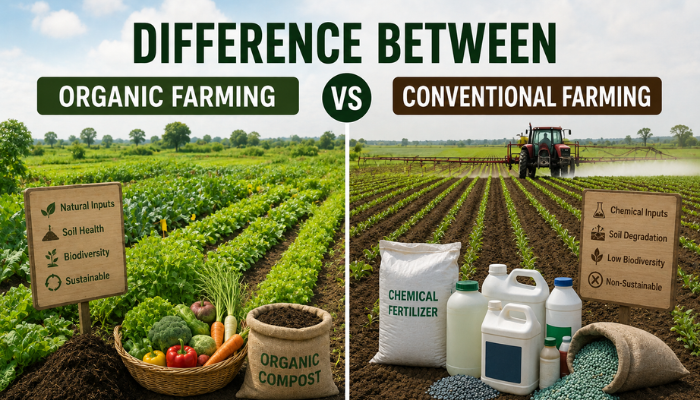
Farmers mainly use two methods to grow crops: organic farming and conventional farming. Both methods aim to produce healthy crops, but they differ in the way they manage soil, provide nutrients, control pests, and improve crop production.
Understanding the difference between organic farming and conventional farming helps farmers choose the right farming method based on their land, budget, crop type, and market demand.
What is Organic Farming?
Organic farming is a natural farming method that avoids synthetic fertilizers and chemical pesticides. Instead, it uses natural materials and eco-friendly practices to improve soil fertility and crop growth.
Organic farming mainly focuses on keeping the soil healthy and maintaining a natural balance in the farming ecosystem.
Common practices used in organic farming include:
- Compost and farmyard manure (FYM)
- Green manure
- Crop rotation
- Biological pest control
- Mulching
- Organic fertilizers and bio-based inputs
Organic farming does not allow the use of synthetic fertilizers, most chemical pesticides, or genetically modified (GMO) seeds.
What is Conventional Farming?
Conventional farming is a modern farming method that uses synthetic fertilizers, chemical pesticides, herbicides, and advanced farming technologies to increase crop production.
The main goal of conventional farming is to produce higher yields and protect crops from pests, diseases, and weeds quickly.
Common practices used in conventional farming include:
- Chemical fertilizers
- Chemical pesticides
- Herbicides
- Modern irrigation systems
- High-yielding seed varieties (including GMO seeds in some countries)
Conventional farming mainly depends on purchased farm inputs and modern technology.
Difference Between Organic Farming & Conventional Farming
The difference between organic farming and conventional farming can be understood by comparing how both methods manage crops and soil.
|
Feature |
Organic Farming |
Conventional Farming |
|
Inputs Used |
Uses compost, manure, biofertilizers, and natural inputs. |
Uses synthetic fertilizers, pesticides, and herbicides. |
|
Soil Fertility |
Improves soil using compost, crop rotation, and organic matter. |
Mainly depends on chemical fertilizers for plant nutrients. |
|
Pest & Weed Control |
Uses natural methods, beneficial insects, traps, and crop rotation. |
Uses chemical pesticides and herbicides for quick control. |
|
Crop Yield |
May produce lower yields initially but improves over time. |
Usually provides higher yields in the short term. |
|
Environmental Impact |
Supports soil health, biodiversity, and reduces pollution. |
Can affect soil and water if chemicals are overused. |
|
Cost & Dependency |
Uses fewer synthetic inputs but may require more labour. |
Depends more on purchased fertilizers and pesticides. |
|
Certification |
Requires organic certification and follows strict standards. |
Usually does not require special certification. |
Which Farming System is More Sustainable?
Both farming methods can be successful when managed properly.
Organic farming is generally considered more sustainable because it:
- Improves soil health.
- Reduces the use of synthetic chemicals.
- Supports biodiversity.
- Protects the environment.
Conventional farming can also become more sustainable when farmers:
- Test their soil regularly.
- Apply balanced fertilizers.
- Follow Integrated Pest Management (IPM).
- Avoid excessive use of chemicals.
The best farming method depends on:
- Soil condition
- Crop type
- Market demand
- Available budget
- Farm resources
Benefits of Organic Farming
Organic farming offers several long-term benefits:
- Uses compost, organic manure, and crop rotation to keep the soil healthy and fertile.
- Reduces the use of harmful chemicals, helping protect soil and water.
- Encourages beneficial insects, birds, earthworms, and other useful organisms.
- Crops contain fewer synthetic chemical residues.
- Organic produce often sells at a higher price, increasing farmers' income.
Benefits of Conventional Farming
Conventional farming also offers many advantages:
- Helps farmers produce more crops in a shorter time.
- Chemical pesticides help control pests, diseases, and weeds faster.
- Modern machinery and farming methods make it easier to manage large farming areas.
- Chemical fertilizers provide nutrients quickly, helping crops grow faster.
- Produces large quantities of crops efficiently, reducing the cost of production.
How Farmers Can Choose the Right Farming System
Farmers should choose the farming method based on their goals.
Choose Organic Farming if you want to:
- Improve soil health for the long term.
- Reduce the use of chemical fertilizers and pesticides.
- Grow chemical-free and eco-friendly crops.
- Protect the environment and support sustainable farming.
- Sell produce in organic markets for better prices.
Choose Conventional Farming if you want to:
- Get higher crop yields in a shorter time.
- Control pests, diseases, and weeds quickly.
- Produce crops on a large scale.
- Use modern fertilizers and farming techniques for faster crop growth.
- Meet high market demand with consistent production.
Many farmers also follow integrated farming, where they combine organic manure, balanced fertilizers, and safer pest management practices to improve productivity and soil health.
Conclusion
Understanding the difference between organic farming and conventional farming helps farmers choose the best farming method for their crops and land. Organic farming focuses on improving soil health, protecting the environment, and supporting sustainable agriculture. Conventional farming helps farmers achieve higher production and quicker crop response with modern inputs.
Want to grow healthy crops without relying on harmful chemicals? SV Agro Solutions offers a range of high-quality fertilizers for organic farming that improve soil fertility, support healthy plant growth, and promote chemical-free farming. Our organic solutions help increase nutrient availability, strengthen crops, improve long-term soil health, and support sustainable agriculture.
FAQs
1. What is the main difference between organic farming and conventional farming?
Organic farming uses natural inputs like compost and biofertilizers, while conventional farming uses synthetic fertilizers, pesticides, and herbicides to increase crop production.
2. Which farming method is better for soil health?
Organic farming is generally better for soil health because it improves organic matter, soil structure, and beneficial microbial activity.
3. Does conventional farming always produce higher yields?
Conventional farming often gives higher yields in the short term, while organic farming may improve productivity gradually as soil health improves.
4. Is organic farming completely chemical-free?
Organic farming avoids synthetic chemicals but may use approved natural and biological products for nutrient management and pest control.
5. Can farmers use both organic and conventional farming practices together?
Yes. Many farmers follow integrated farming by using organic manure, balanced fertilizers, and safer pest management practices to improve crop yield and soil health.