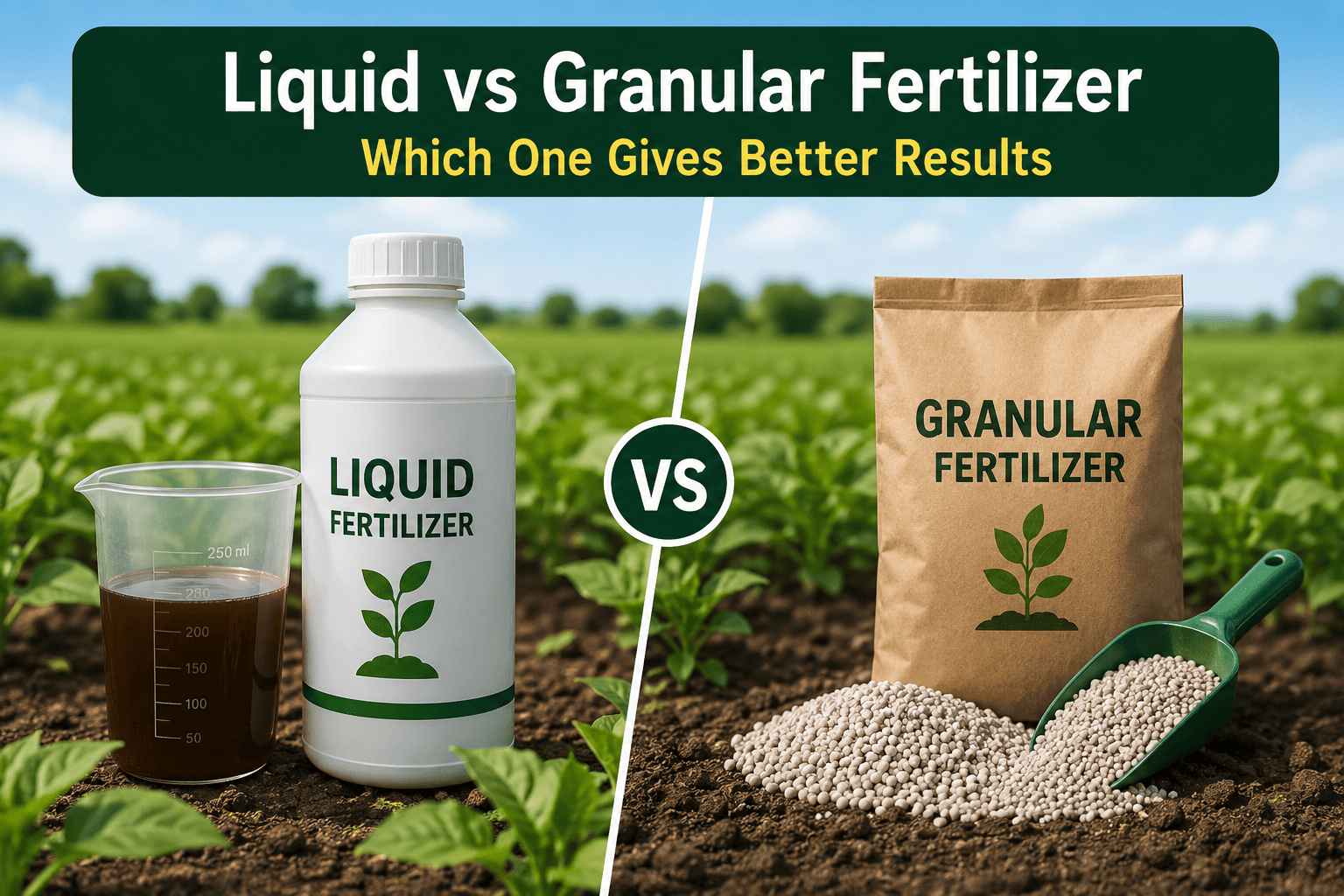
Choosing the right fertilizer is important for healthy crop growth and better yields. Farmers and gardeners often compare liquid vs granular fertilizer because both provide essential nutrients, but they work in different ways.
Liquid fertilizer provides nutrients quickly, while granular fertiliser releases them slowly over time. Knowing the difference between liquid vs granular fertilizer helps farmers choose the right option based on their crop, soil conditions, budget, and farming method.
Liquid vs Granular Fertilizer: A Complete Comparison
Learn the key differences between liquid and granular fertilizer to choose the right option for better crop growth, nutrient efficiency, and higher yields.
|
Feature |
Liquid Fertilizer |
Granular Fertilizer |
|
Nutrient Release |
Nutrients are already dissolved in water, so crops absorb them quickly and show faster results. |
Nutrients are released slowly as the granules dissolve in the soil, providing a steady nutrient supply. |
|
Duration |
Provides a quick nutrient boost, but the effect lasts for a shorter period and may require repeated applications. |
Releases nutrients gradually and feeds crops for a longer time, reducing the need for frequent applications. |
|
Application Method |
Applied through foliar spray, fertigation, or irrigation systems for quick nutrient uptake. |
Applied directly to the soil by broadcasting, band placement, or side dressing before or during crop growth. |
|
Nutrient Distribution |
Spreads evenly with water, ensuring uniform nutrient application when applied correctly. |
Nutrient distribution depends on how evenly the granules are spread across the field. |
|
Cost |
Usually costs more but provides faster nutrient availability and quick crop response. |
Generally more affordable, easy to store and transport, and suitable for large-scale farming. |
Although both fertilizers provide nutrients, they differ in how they work and how they are applied.
What is Liquid Fertilizer?
Liquid fertilizer contains nutrients that are dissolved in water. It can be applied through foliar spray, drip irrigation (fertigation), or directly to the soil.
Crops absorb liquid fertilizer quickly through their roots and, in some cases, through their leaves. Because of its fast action, it is commonly used to correct nutrient deficiencies and support crops during important growth stages.
What is Granular Fertilizer?
Granular fertilizer is a dry fertilizer available in small granules or pellets. It is applied directly to the soil, where it slowly dissolves with water and releases nutrients over time.
Granular fertilizer is mainly used before sowing or planting and provides long-lasting nutrition for crops. It is widely used for field crops and large farming areas.
Benefits of Liquid Fertilizer
Liquid fertilizer is ideal when crops need nutrients quickly.
1. Quick Nutrient Absorption
- Nutrients are absorbed rapidly by crops.
- Helps correct nutrient deficiencies quickly.
2. Suitable for Foliar Spray
- Can be sprayed directly on leaves.
- Provides fast nutrition during important growth stages.
3. Ideal During Crop Stress
- Helps crops recover faster from drought, heat, transplant shock, and other stress conditions.
4. Accurate Application
- Easy to apply in the required quantity.
- Reduces uneven fertilizer distribution.
5. Best for High-Value Crops
- Commonly used for vegetables, fruits, flowers, and greenhouse crops where quick results are needed.
Benefits of Granular Fertilizer
Granular fertilizer provides steady nutrition for a longer period.
1. Long-Lasting Nutrition
- Releases nutrients slowly.
- Supports crop growth for a longer time.
2. Improves Soil Fertility
- Helps maintain nutrient levels in the soil.
- Supports healthy crop growth throughout the season.
3. Cost-Effective
- Usually costs less per unit of nutrient.
- Suitable for large farming areas.
4. Easy to Store and Transport
- Simple to handle and store.
- Has a longer shelf life than liquid fertilizer.
5. Suitable for Base Fertilization
- Ideal before sowing or transplanting.
- Provides nutrients during early crop growth.
Which One Should Farmers Choose?
The right fertilizer depends on your farming needs.
Choose liquid fertilizer when:
- Nutrients are already mixed with water, so crops absorb them faster through roots or leaves.
- Helps crops recover quickly if they show yellow leaves or poor growth due to nutrient deficiency.
- Nutrients are spread evenly across the crop, helping all crops grow uniformly.
- Can be used through foliar spray, drip irrigation (fertigation), or irrigation water.
- Gives quick results, making it suitable for high-value crops like vegetables, fruits, flowers, and greenhouse crops.
- Since it works quickly, its effect lasts for a shorter time and may need to be applied again during the season.
Choose granular fertilizer when:
- Granules dissolve slowly in the soil, providing nutrients over a longer period.
- One application can supply nutrients for several weeks, reducing the need for frequent use.
- Usually cheaper than liquid fertilizer, especially for large farms.
- Granular fertilizers are simple to handle, store, and carry in large quantities.
- Commonly used for crops like wheat, rice, maize, cotton, and other large-scale field crops.
- Because nutrients are released slowly, farmers do not need to apply them often.
- Rainfall or irrigation is needed to dissolve the granules so crops can absorb the nutrients.
Can Liquid and Granular Fertilizer Be Used Together?
Yes. Many farmers use both liquid and granular fertilizer together to get better crop performance.
- Liquid fertilizer provides nutrients quickly and helps crops recover from nutrient deficiencies faster.
- Granular fertilizer releases nutrients slowly, providing continuous nutrition over a longer period.
- Liquid fertilizer is ideal for quick crop response, while granular fertilizer supports steady plant growth.
- Using both together improves nutrient uptake and fertilizer efficiency.
- This combination promotes healthier crops, better growth, and higher yields.
- Always follow the recommended dosage and application schedule for the best results.
When used correctly, this combination can improve crop growth, yield, and fertilizer efficiency.
Best Practices for Using Fertilizer Wisely
Follow these simple practices for better results:
- Test the soil before choosing the fertilizer.
- Select the right fertilizer according to crop needs.
- Apply fertilizer at the correct crop stage.
- Calibrate sprayers and spreaders for even application.
- Avoid using more fertilizer than recommended.
- Always follow the instructions on the product label.
Conclusion
Understanding liquid vs granular fertilizer helps farmers choose the right fertilizer based on crop requirements, soil conditions, and farming practices. Liquid fertilizer provides fast nutrient absorption and is useful during stress or nutrient deficiency, while granular fertilizer supplies nutrients gradually and supports long-term crop growth.
Looking for the right fertilizer for your crops? SV Agro Solutions offers a wide range of high-quality organic fertilizers and granular fertilizers designed to improve nutrient availability, support healthy plant growth, and increase crop productivity.
Whether you need quick nutrient absorption with liquid fertilizers or long-lasting nutrition with granular fertilizers, our solutions help farmers achieve better yields and sustainable farming. Choose SV Agro Solutions for reliable fertilizer products that support healthier crops and improved farm performance.
FAQs
1. What is the main difference between liquid and granular fertilizer?
Liquid fertilizer works quickly because nutrients are dissolved in water, while granular fertilizer releases nutrients slowly over time.
2. Which works faster: liquid vs granular fertilizer?
Liquid fertilizer works faster because crops absorb the nutrients quickly through roots or leaves.
3. Is granular fertilizer better for long-term feeding?
Yes. Granular fertilizer provides a slow and steady supply of nutrients, making it suitable for long-term crop nutrition.
4. Can I use both liquid and granular fertilizer together?
Yes. Many farmers use granular fertilizer for base nutrition and liquid fertilizer for quick nutrient supply during important crop stages.
5. Which is more cost-effective liquid or granular fertilizer?
Granular fertilizer is generally more economical for large-scale farming, while liquid fertilizer provides faster results and precise nutrient application.