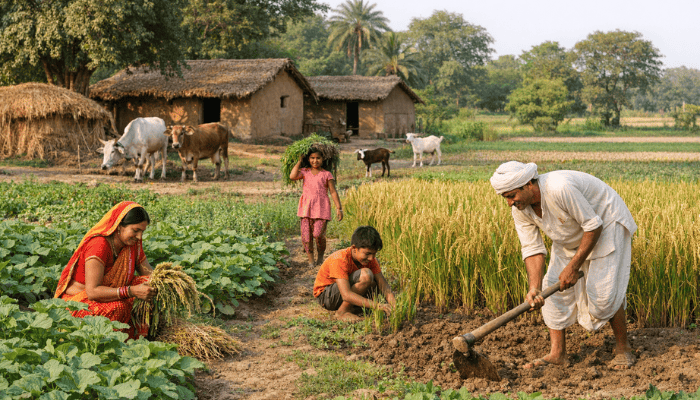
Agriculture is practised in many different ways across the world. Some farmers grow crops mainly to sell in the market, while some grow food only for their own family. This second type of farming is called subsistence farming.
Understanding “What is Subsistence Farming” is very important for small and marginal farmers in India because a large part of rural families still follow this system. It helps them meet their basic food needs even when income is low or market conditions are uncertain.
What is Subsistence Farming?
Subsistence farming means growing crops or keeping animals mainly to feed your own family. Farmers usually do not have extra produce to sell. The farms are small, work is done by hand using simple tools, and the yield is low. It is common in developing countries where families aim to be self-sufficient.
Characteristics of Subsistence Farming
Here are the main features:
1. The main purpose is self-use
Farmers grow crops and keep animals mainly to feed their own family. Very little is sold in the market.
2. Small farms
The land is small and sometimes spread out, so it is hard to grow crops on a large scale.
3. More manual work
Most of the work is done by family members using simple tools like sickles or hoes, not big machines.
4. Low production
Because there is less technology, no proper irrigation, and fewer inputs, the crop yield remains low.
5. Old farming methods
Farmers follow traditional methods that they learned from older generations.
6. Less use of modern inputs
Many farmers cannot afford fertilisers, pesticides, or improved seeds.
7. Depends on rainfall
Farming mostly depends on rain, so droughts or irregular rains can reduce production.
8. Different crops grown
Farmers grow many types of crops to make sure the family has food throughout the year.
Types of Subsistence Farming
|
Type of Farming |
Method (How it is done) |
Crops/Livestock |
Where it is Common |
|
Intensive Subsistence Farming |
Small land, high manual labour, simple tools; aim is to get maximum food for family |
Rice, wheat, millets, pulses, oilseeds |
Fertile and crowded plains of India |
|
Shifting Cultivation (Jhum) |
Cut and burn forest patches, farm for few years, move when soil becomes weak |
Millets, vegetables, tubers |
Tribal and hilly areas, Northeast India |
|
Nomadic Herding (Pastoralism) |
People move with animals in search of grass and water |
Sheep, goats, camels, yaks |
Dry and semi-dry regions like Rajasthan, J&K |
|
Sedentary Subsistence Farming |
Farmers stay in one place and grow food mainly for self-use |
Cereals, vegetables, pulses |
Plains and settled village areas |
|
Diversified Subsistence Farming |
Many crops + some livestock grown on small farms for family needs |
Fruits, vegetables, grains, cows, goats |
Throughout rural India |
Common crops grown in Subsistence Farming
- In India, subsistence farming mainly focuses on rice, especially in areas with good rainfall and water.
- Along with rice, farmers also grow wheat, maize, millets (like jowar, bajra, ragi), pulses, and oilseeds.
- These crops are grown on small pieces of land mainly for the family’s food needs.
- Most of the work is done using manual labour and traditional tools, not big machines.
- Farmers use old farming practices to get the best possible yield from their small land.
- This type of farming is common in the densely populated regions of South, Southeast, and East India, where people depend heavily on agriculture for daily food.
Advantages of Subsistence Farming
- Farmers mostly use organic manure to keep the soil healthy. This is an important part of sustainable farming.
- This type of farming is low-cost because it does not require expensive machines or inputs. So, it is suitable for small farmers with limited money.
- Subsistence farming gives food security to farmers and their families, as they get fresh food throughout the year.
- It also helps farmers become self-sufficient, meaning they can grow their own food and depend less on the market.
- This farming system is based on traditional knowledge and old methods.
- These practices, passed down through generations, help preserve local culture and farming traditions.
Challenges of Subsistence Farming
- Soil can lose its fertility over time, and the land may get damaged.
- Farmers often do not have enough resources, money, or access to good markets.
- Productivity stays low because farmers mostly use old and traditional methods.
- Since there is no extra produce to sell, farmers earn very little income.
- There are fewer chances to grow different types of crops due to limited land and resources.
Conclusion
Understanding What is Subsistence Farming? helps us know how small farmers grow food mainly for their own families using simple tools and traditional methods. Even today, subsistence farming is important in rural India, and with better seeds, water management, and government support, farmers can improve their productivity while still meeting their family’s basic needs.
Boost your farm with SV Agro CRF Fertilizers! They release nutrients slowly, helping crops grow healthier and give higher yields. Perfect for small farms and unpredictable rainfall, CRF saves labour, improves soil, and makes farming easier and more profitable.
FAQs
1. What are the three main types of farming in India?
India mainly has three types of farming: subsistence farming, organic farming, and industrial/commercial farming.
2. How many subsistence farmers are there in India?
Nearly two-thirds of Indians depend on small subsistence farms, where farmers grow crops mainly to feed their families and earn a small income
3. Which crops are grown under subsistence farming in India?
Rice, wheat, millets, pulses, vegetables, and maize.
4. How is subsistence farming different from commercial farming?
Subsistence focuses on self-consumption; commercial focuses on profit.
5. Is subsistence farming sustainable in the long run?
Yes, if improved with better seeds, water management, and eco-friendly practices.