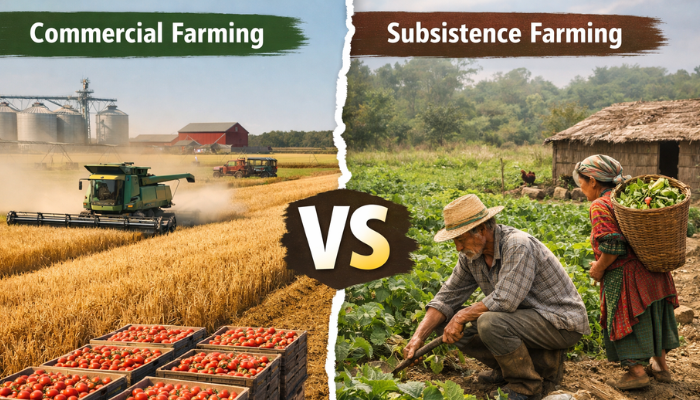
Farming is the backbone of rural life and food security. Across India, farmers follow different types of farming based on land size, resources, and purpose. The two most common systems are commercial farming and subsistence farming.
Understanding the difference between commercial farming and subsistence farming helps farmers make better decisions about crop selection, investment, income, and long-term sustainability. Both systems play an important role in Indian agriculture, but they differ greatly in methods, scale, and outcomes.
What is Commercial Farming?
Commercial farming is a type of agriculture where crops or livestock are grown mainly to sell in markets and earn a profit. It is usually practiced on large areas of land and uses modern farming techniques.
In commercial farming, farmers grow cash crops such as wheat, cotton, sugarcane, rice, vegetables, fruits, or flowers. This system depends on tractors, irrigation systems, high-yield seeds, fertilizers, pesticides, and hired labor to increase production and income.
What is Subsistence Farming?
Subsistence farming is a traditional form of farming where crops are grown mainly to feed the farmer’s family. Only a small surplus, if any, is sold in the local market.
It is practiced on small landholdings using family labor and simple tools. Subsistence farmers depend heavily on rainfall, local seeds, and organic manure. This type of farming is common among small and marginal farmers in many parts of India.
Differences Between Commercial Farming and Subsistence Farming
Here are the differences between commercial and subsistence farming, including purpose, scale, income, and farming methods.
|
Feature |
Commercial Farming |
Subsistence Farming |
|
Main Objective |
To earn profit by growing crops mainly for sale in markets, factories, or exports. |
To grow enough food for the farmer’s family and for basic survival. |
|
Scale of Farming |
Practiced on large farms and estates covering many acres of land. |
Practiced on small landholdings, usually 1–5 acres or less. |
|
Dependence on Rainfall |
Uses assured irrigation like canals, borewells, drip, and sprinklers. |
Depends mainly on monsoon rainfall for crop growth. |
|
Use of Technology |
Uses modern machines such as tractors, harvesters, irrigation systems, and farm equipment. |
Uses traditional tools like ploughs, sickles, and bullocks. |
|
Cropping Pattern |
Mostly follows monoculture, where one main crop is grown over a large area. |
Mixed cropping is common to reduce risk and meet family needs. |
|
Type of Seeds Used |
Uses improved and hybrid seeds for higher yield and uniform crops. |
Farmers often save seeds from the previous harvest. |
|
Fertilizers & Inputs |
Depends on chemical fertilizers, pesticides, and modern farm inputs. |
Uses compost, animal manure, and natural inputs. |
|
Labour Requirement |
Uses hired labour and machines; capital-intensive but time-efficient. |
Uses family labour and manual work; labour-intensive. |
|
Types of Crops Grown |
Cash crops include wheat, sugarcane, cotton, soybeans, and commercial vegetables. |
Food crops like rice, wheat, millets, pulses, and vegetables for home use. |
|
Market Connection |
Strongly connected to markets, storage units, mills, factories, and export chains. |
Very limited market access; surplus is rarely sold. |
|
Investment Level |
Requires high investment, bank loans, insurance, and advanced planning. |
Requires low investment with minimum external support. |
|
Productivity & Output |
High yield per hectare with a large surplus for sale. |
Low yield with little or no surplus after family consumption. |
|
Regional Presence in India |
Found in Punjab wheat belts, Maharashtra sugarcane areas, and cotton farms in Tamil Nadu. |
Common in the Deccan Plateau, Bihar, Odisha, tribal, and rain-fed regions. |
|
Examples in India |
Large wheat farms in Punjab, sugarcane farms in Maharashtra, cotton farms in Tamil Nadu, and supplying factories. |
Small farmers in Bihar or Odisha growing rice and pulses on 1–2 acres for family food. |
|
Government Support |
Supported by schemes like PMKSY, MSP, FPOs, crop insurance, and subsidies. |
Gradually supported through schemes to improve productivity and shift towards commercial farming. |
Advantages of Commercial Farming
- Produces large amounts of food, which helps meet the needs of a growing population
- Uses machines and modern methods, saving time and reducing the cost per unit of production
- Helps farmers earn more income and supports the growth of related businesses and industries
- Ensures regular and reliable food supply even during changing weather conditions
Disadvantages of Commercial Farming
- Heavy use of fertilizers and pesticides can pollute soil and water
- Continuous farming can reduce soil fertility over time
- Needs high investment for machines, fuel, seeds, and chemicals
- Small farmers may struggle to compete and lose their livelihoods
Advantages of Subsistence Farming
- Provides food for the family and reduces reliance on markets.
- Costs less because it uses simple tools and natural fertilizers.
- Keeps soil healthy and protects the environment.
- Preserves traditions, old crops, and local biodiversity.
Disadvantages of Subsistence Farming
- Produces low crop yields.
- Earns little money because most produce is for personal use.
- Vulnerable to bad weather and natural disasters.
- Limited access to technology, loans, and markets
Conclusion
The difference between commercial farming and subsistence farming lies in scale, purpose, technology, and income. Subsistence farming ensures food security, while commercial farming drives profit and growth.
For Indian farmers, a smart combination of both systems supported by technology and sustainable practices can improve income while protecting soil and resources. Choosing the right method based on land size, budget, and goals is the key to successful farming.
Looking to boost your farm’s productivity and crop health? SV Agro helps farmers in all types of farming across India with products like Biostimulants, CRF Fertilizers, and Micronutrients, which improve soil health, enhance plant growth, and ensure better yields, making farming easier and more profitable.
FAQs
1. What is the main aim of commercial farming?
The main aim is to earn profit by producing large quantities of crops or livestock efficiently.
2. What is another name for commercial farming?
Commercial farming is also called agribusiness, where produce is grown primarily for sale in markets.
3. What are the main types of subsistence farming?
Subsistence farming mainly includes shifting cultivation and intensive subsistence agriculture, focused on meeting family needs rather than profit.
4. Which crops suit commercial farming in India?
Wheat, cotton, sugarcane, rice, fruits, and vegetables.
5. Can subsistence farmers switch to commercial methods?
Yes, with government support, training, and investment.