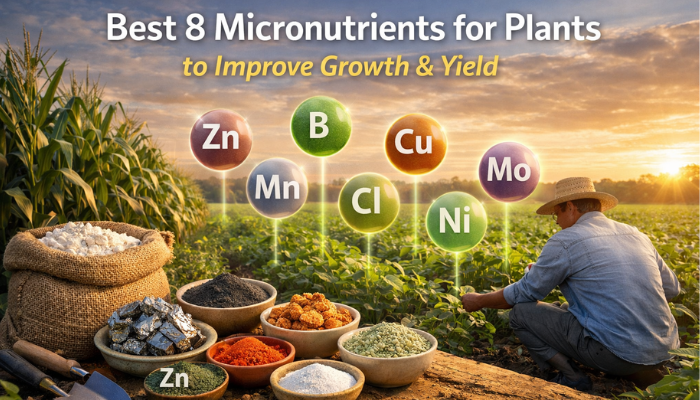
Plants need the right balance of nutrients to grow strong, healthy, and productive. While most growers focus on major nutrients like nitrogen, phosphorus, and potassium, plants also require micronutrients to complete many important biological processes.
The best micronutrients for plants produce chlorophyll, activate enzymes, support photosynthesis, and improve nutrient absorption. They also contribute to better flowering, fruit development, and overall crop quality.
When plants do not receive enough micronutrients, they may show symptoms such as yellow leaves, stunted growth, and reduced yields. By understanding the best micronutrients and their functions, farmers and gardeners can maintain soil health and ensure better plant growth and productivity.
List of Best Micronutrients for Plants
Below are the most important micronutrients and their roles in plant growth.
|
Micronutrient |
Main Role in Plants |
|
Iron |
Helps in chlorophyll formation and supports photosynthesis |
|
Zinc |
Supports enzyme activity and growth hormone production |
|
Manganese |
Activates enzymes and supports photosynthesis |
|
Copper |
Helps in respiration, enzyme activation, and plant metabolism |
|
Boron |
Essential for cell wall formation, flowering, and fruit development |
|
Molybdenum |
Helps plants use nitrogen efficiently and supports nitrogen fixation |
|
Chlorine |
Maintains osmotic balance and supports photosynthesis |
|
Nickel |
Helps break down urea and supports nitrogen metabolism |
1. Iron (Fe)
Iron is one of the most important micronutrients for plants because it plays a major role in chlorophyll production and photosynthesis. Healthy green leaves depend heavily on sufficient iron levels.
Role in Plants
- Helps in chlorophyll formation
- Supports photosynthesis and energy transfer
- Assists in respiration and enzyme functions
Iron deficiency often appears as yellowing of young leaves, a condition called interveinal chlorosis.
2. Zinc (Zn)
Zinc is essential for plant growth and development because it regulates many enzymes and plant hormones.
Role in Plants
- Helps produce growth hormones like auxin
- Activates important enzymes
- Supports protein synthesis and plant metabolism
A lack of zinc can cause stunted plant growth, smaller leaves, and reduced crop yield.
3. Manganese (Mn)
Manganese is required for several plant metabolic processes, especially those related to photosynthesis.
Role in Plants
- Activates enzymes involved in photosynthesis
- Supports nitrogen metabolism
- Helps in oxygen production during photosynthesis
Manganese also helps plants convert nutrients into usable forms for growth.
4. Copper (Cu)
Copper plays an important role in plant metabolism and enzyme activity. It is also important for plant strength and disease resistance.
Role in Plants
- Supports photosynthesis and respiration
- Helps in enzyme activation
- Improves plant immunity and stress tolerance
Copper also contributes to strong stems and improved root development.
5. Boron (B)
Boron is essential for plant reproduction and cell structure. It helps plants produce flowers, fruits, and seeds effectively.
Role in Plants
- Supports cell wall formation
- Improves sugar transport within plants
- Helps pollen germination and fruit development
Boron deficiency can lead to poor flowering, fruit drop, and weak plant growth.
6. Molybdenum (Mo)
Molybdenum is required in very small amounts but plays a vital role in nitrogen metabolism.
Role in Plants
- Helps plants use nitrogen efficiently
- Supports nitrogen fixation in legumes
- Assists in protein formation
Without molybdenum, plants cannot convert nitrogen into usable forms for growth.
7. Chlorine (Cl)
Chlorine is an essential micronutrient that plays an important role in several physiological processes in plants. Although plants require chlorine in very small amounts, it is necessary for maintaining proper plant growth and development.
Role in Plants
- Supports photosynthesis
- Maintains osmotic balance
- Helps regulate water movement in plants
Chlorine also helps in the water-splitting reaction during photosynthesis, which releases oxygen.
8. Nickel (Ni)
Nickel is one of the micronutrients required by plants in extremely small quantities, but it is still essential for normal plant growth. Even though its requirement is minimal compared to other nutrients, nickel plays a critical role in certain enzyme functions and nitrogen metabolism in plants.
Role in Plants
- Supports nitrogen metabolism
- Helps break down urea into usable nitrogen
- Assists enzyme activity
Although needed in tiny quantities, nickel is important for proper plant nutrition.
Why Micronutrients are Important for Plants?
Micronutrients support several important plant functions. Even though they are needed in small quantities, their absence can significantly affect plant health.
1. Improve Photosynthesis: Elements like iron and manganese help plants produce chlorophyll, which is necessary for photosynthesis.
2. Activate Enzymes: Many micronutrients act as enzyme cofactors, helping plants carry out metabolic reactions.
3. Support Plant Growth: Micronutrients help regulate hormones and growth processes, leading to healthy development.
4. Increase Crop Yield: Balanced micronutrient supply improves flowering, fruit development, and seed production.
5. Improve Plant Resistance: Some micronutrients increase disease resistance and stress tolerance in plants.
Tips for Proper Micronutrient Management
To maintain healthy plants and improve productivity, follow these tips:
- Test the soil regularly to identify nutrient deficiencies
- Apply micronutrients only when needed
- Avoid excessive use, as high levels can harm plants
- Use balanced fertilizers with both macro and micronutrients
- Maintain proper soil pH for better nutrient absorption
Proper nutrient management ensures plants grow healthy and produce better yields.
Conclusion
The best micronutrients for plants are small but essential components of plant nutrition. Elements like iron, zinc, manganese, copper, boron, molybdenum, chlorine, and nickel play vital roles in plant growth, metabolism, and crop productivity. Even though plants require these nutrients in tiny amounts, their absence can lead to poor growth, low yield, and unhealthy plants.
Are your crops not growing well even after using regular fertilizers? Your soil may be lacking important micronutrients. SV Agro’s Micronutrient Fertilizer helps provide the essential trace nutrients that plants need for healthy growth, better flowering, and higher yields. It supports plant metabolism, improves nutrient absorption, and helps crops grow stronger and more productive.
Frequently Asked Questions
1. What is the best source of micronutrients?
Ans: The best sources of micronutrients for plants include organic matter, compost, manure, and balanced micronutrient fertilizers.
2. Where do plants get micronutrients from?
Ans: Plants mainly get micronutrients from the soil. These nutrients are naturally present in soil minerals, organic matter, and decomposed plant materials.
3. How to make micronutrients for plants naturally?
Ans: You can provide micronutrients to plants naturally by adding compost, well-rotted manure, or organic fertilizers to the soil.
4. Can I apply too much micronutrient fertilizer?
Ans: Yes, applying too much micronutrient fertilizer can harm plants. Excess nutrients can damage roots, cause leaf burn, and disturb the balance of other nutrients in the soil.