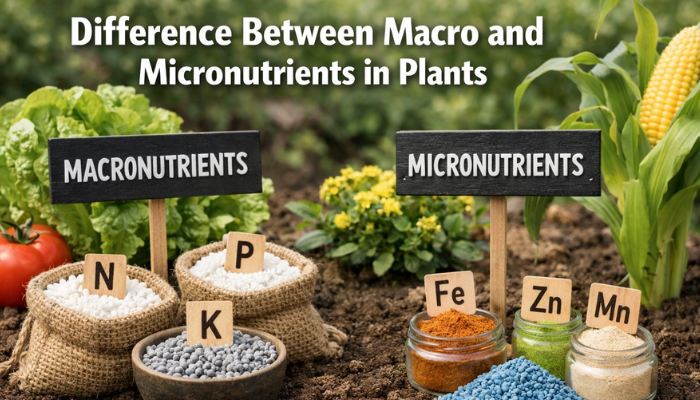
Plants need the right nutrients to grow healthy and give a good yield. In fact, plants require 17 essential nutrients for proper growth. These nutrients are divided into macronutrients and micronutrients based on the amounts the plant needs.
Macronutrients are nutrients that plants need in large amounts for growth and energy, while micronutrients are needed in very small amounts to support important plant processes like enzyme activity and metabolism.
If even one nutrient is missing, crops may not grow properly, and yields can decrease. That’s why farmers need to understand the difference between macro and micronutrients and apply them in the right balance for better crop production.
What are Macronutrients and Micronutrients?
Plants need 17 essential nutrients to grow properly and complete their life cycle. These nutrients are divided into two groups based on the amount the plant requires.
Macronutrients
Macronutrients are essential elements required in large amounts for plant growth, comprising Nitrogen (N), Phosphorus (P), Potassium (K), Calcium (Ca), Magnesium (Mg), and Sulfur (S), along with Carbon, Hydrogen, and Oxygen. These nutrients help in building plant tissues and supporting important processes like photosynthesis and energy production.
Micronutrients
Micronutrients are essential mineral elements required by plants in trace amounts for crucial metabolic processes, enzyme functions, and growth. Micronutrients include Iron (Fe), Boron (B), Chlorine (Cl), Manganese (Mn), Zinc (Zn), Copper (Cu), Molybdenum (Mo), and Nickel (Ni). Micronutrients usually make up less than 1% of the plant’s dry weight, but they play a very important role in enzyme activity, metabolism, and overall plant functioning.
Difference between Macro and Micronutrients
Plants need different nutrients to grow properly. These nutrients are divided into macronutrients and micronutrients based on how much the plant requires.
|
Points |
Macronutrients |
Micronutrients |
|
Meaning |
Needed in large amounts for plant growth. |
Needed in very small (trace) amounts. |
|
Quantity Required |
Similar to daily foods like Rice or Wheat for humans. |
Similar to small nutrients like salt or Vitamins in our diet. |
|
Main Role |
Help build plant parts like leaves, stems, and roots. |
Help control internal plant processes. |
|
Importance |
Affect plant size and crop yield. |
Help in chlorophyll formation and nutrient use. |
|
Deficiency Effect |
Deficiency causes slow growth and yellow leaves. |
Deficiency causes leaf discoloration or small leaves. |
Functions of Macronutrients and Micronutrients
Macronutrients and micronutrients play different but equally important roles in helping plants grow, develop properly, and produce healthy yields.
Macronutrients
- Helps in chlorophyll formation, photosynthesis, and healthy leaf growth.
- Supports energy transfer, root development, and flowering.
- Controls water balance and improves overall plant health.
- Strengthens cell walls and supports cell growth.
- Important for chlorophyll and photosynthesis.
- Helps form proteins and vitamins.
- Build the basic structure of plant tissues.
Micronutrients
- Supports plant growth, stem development, and enzyme activity.
- Important for cell formation, flowering, and fruit development.
- Helps in photosynthesis and plant metabolism.
- Activates enzymes and supports plant respiration.
- Helps plants use nitrogen properly.
- Maintains water balance and supports photosynthesis.
- Helps plants process nitrogen and prevents toxicity.
Tips for Managing Plant Nutrients
- Use good-quality or slow-release fertilizers, so plants get nutrients gradually.
- Nitrogen supports leaf growth, phosphorus strengthens roots and flowering, and potassium improves overall plant health.
- Micronutrients like iron and zinc are needed in small amounts but are very important.
- Apply micronutrients through foliar spray or water-soluble fertilizers for better absorption.
- Avoid over-fertilizing as it can burn leaves and reduce crop quality.
- Too much of one nutrient can block another (e.g., excess phosphorus reduces zinc uptake).
- Add compost or organic matter to improve soil fertility and structure.
- Check soil pH regularly because it affects nutrient availability.
- Watch for deficiency symptoms like yellow leaves or slow growth.
- Crop rotation helps maintain soil fertility and balanced nutrients
Conclusion
The main difference between macro and micronutrients is the quantity required, but both are equally essential for crop growth. Macronutrients help in plant structure and growth, while micronutrients support metabolic and enzyme functions. Farmers should always focus on balanced fertilization instead of only applying NPK.
Give your crops the essential nutrients they need with SV Agro’s Micronutrients Fertilizer, a high-quality micronutrient solution developed by SV Agro Solutions - one of India’s trusted agricultural experts in crop nutrition and micronutrient technology
SV Agro Solutions uses advanced research and quality manufacturing to deliver fertilizers that help farmers produce healthier crops at a lower cost.
FAQs
1. What is the role of micronutrients in plants?
Micronutrients help plants grow properly by supporting important internal processes, even though they are needed only in very small amounts.
2. Which crops suffer most from micronutrient deficiencies in India?
Rice, wheat, maize, sugarcane, and vegetables commonly suffer from zinc and iron deficiencies.
3. Why are secondary macronutrients important?
Calcium, magnesium, and sulfur support cell wall formation, chlorophyll production, and protein synthesis. Without them, crop quality decreases.
4. What are the 4 types of micronutrients?
The four types of micronutrients are water-soluble vitamins, fat-soluble vitamins, microminerals, and trace minerals.