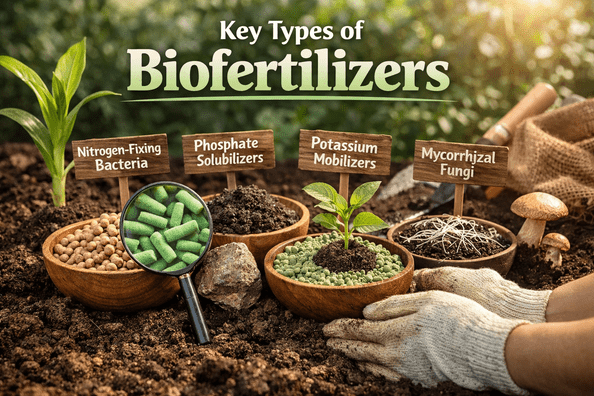
Many farmers today are struggling with rising fertilizer costs and declining soil health. Overuse of chemical fertilizers has not only drained soil fertility but also increased farming expenses. This is where biofertilizers offer a natural solution.
Biofertilizers are made up of living microorganisms that supply essential nutrients to crops naturally. By using them, farmers can cut down chemical fertilizer usage by 25–50% while gradually improving soil health. In this article, we will explore key types of biofertilizers such as Nitrogen-Fixing, Phosphate-Solubilising, and Potassium-Mobilising biofertilizers along with practical tips for effective use, especially tailored for Indian farmers.
What are Biofertilizers?
Biofertilizers are natural fertilizers that contain useful bacteria, fungi, or algae. These microorganisms improve nutrient availability in the soil and support plant growth.
The most common ones used in India are nitrogen-fixing bacteria, phosphate-solubilizing bacteria (PSB), and potassium-mobilizing bacteria (KMB). They are very useful for crops like rice, pulses, wheat, vegetables, fruits, and oilseeds.
Classification of Biofertilizers
Biofertilizers can be grouped in different ways. Let us understand this step by step in an easy way.
1. Based on the Type of Microorganism
Biofertilizers contain living microbes. They can be:
i. Bacterial Biofertilizers
These contain useful bacteria.
- Rhizobium – Best for pulses like tur, gram, and soybean.
- Azotobacter – Good for wheat, vegetables, and cotton.
- Bacillus – Helps in nutrient availability and plant growth.
These bacteria live in soil or roots and help plants take nutrients easily.
ii. Fungal Biofertilizers
- These contain helpful fungi.
- Mycorrhiza (AMF) is the most common.
- It increases root size and helps plants absorb more water and phosphorus.
- Very useful for fruit crops, vegetables, sugarcane, and plantation crops.
iii. Algal Biofertilizers
- These contain algae that is Blue Green Algae (BGA).
- Mainly used in paddy (rice) fields.
- It fixes nitrogen naturally in standing water.
2. Based on the Nutrients They Supply
Some biofertilizers are grouped based on which nutrient they help to supply.
i. Nitrogen-Fixing Biofertilizers
- They take nitrogen from the air and give it to plants.
- Example: Rhizobium, Azotobacter.
- Very important for green growth and leaves.
ii. Phosphate-Solubilizing Biofertilizers (PSB)
- They unlock phosphorus already present in the soil.
- Make it available to the roots.
- Improve root growth and flowering.
iii. Potassium-Mobilising Biofertilizers (KMB)
- They help plants absorb potassium.
- Improve fruit size, grain filling, and disease resistance.
iv. Micronutrient Solubilizers
- Help in making small nutrients like Zinc available.
- Improve crop quality and reduce deficiency problems.
3. Based on Form
Biofertilizers come in two main forms:
i. Liquid Biofertilizers
- Available in liquid form.
- High number of live microbes.
- Easy to use in drip irrigation and soil drenching.
- Longer shelf life compared to powder.
ii. Carrier-Based (Powder) Biofertilizers
- Available in powder form.
- Mixed with materials like peat or lignite.
- Mostly used for seed treatment before sowing.
- Cost-effective and easy for small farmers.
Main Types of Biofertilizers
Explore the main types of biofertilizers that naturally improve soil fertility and help crops grow healthier and stronger.
|
Type of Biofertilizer |
What it do? |
Common Microbes |
Suitable Crops |
Main Benefits |
Best Time / Method of Application |
|
Nitrogen-Fixing Biofertilizers |
Take nitrogen from the air and convert it into a form plants can use for growth. |
Rhizobium, Azotobacter, Azospirillum, Cyanobacteria (BGA) |
Pulses, Rice, Wheat, Maize |
Improves green growth |
Seed treatment or soil application before sowing |
|
Phosphate-Solubilizing Biofertilizers (PSB) |
Make the fixed phosphorus in soil available to plants. |
Bacillus megaterium, Pseudomonas striata |
Cereals, Legumes, Fruits, Vegetables |
Better root growth |
Mix with FYM (Farm Yard Manure) and apply in soil before sowing |
|
Potassium-Mobilizing Biofertilizers (KMB) |
Release locked potassium from soil minerals so plants can absorb it. |
Frateuria aurantia |
Oilseeds, Fruits, Vegetables |
Better grain filling improves disease resistance and |
Best applied during the flowering stage |
|
Mycorrhizal Biofertilizers (AMF) |
Helpful fungi that attach to roots and increase nutrient and water absorption. |
Glomus species |
Horticulture crops, Tea, Plantation crops |
Improves phosphorus uptake, increases drought tolerance, and |
Best applied during transplanting |
|
Plant Growth-Promoting Rhizobacteria (PGPR) |
Helpful bacteria that promote plant growth by producing natural growth hormones and protecting plants from harmful microbes. |
Bacillus subtilis, Pseudomonas fluorescens |
Vegetables, Cereals, Floriculture crops |
Faster plant growth, better immunity, improved crop health |
Seed treatment or foliar spray |
|
Composite Bio NPK |
Contains multiple beneficial microbes that help provide Nitrogen, Phosphorus, and Potassium together. |
A combination of N, P, and K solubilizing microbes |
All crops |
Complete nutrient support, balanced growth and convenient for farmers |
Basal soil application or soil drenching |
Application Tips for Farmers
- Apply biofertilizers in the early morning or late evening when the weather is cool.
- Avoid applying during strong sunlight because heat can damage or kill the beneficial microbes.
- For seed treatment, coat the seeds evenly with biofertilizer before sowing.
- This helps in better germination and strong early root growth.
- For seedling root dipping, prepare a biofertilizer solution and dip the roots for 15–30 minutes before transplanting.
- This helps seedlings establish quickly in the field.
- For soil application, mix biofertilizer with 40-60 kg of well-decomposed FYM or compost and apply at the time of planting or as top dressing. This ensures proper spread in the soil.
- For drip irrigation (fertigation), use liquid biofertilizers through the drip system for uniform distribution and better efficiency.
Conclusion
Biofertilizers are an important part of sustainable farming in India. They reduce dependence on costly chemical fertilizers and improve soil health naturally. By understanding the different types of biofertilizers, farmers can choose the right one based on crop and soil needs.
Looking to improve crop yield and soil health? SV Agro offers advanced solutions like biostimulants for stronger roots and stress resistance, CR Fertilizers for steady nutrient supply, micronutrients to correct deficiencies, and biofertilizers to boost soil fertility naturally. With SV Agro, farmers can achieve better growth, higher quality produce, and sustainable farming results.
FAQs
1. Which is the main source of biofertilizer?
Biofertilizers mainly come from beneficial bacteria, fungi, and cyanobacteria that improve soil nutrients.
2. Which crops benefit the most from biofertilizers?
Most crops benefit, especially pulses, rice, wheat, maize, vegetables, fruits, sugarcane, and plantation crops.
3. Which fungi are used as a biofertilizer?
Arbuscular mycorrhizal fungi (AMF) are commonly used and help plant roots absorb nutrients better.
4. Which biofertilizer is used in rice crops?
Azolla and blue-green algae are commonly used in rice fields to supply natural nitrogen.