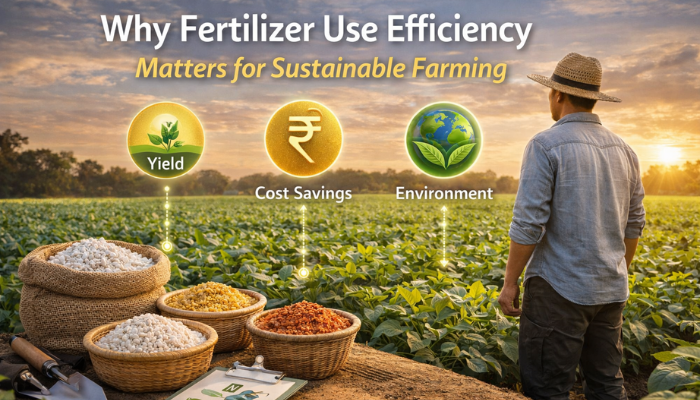
Did you know that a large part of fertilizers used in farming often goes to waste? This not only increases costs but also harms the environment.
Fertilizer efficiency means using the right nutrients, in the right amount, at the right time. When done correctly, it helps farmers grow healthy crops, improve soil quality, and reduce pollution. With better fertilizer application and the right types of fertilizers, farmers can increase yields while protecting natural resources.
In today’s agriculture, improving fertilizer use efficiency is the smart way to achieve both productivity and long-term sustainability.
Importance of Fertilizers in Agriculture
Fertilizers provide essential nutrients like nitrogen, phosphorus, and potassium that plants need to grow. Over time, soil loses these nutrients due to continuous farming.
- Continuous farming reduces soil nutrients, making fertilizers necessary to restore soil fertility.
- Using the right types of fertilizers ensures balanced nutrition for crops.
- Helps improve plant growth and overall crop health.
- Supports strong root development and better nutrient absorption.
- Proper fertilizer application increases crop yields and improves quality.
- Maintains long-term soil productivity and farming sustainability.
- Ensures consistent food production to meet growing demand.
Understanding Nutrient Management
Nutrient management is about giving crops exactly what they need. Farmers test the soil and then plan proper fertilizer application.
Good nutrient management helps to:
- Maintain soil fertility
- Reduce pollution
- Prevent nutrient loss
- Support long-term farming
Modern methods like precision farming and fertigation systems improve fertilizer efficiency by delivering nutrients directly to plants.
Enhancing Soil Fertility
Healthy soil is the base of successful farming. Continuous cropping reduces soil nutrients, making fertilizers necessary.
Efficient fertilizer use:
- Restores lost nutrients
- Improves soil structure
- Supports beneficial microbes
This leads to better soil fertility and long-term productivity.
Boosting Crop Yields
One of the main benefits of fertilizers is higher crop production. When used correctly, fertilizers help plants grow faster and stronger.
Proper fertilizer application ensures:
- Better nutrient absorption
- Healthy crop development
- Increased yield and quality
This is essential for meeting global food demand.
Optimizing Nutrient Uptake
Fertilizers work best when plants can easily absorb nutrients. Efficient use ensures nutrients reach the root zone.
Techniques like fertigation:
- Deliver nutrients through irrigation
- Reduce fertilizer loss
- Improve crop performance
This increases overall fertilizer use efficiency.
Challenges of Improper Fertilizer Use
Using fertilizers incorrectly can harm the environment. Common issues include:
- Nutrient runoff into rivers and lakes
- Groundwater contamination
- Soil degradation
This is why improving fertilizer efficiency is necessary for sustainable farming.
Sustainable Practices for Better Efficiency
Farmers can improve fertilizer efficiency by adopting simple and smart practices:
- Soil testing before fertilizer application
- Using the right types of fertilizers
- Applying fertilizers at the correct time
- Using organic options like compost and manure
- Practicing crop rotation
- Using fertigation systems
These methods reduce waste and protect the environment.
Choosing the right supplier is also important. A trusted fertilizer company in Pune, like SV Agro Solutions, provides high-quality and eco-friendly products that support efficient farming.
They offer:
- Advanced fertilizer solutions
- Products suited for different crops
- Support for sustainable agriculture
This helps farmers improve productivity while maintaining soil health.
Conclusion
Fertilizers are important for healthy crops, but using them wisely is the key to sustainable farming. When farmers focus on fertilizer use efficiency and proper fertilizer application, they can grow more while protecting the soil and environment.
Choosing the right types of fertilizers and following smart farming practices helps ensure better yields and long-term success.
Are your crops not getting the right nutrients despite regular fertilisation? SV Mr. Micro-G is an advanced micronutrient fertilizer made with SRF (Slow Release Fertilizer) Technology, ensuring gradual nutrient release for better crop growth. Suitable for all crops, it improves yield and prevents nutrient loss through leaching. Its nano polymer coating helps nutrients stay available for better absorption. Choose SV Mr. Micro-G for healthier crops and higher productivity.
Frequently Asked Questions
1. What is the role of fertilizers in sustainable agriculture?
Ans: Fertilizers provide essential nutrients that help crops grow healthy and strong. In sustainable agriculture, they are used carefully to improve soil fertility, increase crop yields, and reduce environmental impact.
2. What is fertilizer efficiency?
Ans: Fertilizer efficiency means using fertilizers in a way that plants absorb the maximum nutrients with minimum waste. It focuses on applying the right amount, at the right time, and in the right method.
3. How to improve fertilizer use efficiency?
Ans: Farmers can improve fertilizer use efficiency by:
- Testing soil before use
- Choosing the right types of fertilizers
- Applying fertilizers at the correct time
- Using proper fertilizer application methods like fertigation
- Combining organic and chemical fertilizers
4. Does fertilizer lose its effectiveness?
Ans: Yes, fertilizers can lose effectiveness if not used properly. Overuse and poor timing, can lead to nutrient loss, reduced plant absorption, and lower crop productivity.