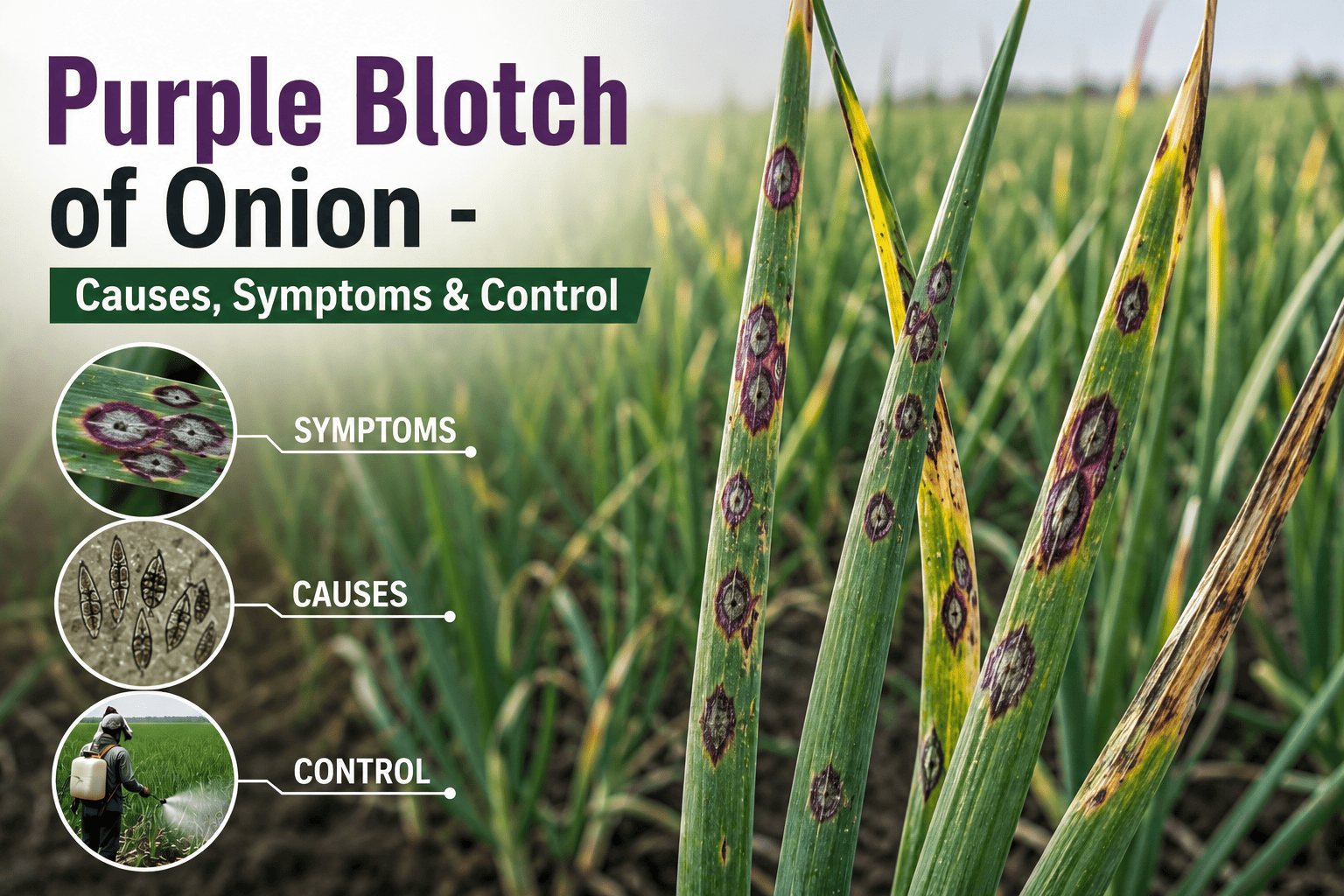
Purple blotch is one of the most common fungal diseases in onion farming. It mainly attacks onion leaves and reduces the plant's ability to produce healthy bulbs. If the purple blotch of onion is not identified and managed at the right time, it can cause heavy yield losses, poor bulb quality, and lower storage life.
The disease spreads quickly in warm, humid weather, especially when onion leaves remain wet for extended periods. Farmers can reduce damage by identifying symptoms early and by following proper field management and applying timely fungicide sprays.
What is the Purple Blotch Disease in Onions?
Purple blotch is a serious fungal disease of onion caused by Alternaria porri. It spreads quickly during the monsoon and kharif seasons when the weather is warm and humid. High humidity (above 85%), frequent rainfall, and temperatures between 20°C and 25°C create ideal conditions for the fungus. The disease spreads from one plant to another through wind and rainwater.
Causes of Purple Blotch of Onion
Purple blotch spreads easily when weather conditions are favourable, and the fungus finds a way to enter the plant.
Favourable Weather Conditions
- Warm and humid weather helps the fungus grow quickly.
- Continuous rainfall, heavy dew, and high humidity keep onion leaves wet for a long time.
- Wet leaves allow fungal spores to germinate and infect the plant easily.
Damage to Leaves
- The fungus enters the plant through small wounds on the leaves.
- Damage caused by thrips, hailstorms, or other diseases creates openings for the fungus.
- Onion plants with damaged leaves are more likely to get infected.
Infected Soil and Crop Residue
- The fungus can survive in infected onion leaves, plant debris, and the upper layer of the soil after harvest.
- If infected crop residue is left in the field, it becomes a source of infection for the next onion crop.
Susceptible Onion Varieties
- Some onion varieties are more sensitive to purple blotch than others.
- Commonly grown short-day onion varieties, such as Bhima Super, N-2-4-1, and many local varieties, are more prone to this disease, especially during the rainy season.
Poor Field Management
- Dense planting reduces air circulation and keeps leaves wet for longer.
- Overhead irrigation and poor drainage also increase the chances of disease development.
- Fields that are not cleaned after harvest may carry the fungus into the next season.
Symptoms of Purple Blotch Disease
Farmers should regularly inspect onion fields to detect the disease early.
- Small, round, white or light-coloured spots with purple or brown edges appear on the lower leaves.
- These spots slowly become larger and develop purple or brown rings, giving them a target or bull's-eye appearance.
- As the disease grows, the spots join together and cover a large part of the leaf.
- Infected leaves gradually turn yellow, then brown, and finally dry up completely.
- During humid or rainy weather, dark grey or brown fungal growth may appear on the infected spots.
- The infection usually starts on the lower leaves and slowly moves to the upper leaves.
- As more leaves dry, the entire plant becomes weak, and the crop looks yellow and sparse.
- Since the leaves cannot prepare enough food, onion bulbs remain small, light in weight, and have poor storage quality.
- If not controlled in time, purple blotch can reduce onion yield by 30-50% and increase bulb rotting during storage.
Disease Cycle of Purple Blotch of Onion
Purple blotch spreads quickly when weather conditions are favourable. The disease follows this cycle:
- The fungus remains alive in infected crop residue, onion plant debris, and leftover bulbs after harvest.
- During warm and humid weather, especially in the monsoon season, the fungus produces large numbers of spores.
- These spores spread from one plant to another through wind, rain splashes, irrigation water, and infected plant material.
- When onion leaves stay wet for several hours, the spores germinate and enter the plant through small wounds or natural openings in the leaves.
- Within a few days, small white spots appear on the leaves. These spots gradually become purple blotches with concentric rings.
- The new purple blotches produce more spores, which continue spreading the disease to healthy plants throughout the growing season.
Impact on Crop and Yield
Purple blotch reduces the green leaf area needed for photosynthesis.
As leaves dry early, plants cannot prepare enough food for bulb development.
This results in:
- Smaller bulb size
- Lower bulb weight
- Poor bulb quality
- Reduced storage life
- Yield losses that may exceed 40% under severe infection.
Prevention of Purple Blotch of Onion
Good farming practices can greatly reduce the chances of disease.
Cultural Practices
- Use healthy and disease-free seeds or seedlings.
- Choose disease-tolerant onion varieties whenever available.
- Maintain proper spacing between plants for better air circulation.
- Avoid applying excess nitrogen fertilizer.
- Follow crop rotation with non-onion crops for 2-3 years.
- Remove and destroy infected leaves and crop residues after harvest.
- Plough crop residue deep into the soil to reduce fungal survival.
Field and Irrigation Management
- Maintain proper drainage to avoid waterlogging.
- Prefer drip irrigation instead of overhead sprinklers.
- Avoid working in the field when leaves are wet.
- Keep the field free from weeds that increase humidity.
Control of Purple Blotch Disease
Timely identification, proper field management, and recommended fungicide sprays help control purple blotch of onion and protect crop yield and bulb quality.
Early Detection
- Inspect the crop regularly, especially after rainfall or during humid weather.
- Check older leaves carefully for early spots.
- Start control measures immediately after the first symptoms appear.
Chemical Control
- Spray the recommended fungicides as soon as symptoms appear.
- Common protective fungicides include:
Mancozeb
Chlorothalonil
Boscalid - Systemic fungicides commonly used include:
Tebuconazole
Propiconazole
Azoxystrobin - Rotate fungicides with different modes of action to avoid resistance.
- Repeat spraying every 7-14 days, depending on weather and disease pressure.
- Ensure complete coverage of both sides of the leaves.
Biological and Integrated Control
- Use neem-based products or biological products where recommended.
- Maintain balanced crop nutrition.
- Provide proper irrigation without overwatering.
- Combine cultural, biological, and chemical methods for better disease management.
Conclusion
Purple blotch of onion is a serious fungal disease that spreads quickly during warm and humid weather. If ignored, it can reduce bulb size, quality, and overall yield.
Farmers can successfully manage this disease by using healthy planting material, maintaining proper field hygiene, following crop rotation, monitoring the crop regularly, and applying recommended fungicides at the right time.
Looking for a simple solution to improve crop growth and correct micronutrient deficiencies? SV Mr. Micro-G from SV Agro Solutions is an advanced multi-micronutrient fertilizer that supplies essential micronutrients required for healthy plant growth, better flowering, fruit development, and higher yields.
Developed with Slow Release Fertilizer (SRF) Technology, it provides a steady supply of nutrients for up to 90-120 days, helping reduce nutrient loss and improve fertilizer efficiency. Its nano polymer coating prevents nutrient fixation and leaching, ensuring better nutrient availability to crops.
Frequently Asked Questions (FAQs)
1. What causes purple blotch of onion?
Purple blotch is caused by the fungus Alternaria porri, which survives in infected crop residue and spreads through wind, rain, irrigation water, and infected planting material.
2. What are the early symptoms of purple blotch in onion?
The first signs are small white or light-coloured spots on older leaves, which later become purple or brown patches with circular rings.
3. How does purple blotch spread in onion fields?
The disease spreads through fungal spores carried by wind, rain splash, irrigation water, and infected crop residue.
4. How can farmers prevent purple blotch of onion?
Farmers should use healthy seeds, maintain proper spacing, follow crop rotation, avoid excess nitrogen, remove infected plant debris, and use drip irrigation whenever possible.
5. Which fungicides are commonly used to control purple blotch?
Common fungicides include Mancozeb, Chlorothalonil, Boscalid, Tebuconazole, Propiconazole, and Azoxystrobin, used according to label instructions and local agricultural recommendations.