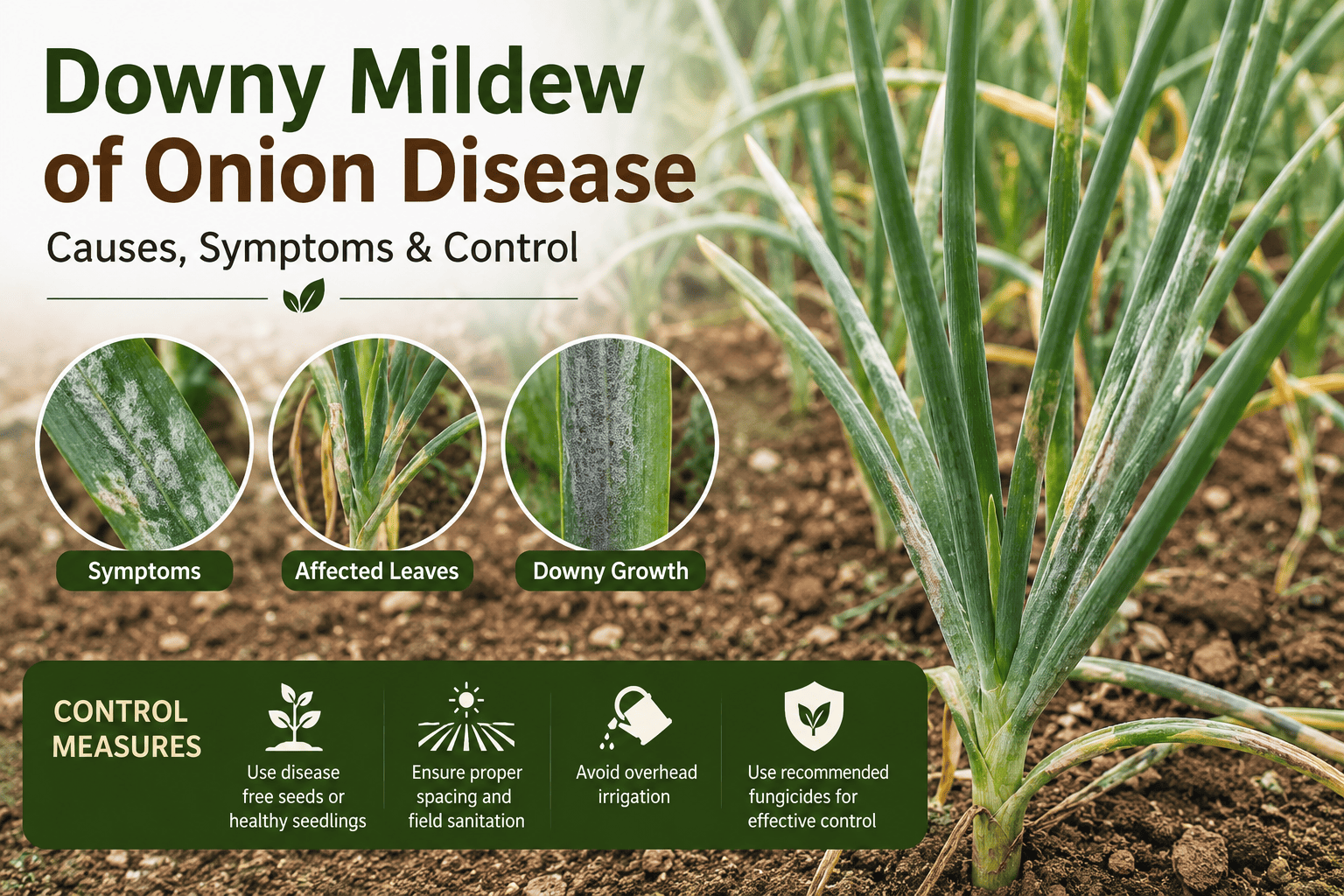
Downy Mildew of Onion is a serious disease that affects onion crops, especially during cool and humid weather. It attacks the leaves, reduces plant growth, and results in smaller bulbs of poor quality. If farmers do not control the disease at the right time, it can cause heavy yield losses.
The disease spreads quickly when onion leaves remain wet due to rain, heavy dew, or overhead irrigation. By identifying the symptoms early and following proper field management along with timely fungicide sprays, farmers can protect their onion crop and improve production.
What is Downy Mildew Onion Disease?
Downy Mildew of Onion is a disease caused by Peronospora destructor, which is a fungus-like organism called an oomycete (water mould). It mainly attacks onion leaves, flower stalks, and sometimes bulbs.
The disease weakens the plant, reduces bulb size, affects bulb quality, and shortens storage life. It can also infect other Allium crops such as garlic, shallots, and chives.
Causes of Downy Mildew of Onion
Downy Mildew develops quickly when weather conditions are favourable.
Cool and Humid Weather
- Cool temperatures between 10°C and 20°C are ideal for disease development.
- High humidity above 80–90% helps the disease spread rapidly.
- Rain, heavy dew, and long periods of wet leaves increase infection.
Infected Crop Residue
- The disease survives in infected onion leaves, crop debris, volunteer onions, and old bulbs left in the field.
- If infected plant material is not removed, it becomes the source of infection for the next crop.
Spread Through Wind and Water
The disease spreads through:
- Wind
- Rain splash
- Overhead irrigation
- Heavy dew
- Infected planting material
Poor Field Management
- Dense planting reduces air circulation.
- Poor drainage and waterlogging increase humidity.
- Overhead irrigation keeps leaves wet for a longer time.
- Excess nitrogen fertilizer produces soft leaves that are more prone to infection.
Downy Mildew Symptoms Found in Onion
Farmers should inspect onion fields regularly, especially during cool and humid weather.
- Light green or yellow patches first appear on older leaves.
- These patches usually develop near the leaf tip or middle portion.
- During humid mornings, a grey or violet fuzzy growth appears on infected leaves.
- As the disease spreads, infected areas turn brown and dry.
- Several spots join together and cover large portions of the leaf.
- Leaves start drying from the tip and finally collapse.
- Flower stalks may also become infected, reducing seed production.
- Bulbs remain small, soft, and have poor storage quality.
- Severe infection causes early drying of leaves and significant yield loss.
Disease Cycle of Downy Mildew of Onion
The disease spreads very quickly under favourable weather conditions.
- The pathogen survives in infected crop residue, volunteer onion plants, old bulbs, and infected planting material.
- During cool, humid weather, it produces large numbers of spores on infected leaves.
- These spores spread through wind, rainwater, irrigation water, and heavy dew.
- When spores land on wet onion leaves, they germinate and infect the plant.
- New yellow patches appear within a few days.
- These infected spots produce more spores, which continue spreading the disease throughout the field.
Impact on Crop and Yield
Downy Mildew can cause serious damage to onion crops.
- It reduces the green leaf area needed for photosynthesis.
- Leaves dry early, and crops become weak.
- Bulbs remain small and lightweight.
- Reduces bulb quality and storage life.
- Infected bulbs may rot during storage.
- Seed crops produce poor-quality seed.
- Severe infection can cause heavy yield losses.
Prevention of Downy Mildew of Onion
Good farming practices help reduce disease incidence.
Cultural Practices
- Use healthy and disease-free seeds or seedlings.
- Select disease-tolerant onion varieties whenever available.
- Maintain proper spacing for better air circulation.
- Avoid excessive nitrogen fertilizer.
- Follow crop rotation with non-onion crops for 2-3 years.
- Remove and destroy infected plants and crop residue after harvest.
- Eliminate volunteer onion plants growing near the field.
Field and Irrigation Management
- Maintain proper drainage.
- Avoid waterlogging.
- Use drip irrigation instead of overhead sprinklers.
- Do not work in the field when leaves are wet.
- Keep the field free from weeds that increase humidity.
Control of Downy Mildew of Onion
Early detection, proper field management, and timely fungicide application are essential to effectively control Downy Mildew of Onion and protect crop yield and bulb quality.
Early Detection
- Inspect the crop regularly during cool and humid weather.
- Check older leaves for yellow patches and grey fungal growth.
- Start disease control immediately after the first symptoms appear.
Biological and Biostimulants Management
- Use neem-based products or biological products wherever recommended.
- Apply SV Rounder P from SV Agro Solutions as part of an integrated crop management programme.
- It improves crop health, acts as a bactericide, and is effective against viral infections, helping plants remain stronger under disease pressure.
- Maintain balanced crop nutrition to improve the plant's natural resistance against diseases.
- Avoid excessive irrigation and keep leaves as dry as possible to reduce disease spread.
- Combine cultural practices, biological products, and recommended fungicides for better and long-lasting control of Downy Mildew.
Conclusion
Downy Mildew of Onion is a serious disease that spreads rapidly during cool and humid weather. If not managed on time, it can reduce bulb size, quality, storage life, and overall yield.
Farmers can effectively control the disease by using healthy planting material, maintaining proper field hygiene, improving drainage, following crop rotation, regularly monitoring the crop, and applying recommended fungicides at the right time.
Looking for high-quality biostimulants to improve crop growth and yield? SV Agro Solutions is a trusted biostimulants manufacturer and supplier in Pune, offering high-quality biostimulants that improve plant health, nutrient uptake, stress tolerance, and overall crop productivity. Our products support sustainable farming and are trusted by farmers across India as well as international markets.
Frequently Asked Questions (FAQs)
1. What causes Downy Mildew of Onion?
Downy Mildew of Onion is caused by Peronospora destructor, a fungus-like water mould that survives in infected crop residue and spreads through wind, rain, and irrigation water.
2. What are the early symptoms of Downy Mildew of Onion?
The first symptoms are light green or yellow patches on older leaves. During humid weather, grey or violet fuzzy fungal growth appears on these patches.
3. How does Downy Mildew spread in onion fields?
The disease spreads through spores carried by wind, rain splash, irrigation water, heavy dew, infected bulbs, and infected crop residue.
4. How can farmers prevent Downy Mildew of Onion?
Farmers should use healthy seeds, maintain proper spacing, follow crop rotation, remove infected plant debris, improve field drainage, use drip irrigation, and avoid excessive nitrogen fertilizer.
5. Which fungicides are commonly used to control Downy Mildew of Onion?
Common fungicides include Mancozeb, Chlorothalonil, Metalaxyl, Fosetyl Aluminium, Azoxystrobin, and Difenoconazole. These should be used according to the product label and local agricultural recommendations.