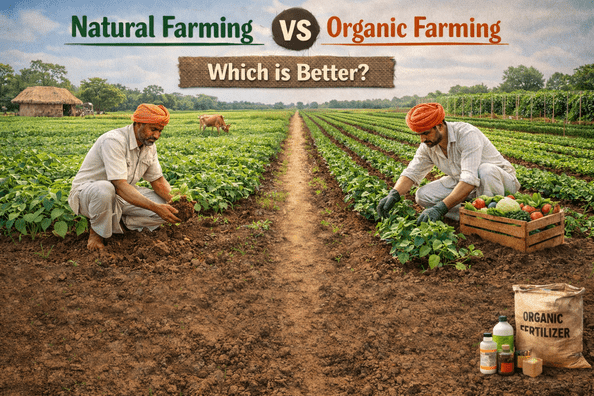
Many Indian farmers are confused about chemical-based farming. Rising fertilizer prices, decreasing soil fertility, and changing climate conditions have made them question whether chemical farming is the right long-term solution. Because of these challenges, farmers are now looking for better, safer, and more sustainable farming methods that protect both soil and income.
Two popular options are natural farming and organic farming. Both methods avoid chemical fertilisers and pesticides, but they follow different approaches and principles.
In this blog, we will clearly explain natural farming vs organic farming, their basic ideas, benefits, challenges, and help you understand which method may be better for Indian farmers.
What is Natural Farming?
Natural farming is a simple and chemical-free way of doing agriculture. It works with nature instead of trying to control it. Farmers do not use chemical fertilizers or pesticides. Instead, they use natural materials available on the farm, like cow dung, cow urine, crop waste, and natural mixtures.
Natural farming is sometimes called “do-nothing farming” because farmers do very little disturbance to the soil and allow nature to manage most of the work on its own.
What is Organic Farming?
Organic farming is a method of farming where farmers do not use chemical fertilizers or pesticides. Instead, they use organic fertilizers made up of crop waste, animal manure, green plants, and bio-pesticides.
This helps farmers grow crops in a safe and sustainable way while maintaining soil fertility for the long term.
Organic farming allows approved natural inputs and follows certification standards like NPOP (National Programme for Organic Production) to sell produce in premium markets.
Natural Farming vs Organic Farming- Differences Every Farmer Must Know
Natural and organic farming grow crops without harmful chemicals, but their methods and inputs are different.
|
Aspect |
Natural Farming |
Organic Farming |
|
Inputs & Cost |
Farmers use only what is available on their farm, so the cost is very low. |
Farmers buy organic fertilizers and sprays, so the cost is higher. |
|
Soil Work |
Farmers do not plough much and let leaves and crop waste naturally improve the soil. |
Farmers plough the land and mix compost into the soil. |
|
Basic Idea |
Let nature handle most of the farming work. |
Replace chemical products with organic products. |
|
Certification |
Usually no official certificate; mostly based on trust in local markets. |
Needs official approval and a certificate to sell as organic. |
Principles of Natural Farming
- No chemical fertilizers, pesticides, or insecticides are used. Farming is done in a completely natural way.
- Deep ploughing is avoided to protect soil structure, earthworms, and useful microbes.
- Local materials like cow dung, cow urine, jaggery, and flour are used to make natural solutions such as Jivamrit (for soil health) and Beejamrit (for seed treatment).
- Indigenous cow dung and urine help increase good bacteria and improve soil fertility.
- Different crops are grown together through intercropping and multi-cropping to improve nutrients and reduce pest problems.
- Farmers interfere less and allow nature to manage pests, weeds, and soil health naturally.
Principles of Organic Farming
- Organic farming improves soil by using compost, organic fertilizer, and green manure instead of chemical fertilizers.
- Pests and weeds are controlled using natural methods like helpful insects, crop rotation, and hand weeding instead of chemical sprays.
- It does not use synthetic fertilisers, chemical pesticides, hormones, or GMOs.
- It supports biodiversity, helping more plants, insects, and animals grow naturally on the farm.
- Animals are raised with proper care, given natural feed, and antibiotics are used only when truly needed
Advantages of Natural Farming
- It reduces farming costs because farmers do not need to buy chemical fertilizers and pesticides.
- It improves soil health by making the soil loose, rich, and full of useful microorganisms.
- It helps the soil hold more moisture, so crops need less water.
- It produces safe and healthy food while reducing pollution in soil and groundwater.
- It also helps lower carbon emissions and protects the environment.
- In states like Andhra Pradesh, natural farming under ZBNF has helped many farmers reduce debts.
Advantages of Organic Farming
- It helps protect the environment by reducing pollution and stopping harmful chemicals from entering rivers and groundwater.
- It supports long-term farming by creating strong systems that can handle drought, floods, and climate change better.
- It produces healthy food that is free from harmful chemical residues and may contain more natural nutrients.
- Healthy organic soil can store more carbon, which helps in reducing the effects of climate change.
Challenges of Natural Farming
- Yields may drop in the first few years, causing income loss.
- Weed control and natural input preparation need more labour.
- Farmers need proper knowledge and training to avoid mistakes.
- Getting good market prices and certification can be difficult
- Pest attacks can cause losses without chemical sprays.
- Desi cow inputs may not be easily available.
Challenges of Organic Farming
- Crop yields are usually lower in the first 2-3 years.
- More labour is needed for weeding and composting, which increases costs.
- Controlling pests and weeds is harder without chemical sprays.
- Getting organic certification takes time, money, and paperwork.
- Small farmers may struggle to find proper markets and storage facilities.
- Organic seeds and inputs are sometimes not easily available
Which is Better- Natural Farming vs Organic Farming?
There is no single answer. It depends on your farm size, budget, and goals.
-
Natural farming is better if you are a small farmer who wants to reduce costs, improve soil health, and avoid buying outside inputs.
-
Organic farming is better if you want to sell in big markets that need certified and high-quality produce.
Both methods avoid chemical fertilizers and pesticides, but they follow different approaches in using inputs.
Conclusion
When we talk about natural farming vs organic farming, it’s not about deciding which one is better or worse. Both methods aim to grow safe food, keep the soil healthy, and support sustainable farming. Natural farming is about depending on nature and using farm-based resources, while organic farming follows certified standards and helps farmers sell their crops in premium markets.
Looking for a smarter and more sustainable way to farm? SV Agro Solutions offers advanced products like biostimulants, CRF fertilizers and micronutrients to improve soil health and crop productivity. Our solutions help plants absorb nutrients better, grow stronger roots, and handle stress like drought or poor soil conditions.
FAQS
1. Is natural and organic farming the same?
No, natural and organic farming are different; “natural” usually means no artificial colors or preservatives, while organic farming follows certified standards without chemicals.
2. Which state in India is 100% organic?
Sikkim is India’s first and only 100% organic state since 2016.
3. What is another name for natural farming?
Natural farming is also linked to terms like sustainable farming, agroecology, permaculture, and eco-friendly agriculture.
4. What is the subsidy for natural farming?
Farmers can get ₹4,000 per acre per year for up to 2 years (maximum 1 acre) under government support schemes.