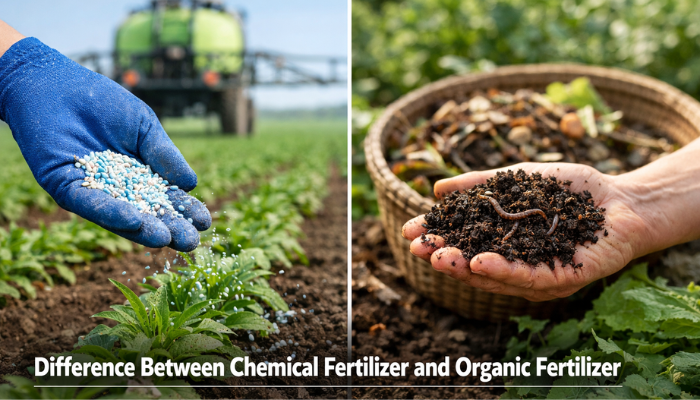
Fertilizers play a very important role in farming. They help crops grow faster, healthier, and give better yields. Today, farmers mainly use two types of fertilizers – chemical fertilizers and organic fertilizers. Understanding the difference between chemical fertilizer and organic fertilizer is very important for farmers who want good crop production along with healthy soil.
Chemical fertilizers give quick nutrients to crops, while organic fertilizers work slowly and improve soil health over time. Choosing the right fertilizer helps farmers balance yield, soil fertility, cost, and long-term sustainability, especially for Indian farms where soil health is a major concern.
What are Organic Fertilizers?
Organic fertilizers are made from natural materials like compost, cow dung, poultry manure, vermicompost, bone meal, and plant waste. These fertilizers break down slowly in the soil with the help of microorganisms. They improve soil structure, increase organic matter, and support beneficial soil life.
What are Chemical Fertilizers?
Chemical fertilizers are synthetic or man-made products produced in factories. They contain nutrients in a concentrated form, mainly NPK. These nutrients are immediately available to plants but do not improve soil health and can harm soil if used continuously.
This basic difference between natural and synthetic sources creates all other differences in their effects.
Differences Between Organic and Chemical Fertilizers
Organic fertilizers improve soil health naturally over time, while chemical fertilizers provide quick nutrients but may harm soil if overused.
|
Factors |
Organic Fertilizer |
Chemical Fertilizer |
|
Source |
Made from natural materials like cow dung, compost, plant waste, and bone meal |
Made in factories using chemicals and minerals |
|
Nutrient Release |
Nutrients are released slowly over time through soil microbes, feeding crops for longer |
Nutrients are released quickly and give instant growth |
|
Effect on Soil Health |
Makes soil soft, fertile, and rich in useful microbes |
Can make soil hard and reduce good microbes if used regularly |
|
Nutrient Content |
Provides balanced nutrients, including small (micro) nutrients |
Mostly gives only the main nutrients like N, P, K |
|
Environmental Impact |
Safe for soil and water, does not cause pollution |
Can pollute soil and water due to leaching and runoff |
|
Cost & Availability |
It may cost more at first and requires more quantity |
Cheaper initially and easily available in the market |
|
Safety for Crops |
Safe for plants with a very low risk of crop burning |
High risk of crop damage if applied in excess |
|
Long-term Use |
Improves soil fertility and crop health over time |
Continuous use reduces soil quality and fertility |
Pros of Organic Fertilizers
Organic fertilizers offer many long-term benefits to farmers:
- Improve soil structure and make the soil soft and fertile
- Increase beneficial bacteria, fungi, and earthworms
- Reduce soil erosion and improve water retention
- Improve crop resistance to pests and diseases
- Safe to handle and suitable for organic farming
- Reduce chemical pollution in soil and water
- Support biodiversity in crops like rice, vegetables, and pulses
Organic fertilizers are ideal for farmers who want sustainable yields without harming the soil.
Cons of Organic Fertilizers
Despite many benefits, organic fertilizers also have some limitations:
- Nutrient release is slow, so results take time
- Nutrient content varies, so soil testing is important
- The initial cost may be higher than chemical fertilizers
- Bulky materials require more storage and transport
- Not suitable for instant nutrient correction
Farmers need patience and regular use to see full benefits.
Pros of Chemical Fertilizers
Chemical fertilizers are popular due to their fast action:
- Provide quick nutrients to crops
- Easy to apply and store
- Cheaper for short-term use
- Useful during critical crop growth stages
- Suitable for high-yield commercial farming
They are helpful when crops show immediate nutrient deficiency.
Cons of Chemical Fertilizers
Long-term use of chemical fertilizers can create serious problems:
- Damage soil structure and reduce organic matter
- Kill beneficial soil microbes
- Increase soil acidity and salinity
- Causes water pollution through leaching and runoff
- Make crops dependent on chemicals
- Increase pest and disease attacks
- Risk of crop burn if overused
Over time, farmers may face higher costs and declining soil productivity.
Practical Applications for Farmers
- Use organic fertilizers for soil regeneration in kitchen gardens, subsistence farming, and natural farming systems.
- Use chemical fertilizers carefully in commercial farming, especially during peak nutrient demand stages.
- Combine both methods for best results – this is called integrated nutrient management.
- Apply organic fertilizers before sowing and chemical fertilizers in small, controlled doses.
- Rotate crops and add compost regularly to maintain soil health.
Conclusion
The difference between chemical fertilizer and organic fertilizer is not just about speed but about long-term soil health and sustainability. Chemical fertilizers give quick results, but organic fertilizers build strong soil and healthy crops over time.
For Indian farmers, the best approach is to use fertilizers wisely, protect soil fertility, and think long-term. Healthy soil today means better yields and safer farming tomorrow.
FAQs
1. What is the main difference between chemical fertilizer and organic fertilizer?
Chemical fertilizers give quick nutrients, while organic fertilizers improve soil health and provide nutrients slowly.
2. Which is better for soil health: organic or chemical?
Organic fertilizers are better for long-term soil health.
3. Can I use both chemical and organic fertilizers together?
Yes, using both in the right balance gives better crop and soil results.
4. How do organic fertilizers prevent nutrient leaching?
They release nutrients slowly and bind them to organic matter in the soil.
5. Are chemical fertilizers safe for vegetable farming?
They can be used carefully, but overuse may leave residues and damage soil.