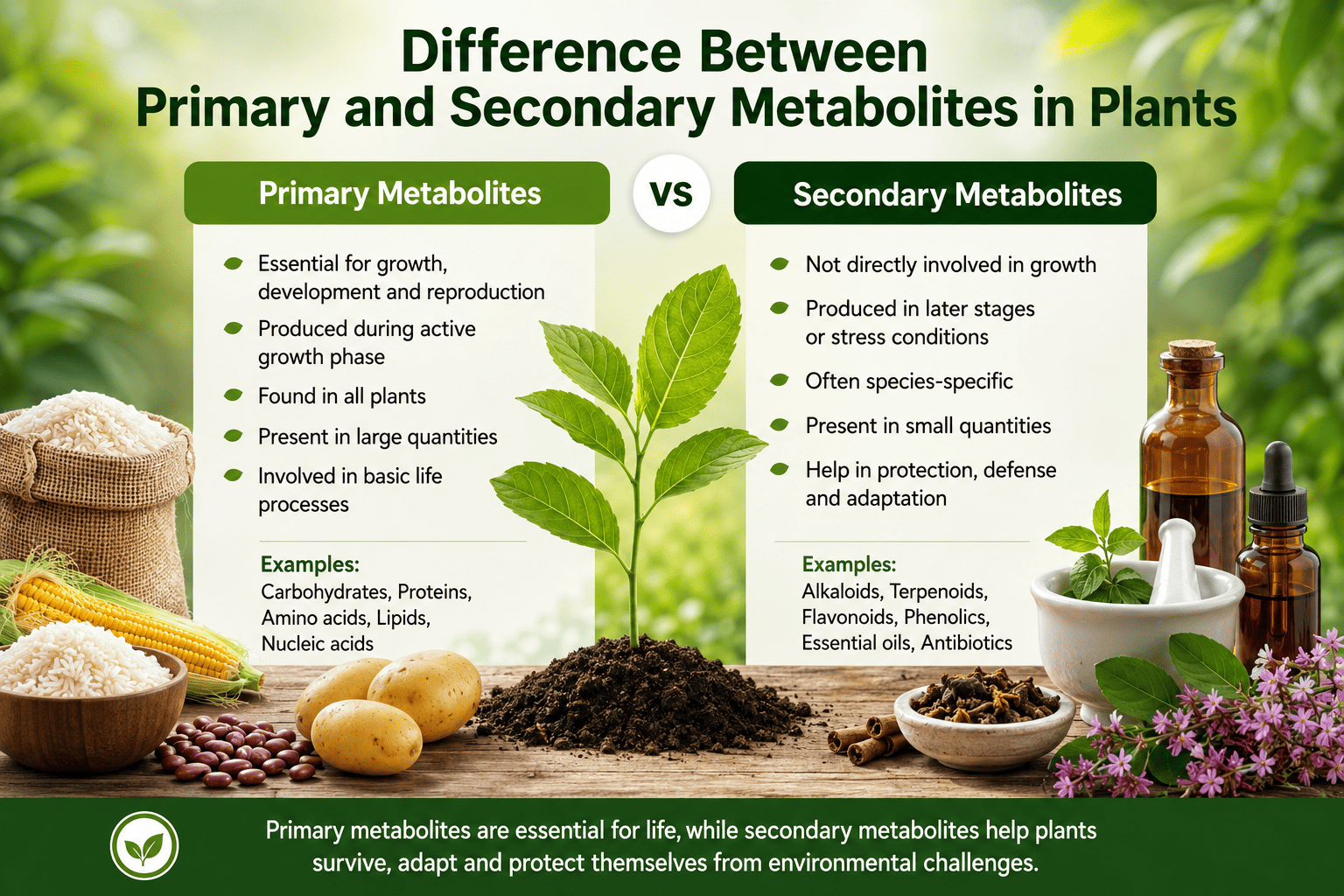
Plants, animals, and microorganisms produce many different substances during their growth and development. These substances are known as metabolites. They play an important role in helping living organisms grow, reproduce, survive, and protect themselves from environmental challenges.
Metabolites are mainly divided into two categories: primary metabolites and secondary metabolites. While both are important, they serve different purposes. Primary metabolites are essential for growth and life processes, whereas secondary metabolites help organisms adapt to their surroundings and defend themselves against pests, diseases, and stress.
In this article, we will understand the difference between primary and secondary metabolites, their definitions, examples, functions, and importance in agriculture and industry.
What are Metabolites?
Metabolites are chemical compounds produced inside living organisms during metabolism. Metabolism includes all the chemical reactions that help organisms obtain energy, grow, repair tissues, and maintain life.
These compounds can be classified based on their role in the organism:
- Primary metabolites are directly involved in growth and development.
- Secondary metabolites are not directly required for growth but help organisms survive and adapt to their environment.
Understanding these metabolites is important in agriculture, biotechnology, medicine, and plant science.
What Are Primary Metabolites?
- Primary metabolites are organic compounds that are essential for the normal growth, development, and reproduction of living organisms.
- They are produced during the active growth phase and are found in almost all living cells.
- Without primary metabolites, plants and microorganisms cannot survive because they are directly involved in basic life processes.
Examples of Primary Metabolites
- Carbohydrates (glucose, starch)
- Proteins
- Lipids (fats and oils)
- Amino acids
- Nucleic acids (DNA and RNA)
- Organic acids
These compounds provide energy, build cell structures, and support important biological activities.
Characteristics of Primary Metabolites
- Essential for survival
- Produced during the growth phase
- Found in large quantities
- Present in most organisms
- Directly involved in metabolism
What Are Secondary Metabolites?
- Secondary metabolites are organic compounds that are not directly involved in the basic growth and development of an organism.
- However, they play a major role in protection, adaptation, and survival.
- Plants and microorganisms often produce secondary metabolites during later stages of growth or when they face environmental stress such as pest attacks, diseases, drought, or competition.
Examples of Secondary Metabolites
- Alkaloids (Nicotine, Caffeine)
- Terpenoids
- Phenolic compounds
- Flavonoids
- Plant pigments
- Antibiotics
- Essential oils
These compounds help plants defend themselves and interact with their environment.
Characteristics of Secondary Metabolites
- Not directly required for growth
- Produced in smaller amounts
- Often species-specific
- Help in defense and adaptation
- Commonly formed during stress conditions
Difference Between Primary and Secondary Metabolites
The main difference between primary and secondary metabolites is that primary metabolites are necessary for growth and survival, while secondary metabolites mainly support defense and adaptation.
|
Feature |
Primary Metabolites |
Secondary Metabolites |
|
Definition |
Compounds essential for growth and development |
Compounds involved in defense and adaptation |
|
Role |
Support basic life processes |
Help survive under environmental stress |
|
Production Stage |
Active growth phase |
Later growth stages or stress conditions |
|
Quantity Produced |
Large amounts |
Small amounts |
|
Distribution |
Found in almost all organisms |
Often species-specific |
|
Importance |
Essential for survival |
Important for protection and ecological interactions |
|
Examples |
Carbohydrates, proteins, amino acids |
Alkaloids, terpenoids, flavonoids, antibiotics |
|
Commercial Uses |
Food, fermentation, biotechnology |
Medicines, pesticides, flavours, fragrances |
This table clearly explains the difference between primary and secondary metabolites and helps students and farmers understand their unique roles.
Functions of Primary Metabolites
Primary metabolites are the building blocks of life. They perform several important functions.
1. Energy Production
Carbohydrates such as glucose provide the energy required for plant growth and cellular activities.
2. Formation of Cell Structures
Proteins, lipids, and nucleic acids help build and maintain plant cells and tissues.
3. Growth and Development
Amino acids and proteins support plant growth, flowering, and seed formation.
4. Enzyme Production
Many primary metabolites are involved in enzyme synthesis, which controls metabolic reactions.
5. Reproduction
Primary metabolites provide the materials required for reproduction and seed development.
Functions of Secondary Metabolites
Secondary metabolites may not be directly involved in growth, but they play a vital role in plant survival.
1. Protection Against Pests
Many secondary metabolites act as natural insect repellents and reduce pest attacks.
2. Disease Resistance
Plants produce antimicrobial compounds that protect them from bacteria, fungi, and viruses.
3. Environmental Stress Tolerance
Secondary metabolites help plants survive drought, heat, UV radiation, and other stress conditions.
4. Attraction of Pollinators
Pigments and fragrances attract bees, butterflies, and other pollinating insects.
5. Competition With Other Plants
Some plants release secondary metabolites into the soil to suppress the growth of competing plants.
Conclusion
Understanding the Difference Between Primary and Secondary Metabolites is important for farmers, students, and researchers. While both types of metabolites are essential for living organisms, they perform different roles. Primary metabolites are essential for growth, development, and reproduction, while secondary metabolites help in protection, survival, and adaptation to environmental challenges.
Looking for high-quality fertilizers to improve crop growth and increase yields? SV Agro Solutions is a trusted fertilizer manufacturer and supplier in Pune, offering innovative agricultural solutions for farmers and agribusinesses. Our products are designed to support healthy plant growth, improve productivity, and help farmers achieve better farming results. Trusted by farmers across India, we also supply our fertilizers to international markets.
FAQs
1. What is the difference between primary and secondary metabolites?
Primary metabolites are essential compounds required for growth and development, while secondary metabolites mainly help in defense, adaptation, and survival.
2. What are examples of primary metabolites?
Examples include carbohydrates, proteins, amino acids, lipids, nucleic acids, and organic acids.
3. What are examples of secondary metabolites?
Examples include alkaloids, flavonoids, terpenoids, phenolic compounds, pigments, and antibiotics.
4. Are secondary metabolites essential for growth?
No. Secondary metabolites are not directly required for growth but help organisms survive environmental challenges and protect themselves from pests and diseases.
5. Why are secondary metabolites important in plants?
Secondary metabolites help plants defend against insects, pathogens, drought, UV radiation, and other environmental stresses while also attracting pollinators.