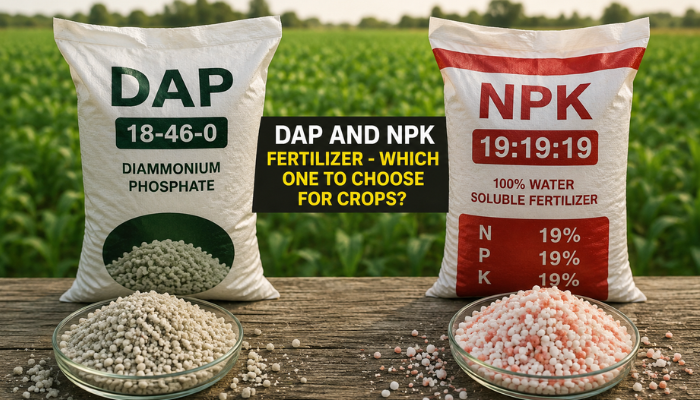
Fertilizers play an important role in modern farming because they provide essential nutrients needed for healthy crop growth and higher yield. Among the most commonly used fertilizers in India are DAP (Diammonium Phosphate) and NPK fertilizer. Farmers often compare these two fertilizers before sowing or during crop growth to decide which one is better for their crops.
Choosing the right fertilizer depends on several factors, such as crop stage, soil nutrient condition, crop type, and yield goals. Using the correct fertilizer at the right time helps improve crop growth, nutrient efficiency, and overall farm productivity.
In this guide, we will explain the difference between DAP and NPK fertilizer, their uses, benefits, and how farmers can choose the right one for better crop production.
What is DAP Fertilizer?
DAP (Diammonium Phosphate) is one of the most commonly used phosphorus fertilizers in farming. It contains 18% nitrogen and 46% phosphorus, which are important nutrients for healthy crop growth.
Farmers mainly use DAP during the early stage of crop growth because it helps in strong root development, better seed germination, and faster plant establishment. It gives young plants a strong start, helps roots absorb nutrients more effectively, and supports healthy overall crop growth.
What is NPK Fertilizer?
NPK fertilizer is a fertilizer that contains three important nutrients needed for healthy plant growth: Nitrogen (N), Phosphorus (P), and Potassium (K). These nutrients help plants grow strong roots, healthy green leaves, better flowers, and higher-quality fruits.
NPK fertilizer is widely used in farming because it provides balanced nutrition to crops, improves overall plant development, increases crop yield, and helps replace important nutrients in the soil that are used up during farming.
Difference Between DAP and NPK Fertilizer
DAP mainly focuses on phosphorus supply, while NPK provides balanced nutrition throughout the crop cycle.
|
Feature |
DAP Fertilizer |
NPK Fertilizer |
|
Nutrients |
Contains high phosphorus and moderate nitrogen |
Contains balanced nitrogen, phosphorus, and potassium |
|
Best Used For |
Mainly used during the sowing stage for early crop growth |
Used from vegetative growth to flowering and fruiting stages |
|
Suitable Soil Type |
Works best in neutral and alkaline soils |
Suitable for almost all soil types |
|
Nutrient Release |
Releases nutrients quickly for immediate root development |
Provides moderate or controlled nutrient release for continuous growth |
|
Main Benefit |
Improves root growth, seed germination, and early plant establishment |
Improves overall plant growth, flowering, fruit development, and final yield |
|
Cost |
Usually slightly higher due to high phosphorus content |
Generally moderate depending on grade and nutrient ratio |
|
Versatility |
Limited because it does not contain potassium |
Highly versatile because different grades are available for different crop needs |
DAP and NPK Fertilizer Uses
DAP and NPK fertilizers are widely used to provide essential nutrients that support strong root development, healthy plant growth, better flowering, and higher crop yield.
DAP Uses
- Seed Starter: DAP provides important nutrients during the early growth stage and helps develop strong and healthy roots.
- Basal Application: Farmers usually mix DAP into the soil before sowing or planting to provide phosphorus for better crop establishment.
- Foliar Spray and Fertigation: Water-soluble DAP can be applied through leaf spray or irrigation systems for quick nutrient absorption.
- Suitable for Many Crops: DAP is widely used for crops like wheat, rice, maize, pulses, sugarcane, vegetables, and fruit crops to support healthy early growth.
NPK Uses
- Nitrogen (N): Helps plants grow healthy green leaves and strong stems. It also supports chlorophyll production, which helps plants prepare food through photosynthesis.
- Phosphorus (P): Helps in strong root development and supports better flowering, fruit formation, and seed development.
- Potassium (K): Improves overall plant strength, increases disease and drought resistance, and helps plants absorb and move water and nutrients properly.
Which is Better, DAP or NPK?
- Both fertilizers are useful, but the right choice depends on the crop growth stage and soil nutrient needs.
- Use DAP during sowing or planting time because it helps in strong root development and better early plant growth.
- Use NPK during the vegetative, flowering, and fruiting stages for balanced nutrition and better crop development.
- DAP is best for: Seed sowing, planting, and early crop establishment.
- NPK is best for: Leaf growth, flowering, fruit development, and improving final yield.
- For best results, farmers can use both:
Apply DAP at sowing to build strong roots, then apply NPK during later growth stages to provide complete and balanced nutrition for healthy crop growth and higher production
Conclusion
DAP and NPK fertilizers are both essential for successful farming, but they serve different purposes. DAP is best for early root development and crop establishment, while NPK is ideal for balanced nutrition throughout the crop cycle.
Looking for a trusted fertilizer company in Pune for better crop growth and higher productivity?
SV Agro Solutions is a leading fertilizer company in Pune offering high-quality fertilizers for farmers and agricultural businesses. As a trusted fertilizer manufacturer and supplier in Pune, we provide innovative agricultural solutions that help improve soil health, crop quality, and overall farm productivity. We are committed to supporting local farmers with reliable products while also supplying our fertilizers to international markets.
Frequently Asked Questions
1. What is the golden ratio for fertilizer?
The golden ratio for fertilizer is often NPK 20:10:10, which provides balanced nutrients for healthy crop growth and better yield.
2. What is the best time to apply DAP fertilizer?
DAP is best applied before or during sowing to support strong root growth and early plant development.
3. What plants benefit most from DAP?
DAP is useful for cereals, pulses, vegetables, fruit crops, and flowering plants for better early growth.
4. Can we spray NPK on leaves?
Yes, NPK can be sprayed on leaves as a foliar spray for quick nutrient absorption and faster plant response.