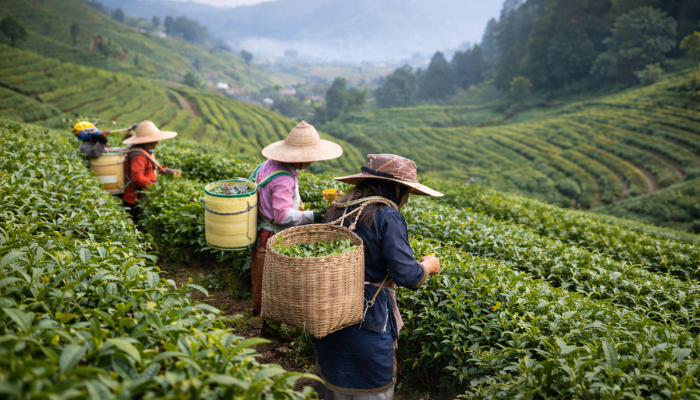
Plantation agriculture is an important system of farming that focuses on growing cash crops on a large scale. Unlike traditional subsistence farming, which is mostly for family use, plantation agriculture produces crops for the market.
This type of farming is mostly done in warm regions and helps increase exports and rural income. In India, plantations give jobs, support businesses, and grow crops like tea, coffee, and rubber. Let us understand what is plantation agriculture, its main features, the crops grown, and its importance for India.
What is Plantation Agriculture?
Plantation agriculture is large-scale farming where one main cash crop is grown for profit. It is done in warm regions and uses a lot of money, workers, and modern methods to grow crops like tea, coffee, sugar, and rubber.
In India, it is common in places like Assam, Kerala, and the Nilgiris, where the climate is suitable. These farms are linked to local and global markets and help create jobs and income.
Main Characteristics of Plantation Agriculture
Plantation agriculture has several unique features that make it different from small-scale or subsistence farming:
1. Large Scale & One Crop Farming
Plantation farming is done on very large areas of land where only one main crop, like tea, coffee, rubber, sugarcane, or banana, is grown.
2. Commercial & Export-Oriented
Crops are grown mainly to earn a profit. Most of the produce is sold in big markets or exported to other countries, not for local use.
3. High Investment Needed
Plantation farming needs a lot of money for machines, fertilizers, irrigation systems, and processing units.
4. Needs Many Workers
A large number of workers are required for planting, caring for, and harvesting crops. In some places, workers may get low wages and basic facilities.
5. Uses Modern Farming Methods
Scientific techniques like improved seeds, fertilizers, and pesticides are used to get better and higher yields.
6. Connected to Industries
Plantations are linked with nearby factories and mills for processing crops. Good roads, transport, and communication are important.
7. Grown in Tropical Regions
This type of farming is suitable in tropical and subtropical areas where the climate supports cash crops.
8. Owned by Big Companies
Most plantations are owned by large companies or rich individuals who manage them as businesses.
Suitable Crops for Plantation Agriculture
Plantation agriculture mostly involves perennial crops, which live and produce for several years. Some common crops include:
- Beverages (Tea, Coffee, Cocoa)
These crops are mainly grown for making drinks. They are high-value crops and are mostly grown in hilly and rainy areas.
- Oils & Nuts (Coconut, Oil Palm, Cashew, Arecanut)
These crops are used to produce cooking oil, dry fruits, and edible nuts. They are long-term crops and give income for many years.
- Fibres & Materials (Rubber, Cotton, Sisal, Jute)
These crops are used in industries to make clothes, ropes, tyres, bags, and other products.
- Sugars & Spices (Sugarcane, Pepper, Cloves)
Sugarcane is grown for making sugar and jaggery, while spices are used in food and medicines.
- Fruits & Others (Bananas, Pineapples, Betel Vine)
These crops are grown for direct sale in markets and daily use.
Geographical Requirements
Plantations grow best in specific regions:
- Tropical or subtropical with annual rainfall between 150-300 cm.
- Fertile, well-drained soils, often on hill slopes, for root crops.
- Close to ports or transport facilities for easy export.
Plantation Agriculture in India
Plantation farming is prominent in India, especially in:
- Tea: Assam, West Bengal, Kerala, Tamil Nadu, Karnataka
- Coffee: Karnataka, Kerala, Tamil Nadu
- Rubber: Kerala, Tamil Nadu, North-East
- Spices & Cardamom: Kerala, South India
- Coconut, Cashew, Arecanut, Oil Palm: South India, North-East
Advantages of Plantation Agriculture
Plantation agriculture has many benefits:
- Gives high crop yield due to large-scale farming and the use of scientific methods
- Creates many jobs for skilled and unskilled workers in rural areas
- Helps earn foreign exchange by exporting crops like tea, coffee, and rubber
- Supports agro-based industries such as processing, packaging, and transport
- Encourages new technology and innovation in farming
- Produces important cash crops efficiently, benefiting both farmers and consumers
Disadvantages of Plantation Agriculture
Despite its benefits, plantation farming has some drawbacks:
- Causes environmental damage like deforestation, soil erosion, and loss of wildlife
- Reduces soil fertility because the same crop is grown again and again
- Heavy use of fertilizers and pesticides can harm soil, water, and human health
- Workers may face low wages, poor living conditions, and exploitation
- High farming and maintenance costs make it risky for farmers
- Dependence on one single crop increases the risk of crop failure
Conclusion
Plantation agriculture is a key part of India’s farming economy. When we understand what is plantation agriculture, it means growing cash crops like tea, coffee, and rubber on a large scale, mainly in tropical regions, creating jobs and supporting trade. With sustainable practices, it can be profitable and eco-friendly for farmers.
Want to start farming or feeling stuck with complicated chemical-based agriculture? It’s the right time to move towards organic and sustainable farming.
With products like Biostimulants, CRF Fertilizers, and natural Micronutrients, SV Agro Solutions helps improve soil health, nutrient efficiency, and crop strength, while increasing yield without harming the environment.
FAQs.
1. How does plantation agriculture contribute to India’s export economy?
It earns India over $2 billion every year by exporting tea, coffee, and rubber to global markets.
2. How much capital is required to start plantation agriculture?
Plantation farming needs a heavy investment of ₹50–100 lakhs per hectare and takes several years to start giving profits.
3. Why are perennial crops preferred in plantation agriculture?
Perennial crops give a harvest for many years, reduce replanting costs, and suit large farms focused on long-term production.
4. Can crop rotation be applied in plantation agriculture?
Crop rotation is limited, but small crops can be grown between main plants to improve soil health.
5. How is climate change affecting plantation agriculture in India?
Climate change is reducing yields due to irregular weather, forcing farmers to adopt climate-resilient farming methods.