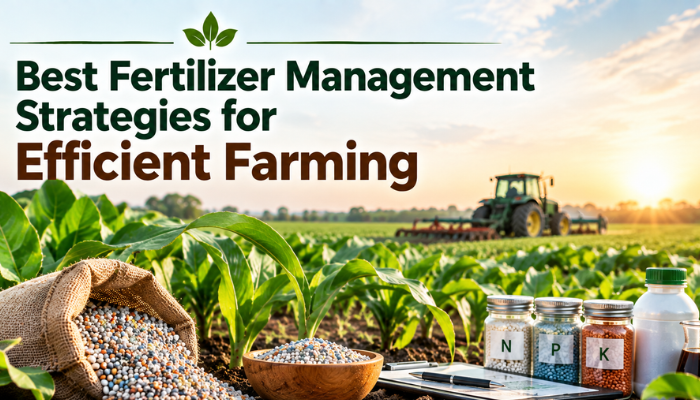
Fertilizer management plays an important role in improving crop nutrition, maintaining soil fertility and using farm inputs efficiently. For smallholder farmers, applying the right fertilizer in the right quantity and at the right time can help reduce unnecessary costs and improve nutrient use.
Effective fertilization management is not about using more fertilizer. It involves considering soil conditions, crop nutrient requirements, fertilizer type, application timing and available organic sources to provide crops with the nutrients they need.
In this blog, we’ll look at practical fertilizer management strategies for smallholder farmers, including the 4Rs of nutrient management and ways to improve nutrient use efficiency.
Fertilizer Management Strategies for Farmers
Smallholder farmers often work with limited land, labour, water and financial resources. Fertilizer decisions therefore need to focus on nutrient efficiency rather than simply increasing fertilizer quantities.
1. Start With Soil Testing
Soil testing provides useful information about nutrient availability and soil conditions. Instead of applying the same fertilizer programme every season, farmers can use soil-test results to identify nutrient deficiencies and make more informed decisions.
A basic soil testing programme can help farmers:
- Identify nutrient deficiencies
- Avoid unnecessary applications
- Select suitable fertilizer grades
- Maintain soil fertility
- Improve fertilizer efficiency
In India, the Soil Health Card system provides farmers with information that can support soil and nutrient management decisions.
2. Follow the 4Rs of Fertilizer Management
The 4R approach provides a practical framework for nutrient management. It means using the Right Source, Right Rate, Right Time and Right Place.
|
4R Principle |
What It Means |
Practical Approach |
|
Right Source |
Select a suitable nutrient source |
Match fertilizer to crop and soil needs |
|
Right Rate |
Apply an appropriate quantity |
Base rates on soil and crop requirements |
|
Right Time |
Apply nutrients when crops can use them |
Match applications with crop growth |
|
Right Place |
Position nutrients where roots can access them |
Place fertilizer close enough for effective uptake |
The four principles work together. Choosing the right fertilizer but applying too much or at the wrong time can still lead to poor nutrient efficiency.
3. Match Fertilizer to Crop Requirements
Different crops remove different quantities of nitrogen, phosphorus, potassium and other nutrients from the soil. Even the same crop can have different nutrient requirements depending on its variety, yield target, soil condition and growing environment.
Farmers should therefore avoid following a single fertilizer schedule for every crop.
For better fertilization management:
- Identify the major nutrients required by the crop.
- Check the nutrient content shown on the fertilizer label.
- Adjust applications according to crop growth.
- Consider secondary and micronutrients where deficiencies are identified.
4. Use Split Applications Where Appropriate
Splitting nitrogen applications can improve nutrient availability and reduce avoidable losses.
- Avoid one-time application: Reduces the risk of nutrient losses.
- Split applications: Supply nitrogen across key growth stages.
- Match crop demand: Apply when nutrient needs increase.
- Follow crop guidance: Adjust timing and frequency to the crop.
Organic and Mineral Fertilizers: Use Them Wisely
Fertilizer management can combine organic and mineral nutrient sources based on crop and soil needs, supporting informed nutrient-management decisions.
- Manure, compost and crop residues provide nutrients and support soil organic matter.
- Provide concentrated, readily available nutrients to crops.
- Depends on the crop, soil, nutrient needs and material quality.
- Compare both sources in our Fertilizer vs Manure guide.
Improve Fertilizer Application Efficiency
The way fertilizer is applied can affect how much of the nutrient becomes available to crops.
Important practices include:
- Apply fertilizer according to recommended rates.
- Avoid applications immediately before heavy rainfall where runoff is likely.
- Keep fertilizer away from direct contact with seeds when the product or crop requires separation.
- Place nutrients where crop roots can access them.
- Follow crop-specific recommendations for top dressing and basal applications.
Keep Fertilizer Costs Under Control
For small farmers, choosing the right fertilizer is important for both crop growth and farm expenses. Good fertilizer management does not always require costly technology.
Simple and practical steps can help farmers use fertilizers properly and reduce unnecessary costs.
Cost-saving practices include:
- Test the soil before deciding which fertilizers to use.
- Check the nutrient content of fertilizers instead of comparing only their prices.
- Avoid using extra fertilizers when they are not needed.
- Use farmyard manure and compost properly along with fertilizers.
- Apply fertilizers at the right stage of crop growth.
- Reduce nutrient loss by using the right method and quantity of fertilizer.
- Keep records of fertilizer use and crop results for future planning.
Common Fertilizer Management Mistakes to Avoid
Some common fertilizer mistakes can reduce crop growth, waste money, and lower fertilizer efficiency.
Using too much fertilizer
- Using more fertilizer does not always give better results.
- Extra fertilizer can increase costs and cause nutrient loss.
Using the same fertilizer for every crop
- Different crops need different nutrients and quantities.
- Fertilizer should be selected according to the crop’s needs.
Ignoring soil condition
- Farmers should know the nutrient condition of their soil before applying fertilizer.
- This helps avoid adding nutrients that are already present in sufficient amounts.
Applying fertilizer at the wrong time
- Fertilizer should be applied when the crop can use the nutrients properly.
- Applying it at the wrong time can lead to nutrient loss.
Applying fertilizer in the wrong place
- Fertilizer should be placed where crop roots can easily take up the nutrients.
- Poor placement can reduce nutrient absorption.
Focusing on only one nutrient
- Nitrogen, phosphorus, and potassium have different roles in plant growth.
- Crops need a proper balance of nutrients for healthy growth.
Conclusion
Effective fertilizer management focuses on using the right nutrients efficiently rather than simply applying more fertilizer. Soil testing, suitable fertilizer selection, correct rates and proper timing can help smallholder farmers improve crop nutrition and control input costs.
Looking for quality fertilizers to support healthy crop growth and better yields? SV Agro Solutions Pvt. Ltd. is a trusted fertilizer manufacturer in Pune, offering quality fertilizer solutions designed to provide essential nutrients, support balanced crop nutrition, and improve overall plant growth.
With a focus on quality and sustainable agriculture, SV Agro Solutions provides reliable fertilizers for different crop needs. As an experienced fertilizer supplier in Pune, the company serves farmers and agricultural businesses with dependable agricultural inputs.
FAQs
1. What are the 4Rs of fertilizer management?
The 4Rs mean using the Right Source, Right Rate, Right Time, and Right Place for better nutrient management.
2. Which fertilizer is called the king of fertilizer?
Urea is often called the king of fertilizers because it contains high nitrogen and is widely used.
3. Which fertilizer is highest in nitrogen?
Urea contains 46% nitrogen, making it one of the most widely used high-nitrogen fertilizers.
4. Which one is better, DAP or NPK?
DAP provides nitrogen and phosphorus, while NPK provides nitrogen, phosphorus, and potassium, so the choice depends on crop and soil needs.
5. What is the price of a 50 kg bag of nitrogen fertilizer?
Fertilizer prices vary by product and market; in India, urea is generally sold in 45 kg bags, while other nitrogen fertilizers have different prices.