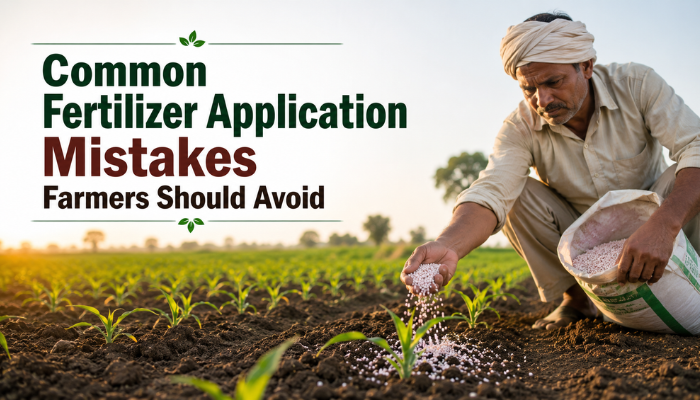
Fertilizer is an important input for healthy crop growth. It provides crops with essential nutrients and helps improve yield and quality. However, using the wrong fertilizer, applying too much, or applying it at the wrong time can waste money and affect crop and soil health.
Many farmers face lower yields and higher input costs because of simple fertilizer application mistakes. Understanding these common mistakes can help farmers use fertilizers more effectively, reduce waste, protect soil health, and improve farm income.
Why Correct Fertilizer Application Matters?
Correct fertilizer application helps crops receive the nutrients they need at the right time and in the right amount. Proper fertilizer management can provide several benefits:
- Better nutrient uptake by crops
- Improved crop growth, yield, and quality
- Lower fertilizer and input costs
- Better soil health
- Less nutrient loss and environmental pollution
On the other hand, poor fertilizer application can cause nutrient loss through runoff, leaching, or evaporation. It can also create nutrient imbalances, reduce soil quality, and cause fertilizer burn that may damage crops.
Common Fertilizer Application Mistakes Farmers Should Avoid
Here are some of the most common fertilizer application mistakes and simple ways to fix them.
1. Applying Fertilizer Without Soil Testing
- Many farmers apply fertilizers based on past experience or simply use the same fertilizer that nearby farmers are using.
- However, nutrient levels can vary from one field to another.
- Applying fertilizer without knowing the soil condition may result in too much of one nutrient and not enough of another.
How to fix it:
Test the soil every 2-3 years. Use the soil test results to decide the right type and amount of fertilizer required for the crop.
2. Over-Fertilization
Using more fertilizer does not always mean getting a higher yield. Excess fertilizer can harm both crops and soil.
Over-fertilization can lead to:
- Fertilizer burn and root damage
- Leaf yellowing
- Nutrient leaching
- Soil salinity
- Nutrient imbalance
- Higher production costs
How to fix it:
Follow the recommended fertilizer dose for the crop and soil. Where suitable, divide fertilizer into multiple applications instead of applying the entire quantity at once.
3. Under-Fertilization
- Using too little fertilizer can also affect crop growth.
- When crops do not receive enough nutrients, their growth and yield potential may decrease.
- Some farmers reduce fertilizer use to lower costs, but this may result in poor crop performance and lower returns.
How to fix it:
Use a balanced fertilizer dose based on soil test results and the nutrient requirements of the crop.
4. Applying Fertilizer at the Wrong Time
- The timing of fertilizer application is important because crops need different nutrients at different growth stages.
- For example, too much nitrogen before flowering can encourage excessive vegetative growth and increase the risk of lodging.
- Applying fertilizer just before heavy rainfall can also result in nutrient runoff.
How to fix it:
Match fertilizer application with the crop growth stage and weather conditions. Apply nutrients when crops can use them effectively.
5. Incorrect Fertilizer Placement
- Simply spreading fertilizer on the soil surface may result in nutrient losses through runoff or evaporation.
- At the same time, placing fertilizer too close to seeds can damage young seedlings.
How to fix it:
Use suitable methods such as banding, side dressing, or fertigation. Place fertilizer where crop roots can access the nutrients without causing seed or root damage.
6. Using the Wrong Type of Fertilizer
- Different crops and soils have different nutrient requirements.
- For example, using urea when phosphorus is required or applying NPK when the main problem is a micronutrient deficiency may not solve the nutrient problem.
- Some fertilizers may also be less suitable for certain soil conditions, such as high-pH soils.
How to fix it:
Select fertilizer based on the soil test, crop requirements, and local agricultural recommendations.
7. Ignoring Weather Conditions
- Weather can have a major effect on fertilizer efficiency.
- Heavy rain can wash nutrients away, while high temperatures can increase nitrogen losses through volatilization.
- Applying fertilizer during drought or on waterlogged soil can also reduce nutrient uptake.
How to fix it:
Apply fertilizer when the soil has suitable moisture. Avoid applying it just before heavy rain, during waterlogging, or when the soil is extremely dry.
8. Poor Calibration of Application Equipment
- Incorrect settings on spreaders and other fertilizer application equipment can result in uneven distribution.
- Some parts of the field may receive too much fertilizer while others receive too little.
How to fix it:
Calibrate spreaders, sprayers, and fertigation equipment regularly. Check the distribution pattern to ensure fertilizer is applied evenly.
9. Mixing Incompatible Fertilizers or Chemicals
- Some fertilizers may not be compatible with pesticides or other agricultural inputs.
- Mixing incompatible products can cause unwanted chemical reactions, reduce effectiveness, or damage crops.
How to fix it:
Always check product labels and compatibility information before mixing fertilizers with other inputs. When unsure, take advice from an agricultural expert.
10. Relying Only on Chemical Fertilizers
- Chemical fertilizers provide important nutrients, but depending only on them for a long period may affect soil health.
- Continuous use without proper nutrient management can reduce organic matter and affect beneficial microbial activity.
How to fix it:
Use chemical fertilizers along with suitable organic sources such as farmyard manure (FYM), compost, and green manure. Biofertilizers can also be included where appropriate as part of an integrated nutrient management approach.
How to Avoid Fertilizer Application Mistakes
Farmers can improve fertilizer efficiency by following a few practical steps.
- Check spreaders, sprayers, and fertigation systems regularly.
- Proper calibration helps ensure that the recommended amount of fertilizer reaches the field evenly.
- Maintain records of the fertilizer type, quantity, application date, crop, and field.
- These records can help farmers understand what works best and plan future fertilizer applications.
- Agronomists, soil scientists, and local agriculture officers can provide useful advice on fertilizer selection, dosage, timing, and application methods.
- Farmers should also stay updated about recommended farming practices.
Benefits of Avoiding Fertilizer Application Mistakes
Proper fertilizer management can help farmers achieve:
- Higher crop yield and better quality
- Lower fertilizer costs and less waste
- Better soil health
- Improved long-term farm productivity
- Less nutrient runoff and leaching
- Better return on investment
Conclusion
Avoiding common fertilizer application mistakes is important for profitable and sustainable farming. Simple practices such as soil testing, using the correct dose, choosing the right fertilizer, applying nutrients at the right time, and using proper placement methods can make a major difference.
Looking for a reliable organic fertilizer to support healthier crops and better soil health? SV Agro Solutions offers quality fertilizer solutions developed to meet the nutritional needs of different crops and farming conditions. As a trusted fertilizer manufacturer in Pune, SV Agro Solutions focuses on research-based and quality-tested products that support better crop growth, nutrient management, and sustainable farming.
Its fertilizer range, including SV Mr. Micro-G, can help farmers improve crop nutrition and overall farm productivity. Learn more about SV Agro Solutions’ fertilizer solutions and choose the right option for your farming needs.
FAQs
1. What are the most common fertilizer application mistakes?
The most common mistakes include applying fertilizer without soil testing, using too much or too little fertilizer, choosing the wrong fertilizer, applying it at the wrong time or place, and ignoring weather conditions.
2. How can I avoid fertilizer burn in crops?
Follow the recommended fertilizer dose, use split applications where suitable, and maintain proper soil moisture.
3. Is soil testing necessary before fertilizer application?
Yes. Soil testing helps identify nutrient deficiencies and excesses. It allows farmers to select suitable fertilizers and avoid unnecessary applications, helping save costs and maintain soil health.
4. What is the best time to apply fertilizer?
The best time depends on the crop, fertilizer, soil, and growth stage. Generally, fertilizer should be applied according to crop nutrient requirements, with basal application at sowing or transplanting and top dressing during suitable active growth stages.
5. Can I mix fertilizers with pesticides?
Only when the products are compatible. Always check the product label and mixing instructions before combining fertilizers with pesticides. If there is any doubt, consult an agricultural expert.