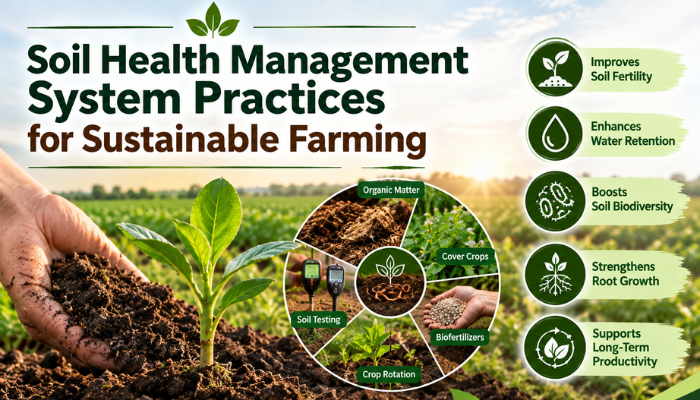
Healthy soil is important for good crops and sustainable farming. Soil management includes simple farming practices that help plants grow, use nutrients properly, manage water, and support useful soil organisms.
A soil health management system focuses on maintaining soil fertility, structure, water, and biological activity for the long term. Practices like reducing soil disturbance, keeping soil covered, growing different crops, and maintaining living roots help improve soil health.
In this blog, we will discuss important soil health management system practices and how they support sustainable farming and long-term soil health.
Best Soil Health Management System Practices for Sustainable Farming
These practical soil health management practices help farmers maintain fertile soil while supporting productive farming:
1. Minimise Soil Disturbance
Frequent and heavy soil preparation can damage soil structure, increase erosion and disturb organisms living in the soil. Reducing unnecessary soil disturbance helps protect soil structure, organic matter and biological activity.
Farmers can consider:
- Minimum or reduced soil preparation
- Conservation tillage
- No-till systems
- Avoiding unnecessary field operations
- Reducing traffic over wet soils to limit compaction
The appropriate level of soil preparation depends on crop requirements, soil conditions and the local farming system.
2. Keep Soil Covered
Uncovered soil is more likely to be affected by wind and water erosion. Crop residues and cover crops create a protective layer over the soil surface.
Cover crops can help:
- Reduce soil erosion
- Protect soil from rainfall impact
- Recycle nutrients
- Control some weeds
- Add plant material to the soil
- Support soil organisms
Keeping crop residues on the field after harvest, where appropriate, can also help protect the soil between growing seasons.
3. Use Crop Rotation
Growing the same crop repeatedly can use up certain nutrients and may increase the risk of crop-specific pests and diseases. Crop rotation means growing different crops as part of the farming cycle.
For example, a rotation may include cereals, legumes and other suitable crops instead of relying on a single crop year after year.
Benefits can include:
- Greater crop diversity
- Better nutrient cycling
- Better use of soil resources
- Breaking some pest and disease cycles
- More varied plant residues and root systems
4. Maintain Living Roots
Soil organisms depend on organic matter and nutrients provided by plants and their roots. Keeping living roots in the soil for longer can therefore support soil life and nutrient cycling.
Farmers can keep living roots in the soil for longer by:
- Selecting suitable long season crops
- Using cover crops between main crops
- Including different crop types in rotations
- Avoiding long periods of uncovered soil
This approach also helps support soil life when the main crop is not actively growing.
5. Improve Soil Organic Matter
Soil organic matter helps improve soil structure, nutrient supply and water holding capacity. Crop residues, compost, organic fertilizers and other organic materials can help increase organic matter in the soil.
Good management includes:
- Returning suitable crop residues to the soil
- Using properly managed organic fertiliser where appropriate
- Growing cover crops
- Reducing practices that improves organic matter loss
- Monitoring soil conditions over time
The goal is not simply to add more material, but to maintain a healthy balance within the soil system.
6. Manage Nutrients Responsibly
Crops need the right amount of nutrients. Too little can slow growth, while too much can waste nutrients and harm the environment.
A responsible nutrient management approach should consider:
- Soil test results
- Nutrient needs of the crop
- Suitable nutrient sources
- Nutrients removed by crops
- Nutrient loss through flowing water or soil drainage
7. Manage Water Efficiently
Water management is closely linked to soil health. Healthy soil with good structure can absorb and store more water, while damaged soil may lead to more water loss.
Sustainable water management can include:
- Watering based on crop and soil needs
- Protecting soil structure
- Improving water infiltration
- Avoiding too much irrigation
- Using suitable irrigation systems and schedules
The right approach depends on soil type, crop, rainfall and local water availability.
8. Control Soil Erosion
Erosion removes valuable topsoil and can transport soil particles and nutrients away from agricultural land.
To reduce erosion, farmers can use practices such as:
- Cover crops
- Crop residues
- Reduced soil preparation
- Farming along the natural slope where suitable
- Plant barriers
- Keeping the soil covered during high-risk periods
Combining several erosion-control measures is often more effective than relying on a single practice.
9. Reduce Soil Compaction
Soil hardening can reduce the space between soil particles and limit the movement of air and water. It can also make it harder for plant roots to grow properly.
Farmers can reduce the risk of soil becoming hard by:
- Limiting unnecessary machinery use
- Avoiding field work when soil is very wet
- Using controlled traffic methods
- Maintaining suitable soil organic matter
- Managing grazing pressure properly
These practices help keep the soil loose, healthy and suitable for strong root growth.
Why Soil Health Matters for Sustainable Farming
Soil health affects more than crop growth. It influences how agricultural land stores and moves water, manages nutrients and supports soil life.
Healthy soils can help farmers:
- Improve water absorption and storage
- Support nutrient cycling
- Reduce soil erosion and water loss
- Maintain good soil structure
- Support different types of soil organisms
- Helps crops handle too much or too little water.
- Can reduce unnecessary input and field-work costs.
For a better understanding of environmentally responsible agricultural methods, farmers can also explore sustainable farming methods and compare different approaches according to their farm's needs.
Soil Testing and Monitoring
A soil health programme should not depend only on what we can see. Regular soil tests and field checks can help farmers understand changes in soil condition and make better management decisions.
Depending on the farming system, monitoring may include:
- Soil pH
- Organic matter
- Soil structure
- Soil hardening
- Water absorption
- Crop performance
- Signs of soil erosion
- Soil Life
Comparing results over several seasons can give a clearer idea of whether changes in farming practices are improving soil health.
Common Mistakes That Can Harm Soil Health
Even good farming decisions can harm soil when they are done at the wrong time or used too much.
Common issues include:
- Too much soil preparation
- Leaving soil uncovered for long periods
- Growing the same crop repeatedly
- Using too much fertiliser
- Poor water management
- Heavy machinery traffic on wet soil
- Removing too much crop residue
- Ignoring early signs of soil erosion or hardening
A soil health management system helps farmers consider these factors together instead of dealing with soil problems one at a time.
Conclusion
A Soil Health Management System supports sustainable farming by combining reduced soil disturbance, soil cover, crop variety, living roots, organic matter, balanced nutrients and efficient water management to keep soil healthy and productive. Farmers should select practices according to their soil, climate, crops and farming goals and check results over time.
Choose SV Agro Solutions for Quality Agricultural Inputs
SV Agro Solutions Pvt. Ltd. is a leading producer of agricultural inputs, offering quality biostimulants, fertilizers and micronutrients to support healthy crop growth and better soil management. The company has its own research and development facility in Indapur, Pune, Maharashtra, along with a manufacturing unit at Indapur MIDC.
With its focus on product quality, research and innovation, SV Agro Solutions serves more than 80,000 farmers across Maharashtra, Karnataka, Gujarat, Odisha and other regions of India. Its range of biostimulants, fertilizers and micronutrients is developed to support plant growth, improve nutrient availability and help farmers maintain productive and healthy crops.
FAQs
- What are some sustainable agricultural practices that can benefit soil health?
Crop rotation, cover cropping, reduced soil preparation, crop residue management, organic matter addition, balanced nutrient use and erosion control help improve soil health.
- What are the 7 practices of sustainable agriculture?
The seven common practices are crop rotation, cover crops, reduced soil preparation, organic matter management, integrated pest management, precise nutrient management and efficient water management.
- What is the best practice to maintain soil health in organic farming?
A combination of crop rotation, cover crops, organic matter management, soil cover and reduced soil disturbance is effective for maintaining soil health.
- What are the 5 principles of soil health?
Soil health principles generally include minimising disturbance, maximising soil cover, increasing crop diversity, maintaining living roots and supporting healthy soil biological activity.
- What are sustainable soil management practices?
Sustainable soil management includes reduced soil preparation, crop rotation, cover crops, organic matter management, balanced nutrients, efficient water use and erosion control.