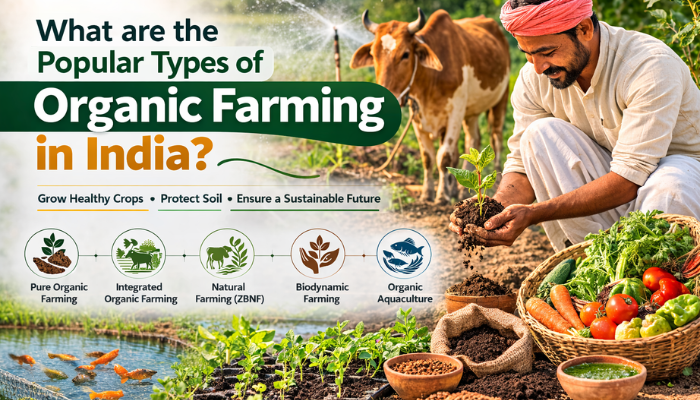
Organic farming is becoming popular in India as farmers look for safe and sustainable ways to grow crops. In this method, chemical fertilizers and pesticides are avoided, and natural inputs are used to maintain soil health.
The main types of organic farming include pure organic farming, integrated organic farming, natural farming (ZBNF), biodynamic farming, and organic aquaculture systems. With support from schemes like Paramparagat Krishi Vikas Yojana, states such as Sikkim and Madhya Pradesh are leading the growth of organic farming in India. This guide explains these types and the techniques for farmers.
Types of Organic Farming in India
Here are the main types of organic farming in India, the inputs used in each method, the farm scale, and the states where these practices are commonly followed.
|
Type of Organic Farming |
Main Inputs Used |
Farm Size / Cost |
|
Pure Organic Farming |
Uses natural inputs like compost and bio-pesticides. No chemical fertilizers or pesticides are used. |
Mostly practised on small farms. The cost is moderate because farmers prepare natural inputs. |
|
Integrated Organic Farming |
Uses farm resources such as crop waste, animal manure, and livestock together to support farming. |
Suitable for medium to large farms. Requires low external inputs because most resources come from the farm itself. |
|
Natural Farming (ZBNF) |
Uses natural solutions made from desi cow products such as Jeevamrut and Beejamrut. |
Best for small farms and very low-cost farming because most inputs are locally available. |
|
Biodynamic Farming |
Uses special herbal and natural preparations to improve soil health and plant growth. |
Usually practiced on small farms and requires good knowledge and careful management. |
|
Organic-Aquaculture Farming |
Combines crop farming with fish farming in the same field or water system. |
Suitable for wetland farming areas and helps farmers earn income from both crops and fish. |
1. Pure Organic Farming
Pure organic farming is the most traditional form of organic farming. In this system, farmers use only natural inputs such as compost, farmyard manure, green manure, and bio-pesticides.
Chemical fertilisers, synthetic pesticides, and genetically modified seeds are completely avoided.
State- Sikkim (India’s first fully organic state, where all farmland follows organic practices)
Year- The organic farming movement began in 2003 when chemical fertilisers were banned.
Features
- Uses natural fertilizers like compost and vermicompost
- Uses bio-pesticides and herbal sprays
- Focuses on traditional farming practices
- Maintains soil fertility naturally
2. Integrated Organic Farming
Integrated organic farming is a holistic farming system where crops, livestock, poultry, and sometimes fish farming are combined. The waste from one activity becomes input for another.
For example, cow dung from livestock is used to make manure, which improves soil fertility for crops.
States- Sikkim, Uttarakhand, Tripura
Year- Started in the early 2000s as a modern and sustainable farming approach.
Features
- Combines crops, livestock, poultry, and fisheries
- Uses farm waste as natural fertilizer
- Reduces the need for external inputs
- Improves farm productivity and income
3. Natural Farming (ZBNF / SPNF)
Natural farming is a low-cost organic farming system developed by Subhash Palekar. It is also called Zero Budget Natural Farming (ZBNF) because farmers can grow crops with very low input costs.
This system mainly uses products made from desi cow dung and urine, such as Jeevamrut and Beejamrut.
States- Karnataka, Andhra Pradesh and Himachal Pradesh
Year- In the mid 1990s, by Subhash Palekar in Karnataka, and later expanded widely in Andhra Pradesh.
Features
- Very low farming cost
- No chemical fertilizers or pesticides
- Uses cow-based natural inputs
- Focuses on soil microbes and natural processes
4. Biodynamic Farming
Biodynamic farming is a special type of organic farming that treats the farm as a living ecosystem. It uses herbal preparations, compost mixtures, and follows natural cycles such as lunar phases. Although this method is not very common in India, it is slowly growing in hill states.
States- Kerala, Gujarat, Madhya Pradesh, and Uttarakhand
Year- Introduced in the early 1990s and started by T.G.K. Menon, who conducted training workshops for Indian farmers.
Features
- Uses herbal compost preparations
- Follows lunar and natural cycles
- Improves soil fertility naturally
- Focuses on ecological balance
5. Integrated Organic-Aquaculture Farming
In this system, crop farming is combined with fish farming. One common example is the paddy-fish system, where fish are raised in rice fields.
Fish help control pests and weeds, while their waste acts as natural fertilizer for crops.
State- Sikkim (first organic fish cluster started in Soreng district)
Year- Recently launched in 2025 under the Pradhan Mantri Matsya Sampada Yojana (PMMSY) to promote organic fish farming.
Features
- Combines rice farming with fish culture
- Efficient use of water resources
- Provides both grain and protein production
- Increases farmer income
This system is common in wetland regions such as Assam and Manipur.
Techniques Used in Organic Farming
Different types of organic farming use similar natural techniques to maintain soil health and improve crop production.
- Crop Rotation: Growing different crops in different seasons to maintain soil nutrients, improve soil health, and reduce pests and weeds.
- Composting and Mulching: Using decomposed organic waste and plant materials to improve soil fertility and retain moisture.
- Green Manure: Growing special crops like clover or sunhemp and mixing them into the soil to add natural nutrients.
- Integrated Pest Management (IPM): Controlling pests using natural methods such as beneficial insects, traps, and bio-pesticides like neem oil instead of chemicals.
- Mixed Farming: Combining crop farming with livestock so that animal manure can be used as natural fertilizer, creating a sustainable farming system
Conclusion
Organic farming is a sustainable way to grow crops while protecting soil health and the environment. Different types of organic farming, such as pure organic farming, integrated farming, natural farming, biodynamic farming, and organic-aquaculture systems, allow farmers to choose methods that suit their land and resources.
Start your organic farming journey with the support of SV Agro Solutions' organic fertilizers. Our research-based organic inputs help improve soil health, increase nutrient availability, and support healthy crop growth. The company also provides expert guidance to farmers from sowing to harvest, helping them achieve higher yields with sustainable farming practices.
FAQs
1. How does ZBNF differ from pure organic farming?
ZBNF focuses on very low-cost farming using cow-based inputs, while pure organic farming may use purchased organic inputs like compost and bio-fertilizers.
2. Which type of organic farming is best for small farmers?
Natural farming (ZBNF) and pure organic farming are often suitable for small farmers because they require lower investment.
3. Which government scheme supports organic farming in India?
The Paramparagat Krishi Vikas Yojana (PKVY) scheme supports organic farming through training and financial assistance.
4. Why is crop rotation important in organic farming?
Crop rotation improves soil fertility, reduces pest problems, and helps maintain healthy crop production.