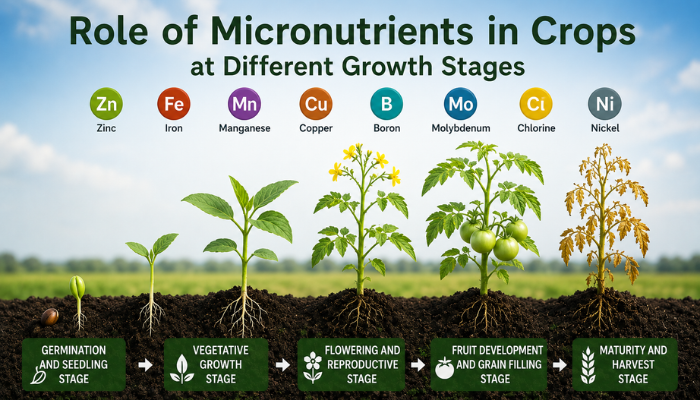
Crops need more than just Nitrogen (N), Phosphorus (P), and Potassium (K) for healthy growth. They also need small amounts of other important nutrients called micronutrients.
Micronutrients are needed in very small quantities, but they play an important role in plant growth, flowering, fruit development, and crop quality. Even a small micronutrient deficiency can reduce crop yield and quality.
Understanding the role of micronutrients in crops at different growth stages helps farmers provide the right nutrients at the right time for healthier crops and better harvests.
What Are Micronutrients?
Micronutrients are essential nutrients that crops need in small amounts for healthy growth and development. The main micronutrients required by crops include Zinc (Zn), Iron (Fe), Manganese (Mn), Copper (Cu), Boron (B), Molybdenum (Mo), Chlorine (Cl), and Nickel (Ni) in small amounts.
These nutrients support important plant functions such as photosynthesis, enzyme activity, hormone production, flowering, seed formation, and stress management.
Why Are Micronutrients Important for Crops?
Micronutrients support many important plant functions, including:
- Helping crops produce chlorophyll and carry out photosynthesis.
- Supporting enzyme activity and plant metabolism.
- Helping maintain proper hormone balance.
- Supporting flowering, fruit set, and seed formation.
- Improving root, leaf, and stem development.
- Helping crops tolerate drought, heat, salinity, and other stresses.
- Supporting better crop quality and yield.
Even when farmers apply enough N, P, and K, a micronutrient deficiency can still affect crop growth and yield.
Role of Micronutrients in Crops at Different Growth Stages
Different micronutrients become important at different stages of crop growth. Providing the required nutrients at the right stage helps crops develop properly.
1. Germination and Seedling Stage
During germination and early seedling growth, crops need strong roots and healthy early growth.
Important micronutrients at this stage include:
- Zinc: Supports early root growth and helps maintain proper plant hormone activity.
- Manganese: Supports germination and early leaf development.
- Boron: Helps cell division and root tip growth.
- Iron: Supports chlorophyll formation and helps young crops develop a healthy green colour.
A lack of micronutrients during this stage can result in weak seedlings, poor root growth, and slow crop establishment.
2. Vegetative Growth Stage
During the vegetative stage, crops develop their leaves, stems, and roots. Good micronutrient supply helps crops build a strong structure.
- Iron: Helps in chlorophyll formation and photosynthesis, which keeps leaves healthy and green.
- Manganese: Supports photosynthesis and proper nitrogen use.
- Zinc: Helps with protein formation, leaf growth, and stem development.
- Copper: Supports enzyme activity and helps strengthen plant tissues.
- Chlorine: Helps maintain water balance and proper stomatal function.
Proper micronutrient nutrition during this stage helps crops develop a strong base for flowering and fruit or grain production.
3. Flowering and Reproductive Stage
The flowering stage is very important because it affects flower formation, fruit set, seed development, and final yield.
- Boron: Supports flowering, pollen development, fruit set, and seed formation.
- Zinc: Helps maintain hormone balance and supports fruit and grain development.
- Copper: Supports reproductive growth and seed quality.
- Molybdenum: Helps crops use nitrogen properly, especially in pulse and legume crops.
A deficiency of Boron or Zinc during flowering may result in flower drop, poor fruit set, and poor grain formation.
4. Grain Filling and Fruit Development Stage
During grain filling and fruit development, crops need proper nutrition to produce good-size, weight, and quality.
- Zinc: Supports carbohydrate use and helps in grain filling.
- Iron: Supports chlorophyll formation and continued photosynthesis.
- Manganese: Helps maintain photosynthesis and food production.
- Copper: Supports grain and fruit quality.
- Boron: Helps with seed development and uniform crop maturity.
Proper micronutrient supply at this stage can help improve grain weight, fruit size, colour, and overall market quality.
5. Maturity and Harvest Stage
Micronutrients also play a role during crop maturity and harvesting.
- Boron and Zinc: Support uniform maturity and seed development.
- Manganese: Helps with proper crop maturity and seed quality.
- Molybdenum: Supports proper nitrogen use and can help maintain seed protein development.
Good micronutrient nutrition at maturity can support better seed quality, uniform harvesting, and improved storage performance.
Micronutrient Functions in Crops
Here is a quick look at the main functions of important micronutrients:
- Zinc (Zn): Supports hormone balance, protein formation, root growth, stem growth, and grain development.
- Iron (Fe): Helps with chlorophyll formation, photosynthesis, and enzyme activity.
- Manganese (Mn): Supports photosynthesis, nitrogen use, germination, and crop maturity.
- Copper (Cu): Supports enzyme activity, reproductive growth, and plant tissue strength.
- Boron (B): Helps with cell wall formation, flowering, fruit set, and seed development.
- Molybdenum (Mo): Helps with nitrogen fixation and nitrogen use, especially in legume crops.
- Chlorine (Cl): Helps maintain water balance, stomatal activity, and plant health.
Common Micronutrient Deficiency Symptoms
Micronutrient deficiencies can affect plant growth in different ways.
- Zinc deficiency: Small leaves, short plant growth, short internodes, and stunted crops.
- Iron deficiency: Young leaves may turn yellow while the veins remain green.
- Manganese deficiency: Yellowing between leaf veins and small brown spots may appear.
- Copper deficiency: Young leaves may wilt, and flowering or fruit and grain formation may be poor.
- Boron deficiency: Growing points may die, stems may become hollow, and fruit set may be poor.
- Molybdenum deficiency: Yellowing, stunted growth, and poor nodulation may occur in legume crops.
- Chlorine deficiency: Wilting, chlorosis, and reduced root growth may occur.
Many nutrient deficiency symptoms look similar. Therefore, soil testing and leaf testing can help farmers identify the actual nutrient deficiency before applying a product.
How to Manage Micronutrients in Crops?
Farmers can manage micronutrients by following these simple practices:
1. Test the Soil and Leaves
Test the soil before applying micronutrients to identify which nutrients are low. Leaf testing can also help confirm nutrient problems during crop growth.
2. Use Micronutrient Mixtures
Micronutrient mixtures can provide nutrients such as Zinc, Iron, Manganese, Copper, Boron, and Molybdenum according to crop requirements.
3. Choose the Right Application Method
Micronutrients can be applied through:
- Soil application: Granular or soil-mixed products can be applied according to crop and soil requirements.
- Foliar spray: Water-soluble micronutrients can be sprayed directly on plant leaves.
- Seed treatment: Suitable micronutrients can be used during seed treatment to support early crop growth.
4. Apply at the Right Growth Stage
Apply micronutrients according to crop requirements and important growth stages such as:
- Seedling stage
- Vegetative growth
- Flowering
- Fruit development
- Grain filling
5. Avoid Excess Application
- Crops need micronutrients in very small amounts.
- Applying too much can cause toxicity and may damage the crop.
- Always follow the recommended dose and product instructions.
Benefits of Proper Micronutrient Management
Proper micronutrient management can help farmers achieve:
- Better germination and crop establishment.
- Stronger roots, leaves, and stems.
- Better flowering and fruit set.
- Improved grain filling and seed development.
- Higher crop yield.
- Better fruit and vegetable size, colour, and quality.
- Improved tolerance to drought, heat, salinity, and other stresses.
- Better overall crop health and productivity.
Conclusion
The role of micronutrients in crops is important at every stage of crop growth, from germination to maturity. Although crops need micronutrients in small amounts, these nutrients support important processes such as photosynthesis, root growth, flowering, fruit set, grain filling, and stress tolerance.
Want to improve crop growth, yield, and quality with the right micronutrient nutrition? SV Agro Solutions offers high-quality micronutrient fertilizers designed to support crops at different growth stages. Our solutions help provide essential nutrients like Zinc, Iron, Boron, Manganese, and other micronutrients needed for healthy roots, strong plant growth, better flowering, fruit development, and improved crop quality. Choose SV Agro Solutions for balanced crop nutrition and healthier, more productive crops.
FAQs
1. What is the role of micronutrients in crops?
Micronutrients support important plant functions such as photosynthesis, enzyme activity, hormone formation, flowering, fruit set, seed development, and stress tolerance.
2. Which micronutrients are important for flowering and fruit set?
Boron and Zinc are especially important during flowering because they support pollen development, fruit set, and seed formation.
3. When should farmers apply micronutrients?
Micronutrients should be applied at important crop stages such as seedling growth, vegetative growth, flowering, and grain or fruit development, based on crop and soil requirements.
4. Can too much micronutrient harm crops?
Yes. Excess micronutrients can cause toxicity, leaf damage, and poor plant growth. Farmers should always follow the recommended dose.
5. How can farmers identify micronutrient deficiency?
Farmers can look for symptoms such as yellow leaves, stunted growth, poor flowering, and poor fruit or grain development. Soil and leaf tests can help confirm the exact deficiency.