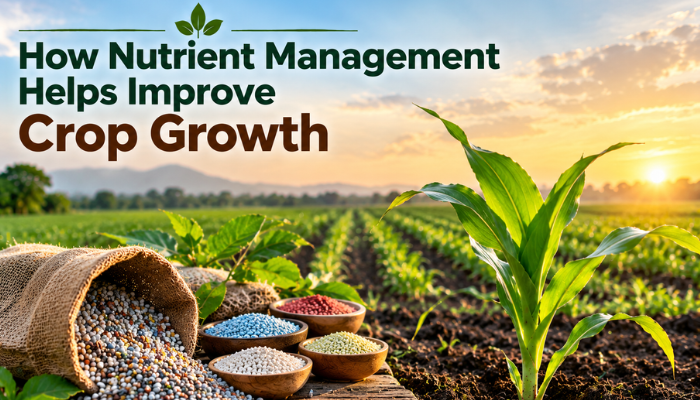
Crops need essential nutrients at every stage of growth to develop strong roots, healthy leaves, flowers, and quality grains or fruits. Just like people need a balanced diet, crops need the right nutrients in the right amount and at the right time.
Proper Nutrient Management helps farmers provide these nutrients according to the crop’s needs. It supports healthy crop growth, improves yield and quality, maintains soil health, and helps farmers use fertilizers efficiently.
In this blog, let’s understand how proper Nutrient Management can help crops grow better, improve yield, maintain soil health, and support more sustainable farming.
What is Nutrient Management?
Nutrient Management means planning and applying nutrients according to the needs of the crop and soil. It includes nutrients from different sources such as:
- Organic manures such as farmyard manure, compost, and vermicompost
- Biofertilizers
- Crop residues and green manures
- Chemical fertilizers
- Nutrients supplied through irrigation water and other organic sources
Good nutrient management follows the 4R principle:
- Right Source: Choose the right fertilizer or nutrient source.
- Right Rate: Apply the right amount based on soil and crop needs.
- Right Time: Apply nutrients when the crop needs them.
- Right Place: Apply nutrients where plant roots can easily absorb them.
How Nutrient Management Improves Crop Growth
Proper nutrient management provides crops with essential nutrients for healthy growth, strong development, and better yield.
1. Supports Early Growth and Strong Establishment
- Nutrients given during sowing or transplanting help young crops start growing properly.
- Proper nutrition helps seedlings develop healthy roots that can absorb water and nutrients better.
- Good nutrition supports healthy leaves, stems, and shoots during the early stage.
- Healthy early growth helps the crop develop properly in later stages and supports better yield.
2. Supports Healthy Vegetative Growth
- Nitrogen and other nutrients help crops develop healthy and green leaves.
- Healthy leaves can use sunlight more effectively to produce energy for crop growth.
- Balanced nutrients help plants develop stronger stems and root systems.
- Providing the required nutrients helps avoid weak growth and deficiency symptoms.
- Good nutrition helps plants grow evenly and maintain healthy vegetative growth.
3. Supports Flowering and Fruit Set
- Phosphorus and other nutrients support healthy flower development.
- Boron and other micronutrients play an important role in proper pollination and fruit set.
- Potassium and other nutrients support the development of healthy fruits.
- Balanced nutrition can help reduce unnecessary flower and young fruit drop.
- Good nutrition during flowering helps plants produce more healthy fruits, grains, or seeds.
4. Improves Grain and Fruit Filling
- Proper nutrients help grains develop properly during the reproductive stage.
- Adequate nutrition supports better fruit growth and size.
- Balanced nutrients can support better colour, weight, and overall produce quality.
- Good grain and fruit filling can increase the amount of marketable produce.
- Supplying nutrients when the crop needs them helps plants complete their growth properly.
5. Helps Crops Handle Stress
- Balanced nutrition supports stronger roots and helps plants use available water efficiently.
- Healthy and well-nourished crops can better manage high temperatures.
- Proper nutrient management can support crops growth when soil has excess salts.
- Balanced nutrition helps plants maintain healthy growth during difficult conditions.
- Well-nourished plants can recover better after facing environmental or pest-related stress.
Why is Nutrient Management Important for Sustainable Agriculture?
Nutrient management helps maintain soil fertility, reduce nutrient losses, and support long-term crop productivity.
1. Provides Essential Nutrients to Crops
- Crops need macronutrients such as N, P, K, Ca, Mg, and S and micronutrients such as Zn, Fe, Mn, Cu, B, Mo, and Cl.
- Proper nutrient management helps provide these nutrients when crops need them.
2. Improves Nutrient Use Efficiency
- Good nutrient management helps crops use applied nutrients more effectively.
- It reduces nutrient losses through leaching, runoff, and volatilization, which can also reduce fertilizer wastage and costs.
3. Supports Root and Plant Growth
- Balanced nutrition helps plants develop strong roots, healthy stems, and better leaf growth.
- Strong plants can absorb water and nutrients more effectively.
4. Improves Crop Yield and Quality
- A proper supply of nutrients supports grain filling, fruit size, colour, and overall crop quality.
- Better crop growth can result in higher and better-quality yields.
5. Supports Soil Health
- Balanced nutrient application helps prevent nutrient loss from the soil.
- Using organic and inorganic nutrient sources together can improve organic matter, soil structure, and microbial activity.
6. Reduces Environmental Impact
- Proper nutrient management reduces excess fertilizer use and nutrient runoff.
- It also helps reduce nutrient losses and supports more sustainable farming practices.
Components of Nutrient Management
Nutrient management includes soil testing, balanced fertilizer use, organic inputs, micronutrients, and timely nutrient application.
1. Soil Testing
- Soil testing helps identify nutrient deficiencies, soil pH, soil salinity, and organic matter levels.
- Farmers can use these results to plan fertilizer and manure applications.
2. Balanced Fertilizer Application
- Apply the right combination of N, P, K, and micronutrients according to crop and soil requirements.
- Avoid using too much or too little of one nutrient.
3. Use of Organic Sources
- Farmyard manure, compost, vermicompost, green manure, and crop residues add organic matter to the soil.
- They can improve soil structure, water retention, and microbial activity.
4. Biofertilizers and Microbial Inputs
- Biofertilizers such as Rhizobium, Azotobacter, and PSB can help improve nutrient availability.
- Beneficial microbes can help with nitrogen fixation, phosphorus availability, and root growth.
5. Crop Rotation and Legumes
- Crop rotation, especially with legumes, can improve soil fertility and help reduce pest problems.
- Legume crops can add nitrogen to the soil and may reduce the need for nitrogen fertilizers.
6. Split Application of Nutrients
- Applying nutrients, especially nitrogen, in split doses can improve nutrient uptake and reduce losses.
- It helps match nutrient supply with crop requirements during different growth stages.
Best Practices for Effective Nutrient Management
- Conduct soil testing regularly to check nutrient levels and understand the condition of the soil.
- Use soil test results to decide the right type and amount of fertilizer and manure.
- Follow the 4R principle by using the Right Source, Right Rate, Right Time, and Right Place when applying nutrients.
- Use organic fertilizers along with manure, compost, and biofertilizers where suitable to improve nutrient availability and support soil health.
- Apply nitrogen in split doses during important crop growth stages instead of applying the full amount at once.
- Split application helps crops use nitrogen better and reduces nutrient losses.
- Return crop residues to the soil to recycle nutrients and increase organic matter.
- Avoid burning crop residues because it can waste nutrients and affect soil health.
- Manage soil pH and salinity to improve nutrient availability and support healthy crop growth.
Improve Soil Health and Nutrient Availability with SV Agro
Looking for better soil nutrient management and healthier crop growth? SV Agro Solutions offers SV 59, a liquid soil conditioner that helps improve soil texture, water-holding capacity, root development, and nutrient uptake. It also supports beneficial microbial activity and helps make fixed nutrients available to plants. SV 59 can be used across agricultural crops and is suitable for improving overall soil health.
For supplying essential nutrients to crops, SV SN 40 is a liquid, nutrient-rich organic fertilizer containing bio-sulphur and bio-potash. It supports nutrient availability, improves nutrient uptake in high-pH and calcareous soils, and helps reduce nutrient deficiency symptoms. Using suitable soil and nutrient management products such as SV 59 and SV SN 40 can support healthier plants, better nutrient utilisation, and improved crop performance.
Conclusion
Nutrient Management is important for healthy crop growth, better crop yield, and sustainable farming. Soil testing, balanced fertilizer application, organic sources, biofertilizers, and proper nutrient timing help crops get the nutrients they need.
By following good nutrient management practices, farmers can improve crop productivity, use fertilizers more efficiently, reduce unnecessary costs, and maintain better soil health for long-term farming.
FAQs
1. What is a nutrient management plan?
A nutrient management plan helps farmers decide which nutrients to use, how much to use, and when to apply them based on crop and soil needs.
2. What are the types of nutrient management?
The main types include soil testing, balanced fertilizer use, organic manure, biofertilizers, crop rotation, and proper nutrient application.
3. How to do a nutrient management plan?
Start with soil testing, understand crop nutrient needs, and follow the 4R principle: Right Source, Right Rate, Right Time, and Right Place.
4. What is the role of nutrient management in natural farming?
It focuses on improving soil health, supporting natural microbes, and using natural nutrient sources instead of relying mainly on synthetic fertilizers.
5. Can nutrient management reduce fertilizer costs?
Yes. Using the right fertilizer and amount can reduce nutrient wastage and improve nutrient use efficiency, which may help lower fertilizer costs.