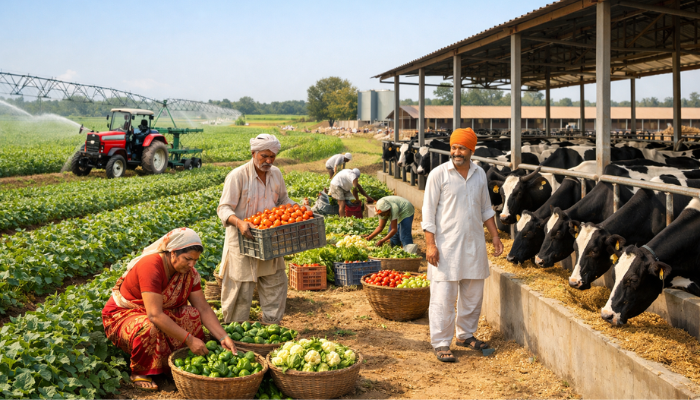
Commercial farming is very important for supplying food to cities and helping farmers earn a steady income. In this type of farming, crops are not grown just for family use. Instead, they are produced on a large scale to sell in the market. To increase production and profit, farmers use modern tools, improved seeds, fertilizers, irrigation systems, and machines.
In India, commercial farming is growing fast because of good road networks, cold storage, food processing industries, and export demand. Let us understand the different types of commercial farming in simple words.
What is Commercial Farming?
Commercial farming is farming done on a large scale to sell crops and animals in markets and earn a profit. Farmers use modern machines, good quality seeds, fertilizers, and new technology. It needs high investment but gives higher production.
Main Features of Commercial Farming-
- Profit purpose: Farming is done mainly to earn money, not just to feed the family.
- Large land area: Crops or animals are raised on large farms.
- Use of machines: Tractors, harvesters, and other machines are widely used.
- Modern materials: Farmers use HYV seeds, fertilizers, pesticides, and insecticides.
- Special focus: Usually, one main crop or animal type is grown in large quantities.
Main Types of Commercial Farming
An overview of the different types of commercial farming that farmers use to produce crops and livestock for market sales.
1. Plantation Farming
Plantation farming is a large-scale farming system where farmers grow one main cash crop like tea, coffee, rubber, sugarcane, or oil palm. It needs high investment, many workers, and modern methods, and the crops are mainly grown to sell in national and international markets for profit.
Examples:
Assam (tea), Kerala (rubber), Karnataka (coffee)
2. Mixed Farming
Mixed farming is a farming method where a farmer grows crops and raises animals on the same land. Crop leftovers are used as animal feed, and animal manure is used to fertilize the fields. This system saves costs, reduces risk, and gives farmers more than one source of income.
Example: Punjab farmers grow wheat and keep dairy cows.
3. Dairy Farming
Dairy farming is a type of farming where farmers raise animals mainly for milk. These animals can be cows, buffalo, goats, sheep, or camels. Farmers take care of breeding, feeding, and managing the animals to get more and better-quality milk.
The milk is then sold directly or used to make products like butter, cheese, and other dairy items.
Example: Gujarat’s Amul dairy model.
4. Livestock Ranching
Livestock ranching is a type of farming where farmers raise large groups of animals like cows and sheep on large open lands. These animals are reared for products such as meat, milk, and wool.
Farmers manage grazing areas and take care of the animals in open fields instead of keeping them in small sheds or closed spaces.
Example: Sheep rearing in Rajasthan.
5. Market Gardening (Truck Farming)
Market gardening is a type of farming where farmers grow vegetables, fruits, and flowers on small pieces of land. These crops are high-value and are sold directly in local markets, to shops, or to restaurants.
Farmers mostly use manual work and grow many different crops instead of just one.
Example: Vegetable farms near Bengaluru, Pune, and Delhi.
6. Grain Farming
Grain farming is a specialised, large-scale agricultural practice focused on cultivating cereal crops such as wheat, corn, rice, barley, and oats primarily for commercial sale and profit.
It is highly mechanised, utilizing advanced technology, tractors, and harvesters across vast tracts of land to maximize yield.
Example: Punjab and Haryana wheat farms.
Comparison of Types of Commercial Farming
A simple comparison of different types of commercial farming based on scale, crops, inputs, and where they are commonly practiced.
|
Type of Farming |
Farm Size & What is Grown |
What Farmers Mainly Need (Inputs) |
Example from India |
|
Plantation Farming |
Very big farms growing one cash crop like tea, coffee, or rubber. |
High investment, many workers, and processing machines. |
Tea gardens in Assam, rubber farms in Kerala |
|
Mixed Farming |
Farms growing crops and raising animals together. |
Animal feed, crop waste for animals, and manure for fields. |
Punjab farms grow wheat and keep dairy animals |
|
Dairy Farming |
Farms focused on milk production. |
Good breed animals, proper feed, clean sheds, and vet care |
Gujarat (Amul model) |
|
Livestock Ranching |
Raising many animals, like sheep or cattle, on open land |
Large grazing land and basic animal care |
Rajasthan sheep farms |
|
Market Gardening |
Small farms growing vegetables, fruits, and flowers for city markets |
Greenhouses, drip irrigation, and regular watering |
Vegetable farms near Bengaluru |
|
Grain Farming |
Large farms growing wheat, rice, or maize |
Use of tractors, harvesters, fertilizers, and irrigation systems |
Punjab wheat farms |
Need for Organic Fertilizer in Commercial Farming
- Organic fertilizers like compost and manure make soil loose, airy, and rich in organic matter. They also increase good soil microbes.
- Soil with organic matter stores water better, so crops need less irrigation and can handle dry weather.
- Nutrients are released little by little, so plants get steady food, and there is less risk of burning crops.
- Regular use can increase production over time and grow more nutritious, healthy crops.
- Healthy soil reduces the need for expensive chemical fertilizers, improving farm profit over time.
- Organic fertilizers reduce chemical pollution, improve natural nutrient cycling, and help store carbon in the soil.
Conclusion
Healthy soil is the key to successful farming. When farmers understand crop nutrition and notice problems early, they can take the right steps to protect crops, improve plant growth, and increase yield and profit. Strong soil and balanced nutrients, along with choosing the different types of commercial farming suitable for their region, help farmers achieve long-term success.
Improve Your Crop Health with SV Agro Biostimulants!
SV Agro biostimulants naturally support stronger plant growth. They improve nutrient absorption, promote better root development, and help crops handle stress like drought and poor soil conditions. With SV Agro solutions, farmers can grow healthier crops, get higher yields, and practice more sustainable farming.
FAQs
1. What is another name for commercial farming?
Commercial farming is also called commercial agriculture or agribusiness, where crops and animals are grown mainly for sale in the market.
2. What type of commercial farming is most profitable?
Farming that produces high-demand products like organic vegetables, free-range eggs, grass-fed meat, mushrooms, or microgreens is usually more profitable.
3. What are the major crops of commercial farming?
Main commercial crops in India include cotton, jute, and sugarcane, which are grown mainly for sale and industrial use.
4. What is the largest commercial crop in India?
Rice is the largest crop in India and is the main food for most people in the country.