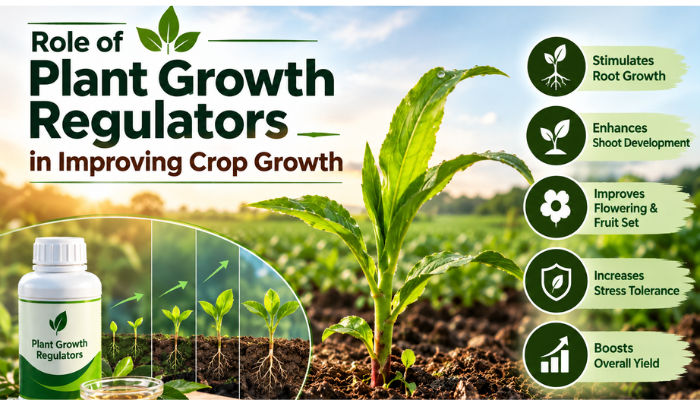
Plants naturally produce hormones that help control their growth and development. These hormones help with root growth, shoot growth, flowering, fruit formation, ripening, and maturity.
Plant Growth Regulators (PGRs) are natural or man-made substances that help control plant growth. They can be used to support root growth, improve flowering and fruit development, manage plant growth, and improve crop quality.
Understanding the Role of Plant Growth Regulators helps farmers select the right product and apply it at the appropriate crop stage.
What are Plant Growth Regulators?
Plant Growth Regulators are compounds that affect plant growth and development when used in small quantities. They are different from fertilizers because they do not mainly provide nutrients such as nitrogen, phosphorus, potassium, or micronutrients.
PGRs can influence several plant activities, including:
- Seed germination
- Root and shoot development
- Cell division and growth
- Flowering
- Fruit formation
- Fruit ripening
- Plant height
- Leaf ageing and dormancy
The major groups of plant hormones associated with growth regulation include auxins, gibberellins, cytokinins, ethylene, and abscisic acid.
Role of Plant Growth Regulators at Different Crop Stages
PGRs support different plant needs, from root growth and flowering to fruit development and maturity.
During Seed Germination and Early Growth
- At the early stage, PGRs may help manage seed dormancy and support germination.
- Some PGR applications can also encourage early root and shoot development, helping seedlings establish well.
During Vegetative Growth
- During vegetative growth, PGRs can be used to manage plant height, branching, root development, and canopy growth.
- Maintaining a suitable plant structure can help crops make better use of sunlight, water, and available nutrients.
During Flowering and Fruit Set
- At the flowering stage, some PGRs can help manage flowering and improve fruit set.
- They may also help reduce the dropping of flowers or young fruits in suitable crops.
- This is especially important for horticultural crops where fruit set has a direct effect on production.
During Fruit Development and Maturity
- During fruit development, selected PGRs may help manage fruit size, firmness, colour, maturity, and uniformity.
- In some crops, they may also support more uniform maturity and harvesting.
During Stress Conditions
- Some PGRs can influence plant responses to environmental conditions such as drought, salinity, heat, and transplanting stress.
- However, PGRs should not replace proper irrigation, nutrition, or other essential crop management practices.
Why are Plant Growth Regulators Important in Agriculture?
Plant Growth Regulators help farmers manage particular stages of crop development. When used correctly, they can support:
- Better seed germination
- Stronger crop establishment
- Improved root development
- Better branching and plant structure
- Controlled plant height
- Improved flowering and fruit set
- Reduced premature fruit drop
- Better fruit size and quality
- More uniform crop maturity
- Easier harvesting
PGRs are most effective when used along with proper soil management, balanced nutrition, irrigation, and pest management. They should not be considered a substitute for basic crop care.
Types of Plant Growth Regulators
Plant Growth Regulators are available in different types, each helping with specific plant growth processes such as roots, shoots, flowering, fruiting, and maturity.
1. Auxins
Auxins help crops grow roots and fruits.
- Help root growth
- Improve fruit setting
- Reduce early fruit drop
- Support fruit growth
- Examples: IAA, IBA, NAA
2. Gibberellins
Gibberellins help crops grow and develop fruits.
- Help seed germination
- Support plant growth
- Improve fruit size
- Help in fruit development
- Example: GA₃
3. Cytokinins
Cytokinins help plants grow new shoots and leaves.
- Help shoot growth
- Encourage new branches
- Support cell growth
- Keep leaves fresh for longer
- Support fruit and vegetable growth
4. Ethylene
Ethylene helps control fruit ripening and maturity.
- Helps fruits ripen
- Improves fruit colour
- Helps manage maturity
- Supports more uniform harvesting
- Example: Ethephon
5. Abscisic Acid and Growth Inhibitors
These help control plant growth and water loss.
- Help plants handle water stress
- Control excess plant growth
- Help manage plant height
- Reduce lodging
- Support stronger plant structure
How to Use Plant Growth Regulators Correctly?
Use the right PGR at the recommended dose and crop stage to support healthy and balanced plant growth.
1. Select the Right PGR
- Choose the product based on the crop, growth stage, crop problem, and expected result.
- A PGR suitable for root development may not be suitable for fruit development or ripening.
2. Apply at the Right Crop Stage
- The timing of the PGR application is very important.
- Applying a product too early or too late may reduce its effectiveness or cause unwanted effects.
- Always follow the product label and crop specific’s recommendation.
3. Use the Recommended Dose
- PGRs are effective in small quantities. Using a higher dose does not necessarily give better results.
- Excessive application can lead to abnormal growth, poor flowering, leaf damage, fruit drop, or reduced crop performance.
4. Follow the Correct Application Method
Depending on the product and crop, PGRs can be applied through:
- Seed treatment
- Soil drenching
- Foliar spray
- Fertigation
For foliar sprays, ensure proper and even coverage of the plant.
5. Check Weather Conditions
- Weather conditions can affect the application and performance of PGRs.
- Follow the product instructions and avoid spraying during unsuitable conditions such as strong winds, heavy rain, or extreme heat.
6. Try on a Small Area First
- Before applying a new PGR across the whole field, testing it on a small area can help farmers observe how the crop responds.
- If the response is satisfactory, the product can be used according to the recommended instructions.
Improve Fruit Size and Quality with Plant Growth Regulators
SV Agro Solutions’ SV Size Builder is a unique blend of auxins, vitamins, fulvic acid, proteins, enzymes, and other plant-supporting nutrients designed to support faster fruit growth and size development. It helps improve fruit size, weight, colour, and shine, making it suitable for orchards and crops with a high fruit load.
With SV Size Builder from SV Agro Solutions, farmers can support better fruit development and improve overall crop quality. It is designed to help plants during important fruit development stages and support better marketable produce.
Conclusion
The Role of Plant Growth Regulators is to influence specific plant growth and development processes. Depending on the crop and product, PGRs can support seed germination, root growth, flowering, fruit set, fruit development, crop quality, maturity, and harvesting.
For effective results, farmers should select the appropriate PGR, use the recommended dose, and apply it at the correct crop stage. Proper application can support crop development, while incorrect or excessive use may cause unwanted effects.
FAQs
1. What are the types of PGR?
PGRs are mainly classified into three types: growth promoters, growth retardants, and growth inhibitors.
2. What is the main Role of Plant Growth Regulators?
The main role of PGRs is to influence processes such as seed germination, root growth, flowering, fruit set, fruit development, ripening, and plant height.
3. Do Plant Growth Regulators replace fertilizers?
No. Plant Growth Regulators do not replace fertilizers. Fertilizers supply nutrients, while PGRs mainly influence plant growth and development.
4. When should farmers apply Plant Growth Regulators?
PGRs should be applied at the appropriate crop stage according to the product and crop recommendation.
5. Can excess PGR harm crops?
Yes. Excessive or incorrect use can result in abnormal growth, leaf damage, poor flowering, fruit drop, or reduced crop performance.