Healthy crops need the right amount of nutrients at the right time. Just like we need a balanced diet to stay healthy, plants also need different nutrients for proper growth, flowering, fruiting, and good yield.
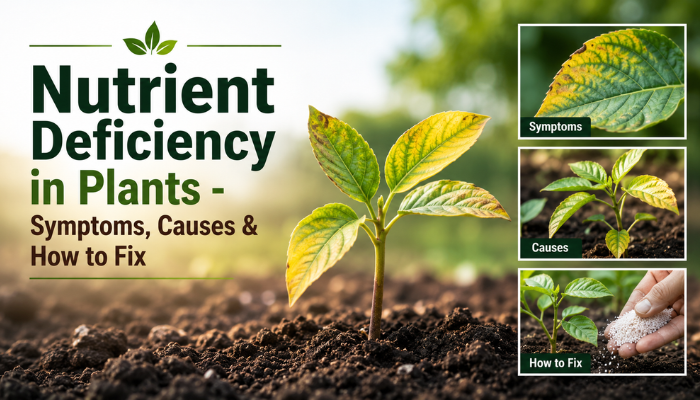
When a plant does not get enough of one or more essential nutrients, it starts showing visible signs such as yellow leaves, weak growth, leaf spots, poor flowering, or small fruits. These problems are commonly known as nutrient deficiency in plants.
For farmers, identifying these symptoms early is very important. A nutrient deficiency can reduce crop growth and yield if it is not corrected on time. The good news is that with proper soil testing, balanced fertilization, and timely nutrient application, most nutrient deficiencies can be managed effectively.
What is Nutrient Deficiency in Plants?
Nutrient deficiency in plants means that a plant is not getting enough of an essential nutrient required for healthy growth and development.
There are two main types of plant nutrients:
- Macronutrients, which plants need in larger quantities.
- Micronutrients, which plants need in smaller quantities but are still very important.
One important point farmers should remember is that a nutrient may be present in the soil but still not be available to the plant. This can happen because of unsuitable soil pH, poor moisture conditions, waterlogging, or an excess of another nutrient.
Common signs of nutrient deficiency include yellowing leaves, slow growth, weak stems, leaf spots, poor flowering, and poor fruit or grain development.
Essential Plant Nutrients and Their Roles
Every nutrient has a different job inside the plant. Knowing these roles makes it easier to understand deficiency symptoms.
Macronutrients: Nutrients Needed in Larger Amounts
Nitrogen (N)
Nitrogen helps plants develop healthy green leaves and strong vegetative growth. It is also important for chlorophyll formation and overall plant vigour.
Phosphorus (P)
Phosphorus supports root development, flowering, fruiting, and energy movement within the plant. It is especially important during early plant growth and reproductive stages.
Potassium (K)
Potassium helps plants manage water, improves their strength, and supports better resistance to environmental stress and diseases. It also helps improve crop and fruit quality.
Calcium (Ca)
Calcium helps build strong cell walls and supports healthy root and shoot development. It is particularly important for growing parts of the plant.
Magnesium (Mg)
Magnesium is an important part of chlorophyll. It helps plants carry out photosynthesis and supports several enzyme activities.
Sulphur (S)
Sulphur is required for protein formation and is important for oil-producing crops.
Micronutrients: Needed in Small Amounts
Although plants need micronutrients in smaller quantities, they are essential for proper crop growth.
- Iron (Fe): Helps in chlorophyll formation and enzyme activity.
- Manganese (Mn): Supports photosynthesis and nitrogen metabolism.
- Zinc (Zn): Helps with plant hormones, growth, and protein formation.
- Copper (Cu): Supports enzyme activity and reproductive growth.
- Boron (B): Important for cell wall development, flowering, and fruit setting.
- Molybdenum (Mo): Helps in nitrogen fixation and nitrate use.
- Chlorine (Cl): Supports water balance and other important plant functions.
Common Symptoms of Nutrient Deficiency in Plants
One of the easiest ways to identify nutrient deficiency in plants is to regularly observe the crop. Pay attention to the colour, shape, and position of affected leaves.
Nitrogen (N) Deficiency
Older leaves usually turn pale green or yellow first. Plants may look weak, thin, and shorter than normal.
Phosphorus (P) Deficiency
Leaves may become dark green and can develop a purple or reddish colour, especially on older leaves. Root growth may be poor and crop maturity can be delayed.
Potassium (K) Deficiency
The edges of older leaves may turn yellow and later become brown or look burnt. Plants may have weak stems, and grain or fruit quality can decrease.
Calcium (Ca) Deficiency
Young leaves may become distorted or hooked. Growing points of roots and shoots can die. Some fruits may develop blossom end rot.
Magnesium (Mg) Deficiency
Yellowing usually appears between the veins of older leaves while the veins remain green. In severe cases, leaves may become reddish and fall early.
Sulphur (S) Deficiency
Young leaves at the top of the plant become yellow. This can look similar to nitrogen deficiency, but sulphur deficiency usually appears first in younger leaves.
Iron (Fe) Deficiency
Young leaves may become yellow between the veins while the veins remain green. Severe deficiency can make leaves almost white.
Manganese (Mn) Deficiency
Yellowing may appear between the veins of young leaves along with small brown spots.
Zinc (Zn) Deficiency
Plants may develop small or narrow leaves and shorter spaces between the leaves. In crops such as maize, a condition called "white bud" may appear.
Copper (Cu) Deficiency
Young leaves may wilt, leaf tips may die back, and flowering or grain and fruit setting may be poor.
Boron (B) Deficiency
The growing points may die. Plants can develop hollow stems, cracked fruits, and poor fruit setting.
Molybdenum (Mo) Deficiency
Legume crops may show poor nodulation. Leaves can become yellow, and leaf margins may roll and turn brown.
Chlorine (Cl) Deficiency
Plants may show wilting, yellowing of leaves, and reduced root growth.
What Causes Nutrient Deficiency in Plants?
- Soil may naturally lack essential nutrients, or nutrients may decrease due to continuous farming.
- Very acidic or alkaline soil can make nutrients unavailable to plants.
- Excess of one nutrient, such as phosphorus, can reduce the uptake of another like zinc.
- Poor organic matter can reduce the soil’s ability to hold nutrients and support healthy soil microbes.
- Growing the same crop repeatedly can remove specific nutrients from the soil.
- Drought, waterlogging, heavy rain, and cold soil can reduce nutrient absorption by roots.
How to Diagnose Nutrient Deficiency in Plants
- Observe leaf colour, spots, leaf edges, shape, and overall plant growth.
- Check nutrient levels and soil pH to identify possible deficiencies.
- Leaf or tissue testing can confirm nutrient deficiencies when symptoms are unclear.
- Uniform symptoms may indicate nutrient problems, while patchy symptoms can be caused by pests or diseases.
- Note when symptoms appear, such as during early growth, flowering, fruiting, or grain filling.
How to Correct Nutrient Deficiency in Plants
- Apply fertilizers such as urea, DAP, MOP, or micronutrient mixtures based on soil test results and crop needs.
- Spray nutrients like iron, zinc, boron, and manganese directly on leaves for faster correction.
- Treat seeds with suitable nutrients such as zinc, boron, or biofertilizers to support early plant growth.
- Apply water-soluble fertilizers through drip irrigation to deliver nutrients directly to the root zone.
- Maintain suitable soil pH to improve nutrient availability and absorption by plants.
- Use compost, farmyard manure, or green manure to improve soil health and nutrient retention.
- Rotate different crops, including legumes, to maintain nutrient balance and improve soil health
Best Practices to Prevent Nutrient Deficiency
Prevention is better than trying to correct a severe deficiency after the crop has already been affected.
Farmers can follow these practices:
- Test the soil every 2-3 years to understand its nutrient status.
- Apply balanced fertilizers according to soil test results and crop requirements.
- Use split applications of nitrogen to reduce nutrient losses.
- Combine organic and inorganic nutrient sources where suitable.
- Inspect crops regularly for early signs of deficiency.
- Avoid excessive use of a single fertilizer or nutrient.
- Maintain proper soil moisture to support nutrient uptake.
- Keep records of fertilizers used and how the crop responds.
- Correct nutrient problems early instead of waiting until severe symptoms appear.
Conclusion
Nutrient deficiency in plants can affect crop growth, yield, and quality. The first step towards solving the problem is to identify the deficiency correctly.
Yellow leaves, leaf spots, weak growth, poor flowering, and poor fruit or grain development can be warning signs, but these symptoms should not always be treated with fertilizer without checking the actual cause.
Looking for better crop growth and improved plant performance? Nutrient deficiency can affect crop health, yield, and quality, but the right plant nutrition can make a difference. SV Agro Solutions offers a range of biostimulants designed to support healthy plant growth, better nutrient utilisation, and improved crop performance.
With products such as SV Fruiter, SV Cofez, SV Defence, SV Sugarban, and SV Size Builder, farmers can provide additional support to crops at different growth stages. Choose quality biostimulant solutions from SV Agro Solutions to support healthier crops and better farming results.
FAQs
1. What is nutrient deficiency in plants?
It occurs when plants do not get enough essential nutrients, causing yellow leaves, weak growth, poor flowering, and low yield.
2. How can I tell which nutrient my plants are lacking?
Check leaf colour, spots, leaf edges, and growth, and use soil or leaf testing to confirm the deficiency.
3. What causes nutrient deficiency in crops?
Low soil nutrients, unsuitable pH, nutrient imbalance, low organic matter, continuous cropping, drought, and waterlogging can cause deficiencies.
4. How can I correct nutrient deficiency quickly?
Foliar sprays can provide quick nutrient support, while soil application and fertigation can help with longer-term correction.
5. Can too much fertilizer cause deficiency?
Yes, excess of one nutrient can reduce the plant’s ability to absorb another, such as phosphorus reducing zinc availability.