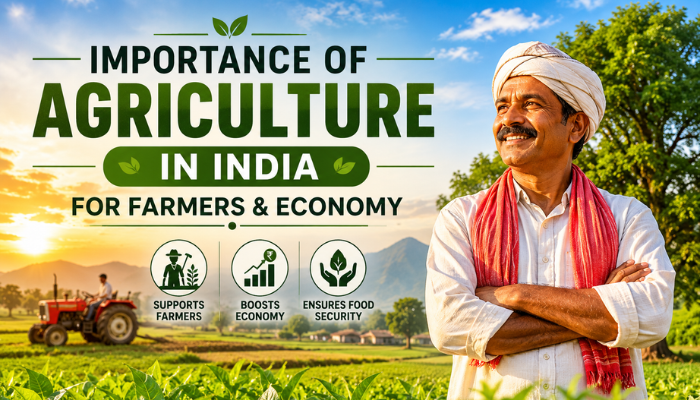
Agriculture is often called the backbone of India because a large part of the country’s population depends on farming for food, income, and employment. Even today, agriculture plays a major role in India’s economy by supporting rural livelihoods, supplying raw materials to industries, and ensuring food security for millions of people.
India is one of the world’s largest producers of rice, wheat, pulses, fruits, vegetables, milk, and spices. Agriculture not only supports farmers but also helps many industries such as food processing, textiles, dairy, sugar, and transportation.
In this blog, we will explain the importance of agriculture in India, its benefits, role in rural development, and the 10 key contributions of agriculture to India’s growth.
Top 10 Importance of Agriculture in India for Farmers
These are the 10 major importance of agriculture in Indian economy that support food security, employment, rural development, industries, exports, and the overall growth of the Indian economy.
1. Food Security
Agriculture provides food grains, fruits, vegetables, pulses, milk, and other essential products for India’s large population. Without agriculture, maintaining food security would not be possible.
2. Employment Generation
Agriculture is the largest source of employment in rural India. Millions of farmers, laborers, transport workers, and traders depend directly or indirectly on farming activities for their livelihood.
3. Contribution to GDP
Agriculture contributes significantly to India’s Gross Domestic Product (GDP). In recent years, agriculture and allied sectors have contributed around 17-20% to the Indian economy.
4. Supply of Raw Materials
Many industries depend on agriculture for raw materials.
Examples include:
- Cotton for textile industries
- Sugarcane for sugar mills
- Jute for packaging industries
- Oilseeds for edible oil production
- Spices and tea for the food industries
5. Support for Exports
India exports many agricultural products, such as:
- Rice
- Tea
- Coffee
- Cotton
- Spices
- Fruits and vegetables
These exports help India earn valuable foreign exchange and strengthen the economy.
6. Rural Development
Agriculture improves the income and living standards of rural families. Higher farm income increases spending on education, healthcare, housing, and local businesses.
Development in agriculture also improves:
- Roads
- Irrigation systems
- Storage facilities
- Rural markets
7. Growth of the Food Processing Industry
Agriculture supports food processing industries that convert raw farm produce into finished products.
Examples include:
- Rice mills
- Dairy processing units
- Fruit processing industries
- Flour mills
- Sugar factories
These industries create additional employment and business opportunities.
8. Market and Trade Activity
Agriculture strengthens trade and business activities across the country.
Farming supports:
- Transportation
- Warehousing
- Wholesale markets
- Retail shops
- Cold storage systems
This improves the movement of goods from farms to consumers.
9. Poverty Reduction
Better crop production and higher farm income help reduce poverty and unemployment in rural areas. Productive agriculture creates economic stability for farming families.
Government support schemes, irrigation, and improved farming practices also help increase rural income.
10. Cultural and Social Importance
Agriculture is deeply connected to Indian culture and traditions. Many Indian festivals and rural customs are linked with farming seasons and crop harvesting.
Examples include:
- Pongal
- Makar Sankranti
- Baisakhi
- Onam
Agriculture continues to shape rural life and social traditions in India.
Role Of Agriculture in Rural India
Agriculture is the main source of livelihood for most rural households in India. Many villages depend directly on farming and allied activities like dairy, poultry, and fisheries.
When agriculture performs well:
- Rural income increases
- Employment improves
- Migration to cities reduces
- Local businesses grow
Improved agricultural productivity also increases purchasing power in villages, which supports rural economic growth.
Future Of Agriculture In India
- The future of Indian agriculture is moving towards modern, technology-based, and sustainable farming methods.
- Farmers are increasingly using technologies like Artificial Intelligence (AI), Internet of Things (IoT), drones, and precision farming to improve crop production.
- These technologies help farmers make better decisions using real-time data and digital tools.
- Modern farming methods help save water, fertilizers, and other important resources.
- Advanced technology also helps farmers manage problems like climate change, unpredictable weather, and soil degradation.
- Digital agriculture can improve crop monitoring, pest control, irrigation management, and overall farm productivity.
- New farming innovations are helping India overcome challenges such as small landholdings and low resource availability.
- Sustainable and climate-resilient agriculture will play an important role in improving farmer income and ensuring long-term food security in India.
Conclusion
Agriculture is one of the strongest pillars of the Indian economy. It supports food production, employment, industries, exports, and rural development. The importance of agriculture in India goes far beyond GDP because it directly affects the lives of millions of farmers and consumers.
Improving agriculture through modern technology, irrigation, balanced nutrition, and sustainable farming practices is essential for India’s future growth and food security.
Looking for a trusted fertilizer company in Pune for better crop growth and higher farm productivity? SV Agro Solutions offers high-quality fertilizers, biostimulants, micronutrients, and sustainable crop nutrition solutions designed to improve soil fertility, plant health, and agricultural yield. As a leading fertilizer manufacturer and supplier in Pune, we provide innovative farming products that support both Indian farmers and international agricultural markets.
FAQs
1. Which type of agriculture is the best?
The best type of agriculture depends on land size, climate, water availability, and farming resources.
2. What are the four types of agriculture?
The four main types of agriculture are subsistence farming, intensive farming, shifting cultivation, and commercial farming.
3. Which type of agriculture is most profitable?
High-value crop farming, dairy farming, poultry farming, and organic farming are considered the most profitable types of agriculture.
4. What type of land is best for agriculture?
Level land with fertile loamy soil is considered the best for healthy crop growth and higher productivity.