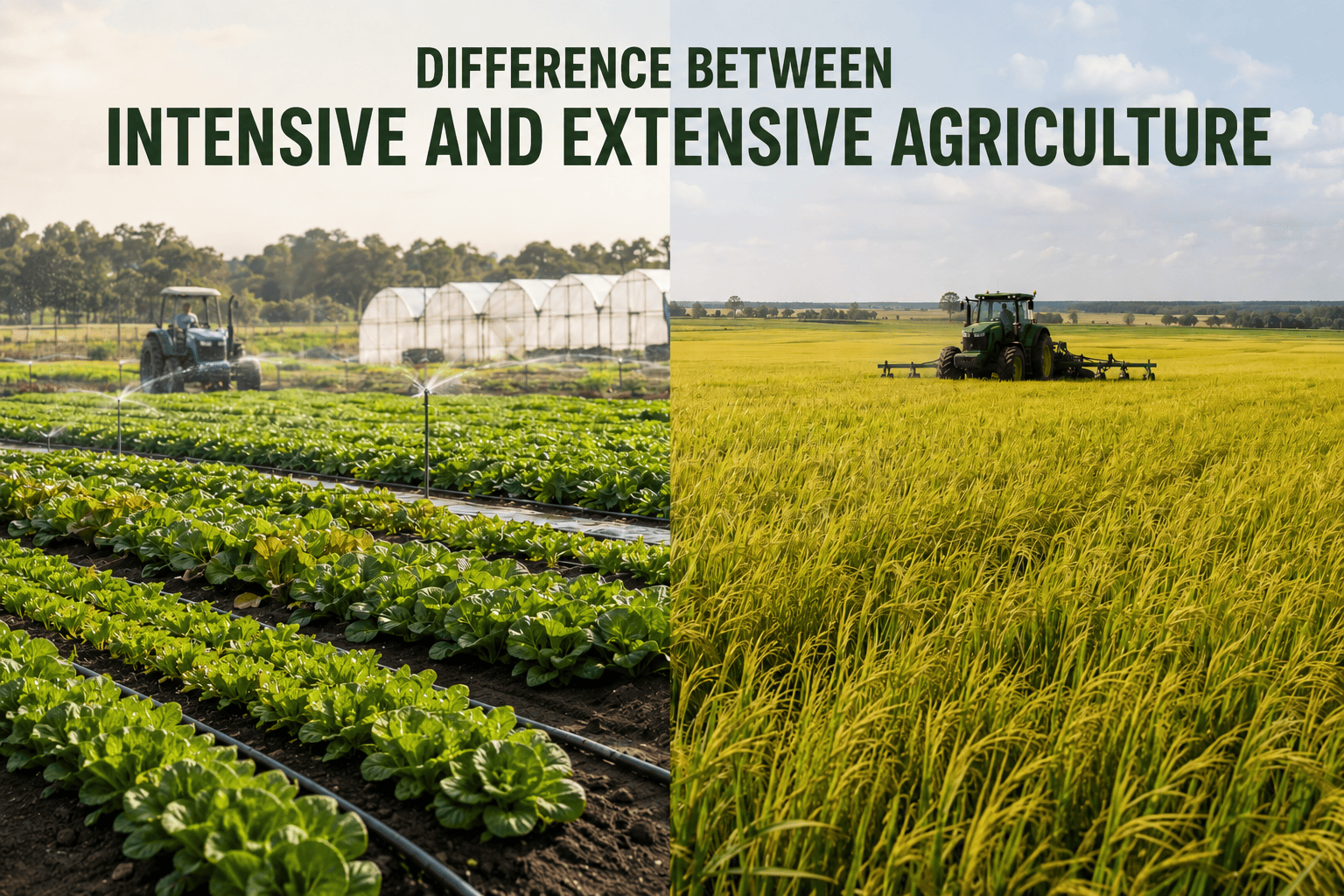
Agriculture is the practice of growing crops and raising animals to produce food, fibre, and other useful products. Farmers use different farming methods depending on land availability, climate, labour, and resources.
Two major farming systems commonly used around the world are intensive agriculture and extensive agriculture.
Intensive agriculture focuses on getting maximum production from a small area of land by using more labour, irrigation, fertilizers, machinery, and modern farming techniques. On the other hand, extensive agriculture uses large areas of land with fewer inputs and lower labour use.
What is Intensive Agriculture?
Intensive agriculture is a farming system that uses high amounts of labour, fertilizers, pesticides, irrigation, machinery, and investment to produce maximum crop or livestock yield from small land areas.
It is commonly practised in densely populated regions where food demand is high. This method helps increase production quickly, but excessive use of chemicals and resources can harm soil and the environment over time.
Intensive farming is widely used for:
- Vegetable farming
- Dairy farming
- Poultry farming
- Fruit cultivation
- High-value commercial crops
What is Extensive Agriculture?
Extensive agriculture is a farming system that uses large land areas with fewer inputs like labour, fertilizers, machinery, and investment. It gives lower crop yield per hectare compared to intensive farming, but it is more cost-effective and environmentally friendly.
This method is mostly used in areas where land is easily available and the population is low, such as large grain farms and livestock ranching.
This system is commonly used for:
- Wheat farming
- Grazing and livestock farming
- Large-scale grain production
- Pasture farming
Difference Between Intensive and Extensive Agriculture
The main difference between intensive and extensive agriculture is the amount of land and inputs used for farming. Intensive agriculture aims for higher production from smaller land areas, while extensive agriculture uses larger land with fewer inputs.
|
Basis of Difference |
Intensive Farming |
Extensive Farming |
|
Inputs Used |
Uses high inputs like fertilizers, irrigation, labour, machinery, and capital for maximum production. |
Uses fewer and low-cost inputs, mainly depending on natural rainfall and soil fertility. |
|
Land Use |
Practised on small land areas with high crop production. |
Requires large land areas with lower crop density. |
|
Crop Yield |
Gives higher yield per hectare due to modern farming methods. |
Gives lower yield per hectare but covers large farming areas. |
|
Environmental Impact |
Heavy chemical and water use can affect soil and the environment. |
More eco-friendly because it uses fewer chemicals and inputs. |
|
Location |
Common near urban and highly populated areas. |
Common in rural areas where land is easily available. |
|
Labour Requirement |
Requires more labour because crops need regular irrigation, fertilizer use, pest control, and continuous care for higher production. |
Requires less labour as farming is done on large land areas with fewer inputs and less crop management. |
|
Capital Investment |
Needs high investment in machinery, irrigation, fertilizers, improved seeds, and modern farming technology. |
Requires moderate to low investment because fewer inputs and technologies are used. |
|
Yield per Unit Area |
Produces very high yields per hectare due to better management, irrigation, and fertilizer use. |
Produces lower yield per hectare because farming depends more on natural conditions and fewer inputs. |
|
Technology Use |
Uses advanced machinery, irrigation systems, and modern farming techniques for higher productivity. |
Uses less machinery and lower technology input compared to intensive farming. |
|
Harvest Frequency |
Farmers can grow multiple crops and take more than one harvest in a year. |
Usually limited to one major harvest per year. |
|
Population Pressure |
Common in densely populated areas where land is limited, and food demand is high. |
Common in low population areas where large land is available for farming. |
|
Examples |
Vegetable farming, dairy farming, greenhouse farming, floriculture, rice farming |
Wheat farming, livestock farming, grain farming, cattle ranching |
Advantages of Intensive Agriculture
- Produces high crop and livestock yields from small land areas
- Helps lower food prices because production is done on a large scale
- Makes efficient use of limited farmland
- Supports year-round crop production with irrigation and greenhouse farming
- Helps meet the food demand of growing populations
Disadvantages of Intensive Agriculture
- Excessive use of chemicals can damage soil and pollute water
- Monocropping may reduce biodiversity and harm the environment
- Requires high investment in machinery, fertilizers, and technology
- Intensive livestock farming can affect animal welfare
- Chemical residues and pesticide exposure may create health risks for farmers and consumers
Advantages of Extensive Agriculture
- Uses fewer chemicals, which helps reduce soil and water pollution
- Requires lower investment because fewer irrigation systems and inputs are needed
- Needs less labour per hectare due to large-scale mechanized farming
- Supports biodiversity and causes less disturbance to natural ecosystems
Disadvantages of Extensive Agriculture
- Produces lower yield per hectare compared to intensive farming
- Requires very large land areas for successful farming
- Depends heavily on rainfall and weather conditions
- Profit per acre is usually lower than that of intensive farming
- Managing large farms may require costly machinery and skilled operators
Which Type of Agriculture is Better?
- Neither intensive nor extensive agriculture is best for every farmer.
- The right method depends on land size, water, labour, climate, and farming goals. Intensive agriculture increases crop yield on small land using fertilizers, irrigation, machinery, and technology, but excessive chemical use can harm soil and water over time.
- Extensive agriculture uses larger land with fewer inputs, making it more sustainable and environment-friendly, though crop yield per acre is lower.
- Today, many farmers combine both methods to improve soil productivity while protecting long-term environmental health.
Conclusion
Understanding the difference between intensive and extensive agriculture is important for modern farming. Intensive agriculture helps increase production from limited land using advanced methods, while extensive agriculture depends on large land areas with lower inputs.
Looking for a trusted agricultural company to improve crop yield and soil health? SV Agro Solutions Pvt. Ltd. is a leading manufacturer of organic agricultural inputs that helps more than 80,000 farmers across India with high-quality products designed to improve productivity, support sustainable farming, and promote healthy crop growth.
FAQs
1. What crops are grown in intensive farming?
Rice, wheat, maize, vegetables, fruits, cotton, and sugarcane are commonly grown in intensive farming.
2. What country is an example of intensive farming?
Countries like India, China, and Japan are common examples of intensive farming.
3. What are the methods of intensive farming?
Intensive farming uses machinery, irrigation, fertilizers, pesticides, and high-yield seeds for maximum production.
4. Which crops are grown in extensive farming?
Wheat, maize, barley, and pasture crops are mainly grown in extensive farming.
5. What is another name for extensive farming?
Extensive farming is also called low-input farming or large-scale farming.