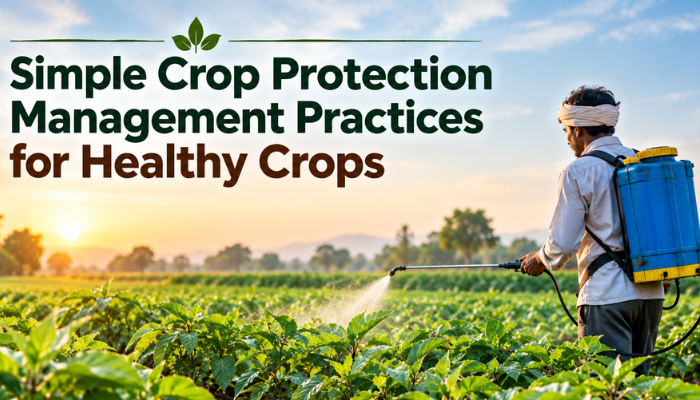
Healthy crops are important for getting good yields and better farm income. When crops are healthy, they grow properly and produce better-quality grains, fruits, and vegetables.
Pests, diseases, and weeds can damage crops and reduce both yield and quality. If these problems are not identified and managed on time, they can cause major crop losses.
Crop Protection Management includes simple and practical methods to protect crops from pests, diseases, and weeds. The main aim is to prevent problems early and use safe and effective methods whenever possible.
Good crop protection can help farmers reduce crop losses, control input costs, and support sustainable farming.
What is Crop Protection Management?
Crop protection management means using planned methods to prevent or control pests, diseases, and weeds during crop growth.
It includes:
- Cultural methods such as crop rotation, proper sowing, and field sanitation.
- Biological methods such as beneficial insects and biopesticides.
- Mechanical methods such as traps, hand weeding, and removal of affected plants.
- Chemical methods such as pesticides, used when necessary and according to recommendations.
Best Crop Protection Management Practices for Farmers
Effective crop protection management practices help farmers control pests and diseases, maintain healthy crop growth, and achieve better yield and quality.
1. Use Healthy and Certified Seeds
- Start with clean, healthy, and certified seeds. Disease-free seeds help produce strong seedlings and reduce the risk of early pest and disease problems.
- Where recommended, seed treatment with suitable fungicides or bio-agents can also be used.
2. Choose Resistant or Tolerant Varieties
- Choose crop varieties that are resistant or tolerant to common pests and diseases in your area.
- Such varieties can reduce crop damage and may reduce the need for frequent pesticide applications.
3. Practice Crop Rotation
- Avoid growing the same crop repeatedly in the same field.
- Rotate crops with non-host crops to help break pest and disease cycles.
- For example, cereals can be rotated with legumes or suitable vegetable crops.
- Crop rotation can also support soil health and help reduce weed problems.
4. Maintain Field Sanitation
Keep the field clean throughout the crop season.
- Remove infected plant parts where recommended.
- Remove crop debris after harvest.
- Keep field boundaries free from excessive weeds.
- Clean farm tools and equipment regularly.
Good field sanitation helps reduce the spread and buildup of some pests and diseases.
5. Follow the Right Sowing Time
- Sow crops at the recommended time for the crop and local conditions.
- Proper sowing time can help crops avoid periods when certain pests and diseases are more common. It also supports healthy and uniform crop growth.
6. Maintain Proper Plant Spacing
- Follow the recommended spacing for each crop.
- Proper spacing allows better air movement between plants and can reduce conditions that favour some diseases.
- It also makes field scouting, weeding, and other crop management activities easier.
7. Manage Weeds on Time
Weeds compete with crops for water, nutrients, sunlight, and space. Some weeds can also provide shelter or act as hosts for pests and diseases.
Farmers can manage weeds through:
- Timely hand weeding
- Mechanical methods
- Mulching
- Suitable herbicides when required
Weed management should be done at the right stage to reduce competition with the crop.
8. Monitor Crops Regularly Through Field Scouting
Regular field scouting helps farmers identify pest, disease, and weed problems at an early stage.
Walk through different parts of the field and check for signs such as:
- Leaf spots
- Wilting
- Insect damage
- Discoloured leaves
- Damaged shoots or fruits
- Unusual plant growth
Early detection allows farmers to take suitable action before the problem becomes serious.
9. Use Traps and Monitoring Tools
Traps can help farmers monitor pest populations and understand when pest activity is increasing.
For example:
- Yellow sticky traps can help monitor aphids and whiteflies.
- Pheromone traps can help monitor moths and fruit borers.
Monitoring tools support better pest management decisions and can help avoid unnecessary spraying.
10. Protect Beneficial Insects
- Not all insects found in a field are harmful. Many beneficial insects help control pests naturally.
- Avoid unnecessary pesticide applications that may kill beneficial insects. Farmers can also maintain flowering plants or suitable field borders to support natural enemies.
- Beneficial organisms such as ladybirds, spiders, and parasitic wasps can help control certain pests naturally.
11. Use Biopesticides and Biofertilizers
Biopesticides and biofertilizers products can be useful components of crop protection when they are suitable for the crop and pest problem.
12. Use Chemical Pesticides Carefully
Chemical pesticides should be used only when needed and after properly identifying the pest or disease.
Farmers should:
- Choose the right product for the identified problem.
- Follow the recommended dose.
- Follow the correct application timing.
- Follow label instructions and safety precautions.
- Avoid unnecessary or repeated spraying.
In an Integrated Pest Management (IPM) approach, pesticides are generally considered only when monitoring shows that intervention is necessary.
Why is Crop Protection Important?
Crop protection is important to prevent pest and disease damage, maintain healthy crop growth, and improve yield and quality.
1. Protects Crop Yield and Quality
Pests, diseases, and weeds can reduce crop yield and quality. Proper crop protection helps plants grow properly and produce better-quality grains, fruits, and vegetables.
2. Reduces Farm Losses
Early detection and proper pest management can reduce crop damage. This helps farmers protect their investment, reduce losses, and improve farm income.
3. Supports Sustainable Farming
Using different crop protection methods can reduce unnecessary pesticide use. It also helps protect beneficial insects, soil health, and the natural balance of the farm ecosystem
Integrated Pest Management (IPM)
Integrated Pest Management (IPM) is an approach that combines different methods to manage pests while keeping pesticide use as low as practical.
The main steps of IPM include:
- Preventing pest and disease problems through good farming practices.
- Regular crop monitoring and field scouting.
- Using cultural, biological, and mechanical methods where suitable.
- Using biopesticides when appropriate.
- Using chemical pesticides only when necessary and based on proper assessment.
IPM focuses on growing healthy crops while protecting beneficial organisms and reducing unnecessary pesticide use.
Benefits of Simple Crop Protection Practices
Following simple Crop Protection Management practices can provide several benefits:
- Healthier crops with better growth and yield.
- Reduced pest, disease, and weed damage.
- Lower risk of unnecessary pesticide use.
- Better quality produce.
- Reduced crop protection costs when inputs are used properly.
- Better protection of beneficial insects.
- Improved soil health and farm ecosystem health.
- More sustainable and profitable farming.
Looking for Quality Biostimulants for Better Crop Growth?
SV Agro Solutions Pvt. Ltd. offers quality biostimulants designed to support healthy plant growth, better nutrient uptake, flowering, fruit development, and overall crop performance. As a trusted Biostimulants Manufacturer in Pune, the company provides a range of biostimulant products for different crop needs, including SV Fruiter, SV Canter, SV 59, SV Fulora, SV SN 40, SV Cofez, SV Rounder P, SV Rounder L, SV Defence, SV Sugarban, and SV Size Builder.
As an experienced Biostimulants Company in Pune and Biostimulants Supplier in Pune, SV Agro Solutions focuses on providing reliable agricultural solutions for farmers and agricultural businesses. These biostimulants can support better nutrient use, healthy plant development, and crop performance under different growing conditions. With a focus on quality and sustainable farming, SV Agro Solutions provides biostimulant solutions to support farmers in achieving healthy and productive crops.
Conclusion
Crop Protection Management plays an important role in maintaining healthy crops and protecting crop yield and quality. Simple practices such as using healthy seeds, selecting resistant varieties, crop rotation, field sanitation, proper spacing, timely weed management, and regular field scouting can help prevent many crop problems.
FAQs
1. What is Crop Protection Management?
Crop Protection Management is the planned use of different practices to prevent or control pests, diseases, and weeds and keep crops healthy.
2. What are simple crop protection practices?
Simple crop protection practices include using healthy seeds, crop rotation, field sanitation, proper plant spacing, regular field scouting, traps, weed management, and timely action.
3. How can farmers reduce pesticide use?
Farmers can reduce pesticide use by using resistant varieties, crop rotation, field sanitation, regular monitoring, biological control, biopesticides, and spraying only when necessary.
4. What is Integrated Pest Management (IPM)?
Integrated Pest Management (IPM) combines cultural, biological, mechanical, and chemical methods to manage pests effectively while reducing unnecessary pesticide use.
5. When should farmers spray pesticides?
Farmers should spray pesticides only after identifying the pest or disease and determining that treatment is necessary based on crop conditions and recommended thresholds or guidance.